Lithium-Ion Battery Plant in India: Investment, Process and Equipment
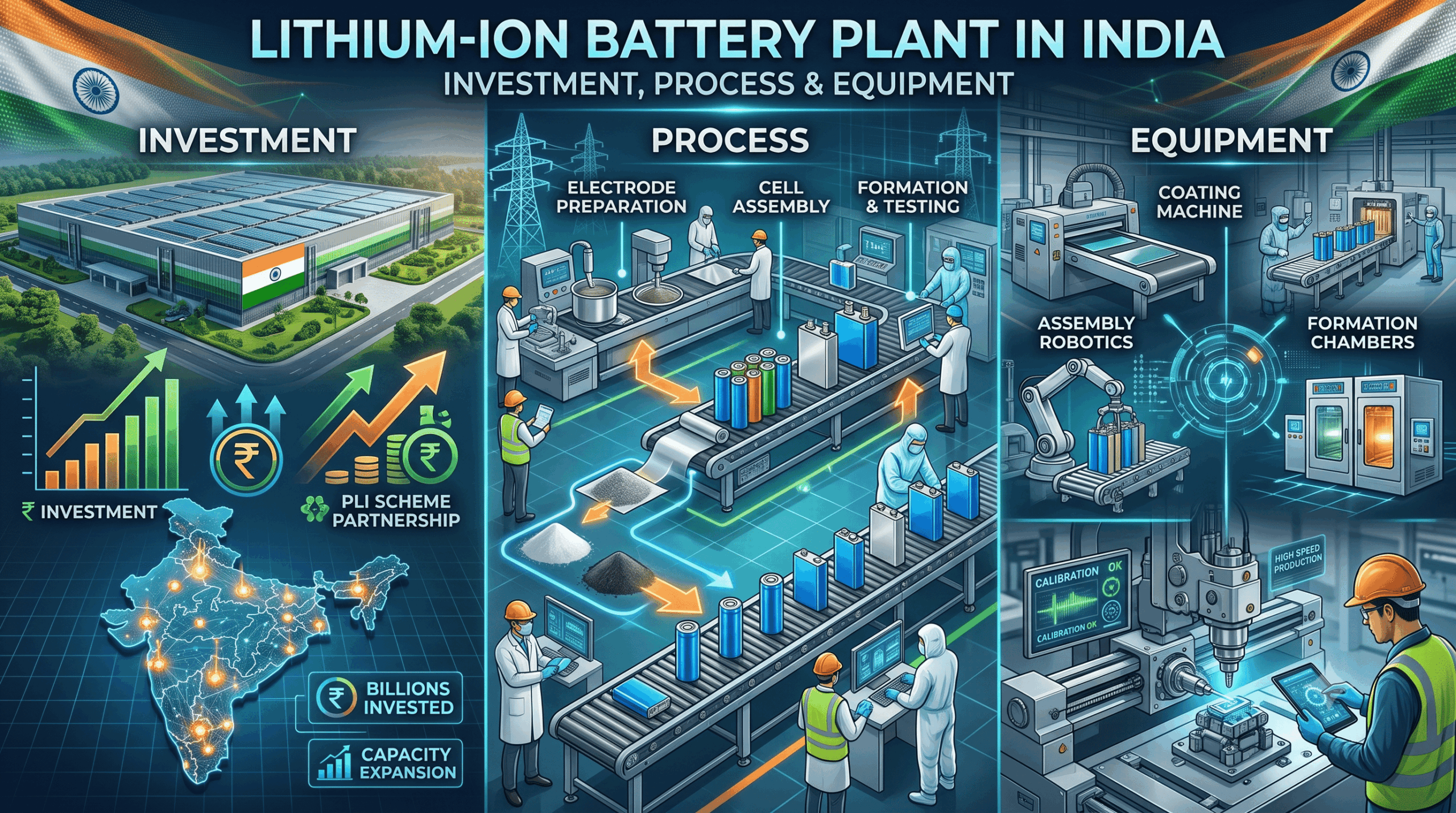
India’s growing electric vehicle market, renewable energy projects, and demand for reliable energy storage are creating opportunities for lithium-ion battery manufacturing. For entrepreneurs and industrial investors, setting up a lithium-ion battery plant in India can be a long-term business opportunity, provided the project has the right technology, production capacity, and customer base.
The first decision is to choose the type of manufacturing facility. A battery pack assembly plant requires less investment and technical complexity than a facility that manufactures battery cells from raw materials. The choice affects the machinery, infrastructure, workforce, operating costs, and time required to begin production.
This guide explains how to establish a lithium-ion battery plant in India, including estimated investment, the manufacturing process, essential equipment, raw materials, regulatory requirements, and business opportunities.
Why Invest in Lithium-Ion Battery Manufacturing in India?
Lithium-ion batteries are used in electric vehicles, solar energy storage systems, consumer electronics, industrial equipment, and backup power solutions.
India’s demand for battery storage is also linked to the expansion of renewable energy and the electrification of transportation. According to the Ministry of Heavy Industries, the government is supporting domestic advanced chemistry cell manufacturing through its Production Linked Incentive (PLI) programme. The programme has an approved outlay of ₹18,100 crore and targets 50 GWh of domestic manufacturing capacity.
Several factors make this sector attractive to investors:
- Electric vehicle growth: Electric two-wheelers, three-wheelers, cars, buses, and commercial vehicles require battery systems.
- Renewable energy storage: Solar and wind projects need batteries to store electricity and balance supply with demand.
- Industrial applications: Warehouses, telecom facilities, data centres, and manufacturing units use battery-based backup and storage systems.
- Domestic manufacturing: Local production can help customers reduce dependence on imported finished battery products.
- Battery replacement demand: Batteries eventually lose capacity, creating opportunities in replacement markets, diagnostics, refurbishment, and recycling.
However, market demand alone does not guarantee profitability. Buyers typically evaluate battery performance, safety, price, reliability, warranty terms, and after-sales support before selecting a supplier.
Types of Lithium-Ion Battery Manufacturing Plants
Before estimating investment, investors should identify which part of the battery value chain they want to enter.
1. Lithium-Ion Battery Pack Assembly Plant
A battery pack assembly plant purchases finished lithium-ion cells and combines them into battery packs or modules for specific applications.
The facility may manufacture packs for electric two-wheelers, three-wheelers, solar storage, industrial equipment, and backup power systems.
Typical operations include cell inspection, sorting, module assembly, electrical connections, battery management system integration, enclosure assembly, and testing.
Best suited for: Startups, MSMEs, electrical equipment manufacturers, and businesses entering the battery market for the first time.
Its main advantage is lower technical complexity compared with manufacturing cells. However, the business remains dependent on external cell suppliers and must compete on design, quality, cost, and customer service.
2. Lithium-Ion Battery Cell Manufacturing Plant
A cell manufacturing facility produces battery cells through electrode preparation, coating, drying, calendaring, assembly, electrolyte filling, formation, and quality testing.
This operation requires specialized production equipment, controlled environmental conditions, advanced process engineering, and substantial investment.
Best suited for: Large industrial companies, established battery manufacturers, technology-led ventures, and investors with access to significant capital and technical expertise.
Cell manufacturing can provide greater control over product technology and manufacturing value, but it also involves more complex production risks and a longer development cycle.
3. Integrated Battery Manufacturing Plant
An integrated plant combines cell manufacturing with module and battery pack assembly. Depending on its scope, it may also manufacture selected components or incorporate recycling and material recovery.
This model can improve control over the supply chain, but it requires careful coordination between different production processes and substantially more capital.
For many new investors, beginning with battery pack assembly and expanding into additional manufacturing stages can be a more practical route.
Lithium-Ion Battery Plant Investment in India
The investment required depends on manufacturing capacity, battery chemistry, automation, factory location, equipment origin, and the degree of backward integration.
The following figures are indicative planning estimates, not supplier quotations or audited project costs. They illustrate possible project scales and should be validated through a detailed feasibility study.
| Plant type | Indicative initial investment |
|---|---|
| Small battery pack assembly unit | ₹50 lakh to ₹2 crore |
| Medium-scale battery pack manufacturing unit | ₹2 crore to ₹10 crore |
| Large automated pack assembly facility | ₹10 crore to ₹50 crore or more |
| Commercial lithium-ion cell manufacturing plant | ₹500 crore to several thousand crore |
| Integrated cell and battery manufacturing facility | Project-specific, potentially several thousand crore |
These ranges are not directly comparable because plant capacities and product specifications vary. A cell manufacturing facility’s investment cannot be estimated reliably without defining its annual GWh capacity, chemistry, production yield, and technology scope.
Major Investment Components
The project budget should account for more than the purchase of production machinery.
Land and factory building: Costs depend on location, industrial zoning, floor space, lease terms, and construction specifications.
Machinery and production lines: Equipment requirements vary substantially between battery pack assembly and cell manufacturing.
Utilities and environmental controls: Electrical systems, HVAC, dry rooms where required, compressed air, water treatment, fire protection, and process monitoring can add significant costs.
Testing and quality control: Battery analysers, charge-discharge cyclers, insulation testers, thermal monitoring equipment, and other testing systems are essential.
Working capital: Funds are needed for cell inventory, electronic components, enclosures, payroll, logistics, customer credit, and warranty obligations.
Engineering and commissioning: Installation, process validation, staff training, software integration, and initial production trials should be included in the budget.
Investors should also maintain a contingency reserve for exchange-rate movements, equipment modifications, construction delays, and unexpected commissioning costs.
Machinery Required for a Lithium-Ion Battery Plant
Equipment selection depends on whether the facility assembles packs or manufactures cells.
Equipment for a Battery Pack Assembly Plant
A pack assembly facility generally requires the following machinery:
| Equipment | Main function |
|---|---|
| Cell testing and sorting machine | Checks cell parameters and groups compatible cells |
| Cell holders and fixtures | Position cells for assembly |
| Spot welding or laser welding machine | Connects cells using the selected joining process |
| Busbar and terminal assembly tools | Establishes electrical connections |
| Battery Management System (BMS) programming equipment | Configures and checks battery protection and monitoring functions |
| Insulation and voltage testers | Checks electrical integrity |
| Battery charge-discharge tester | Measures performance and capacity |
| Thermal and environmental test equipment | Evaluates performance under specified conditions |
| Enclosure assembly tools | Fits battery modules into protective housings |
| Label printing and traceability system | Records product identification and production history |
Additional equipment may include leak-testing systems, torque-controlled tools, automated conveyors, end-of-line test stations, and battery communication test equipment.
The final selection should be based on battery chemistry, pack voltage, capacity, production volume, safety requirements, and the target customer’s specifications.
Equipment for a Battery Cell Manufacturing Plant
Cell manufacturing requires a more extensive production line.
| Equipment | Main function |
|---|---|
| Slurry mixing system | Mixes electrode materials with binders and solvents where applicable |
| Electrode coating machine | Applies electrode slurry to current collector foils |
| Electrode drying equipment | Removes process solvents or moisture as required |
| Calendaring machine | Controls electrode thickness and density |
| Slitting and cutting machines | Prepares electrodes to the required dimensions |
| Cell stacking or winding machine | Assembles electrode and separator layers |
| Cell sealing equipment | Seals the cell enclosure |
| Electrolyte filling system | Introduces electrolyte under controlled conditions |
| Dry room and humidity control system | Maintains moisture levels suitable for sensitive production stages |
| Formation and aging equipment | Activates cells and monitors early-life performance |
| Cell grading and testing systems | Measures cell performance and sorts cells by specification |
Other requirements include automated material handling, inspection systems, process control software, laboratory equipment, fire protection, and waste management systems.
Cell manufacturing machinery must be selected around the chosen cell format, such as cylindrical, prismatic, or pouch cells. These formats have different assembly, sealing, and handling requirements.
Lithium-Ion Battery Manufacturing Process
The manufacturing process differs depending on the plant type. Battery pack assembly begins with purchased cells, while cell manufacturing starts with electrode materials and produces individual cells.
Step 1: Raw Material Procurement
For battery pack assembly, the principal inputs include lithium-ion cells, battery management systems, busbars, cables, connectors, enclosures, insulation materials, and thermal management components.
Cell manufacturing requires electrode active materials, current collector foils, separators, electrolytes, binders, and other chemistry-specific inputs.
Supplier qualification is important because variations in material quality can affect battery performance, reliability, and safety.
Step 2: Cell Inspection and Sorting
In a pack assembly plant, incoming cells are inspected for physical damage, electrical characteristics, and compliance with the supplier’s specifications.
Cells are sorted into compatible groups based on relevant parameters. Poor matching can cause uneven charging and discharging, reduce usable pack capacity, and create reliability problems.
Step 3: Module Assembly
Cells are positioned and mechanically secured according to the pack design.
Electrical connections are created using the selected joining process. Insulation, mechanical support, and thermal management components are installed as specified by the engineering design.
The process must account for electrical isolation, vibration resistance, heat generation, and serviceability.
Step 4: BMS Integration
The battery management system monitors important battery parameters and supports functions such as voltage and temperature monitoring, protection, balancing, and communication with external equipment.
BMS configuration must match the cell chemistry, series and parallel arrangement, operating limits, and intended application.
Step 5: Enclosure and Thermal Management
The assembled module is installed in a suitable enclosure. Depending on the application, the design may include air cooling, liquid cooling, thermal barriers, pressure management, or additional protective features.
Thermal design is especially important in high-power applications and large battery systems.
Step 6: Testing and Quality Inspection
Finished battery packs undergo checks based on the product specification and applicable standards.
Typical tests include voltage verification, insulation resistance, communication checks, charge-discharge testing, and functional verification of protective systems.
Additional environmental, mechanical, and safety tests may be required by the application, customer, or regulatory framework.
Step 7: Packaging and Dispatch
Approved battery packs are labelled, documented, packaged, and prepared for transport under the applicable requirements for lithium batteries.
Manufacturers should maintain traceability records for cells, components, production batches, test results, and warranty claims.
Raw Materials Required for Lithium-Ion Battery Manufacturing
Raw material requirements depend on the selected battery chemistry.
Common chemistries include lithium iron phosphate (LFP) and nickel manganese cobalt (NMC). LFP is widely used in applications where safety characteristics, cycle life, and cost are important. NMC is selected for applications where its energy density and other performance characteristics fit the design requirements.
Typical materials include:
- Cathode materials: LFP or NMC-based materials, depending on the chemistry.
- Anode materials: Commonly graphite-based materials.
- Separator: A porous insulating layer that prevents direct electrical contact between electrodes.
- Electrolyte: Supports the movement of lithium ions within the cell.
- Current collectors: Typically aluminium foil for the cathode and copper foil for the anode.
- Battery management systems: Electronic monitoring and protection components for battery packs.
- Structural components: Enclosures, connectors, insulation, busbars, and thermal management parts.
India’s battery manufacturing sector continues to face supply-chain challenges involving critical minerals and certain battery materials. Investors should evaluate supplier concentration, import dependence, lead times, currency exposure, and material traceability before finalizing a project.
Land, Infrastructure and Factory Requirements
Infrastructure requirements depend on the production process and the level of automation.
A battery pack assembly unit may operate in a suitable industrial building with appropriate electrical capacity, ventilation, fire protection, testing areas, and material storage.
Cell manufacturing requires more specialized infrastructure, including tightly controlled environmental conditions for moisture-sensitive processes, process utilities, and advanced safety systems.
Before selecting a site, evaluate the following:
- Industrial zoning and permitted manufacturing activities.
- Availability and reliability of electrical power.
- Floor loading, ceiling height, and production-line layout.
- Fire access, emergency exits, and emergency response arrangements.
- Safe storage for cells, chemicals, and other regulated materials.
- Waste collection and disposal arrangements.
- Access to suppliers, logistics networks, and target customers.
- Scope for future production expansion.
Industrial locations should be compared on total operating cost, workforce availability, logistics, utility reliability, and applicable state incentives rather than land price alone.
Licenses and Regulatory Requirements in India
The approvals required depend on the manufacturing process, factory size, chemicals used, battery category, and location.
Potential requirements include:
Business registration: Establish an appropriate business entity and complete applicable tax and statutory registrations.
Factory and industrial approvals: Obtain the factory-related approvals and local permissions applicable to the premises and manufacturing activity.
Pollution control approvals: Assess whether consent to establish and consent to operate are required from the relevant State Pollution Control Board or Pollution Control Committee.
Fire and electrical safety: Comply with applicable building, fire protection, electrical installation, and emergency safety requirements.
Environmental and hazardous material compliance: Determine the rules applicable to chemical storage, emissions, waste streams, and any hazardous substances used in production.
Battery Waste Management Rules: Assess obligations under India’s battery waste management framework, including producer registration and extended producer responsibility where applicable.
Product testing and certification: Confirm the applicable BIS standards, transport requirements, customer specifications, and other product-related approvals for the intended battery and end use.
Not every approval applies to every facility. A battery pack assembler using purchased cells may face a different compliance scope from an integrated cell manufacturer handling electrode materials and electrolyte chemicals.
Obtain a site-specific regulatory assessment before purchasing land or ordering machinery.
Government Incentives for Battery Manufacturing in India
Government support can improve project economics, but investors should distinguish between incentives available under a notified scheme and general policy support.
Production Linked Incentive Scheme for Advanced Chemistry Cells
The central government’s PLI programme for advanced chemistry cell battery storage has an approved outlay of ₹18,100 crore and a target of 50 GWh of domestic manufacturing capacity.
Eligibility depends on the scheme’s conditions, beneficiary selection, capacity commitments, investment requirements, and domestic value-addition obligations. The scheme is not a general subsidy automatically available to every new battery factory.
State Industrial Incentives
Some states provide industrial incentives that may include capital subsidies, electricity duty concessions, stamp duty relief, or other benefits, subject to their policies and eligibility conditions.
Investors should compare current policies in shortlisted states and obtain written clarification from the relevant investment promotion agency before including any incentive in a financial forecast.
Customs and Import Policy
Battery manufacturing equipment, components, and raw materials may be subject to different customs treatment depending on the product classification and current policy.
The Union Budget and subsequent notifications can change applicable duties or exemptions. Verify the rules in force at the time of import rather than relying on historical incentive announcements.
Operating Costs and Profitability
The profitability of a lithium-ion battery plant depends on production volume, material prices, product mix, yield, customer contracts, and utilization.
For a battery pack assembly business, the main operating costs typically include:
- Lithium-ion cells and other purchased components.
- Direct labour and production supervision.
- Electricity, utilities, and factory maintenance.
- Testing, quality assurance, and product validation.
- Packaging, logistics, and distribution.
- Warranty provisions and after-sales service.
- Financing costs and working capital.
Cell manufacturing adds substantial process-specific costs related to electrode materials, energy-intensive operations, controlled environments, production yield, and cell formation.
How to Evaluate Project Profitability
A useful starting point is the contribution margin per unit.
Contribution per battery pack = Selling price minus variable cost per pack
The estimated break-even volume can then be calculated as:
Break-even units = Annual fixed costs divided by contribution per unit
For example, assume a battery pack sells for ₹20,000 and its variable cost is ₹16,000. The contribution is ₹4,000 per pack.
If annual fixed costs are ₹2 crore, the approximate break-even volume is 5,000 packs per year, before considering taxes, financing costs not included in fixed costs, capital expenditure recovery, and other adjustments.
This is an illustrative calculation, not a forecast of actual industry margins.
A detailed financial model should test different cell prices, selling prices, production volumes, rejection rates, customer payment periods, and capacity utilization levels.
Key Challenges in Setting Up a Battery Plant
Battery manufacturing offers opportunities, but investors should plan for several risks.
Dependence on Imported Cells and Materials
Many Indian manufacturers rely on imported cells or critical battery materials. Exchange-rate changes, shipping delays, and supplier concentration can affect margins and production schedules.
Technology and Product Development
Battery performance depends on chemistry, pack design, electronics, thermal management, and application requirements. Poor engineering can lead to failures, warranty costs, and customer disputes.
Quality and Safety
Lithium-ion batteries require appropriate electrical, thermal, mechanical, and transport safety controls. A quality management system should be built into the manufacturing process rather than added after production begins.
Working Capital Pressure
Cell purchases can require substantial upfront cash, while customers may negotiate extended payment terms. A profitable order book does not necessarily mean the business has enough cash to operate.
Competition and Price Pressure
Manufacturers may compete with established domestic businesses and imported products. A clear market focus, dependable product performance, and strong customer relationships are important for maintaining margins.
How to Start a Lithium-Ion Battery Plant in India
A structured project plan helps reduce investment risk.
Step 1: Select the Target Market
Choose a clear application, such as electric two-wheelers, three-wheelers, solar storage, industrial backup systems, or commercial energy storage.
Each market has different technical specifications, purchasing cycles, certification needs, and price expectations.
Step 2: Define Production Capacity
Estimate expected monthly and annual sales before selecting equipment. A smaller line with a reliable order pipeline may be more viable than a large facility operating well below capacity.
Step 3: Finalize the Manufacturing Model
Decide whether to assemble battery packs, manufacture cells, or develop an integrated facility. Evaluate the required technical team, capital expenditure, supply chain, and customer commitments.
Step 4: Prepare a Detailed Project Report
The project report should cover capital expenditure, operating expenditure, plant capacity, factory layout, equipment specifications, raw material sourcing, regulatory approvals, projected revenue, working capital, and financial scenarios.
Step 5: Shortlist Machinery Suppliers
Compare equipment vendors on production capacity, automation, installation support, spare parts, training, service availability, and acceptance testing.
Ask for itemized quotations and confirm whether installation, commissioning, software, taxes, and utilities are included.
Step 6: Arrange Funding and Approvals
Finalize equity, debt, and working capital arrangements. Complete the relevant land, factory, environmental, fire safety, and product compliance requirements.
Step 7: Install, Commission and Validate
Install the equipment, train operators, validate manufacturing processes, test pilot batches, and establish traceability and quality control procedures before commercial production.
Step 8: Secure Customers and Build After-Sales Support
Develop relationships with vehicle manufacturers, solar installers, distributors, industrial customers, or energy storage integrators. Define warranty terms, service procedures, and product replacement policies before scaling sales.
Frequently Asked Questions
How much investment is required to start a lithium-ion battery plant in India?
A small battery pack assembly unit may require approximately ₹50 lakh to ₹2 crore under a basic planning scenario. Medium and large facilities require more capital, while commercial cell manufacturing can require hundreds or thousands of crores. Actual costs depend on capacity, technology, automation, infrastructure, and working capital.
Is lithium-ion battery manufacturing profitable in India?
It can be profitable when manufacturers have reliable suppliers, consistent product quality, competitive costs, sufficient capacity utilization, and a clear customer base. Profitability should be assessed using realistic selling prices, material costs, warranty provisions, and working capital requirements.
Which machinery is required for a battery assembly plant?
Common equipment includes cell testing and sorting machines, welding equipment, module assembly fixtures, BMS programming tools, electrical testers, charge-discharge systems, enclosure assembly tools, and final inspection stations.
Can an MSME start a lithium-ion battery business?
Yes. A smaller business can enter through battery pack assembly, specialized battery solutions, testing services, or related components. Cell manufacturing usually demands substantially more capital, process expertise, and specialized infrastructure.
Are government subsidies available for battery manufacturing?
India has a central PLI programme for eligible advanced chemistry cell manufacturers, along with potential state-level industrial incentives. Eligibility is scheme-specific, and a new factory should not assume it will receive a subsidy without meeting the relevant conditions.
What is the difference between a battery pack plant and a cell manufacturing plant?
A battery pack plant combines purchased cells with electronics, electrical connections, thermal management, and an enclosure. A cell plant manufactures the individual electrochemical cells themselves and requires significantly more specialized production equipment and process control.
Conclusion
Setting up a lithium-ion battery plant in India requires a clear manufacturing strategy, realistic investment estimates, reliable technology, and a defined customer base. Battery pack assembly may offer a more accessible entry point for smaller investors, while cell manufacturing is better suited to projects with substantial capital and technical capabilities.
Before committing funds, prepare a detailed project report, obtain current machinery quotations, validate market demand, and confirm the applicable regulatory and incentive requirements. These steps provide a stronger basis for evaluating the project’s feasibility and long-term commercial potential.