


Battery Management System (BMS): Architecture, Functions and How It Works
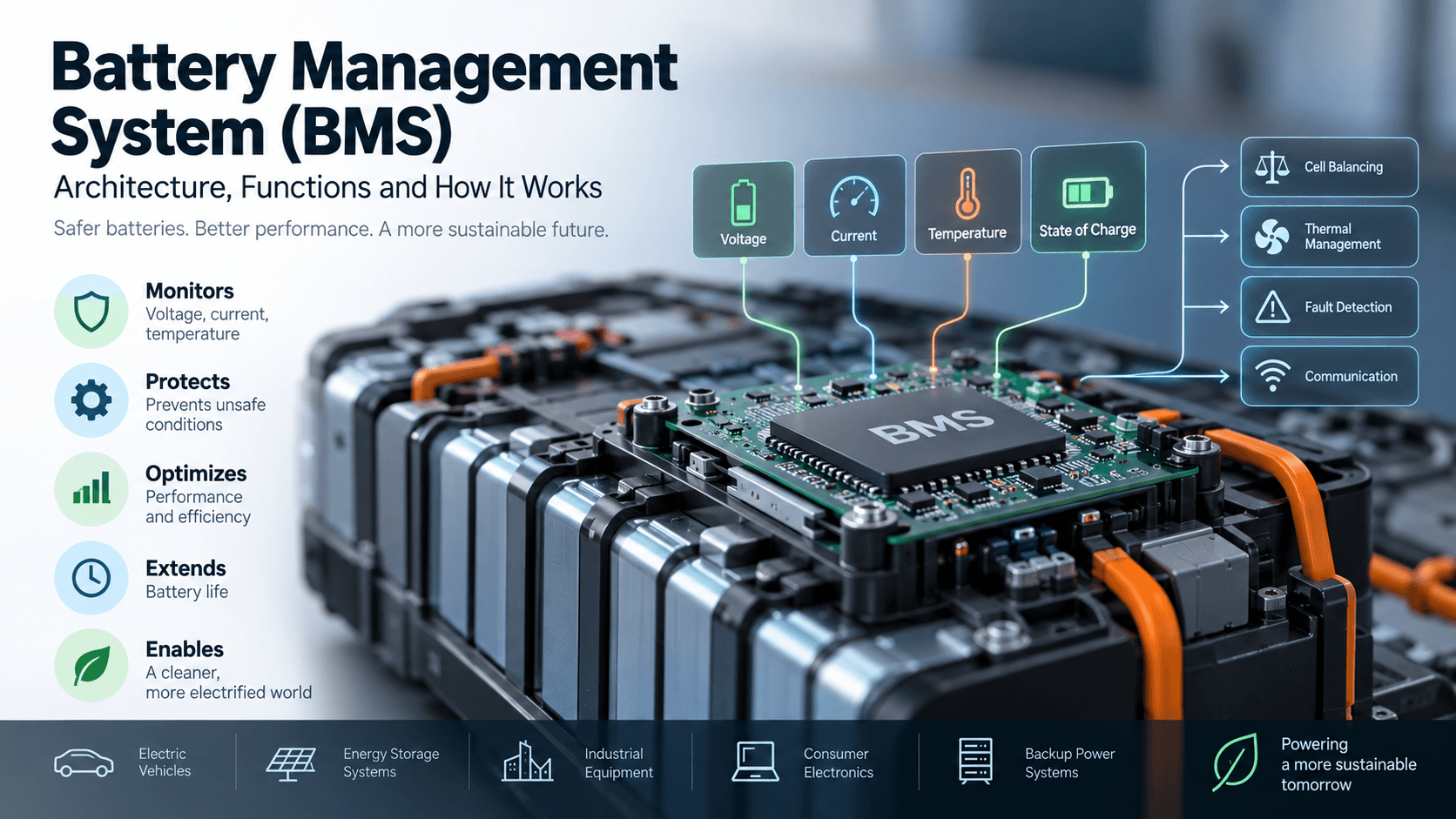
A Battery Management System (BMS) is the control layer that keeps a rechargeable battery pack safe, efficient, and reliable. It monitors battery conditions, manages charging and discharging, estimates the battery’s state, and protects cells from operating outside safe limits.
BMS technology is used in electric vehicles, energy storage systems, industrial equipment, consumer electronics, backup power systems, and other applications that rely on rechargeable battery packs.
As battery packs become larger and more complex, the BMS has an increasingly important role. It is no longer just a protection circuit. Modern systems combine sensing, control, estimation, communication, diagnostics, and thermal management to improve battery performance and service life.
What Is a Battery Management System?
A Battery Management System is an electronic system designed to monitor and control the operation of a battery or battery pack.
At a basic level, a BMS continuously collects information such as:
- Individual cell voltage
- Pack voltage
- Charging and discharging current
- Battery temperature
- State of Charge (SoC)
- State of Health (SoH)
- State of Power (SoP)
It uses this information to determine whether the battery is operating within predefined limits.
If the system detects an unsafe condition, such as excessive temperature or overvoltage, it can take corrective action. Depending on the design, this may include reducing current, disconnecting the battery, activating cooling, or preventing charging.
Why Is a BMS Important?
Rechargeable batteries, particularly lithium-ion batteries, need to operate within specific electrical and thermal limits.
A cell that is overcharged, deeply discharged, overheated, or subjected to excessive current can experience accelerated degradation and, in severe cases, safety problems.
A BMS helps address these risks by continuously monitoring the battery and controlling how it is used.
Its main objectives are to:
- Protect the battery from unsafe operating conditions.
- Improve battery performance and usable capacity.
- Extend battery service life.
- Maintain balance between cells.
- Provide accurate information about battery condition.
- Communicate battery status to other systems.
For an electric vehicle, for example, the BMS can communicate with the vehicle control system to determine how much power the battery can safely deliver at a given moment.
Battery Management System Architecture
A typical BMS architecture consists of several hardware and software layers. The exact design depends on the battery chemistry, voltage, capacity, application, and required safety level.
At a high level, the architecture includes:
- Battery cells and modules
- Voltage sensing circuits
- Current sensing
- Temperature sensors
- Battery monitoring ICs
- Microcontroller or BMS controller
- Cell balancing circuitry
- Protection and switching devices
- Communication interfaces
- Thermal management interfaces
- BMS software and algorithms
A simplified data flow looks like this:
Battery cells → Sensors → Battery monitoring electronics → BMS controller → Control and protection → External system
The controller continuously processes measurements and determines what actions are required.
Main Components of a BMS
Battery Cells and Modules
The battery pack is made up of individual cells connected in series, parallel, or a combination of both.
Cells connected in parallel increase capacity and current capability, while cells connected in series increase the overall pack voltage.
Large battery packs are often organized into modules. The BMS monitors these cells or groups of cells to identify abnormal conditions.
Voltage Measurement Circuit
The BMS measures the voltage of individual cells or cell groups.
Cell voltage monitoring is important because cells in the same pack do not always behave identically. Differences can develop because of manufacturing variation, temperature differences, aging, or operating conditions.
The BMS uses these measurements to detect conditions such as:
- Overvoltage
- Undervoltage
- Cell imbalance
- Abnormal voltage changes
Current Sensor
The BMS needs to know how much current is flowing into or out of the battery.
Common current-sensing technologies include:
- Shunt resistors
- Hall-effect sensors
- Magnetic current sensors
Current measurements are used for protection, State of Charge estimation, power calculations, and battery diagnostics.
Temperature Sensors
Temperature has a major effect on battery performance and safety.
Temperature sensors can be placed at strategic points throughout the battery pack to detect overheating and identify temperature differences between cells or modules.
The BMS can use this information to control cooling or heating systems and limit battery operation when temperatures fall outside safe ranges.
BMS Controller
The controller is the central processing unit of the BMS.
It receives measurements from sensors and battery monitoring ICs, processes the data, runs estimation algorithms, and makes control decisions.
Depending on the system, the controller may be a microcontroller, processor, or dedicated BMS control unit.
Cell Balancing Circuit
Cell balancing helps reduce voltage or charge differences between cells.
Without balancing, a few cells can reach their voltage limits before the rest of the pack. This can reduce the usable capacity of the entire battery.
BMS designs generally use either passive or active balancing.
Contactors and Protection Devices
High-voltage battery packs commonly use contactors to connect or disconnect the battery from the external electrical system.
The BMS can open these contactors when it detects a serious fault.
Other protection elements can include:
- Fuses
- Relays
- Pre-charge circuits
- Electronic switches
- Circuit breakers
These components help protect both the battery and connected equipment.
Communication Interface
The BMS often needs to communicate with other electronic systems.
Common communication protocols include:
- CAN
- UART
- SPI
- I²C
- RS-485
- Ethernet in some larger systems
For example, an EV battery BMS may use CAN communication to exchange battery information with the vehicle control system.
How Does a Battery Management System Work?
A BMS works through a continuous cycle of measurement, analysis, decision-making, and control.
Step 1: Measure Battery Parameters
Sensors continuously measure voltage, current, and temperature.
The BMS collects these measurements from individual cells, modules, and the overall battery pack.
Step 2: Process the Measurements
The controller processes the sensor data and checks it against predefined operating limits.
For example, it may compare cell voltage and temperature with the limits established for the particular battery chemistry and application.
Step 3: Estimate Battery Condition
The BMS calculates or estimates parameters such as State of Charge and State of Health.
These estimates help the system determine how much energy and power the battery can provide.
Step 4: Balance the Cells
If the BMS identifies significant differences between cells, it can activate the appropriate balancing strategy.
This helps maintain a more consistent electrical state across the pack.
Step 5: Control Battery Operation
The BMS can control charging, discharging, contactors, thermal systems, and other components.
If operating conditions become unsafe, the BMS can limit operation or disconnect the battery.
Step 6: Communicate Battery Status
Finally, the BMS sends relevant information to external systems.
This can include:
- Battery voltage
- Current
- Temperature
- SoC
- SoH
- Available charging power
- Available discharge power
- Fault information
Key Functions of a Battery Management System
1. Battery Protection
Protection is one of the most important BMS functions.
The system monitors for conditions such as:
- Overvoltage
- Undervoltage
- Overcurrent
- Short circuit
- Overtemperature
- Excessive charging current
- Excessive discharge current
When a dangerous condition is detected, the BMS can take appropriate protective action.
2. State of Charge Estimation
State of Charge indicates the approximate amount of usable energy remaining in the battery.
It is often expressed as a percentage.
For example, a battery with an SoC of 80% is generally understood to have approximately 80% of its usable charge remaining under the relevant operating assumptions.
SoC estimation is more complicated than simply measuring voltage. Modern BMS algorithms can combine current measurements, voltage, temperature, battery models, and historical operating data.
3. State of Health Estimation
State of Health describes the battery’s condition compared with a reference condition, typically a new or specified baseline.
As batteries age, their capacity and power capability can decline.
A BMS can monitor indicators such as:
- Capacity loss
- Internal resistance changes
- Charge and discharge behavior
- Temperature history
- Cycle history
These measurements can help estimate battery degradation.
4. Cell Balancing
Cells within the same battery pack can develop different charge levels.
Cell balancing helps reduce these differences.
Passive Balancing
Passive balancing typically removes excess energy from higher-voltage cells through resistive elements.
It is relatively simple but dissipates energy as heat.
Active Balancing
Active balancing transfers energy between cells or cell groups.
This can reduce energy losses compared with passive balancing, although the circuit is generally more complex and expensive.
5. Thermal Management
Battery temperature directly affects performance, charging capability, aging, and safety.
The BMS can monitor temperatures and interact with thermal management systems.
Depending on the application, thermal management may involve:
- Air cooling
- Liquid cooling
- Heating elements
- Refrigeration systems
- Thermal interface materials
The BMS may also reduce charging or discharging power when temperature conditions require it.
6. Fault Detection and Diagnostics
A modern BMS does more than detect simple overvoltage or overtemperature events.
It can monitor for abnormal patterns and identify potential faults.
Examples include:
- Sensor failures
- Communication failures
- Cell voltage abnormalities
- Current sensor errors
- Insulation faults
- Contactor problems
- Unexpected temperature behavior
Diagnostic information can help maintenance teams identify problems before they become more serious.
7. Charging Control
The BMS plays an important role during charging.
It monitors cell voltage, temperature, current, and other parameters to determine whether charging can continue safely.
In systems where the BMS communicates with a charger or charging controller, it can provide limits for acceptable charging current and power.
8. Power Management
A battery’s available power can change depending on temperature, SoC, aging, and other conditions.
The BMS can calculate or estimate how much power the battery can safely deliver or accept.
This information allows the larger system to adjust its behavior accordingly.
Types of Battery Management Systems
BMS architectures can be classified in several ways.
Centralized BMS
In a centralized architecture, sensing and control electronics are concentrated in a central BMS unit.
Advantages:
- Simpler overall architecture
- Fewer distributed electronic modules
- Potentially lower component count
Limitations:
- More wiring may be required
- Scaling to large battery packs can become difficult
- Long sensor connections can complicate system design
Distributed BMS
A distributed BMS places monitoring electronics closer to the battery cells or modules.
Each module can have its own monitoring circuitry, with communication between module-level electronics and the main controller.
Advantages:
- Reduced wiring complexity
- Easier scaling for large battery packs
- Modular architecture
Limitations:
- More electronic components
- More complex communication and software architecture
- Higher system integration requirements
Modular BMS
A modular BMS uses multiple monitoring units connected to a central controller.
It provides a middle ground between centralized and distributed architectures and is common in larger battery systems.
BMS in Electric Vehicles
Electric vehicles place demanding requirements on battery management.
An EV battery pack can contain thousands of individual cells, depending on the battery design.
The BMS must coordinate:
- Cell monitoring
- Charging
- Discharging
- Thermal management
- Cell balancing
- Fault detection
- Power estimation
- Communication with vehicle systems
During acceleration, the BMS may determine the maximum power that can safely be delivered.
During regenerative braking, it can help determine how much charging power the battery can accept.
During fast charging, the BMS continuously monitors cell conditions and communicates appropriate limits to the charging system.
BMS for Energy Storage Systems
Battery Energy Storage Systems (BESS) use BMS technology to manage large battery installations.
These systems may be connected to solar generation, electrical grids, commercial facilities, or backup power infrastructure.
In a BESS, the BMS may work alongside:
- Energy Management Systems (EMS)
- Power Conversion Systems (PCS)
- HVAC systems
- Fire detection systems
- Monitoring platforms
- Grid management systems
The BMS provides detailed battery-level information that helps the larger energy system operate safely and efficiently.
BMS vs Battery Protection Circuit
A basic protection circuit and a modern BMS are not the same thing.
A protection circuit may primarily monitor a few parameters and disconnect the battery when predefined limits are exceeded.
A BMS typically provides a much broader set of capabilities, including:
| Function | Basic Protection Circuit | Advanced BMS |
|---|---|---|
| Overvoltage protection | Yes | Yes |
| Undervoltage protection | Yes | Yes |
| Overcurrent protection | Yes | Yes |
| Temperature monitoring | Basic | Advanced |
| Cell balancing | Sometimes | Common |
| SoC estimation | Limited | Yes |
| SoH estimation | No or limited | Yes |
| Diagnostics | Limited | Advanced |
| Communication | Limited | Common |
| Thermal management control | Usually no | Often yes |
The exact capabilities vary by product and application.
Challenges in BMS Design
Designing a BMS requires balancing safety, performance, cost, complexity, and reliability.
Measurement Accuracy
Small measurement errors can affect SoC estimation, cell balancing, and fault detection.
Accurate sensing and proper calibration are therefore important.
Battery Aging
Battery characteristics change over time.
A BMS needs algorithms that can account for changes in capacity, resistance, temperature behavior, and other characteristics.
Thermal Variation
Cells in a large pack may experience different temperatures.
This creates differences in performance and aging, making thermal monitoring and management important.
Software Complexity
Modern BMS software can include estimation algorithms, diagnostics, communication protocols, fault handling, balancing logic, and safety mechanisms.
Testing and validation become increasingly important as system complexity grows.
Functional Safety
Applications such as electric vehicles require carefully designed safety mechanisms.
The BMS needs to detect faults and respond predictably, including situations where sensors, communication networks, or electronic components fail.
What Is the Future of Battery Management Systems?
BMS technology is evolving as battery packs become larger, smarter, and more connected.
Several areas are receiving increasing attention.
Cloud-Connected Battery Monitoring
Battery data can be collected and analyzed remotely to support fleet monitoring, predictive maintenance, and battery lifecycle management.
Data-Driven Battery Diagnostics
Advanced algorithms can analyze operating patterns to identify early signs of degradation or abnormal behavior.
Wireless BMS
Wireless communication can reduce the amount of physical wiring required between battery modules and the central controller.
This can potentially simplify battery-pack manufacturing and improve modularity.
Digital Twins and Battery Modeling
More detailed battery models can help estimate battery behavior under different temperatures, loads, and aging conditions.
Second-Life Battery Management
As batteries are removed from their original applications, BMS technology can help evaluate their remaining capacity and condition for potential second-life applications.
Frequently Asked Questions
What does a Battery Management System do?
A BMS monitors and manages a rechargeable battery to improve safety, performance, and reliability. It can monitor voltage, current, and temperature, estimate SoC and SoH, balance cells, detect faults, and communicate battery information to other systems.
Is a BMS required for lithium-ion batteries?
A BMS or an appropriate protection and control system is generally important for lithium-ion battery packs, particularly larger and more complex systems. The exact requirements depend on the battery design, chemistry, application, and safety architecture.
What are the main parts of a BMS?
Common BMS components include voltage and temperature sensors, current sensors, battery monitoring ICs, a controller, cell-balancing circuits, protection devices, contactors, and communication interfaces.
What is the difference between SoC and SoH?
SoC describes the battery’s current charge level, while SoH describes its condition relative to a reference state, typically reflecting factors such as capacity and power capability.
Does a BMS charge the battery?
The BMS does not necessarily act as the charger itself. Instead, it monitors battery conditions and can control or communicate charging limits to the charger or charging system.
Conclusion
A Battery Management System is a critical part of modern rechargeable battery technology. It combines sensing, control, protection, estimation, balancing, diagnostics, and communication to manage the battery throughout its operating life.
For small battery packs, the BMS may be a relatively simple protection and monitoring circuit. In electric vehicles and large energy storage systems, it becomes a sophisticated combination of hardware and software capable of managing thousands of cells and coordinating with multiple external systems.
As battery technology continues to evolve, BMS capabilities will also expand. Better sensing, more advanced algorithms, connected monitoring, and improved diagnostics will play an important role in making battery systems safer, more reliable, and more efficient.