Construction Equipment Component Sourcing: Lead Times, Tolerances, and Supplier Evaluation
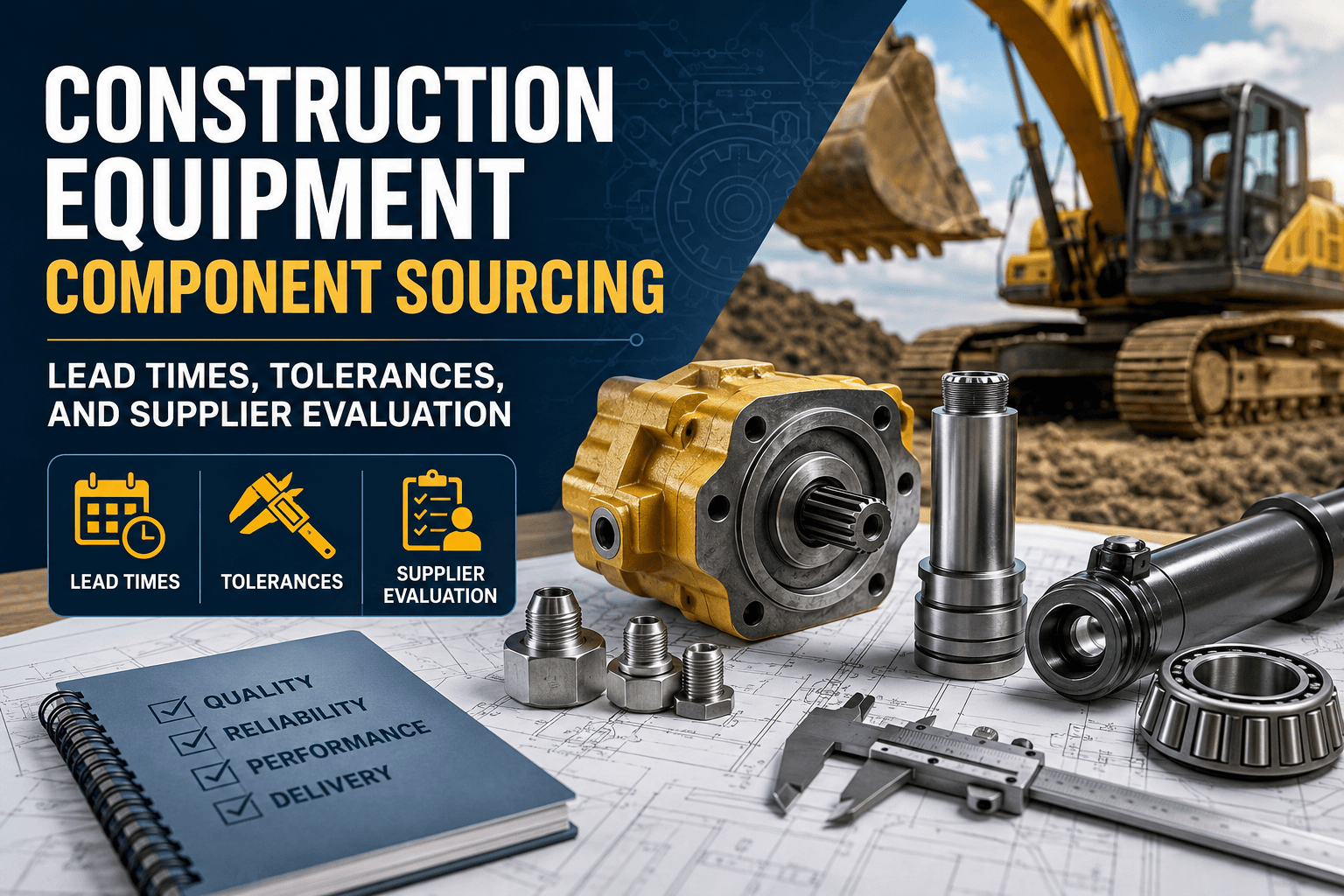
Sourcing components for construction equipment is about much more than finding the lowest price. Every purchased part affects machine performance, production schedules, warranty costs, and customer satisfaction. A delayed hydraulic cylinder or an out-of-spec machined casting can stop an assembly line just as easily as a missing engine.
Manufacturers and OEMs must balance cost, quality, delivery, and supplier reliability throughout the sourcing process. Understanding lead times, engineering tolerances, and supplier capabilities helps procurement teams reduce risk while maintaining consistent production.
This guide explains the three most important factors in construction equipment component sourcing and how to evaluate suppliers that can support long-term growth.
Why Component Sourcing Matters
Construction equipment operates in demanding environments that expose components to heavy loads, vibration, dirt, moisture, and extreme temperatures. Parts must perform reliably over thousands of operating hours while meeting strict safety and durability requirements.
Poor sourcing decisions can lead to:
- Production delays
- Higher warranty claims
- Increased inspection costs
- Supply chain disruptions
- Reduced equipment reliability
- Higher total ownership costs
A structured sourcing strategy minimizes these risks while improving operational efficiency.
Understanding Lead Times
Lead time is the total time required from placing an order until components are delivered and ready for production.
While many buyers focus only on manufacturing time, the complete lead time includes several stages.
Supplier Response
The supplier reviews drawings, specifications, and commercial requirements before confirming production.
Material Procurement
Steel, castings, forgings, seals, bearings, electronics, and other raw materials may have their own procurement timelines.
Manufacturing
Production includes machining, welding, fabrication, heat treatment, coating, assembly, and testing.
Inspection and Quality Approval
Components undergo dimensional inspection, functional testing, and documentation review before shipment.
Packaging and Transportation
International shipments may include customs clearance, port delays, and inland transportation before arriving at the manufacturing facility.
Factors That Influence Lead Times
Several variables affect component availability.
Product Complexity
Precision hydraulic parts or large fabricated structures generally require more manufacturing steps than standard brackets or fasteners.
Material Availability
Special alloy steels, custom forgings, and imported materials often extend procurement timelines.
Production Capacity
Suppliers operating near full capacity may require longer scheduling windows.
Seasonal Demand
Construction equipment demand often increases before peak construction seasons, placing additional pressure on supplier production schedules.
Geographic Location
Long-distance shipping introduces transportation risk, customs processing, and logistics delays.
Strategies to Reduce Lead Time Risk
Organizations can improve supply chain resilience by:
- Forecasting demand accurately
- Sharing production schedules with suppliers
- Qualifying secondary suppliers
- Maintaining safety stock for critical components
- Standardizing commonly used parts
- Monitoring supplier capacity regularly
Collaborative planning often reduces unexpected production disruptions.
Why Engineering Tolerances Matter
Engineering tolerances define the acceptable variation in dimensions, geometry, and surface quality.
Even minor deviations can create assembly problems, excessive wear, vibration, leakage, or premature equipment failure.
For construction equipment, consistent dimensional accuracy is especially important because components frequently operate under high loads and repeated impact.
Common Tolerances to Review
Depending on the component, procurement teams should verify supplier capability for:
Dimensional Tolerances
Critical measurements including diameter, length, thickness, and hole positions.
Geometric Tolerances
Requirements for flatness, concentricity, perpendicularity, parallelism, and runout.
Surface Finish
Surface roughness influences sealing performance, friction, and fatigue life.
Material Properties
Mechanical strength, hardness, heat treatment, and chemical composition should match engineering specifications.
Weld Quality
Fabricated structures require consistent weld penetration, appearance, and structural integrity.
Matching Supplier Capability to Tolerance Requirements
Not every supplier is equipped to manufacture high-precision components.
Before placing production orders, verify:
- Available machining equipment
- CNC capabilities
- Inspection equipment
- Coordinate Measuring Machine (CMM) availability
- Process control procedures
- Calibration records
- Statistical process control methods
- Quality certifications
Capability should be demonstrated with measurable production data rather than marketing claims.
Evaluating Construction Equipment Suppliers
Selecting suppliers requires evaluating more than pricing.
A supplier with slightly higher costs may deliver significantly greater value through better quality, shorter lead times, and lower production risk.
Manufacturing Experience
Look for suppliers with experience producing components for construction, mining, agricultural, or heavy industrial equipment.
Industry-specific knowledge often reduces engineering misunderstandings.
Quality Management
Reliable suppliers maintain documented quality systems covering:
- Incoming material inspection
- In-process inspections
- Final quality verification
- Corrective action procedures
- Traceability documentation
Consistent quality systems reduce variability between production batches.
Production Capacity
Assess whether suppliers can scale production as demand increases.
Questions to ask include:
- Current machine utilization
- Available production shifts
- Expansion capability
- Workforce stability
Capacity planning helps prevent future supply constraints.
Technical Support
Strong suppliers provide engineering assistance during product development.
Support may include:
- Design-for-manufacturing recommendations
- Material alternatives
- Cost optimization suggestions
- Prototype development
- Process improvements
Early collaboration often reduces production costs without affecting product performance.
Delivery Performance
Historical on-time delivery rates provide insight into operational discipline.
Request delivery performance metrics covering at least the previous 12 months whenever possible.
Financial Stability
Long-term sourcing relationships require financially healthy suppliers capable of investing in equipment, workforce development, and quality improvements.
Questions to Ask During Supplier Evaluation
Before approving a supplier, procurement teams should consider:
- Can they consistently meet required tolerances?
- How do they manage production quality?
- What inspection equipment is available?
- What is their average lead time?
- How do they respond to engineering changes?
- Can they support volume increases?
- What contingency plans exist for supply disruptions?
- How are customer complaints handled?
- What certifications and compliance standards do they maintain?
- Can they provide references or production samples?
A structured evaluation process improves supplier selection and reduces sourcing risk.
Balancing Cost with Long-Term Value
Lowest purchase price rarely represents the lowest total cost.
Procurement decisions should consider:
- Scrap rates
- Rework costs
- Warranty expenses
- Transportation costs
- Inventory carrying costs
- Production downtime
- Supplier responsiveness
- Product reliability
Evaluating total cost of ownership creates stronger sourcing decisions over the life of a project.
Best Practices for Long-Term Supplier Relationships
Successful manufacturers treat suppliers as strategic partners rather than transactional vendors.
Effective partnerships include:
- Regular performance reviews
- Transparent demand forecasts
- Collaborative problem solving
- Continuous improvement initiatives
- Joint quality planning
- Early supplier involvement during product development
Strong supplier relationships often result in better pricing, improved quality, and greater flexibility during periods of supply chain disruption.
Conclusion
Construction equipment component sourcing requires balancing delivery performance, manufacturing precision, and supplier capability. Lead times determine production continuity, tolerances ensure reliable equipment performance, and thorough supplier evaluation reduces operational risk.
Organizations that invest time in qualifying suppliers, monitoring performance, and building collaborative partnerships are better positioned to deliver high-quality equipment while maintaining stable production schedules and controlling long-term costs.
Key Takeaways
- Lead time includes procurement, manufacturing, inspection, and logistics.
- Engineering tolerances directly affect equipment reliability and assembly quality.
- Supplier evaluation should measure quality systems, technical capability, capacity, and delivery performance.
- Total cost of ownership provides a more accurate sourcing metric than purchase price alone.
- Long-term supplier partnerships improve resilience, quality, and operational efficiency.
FAQs
Q. What is the biggest sourcing challenge for construction equipment manufacturers?
Maintaining consistent quality while managing long lead times and fluctuating material availability is one of the most common challenges.
Q. Why are tolerances important when sourcing components?
Accurate tolerances ensure proper fit, reliable operation, reduced wear, and consistent equipment performance.
Q. How should suppliers be evaluated?
Assess manufacturing capability, quality systems, delivery history, engineering support, production capacity, financial stability, and responsiveness instead of relying solely on price.
Q. How can companies reduce supply chain disruptions?
Forecast demand accurately, diversify suppliers, maintain safety stock for critical parts, and build long-term relationships with qualified manufacturing partners.