Battery Manufacturing: Components, Process, and Supply Chain
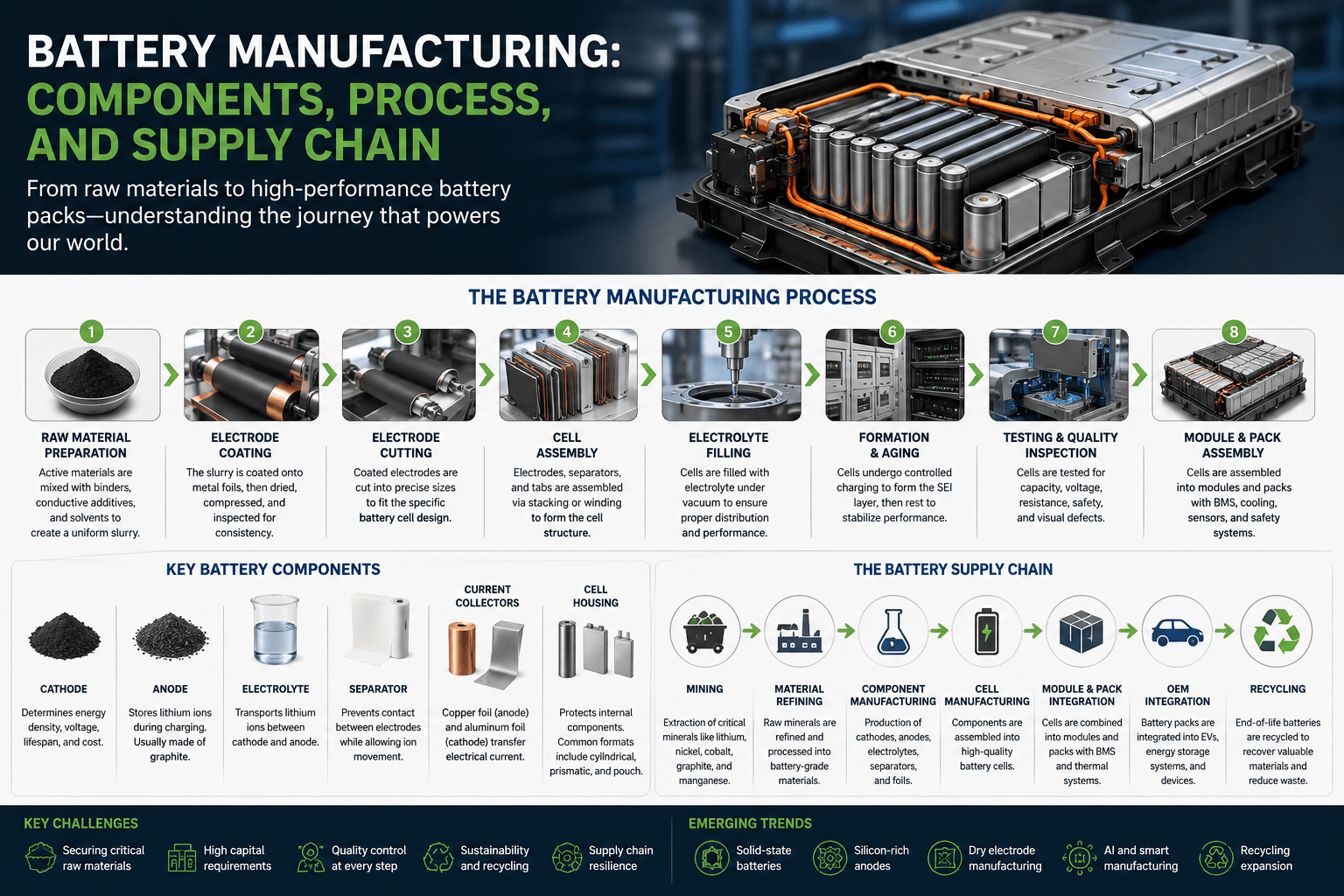
Battery manufacturing has become one of the fastest-growing industries in the world. Demand for electric vehicles (EVs), renewable energy storage, consumer electronics, and industrial equipment continues to increase, driving significant investments in battery production capacity.
Behind every battery is a complex manufacturing process that combines advanced materials, precision engineering, and strict quality control. From sourcing raw materials to assembling battery packs, every stage affects performance, safety, lifespan, and cost.
This guide explains the key components of batteries, how they are manufactured, and the supply chain that supports global battery production.
Why Battery Manufacturing Matters
Modern batteries power nearly every aspect of daily life. Smartphones, laptops, electric vehicles, drones, medical devices, and energy storage systems all depend on reliable battery technology.
As governments and businesses invest in electrification and clean energy, manufacturers face growing pressure to:
- Increase production capacity
- Lower manufacturing costs
- Improve battery performance
- Reduce environmental impact
- Build resilient supply chains
- Secure critical raw materials
These challenges make battery manufacturing both highly technical and strategically important.
Main Components of a Battery
Although battery chemistries vary, most rechargeable lithium-ion batteries share the same core components.
Cathode
The cathode is the positive electrode and one of the most expensive parts of a battery. It largely determines:
- Energy density
- Battery lifespan
- Voltage
- Safety
- Overall cost
Common cathode materials include:
- Lithium Iron Phosphate (LFP)
- Nickel Manganese Cobalt (NMC)
- Nickel Cobalt Aluminum (NCA)
- Lithium Manganese Oxide (LMO)
Each chemistry offers different advantages depending on the application.
Anode
The anode stores lithium ions during charging.
Most commercial batteries use graphite because it offers:
- High electrical conductivity
- Long cycle life
- Stable performance
- Competitive cost
Manufacturers are increasingly introducing silicon-enhanced anodes to improve energy density.
Electrolyte
The electrolyte transports lithium ions between the anode and cathode.
It typically consists of:
- Lithium salts
- Organic solvents
- Performance additives
Electrolyte quality directly affects charging speed, safety, and battery lifespan.
Separator
The separator prevents physical contact between the anode and cathode while allowing lithium ions to pass through.
High-quality separators improve:
- Thermal stability
- Safety
- Cycle life
- Internal resistance
Current Collectors
Metal foils collect and transfer electrical current.
Typical materials include:
- Aluminum foil for the cathode
- Copper foil for the anode
Battery Cell Housing
The housing protects internal components from moisture, contamination, vibration, and mechanical damage.
Common formats include:
- Cylindrical cells
- Prismatic cells
- Pouch cells
Battery Manufacturing Process
Battery production requires tightly controlled manufacturing environments because moisture and contamination can significantly reduce battery performance.
1. Raw Material Preparation
Manufacturers prepare active materials by mixing powders with:
- Conductive additives
- Binders
- Solvents
The resulting slurry must achieve precise viscosity and composition.
2. Electrode Coating
The slurry is coated onto metal foils using precision coating equipment.
The coated electrodes are then:
- Dried
- Compressed
- Inspected
Uniform coating thickness is essential for consistent battery performance.
3. Electrode Cutting
Large coated sheets are cut into precise dimensions suitable for the target battery cell.
Automated cutting minimizes material waste and improves production efficiency.
4. Cell Assembly
Depending on the battery design, electrodes are:
- Wound into cylindrical cells
- Stacked into pouch cells
- Layered into prismatic cells
Additional components, including separators and tabs, are inserted during assembly.
5. Electrolyte Filling
After the cell is sealed, electrolyte is injected under controlled vacuum conditions.
Proper electrolyte distribution is critical for battery performance.
6. Formation and Aging
Formation is one of the most important manufacturing stages.
During formation:
- Cells undergo controlled charging
- A stable solid electrolyte interphase (SEI) forms
- Initial defects become detectable
Cells then rest during aging to stabilize their electrochemical performance.
7. Testing and Quality Inspection
Every battery cell undergoes multiple quality checks, including:
- Capacity testing
- Internal resistance measurement
- Voltage verification
- Leak detection
- X-ray inspection
- Visual inspection
Manufacturers reject defective cells before pack assembly.
8. Module and Pack Assembly
Battery cells are assembled into modules and then into complete battery packs.
Battery packs typically include:
- Battery Management System (BMS)
- Cooling system
- Wiring harnesses
- Sensors
- Structural enclosure
- Safety devices
The BMS monitors temperature, voltage, current, and cell balancing.
Types of Battery Manufacturing Facilities
Battery production generally occurs across several specialized facilities.
Material Processing Plants
These facilities refine and process:
- Lithium compounds
- Nickel
- Cobalt
- Graphite
- Manganese
Cell Manufacturing Plants
These plants produce individual battery cells through electrode manufacturing, assembly, formation, and testing.
Module Assembly Plants
Cells are combined into standardized battery modules.
Battery Pack Assembly Plants
Final battery packs are assembled for:
- Electric vehicles
- Industrial equipment
- Consumer electronics
- Grid-scale energy storage
Battery Manufacturing Supply Chain
The battery supply chain spans multiple industries and countries.
1. Mining
Critical minerals include:
- Lithium
- Nickel
- Cobalt
- Graphite
- Manganese
Mining locations are distributed globally, creating supply chain dependencies.
2. Material Refining
Raw minerals undergo chemical processing before they become battery-grade materials.
Purity is essential for battery performance.
3. Component Manufacturing
Specialized suppliers produce:
- Cathodes
- Anodes
- Electrolytes
- Separators
- Copper foil
- Aluminum foil
4. Cell Manufacturing
Battery manufacturers combine these materials into finished cells.
5. Module and Pack Integration
Cells are integrated into battery systems for end-use applications.
6. OEM Integration
Original equipment manufacturers integrate battery packs into products such as:
- Electric vehicles
- Home energy storage systems
- Industrial machinery
- Consumer electronics
7. Recycling
End-of-life batteries are collected and processed to recover valuable materials.
Recycling helps reduce dependence on newly mined resources while supporting a more circular battery economy.
Key Challenges in Battery Manufacturing
Battery manufacturers face several ongoing challenges.
Securing Raw Materials
Growing global demand has increased competition for lithium, nickel, cobalt, and graphite.
Manufacturing Scale
Large-scale battery production requires billions of dollars in investment, highly automated equipment, and skilled labor.
Quality Control
Even microscopic contamination can reduce battery safety and lifespan. Manufacturers rely on cleanrooms, automation, and advanced inspection systems.
Sustainability
The industry continues to improve:
- Energy-efficient production
- Water conservation
- Lower-carbon manufacturing
- Responsible sourcing
- Battery recycling
Supply Chain Resilience
Geopolitical risks, transportation disruptions, and fluctuating commodity prices encourage manufacturers to diversify suppliers and localize production.
Emerging Trends in Battery Manufacturing
Several innovations are shaping the future of battery production.
Solid-State Batteries
Solid-state batteries replace liquid electrolytes with solid materials, offering the potential for higher energy density and improved safety.
Silicon-Rich Anodes
Adding silicon to graphite anodes can increase energy storage capacity and support longer driving ranges in electric vehicles.
Dry Electrode Manufacturing
Dry coating processes aim to reduce energy use, eliminate certain solvents, and simplify production.
AI and Smart Manufacturing
Artificial intelligence helps manufacturers optimize production by:
- Predicting equipment failures
- Detecting quality issues
- Improving process control
- Reducing waste
- Increasing yield
Battery Recycling Expansion
Growing recycling capacity is expected to recover larger quantities of lithium, nickel, cobalt, and graphite, reducing reliance on virgin materials.
Best Practices for Battery Manufacturers
Successful manufacturers typically focus on:
- Investing in automation and digital manufacturing
- Maintaining rigorous quality assurance
- Diversifying raw material suppliers
- Designing batteries with recyclability in mind
- Improving traceability across the supply chain
- Continuously optimizing production efficiency
These practices help improve product quality while reducing operational costs and environmental impact.
Key Takeaways
Battery manufacturing is a sophisticated process that combines advanced materials, precision engineering, and extensive quality control. From mining and material refining to cell production, pack assembly, and recycling, each step influences battery performance, cost, and sustainability.
As demand for electric mobility and energy storage continues to grow, manufacturers that invest in efficient production methods, resilient supply chains, and next-generation battery technologies will be well positioned to meet future market needs.
Frequently Asked Questions
Q. What are the main components of a lithium-ion battery?
A lithium-ion battery typically consists of a cathode, anode, electrolyte, separator, current collectors, and a protective cell housing.
Q. Why is battery manufacturing performed in dry rooms?
Lithium-ion battery materials are highly sensitive to moisture. Dry rooms help prevent contamination that can reduce battery performance, safety, and lifespan.
Q. What is battery formation?
Formation is the initial controlled charging process that creates a stable solid electrolyte interphase (SEI) on the anode. This step is critical for long-term battery performance and reliability.
Q. Which industries rely most on battery manufacturing?
Battery manufacturing supports electric vehicles, consumer electronics, renewable energy storage, aerospace, medical devices, industrial automation, and telecommunications.
Q. Why is battery recycling becoming more important?
Recycling recovers valuable materials such as lithium, nickel, cobalt, and graphite, reducing waste, lowering demand for newly mined resources, and supporting a more sustainable battery supply chain.