Medical Device Manufacturing in India: Standards, MDR Compliance, and Contract Manufacturer Guide 2026

Introduction
India’s medical device industry reached $11B in 2025 and is projected to reach $50B by 2030. Government policy (PLI for medical devices, dedicated medical device parks, 100% FDI under automatic route) has attracted global device manufacturers including Siemens Healthineers, GE Healthcare, BD, and Abbott to establish or expand India manufacturing. India is now a credible destination for Class I and Class II medical device contract manufacturing – and the regulatory framework (India MDR 2017) provides a clear compliance pathway for global manufacturers.
This guide covers India’s medical device manufacturing ecosystem, the regulatory framework, ISO 13485 supplier landscape, and how to qualify an Indian contract manufacturer for a medical device programme in 2026.
India’s Medical Device Regulatory Framework: MDR 2017
The Medical Devices Rules (MDR) 2017, amended in 2020 and 2023, brought India’s medical device regulation under a structured framework for the first time. Key provisions:
Device Classification
- Class A (Low Risk): Non-sterile, non-measuring; stethoscopes, tongue depressors, bandages. No CDSCO license required for manufacture.
- Class B (Low-Medium Risk): Sterile Class A, non-measuring powered devices; syringes, blood pressure monitors. CDSCO license required.
- Class C (Medium-High Risk): Long-term implantable, life-sustaining; dialysis equipment, ventilators, orthopaedic implants. CDSCO license + technical review.
- Class D (High Risk): Cardiac stents, pacemakers, HIV diagnostics. CDSCO license + clinical evidence evaluation.
Quality Management System Requirement
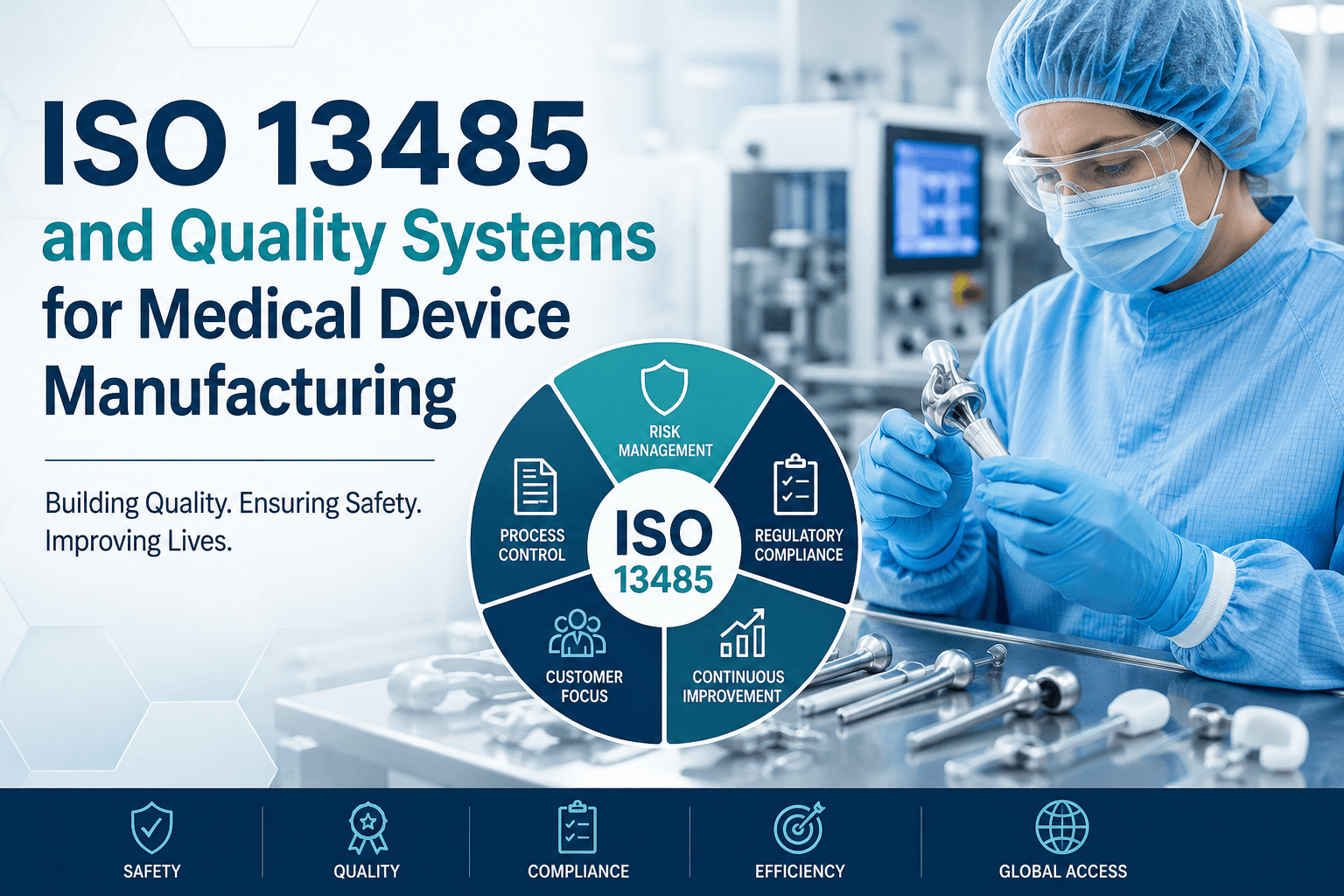
From 2024, all licensed medical device manufacturers in India must hold ISO 13485:2016 certification (or equivalent QMS). ISO 13485 is the international QMS standard for medical devices – analogous to ISO 9001 but with additional requirements for risk management, sterility, traceability, and post-market surveillance. Verify any Indian CM you consider holds current ISO 13485 from an accredited certification body.
Import and Export Registration
For devices imported into India: importer registration with CDSCO required. For devices manufactured in India for export: MDR 2017 does not require export registration (devices must comply with the destination country regulations – FDA 510(k)/PMA for US, CE mark for EU, TGA for Australia).
PLI Scheme for Medical Devices
The PLI scheme for Medical Devices (Rs 3,420 Cr) covers four product segments:
- Segment A: Cancer care / radiology equipment (MRI, CT, X-ray) – high-value capital equipment
- Segment B: Anaesthesia, cardiology, renal care, radiology, implants
- Segment C: Orthopaedic implants, trauma implants, dental implants, IVD reagents
- Segment D: PPE, syringes, needles, sutures – high-volume disposables
PLI incentive: 5% of incremental net sales in Year 1-4, declining to 4% in Year 5. Minimum investment threshold: Rs 50 Cr (Segment A) to Rs 25 Cr (Segment D). Current beneficiaries include HLL Lifecare, Trivitron, Poly Medicure, and subsidiaries of global device companies.
Medical Device Manufacturing Clusters in India
Andhra Pradesh Medical Device Park (Visakhapatnam)
Government-developed medical device park with common infrastructure: cleanrooms, sterilisation, warehousing. Tenants include Siemens Healthineers India, Dixon Technologies (medical), and multiple domestic manufacturers. Preferred destination for diagnostic equipment and imaging manufacturing.
Himachal Pradesh Baddi Cluster
Established pharma and medical device cluster; multiple Class I/II device manufacturers with ISO 13485 certification and WHO GMP compliance. Strong in disposables, packaging, and pharmaceutical combo products.
Tamil Nadu Medical Device Cluster (Chennai / Hosur)
Precision engineering capabilities support orthopaedic implant manufacturing (investment casting, CNC machining of titanium and cobalt-chrome). Multiple AS9100/ISO 13485 crossover manufacturers serve both aerospace and medical.
Pune / Maharashtra
Diagnostic equipment, surgical instruments, dental devices, and Class II IVD manufacturing. Hub for FDI in medical devices – GE Healthcare, BD, Stryker all have India operations in or near Pune.
What Indian Medical Device CMs Can Manufacture
High Confidence (Established Capability)
- Single-use disposables (syringes, catheters, drainage bags, IV sets): Multiple ISO 13485 manufacturers with FDA-registered facilities
- Surgical instruments (stainless steel, titanium): Sialkot-equivalent capability in Tamil Nadu and Karnataka clusters
- Orthopaedic implants (Class C): Investment cast cobalt-chrome and CNC-machined titanium implants supplied to global device companies
- Diagnostic IVD reagents and consumables: Hyderabad cluster; multiple FDA-registered manufacturers
Growing Capability (Qualification Required)
- Class II active devices (patient monitors, infusion pumps): Electronics integration capability growing; validate per specific product requirements
- Imaging accessories and transducers: Limited India capability; primarily assembled from imported sub-assemblies
- Complex Class C active implants (pacemakers, cochlear implants): Not recommended for India primary manufacturing in 2026; component manufacturing viable
Qualifying an Indian Medical Device Contract Manufacturer
Minimum Qualification Requirements
- ISO 13485:2016 certification current (verify certificate on IMDRF database or CB website)
- CDSCO license for the relevant device class
- For US export: FDA 510(k) clearance or PMA (if applicable) or FDA registration of the manufacturing facility
- Cleanroom classification appropriate to the device: ISO Class 7 or 8 for terminally sterilised devices, ISO Class 5-6 for aseptic assembly
- Sterilisation validation (EtO, gamma, autoclave) with current certificate – do not accept untested sterilisation processes
Quality System Deep Dive
Beyond ISO 13485 certification, verify: risk management per ISO 14971, software lifecycle per IEC 62304 (if applicable), biocompatibility testing per ISO 10993 (for body-contact materials), and post-market surveillance system. These are not optional in a compliant MDR 2017 quality system – their absence signals a paper QMS.
Key Takeaways
- India is a credible medical device contract manufacturing destination in 2026 for Class I, Class II, and selected Class C devices.
- ISO 13485:2016 is mandatory for licensed India medical device manufacturers; verify the certificate is current and from an accredited CB before engaging.
- PLI for Medical Devices (Rs 3,420 Cr) is actively disbursing and covers high-volume disposables through advanced capital equipment.
- The highest-confidence India medical device categories are: disposables, surgical instruments, orthopaedic implants, and IVD reagents.
- For US and EU export programmes, FDA registration/510(k) clearance and CE mark certification status of the India facility is the primary compliance gate.
FAQs
Q: Can an India-manufactured medical device be exported to the US under a 510(k) clearance obtained in the US?
A: Yes – a 510(k) clearance covers the device regardless of where it is manufactured, provided the manufacturing site is registered with the FDA and the site is inspected under the QMSR (Quality Management System Regulation, effective February 2026). India FDA-registered manufacturing sites are subject to FDA inspection. Ensure your India CM has a current FDA establishment registration number before beginning export-oriented production.
Q: What is the typical lead time for a Class II medical device qualification in India?
A: From supplier selection to production approval (including DfM, tooling, sterility validation, biocompatibility testing, and first article inspection): 12-18 months for a new Class II device. For devices with existing 510(k) clearance being transferred to an India manufacturing site: the site change may require FDA notification (SMDA – Site Master File amendment) adding 3-6 months.
Q: How does India MDR 2017 align with international frameworks like IMDRF?
A: India is an IMDRF member and MDR 2017 aligns broadly with IMDRF principles for classification, QMS requirements, and post-market surveillance. India has bilateral recognition discussions with the EU and US for potential mutual recognition of conformity assessment – not yet in force as of 2026, but progressing through the US-India strategic trade framework.