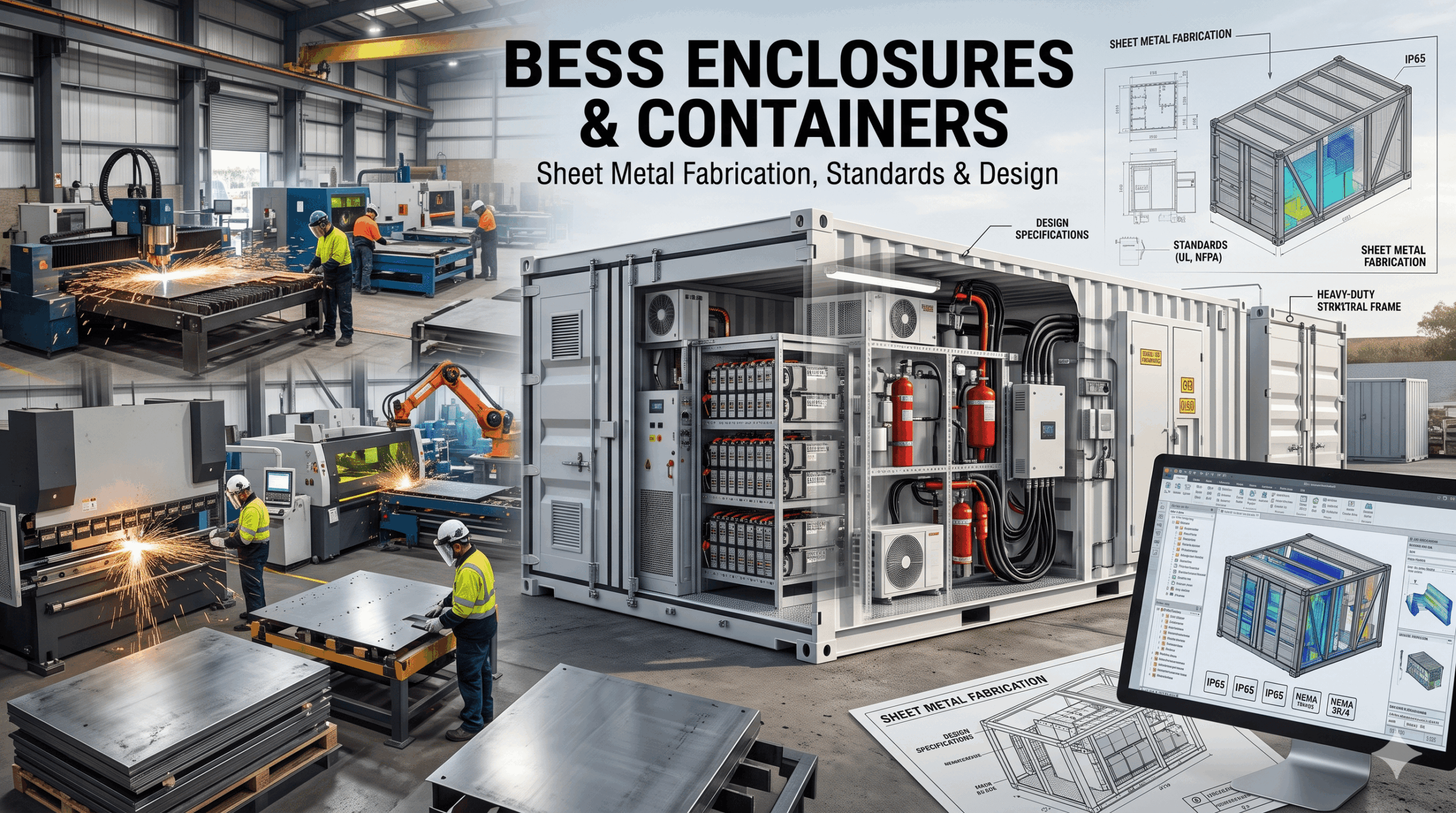
BESS Enclosures and Containers: Sheet Metal Fabrication, Standards and Design
Introduction
Battery energy storage systems (BESS) play an important role in modern power infrastructure. They help store electricity from renewable sources, support grid stability, reduce peak demand, and provide backup power for commercial and industrial facilities.
At the center of these systems is the enclosure or container that houses the batteries, electrical equipment, cooling systems, and safety components. Its design affects equipment protection, thermal performance, structural integrity, maintenance access, and long-term reliability.
BESS enclosures range from compact sheet metal cabinets for smaller installations to large, containerized systems designed for utility-scale energy storage. Each application brings different requirements for fabrication, environmental protection, ventilation, fire safety, and transportation.
Understanding these requirements early helps manufacturers, system integrators, and project developers select the right enclosure design and fabrication approach.
What Are BESS Enclosures and Containers?
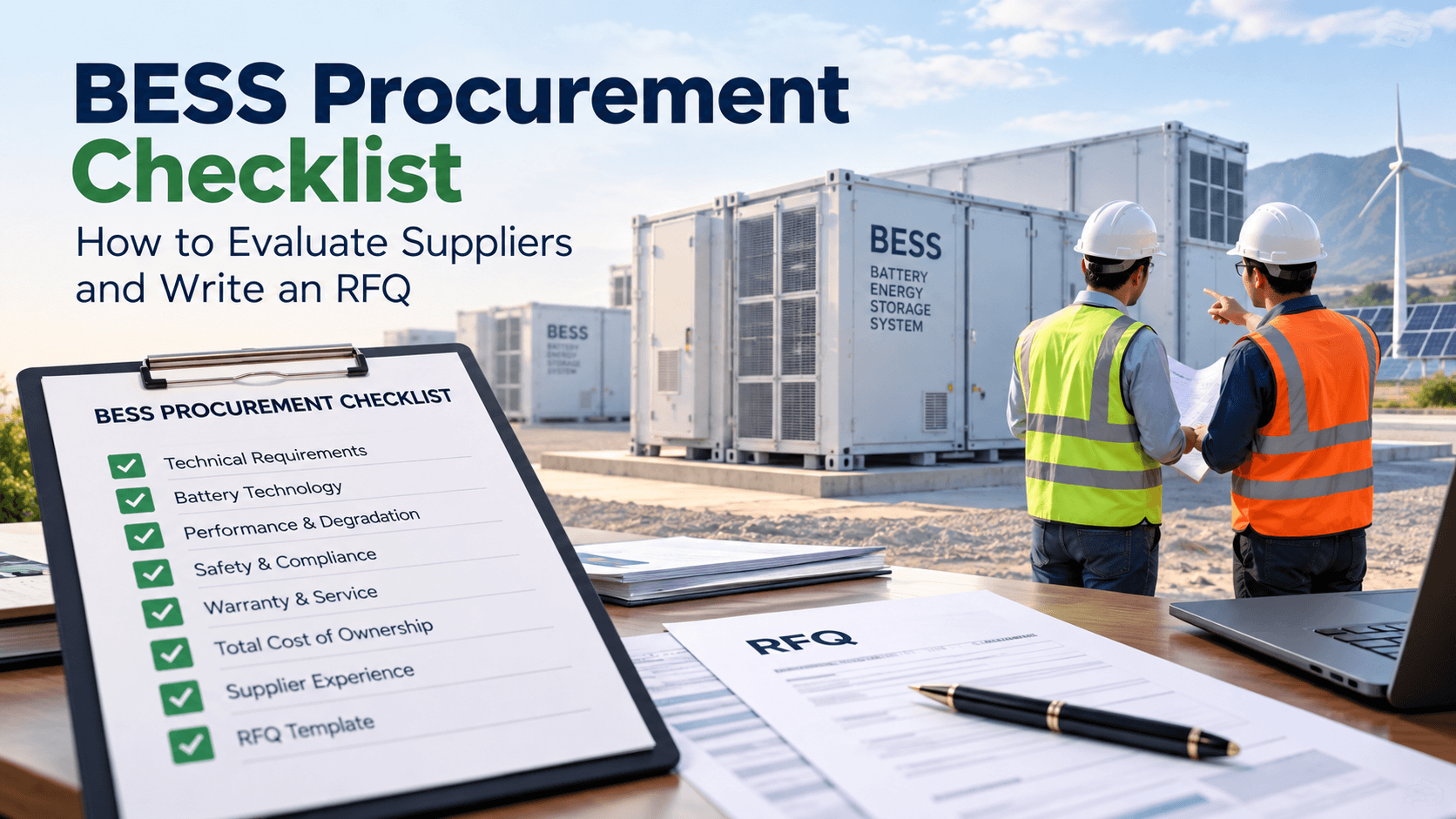
A battery energy storage system enclosure is a protective housing that contains battery modules or racks and their supporting equipment. Depending on the system architecture, it may also accommodate battery management systems (BMS), power conversion equipment, electrical distribution components, cooling units, and fire detection or suppression systems.
The terms BESS enclosure and BESS container are often used interchangeably, but they can describe different formats.
BESS Enclosures
BESS enclosures are commonly fabricated from sheet metal and formed into cabinets or modular housings. They are suitable for distributed energy storage, commercial facilities, industrial applications, and installations where individual equipment cabinets are preferred.
Typical features include:
- Fabricated steel or aluminum panels
- Access doors and removable service panels
- Internal mounting rails and equipment supports
- Cable entry points and electrical cutouts
- Weather-resistant seals and protective coatings
- Provisions for cooling, ventilation, and monitoring equipment
BESS Containers
BESS containers are larger, integrated structures designed to accommodate substantial battery capacity and associated electrical equipment. Many utility-scale systems use containerized designs to simplify transportation, installation, and site integration.
These structures typically require more extensive engineering than standard equipment cabinets. Their design must account for lifting, transportation loads, structural support, weather exposure, equipment weight, and coordinated installation of electrical and thermal management systems.
The choice between a cabinet-based enclosure and a containerized system depends on capacity, site conditions, transport requirements, service access, and the overall system architecture.
The Role of Sheet Metal Fabrication in BESS Enclosure Manufacturing
Sheet metal fabrication provides the structural and protective components used in many BESS enclosures. Manufacturing quality directly affects panel alignment, equipment fit, sealing performance, corrosion resistance, and assembly efficiency.
A well-planned fabrication process also helps manufacturers maintain consistency across production batches and accommodate custom requirements.
Material Selection
The choice of material depends on the operating environment, structural requirements, weight limits, cost, and expected service life.
Carbon steel is widely used because it offers good strength, fabrication flexibility, and cost efficiency. It is suitable for many indoor and outdoor enclosures when the surface preparation and coating system match the exposure conditions.
Stainless steel can be appropriate for corrosive environments, including locations exposed to salt spray or aggressive cleaning chemicals. Its suitability depends on the grade, surface finish, exposure, and contact with other materials.
Aluminum offers lower weight and good natural corrosion resistance in many environments. It may be useful where transport weight or handling requirements are important, although alloy selection and structural design require careful evaluation.
Material thickness should be selected based on panel dimensions, unsupported spans, mounting loads, door sizes, impact requirements, and applicable structural criteria. Using thicker material everywhere is not necessarily the most efficient solution. Formed edges, reinforcement ribs, and strategically positioned supports can improve stiffness without adding unnecessary weight.
Cutting and Punching
Laser cutting, CNC punching, and other suitable cutting processes create the panel profiles, ventilation openings, cable entries, and mounting features required by the enclosure design.
Accuracy matters because dimensional errors can affect door alignment, gasket compression, component mounting, and assembly time.
Fabrication drawings should clearly define hole positions, bend references, tolerances, and any features that must remain free of burrs or sharp edges.
Bending and Forming
Press brake bending and other forming operations create the enclosure’s doors, side panels, covers, mounting channels, and reinforcement features.
Designers should account for bend radii, material thickness, tooling limitations, springback, and the effect of bends on finished dimensions.
Well-designed formed features can improve panel stiffness and reduce the need for additional reinforcement. Consistent bend geometry also makes repeat production easier and improves assembly fit.
Welding and Assembly
Welding may be required for structural frames, support brackets, container components, and reinforced joints. Riveting, bolting, clinching, and other mechanical fastening methods can be appropriate for panels and removable components.
The joining method should match the structural load, material, accessibility, production volume, and corrosion protection requirements.
Welded areas may require grinding, cleaning, inspection, and restoration of the protective coating. For weather-resistant enclosures, joints and seams should be designed to prevent water ingress without compromising drainage or serviceability.
Surface Treatment and Finishing
Surface finishing protects the enclosure against corrosion and environmental wear while supporting the required appearance and service life.
Common options include powder coating, wet paint systems, galvanizing, and suitable conversion coatings or pretreatments.
The finish should be selected according to the expected exposure, including humidity, UV radiation, industrial pollutants, salt spray, and temperature variation. Coating thickness, surface preparation, adhesion, and repair procedures should be defined in the manufacturing specification.
Key Design Considerations for BESS Enclosures
BESS enclosure design requires coordination between mechanical engineering, electrical integration, thermal management, fire safety, and installation planning.
A design that performs well in one area may create problems elsewhere. For example, additional ventilation openings can affect weather protection, while closely packed equipment can restrict airflow and make maintenance more difficult.
Structural Strength and Load Distribution
The enclosure must support the combined weight of battery modules, racks, electrical equipment, cooling systems, and other installed components.
Designers should consider static loads, dynamic loads, equipment mounting points, door loads, vibration, lifting conditions, and transportation forces where applicable.
Large containerized systems may require engineered frames, corner fittings, lifting points, and defined support locations. These features must be designed and verified for the intended handling method rather than assumed suitable based on the appearance of a standard shipping container.
Weather Protection and IP Rating
Outdoor BESS installations must protect sensitive electrical and electronic equipment from rain, dust, moisture, and other environmental conditions.
Ingress protection ratings under IEC 60529 classify protection against access to hazardous parts, solid foreign objects, and water. The appropriate rating depends on the equipment, installation location, and exposure.
Achieving a specified IP rating requires more than selecting a gasket. Door compression, cable glands, panel joints, ventilation interfaces, drainage, and manufacturing tolerances all influence the finished enclosure’s performance.
Designers should also consider condensation. A sealed enclosure can still experience moisture accumulation when internal temperatures fluctuate. Suitable condensation control may involve insulation, controlled ventilation, heating, dehumidification, or other measures based on the operating environment.
Thermal Management and Ventilation
Battery performance and service life depend partly on operating temperature. Excessive heat can accelerate degradation, reduce available power, and increase safety risks.
BESS designs may use liquid cooling, forced-air cooling, or other thermal management approaches. The enclosure must provide sufficient space and suitable interfaces for the selected system.
Important design factors include:
- Cooling equipment capacity and airflow requirements
- Heat loads from batteries and electrical components
- Air inlet and outlet locations
- Separation between hot and cold air paths
- Filter access and maintenance clearance
- Condensation management
- Monitoring and control equipment access
Ventilation should not be treated as a substitute for a properly engineered thermal management system. Where combustible gases may be released during a battery fault, ventilation and gas management must also be evaluated as part of the overall fire and explosion risk assessment.
Fire Safety and Hazard Management
Lithium-ion battery systems can experience thermal runaway, a condition in which a cell undergoes an uncontrolled increase in temperature that may spread to neighboring cells or modules.
Enclosure design should support the safety strategy developed for the complete BESS. Depending on the battery chemistry, system configuration, installation environment, and local requirements, this may involve fire detection, gas detection, ventilation, suppression, thermal barriers, pressure relief, or other protective measures.
These features cannot be selected independently of one another. For example, the operation of a suppression system may interact with ventilation controls, while pressure-relief provisions must be appropriate for the credible hazards and enclosure configuration.
Design teams should establish clear responsibilities among the enclosure manufacturer, battery supplier, system integrator, fire protection engineer, and project owner. Testing and certification of the complete system may be necessary, particularly for large-scale installations.
Service Access and Maintainability
BESS enclosures need to accommodate installation, inspection, repairs, and component replacement throughout the equipment’s service life.
Access doors should provide sufficient clearance for technicians and the intended maintenance tasks. Cable routing should avoid obstructing removable components, while lifting provisions should support the replacement of heavy equipment where required.
Maintenance planning should address electrical isolation, safe access, emergency shutdown, lockout procedures, and any special requirements for working around energized equipment.
Accessible filters, cooling components, monitoring devices, and electrical connections can reduce maintenance time and help prevent avoidable service interruptions.
Important Standards for BESS Enclosures and Containers
BESS projects may be subject to several standards and codes covering battery safety, electrical installation, enclosure protection, fire testing, and structural performance.
The applicable requirements depend on the project location, battery chemistry, system size, installation type, and approval authority. No single standard covers every aspect of a BESS enclosure.
IEC 60529: Degrees of Protection Provided by Enclosures
IEC 60529 defines IP ratings used to classify enclosure protection against access to hazardous parts, solid objects, and water.
For BESS manufacturers, the rating helps establish enclosure requirements for outdoor exposure, dust protection, and water resistance. The specified rating should be supported by the appropriate test evidence for the finished configuration.
IEC 62619: Safety Requirements for Industrial Lithium Batteries
IEC 62619 addresses safety requirements and tests for secondary lithium cells and batteries used in industrial applications, including stationary energy storage applications.
It is relevant to battery-level safety, but it should not be treated as a complete enclosure design standard. Mechanical protection, thermal management, electrical integration, and installation-level hazards require additional evaluation.
IEC 62933 Series: Electrical Energy Storage Systems
The IEC 62933 series addresses different aspects of electrical energy storage systems, including system terminology, planning, performance, safety, and environmental considerations across relevant parts of the series.
Project teams should identify the specific parts applicable to their system rather than referring to the series as if every document applied to every installation.
UL 9540: Energy Storage Systems and Equipment
UL 9540 is a system-level standard addressing safety requirements for energy storage systems and equipment. Its relevance depends on the product configuration, certification pathway, and market.
An enclosure that houses certified components does not automatically make the assembled energy storage system compliant. The complete system configuration and its integration must be evaluated as required by the applicable certification process.
UL 9540A: Test Method for Evaluating Thermal Runaway Fire Propagation
UL 9540A is a test method used to evaluate fire propagation associated with thermal runaway in battery energy storage systems. Test results can inform fire protection engineering, separation distances, and installation decisions.
It is important to distinguish between completing a UL 9540A test and obtaining certification to a product safety standard. The test method provides evidence for evaluating hazards, but it is not itself a general product certification.
NFPA 855: Installation of Stationary Energy Storage Systems
NFPA 855 addresses the installation of stationary energy storage systems. Depending on the adopted edition and local requirements, it can influence siting, separation distances, fire protection, and other installation considerations.
These requirements may affect enclosure layout, access, ventilation, and the integration of fire safety systems. The applicable edition and any local amendments should be confirmed with the authority having jurisdiction.
Local Electrical, Fire, and Building Requirements
Projects must also meet relevant local codes, electrical regulations, building requirements, and fire authority approvals.
In India, project teams should verify the applicable Central Electricity Authority requirements, relevant BIS standards, electrical installation rules, fire requirements, and project-specific approval conditions. The precise requirements depend on the installation and the regulations in force.
Standards and certification requirements change over time. Manufacturers should verify the current edition, scope, and acceptance criteria before finalizing engineering drawings or making compliance claims.
Design for Manufacturing and Assembly
Design for manufacturing and assembly (DFMA) helps reduce fabrication complexity, improve consistency, and control production costs.
For BESS enclosure manufacturers, the goal is to meet safety and performance requirements without creating unnecessary parts, difficult assembly steps, or avoidable rework.
Standardize Components Where Possible
Using common panel sizes, fastening methods, hinges, locks, and mounting features can simplify procurement and production planning.
Standardization is particularly valuable when manufacturing multiple enclosure sizes or producing systems for several projects. However, shared components should not override requirements for different environmental conditions, loads, or certification configurations.
Minimize Unnecessary Fabrication Complexity
Complex bends, excessive welds, numerous small brackets, and difficult-to-access fasteners can increase labor time and introduce quality risks.
Designers should evaluate whether a feature serves a clear structural, protective, or functional purpose. Formed stiffeners, integrated mounting features, and repeatable fastening arrangements may simplify the finished design.
Plan Cable Entries and Equipment Interfaces Early
Cable glands, conduits, busbars, cooling connections, and communication interfaces should be coordinated before fabrication begins.
Late changes can require new cutouts, additional brackets, coating repairs, or panel replacements. A controlled interface drawing helps the enclosure manufacturer and equipment suppliers agree on dimensions and installation requirements.
Establish Inspection and Quality Controls
A documented quality plan should cover the manufacturing steps that affect fit, protection, and structural integrity.
Typical checks include:
- Incoming material verification
- Dimensional inspection after cutting and bending
- Weld and joint inspection where required
- Door alignment and gasket compression checks
- Coating thickness and finish inspection
- Cable-entry and sealing verification
- Functional checks of doors, locks, and removable panels
- Testing of the finished enclosure where specified
The inspection plan should be based on the design requirements, production risks, and applicable customer or certification criteria.
Common Challenges in BESS Enclosure Manufacturing
Even a well-developed design can encounter problems during fabrication or installation.
Water Ingress and Condensation
Poorly designed seams, cable entries, and door seals can allow water to enter the enclosure. Condensation may also develop when humid air comes into contact with cooler internal surfaces.
These issues are best addressed through coordinated enclosure geometry, sealing details, drainage, environmental control, and appropriate testing.
Thermal Hotspots
Restricted airflow, poorly positioned cooling equipment, and dense component layouts can produce uneven temperatures.
Thermal analysis and system-level validation help identify these risks before installation. The enclosure should accommodate the actual cooling arrangement and equipment clearances specified by the system designer.
Corrosion and Coating Failure
Inadequate surface preparation, incompatible materials, damaged coatings, and unsuitable fasteners can lead to premature corrosion.
Material selection and coating specifications should reflect the expected environment. Fabrication and assembly procedures should also include controls for damaged surfaces and dissimilar-metal contact where relevant.
Tolerance and Assembly Problems
Inconsistent bending, inaccurate hole positions, and frame distortion can make it difficult to install doors, gaskets, and internal equipment.
Clear datum references, realistic tolerances, suitable fabrication methods, and in-process inspection reduce the likelihood of these problems.
Late Design Changes
Changes to battery dimensions, cooling systems, cable routing, or certification requirements can force costly redesigns.
A formal design review before production release helps confirm interfaces, mounting points, environmental requirements, and responsibility for safety-related features.
Choosing a BESS Enclosure Fabrication Partner
Selecting a fabrication partner involves more than comparing material prices or sheet metal processing capabilities. The supplier must understand the functional and environmental requirements of energy storage equipment.
Evaluate potential partners based on the following factors:
Engineering support: Can the supplier review drawings, identify manufacturability issues, and recommend practical design improvements?
Fabrication capabilities: Does the facility support the required cutting, punching, bending, welding, fastening, and surface finishing processes?
Quality management: Are inspection procedures, material traceability, dimensional controls, and nonconformance processes documented?
Environmental protection: Can the supplier manufacture and validate the required sealing, corrosion protection, and enclosure configuration?
Production scalability: Can the supplier maintain consistent quality across prototypes, pilot batches, and larger production runs?
Project coordination: Can the supplier work with battery manufacturers, electrical integrators, cooling equipment providers, and certification teams?
Documentation: Can the supplier provide drawings, material records, inspection reports, and other agreed manufacturing documentation?
For complex BESS projects, involving the enclosure manufacturer early in the engineering process can reveal cost and assembly improvements before the design becomes difficult to change.
Future Trends in BESS Enclosure Design
As energy storage deployments expand, enclosure design is evolving to support higher system capacities, modular installation, and more demanding operating environments.
Modular and Scalable Architectures
Modular designs allow manufacturers to reuse enclosure platforms and simplify capacity expansion. Standard interfaces can reduce installation complexity, provided that electrical, thermal, structural, and safety requirements remain satisfied.
Improved Thermal Integration
More advanced cooling approaches and better integration between battery controls and thermal management systems are influencing enclosure layouts.
Designers increasingly need to coordinate the mechanical enclosure with cooling performance, sensor placement, maintenance access, and system controls.
Digital Manufacturing and Traceability
Digital fabrication workflows, CNC automation, and structured production data can improve repeatability and reduce errors between design and manufacturing.
Traceable material records, revision-controlled drawings, and digital inspection records also help support quality investigations and product lifecycle management.
Greater Focus on Lifecycle Performance
Enclosure decisions increasingly account for more than initial manufacturing cost. Corrosion resistance, component accessibility, repairability, and the ability to replace equipment can influence total ownership cost.
A design that is easier to inspect and maintain may offer practical value over the operating life of the storage system.
Conclusion
BESS enclosures and containers are essential components of battery energy storage infrastructure. Their design must balance structural strength, weather protection, thermal management, fire safety, maintainability, and manufacturing efficiency.
Sheet metal fabrication provides the foundation for many enclosure designs, but successful production depends on more than cutting and forming metal. Material selection, tolerances, joining methods, surface treatment, and equipment integration all affect the final product.
Standards such as IEC 60529, IEC 62619, IEC 62933, UL 9540, UL 9540A, and NFPA 855 address different parts of the safety and compliance process. Manufacturers and project developers should identify the requirements that apply to the complete system and verify them against current editions and local regulations.
By integrating engineering, fabrication, quality control, and safety planning from the beginning, BESS manufacturers can develop enclosures that are practical to produce, easier to maintain, and better suited to their intended operating environments.
Frequently Asked Questions
What materials are commonly used for BESS enclosures?
Carbon steel, stainless steel, and aluminum are common options. The choice depends on structural loads, corrosion exposure, weight requirements, fabrication methods, and cost.
What IP rating is suitable for an outdoor BESS enclosure?
There is no single IP rating suitable for every outdoor BESS installation. The required rating depends on exposure, the equipment housed inside, cooling arrangements, and project specifications. The selected enclosure should be verified against the required rating through appropriate testing.
Which standards apply to BESS enclosures?
Relevant standards may include IEC 60529 for enclosure ingress protection, IEC 62619 for industrial lithium battery safety, the applicable IEC 62933 documents for energy storage systems, UL 9540 and UL 9540A for relevant system safety and thermal runaway evaluation, and NFPA 855 for stationary energy storage installations. Local codes and project-specific requirements also apply.
Why is thermal management important in BESS design?
Thermal management helps keep batteries and electrical components within their intended operating conditions. Effective cooling can support performance and service life, while properly engineered hazard controls address risks associated with abnormal battery heating.
What is the difference between a BESS enclosure and a BESS container?
A BESS enclosure commonly refers to a cabinet or housing for battery and electrical equipment. A BESS container generally refers to a larger integrated structure designed to accommodate battery racks and associated systems. The terminology varies by manufacturer and project.
How can sheet metal fabrication costs be reduced?
Manufacturers can reduce costs by standardizing components, simplifying bends and welds, optimizing material usage, coordinating equipment interfaces early, and using repeatable inspection and assembly processes. Cost reductions should not compromise structural performance, environmental protection, or required safety features.
What should manufacturers check before releasing a BESS enclosure for production?
They should confirm material specifications, structural requirements, dimensional tolerances, sealing details, cooling interfaces, cable entries, safety-related features, surface treatments, inspection criteria, and applicable compliance requirements. Changes affecting certified configurations should be reviewed through the appropriate engineering and approval process.