
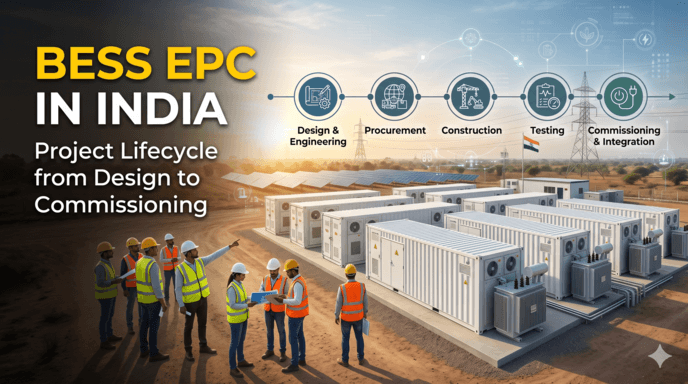
BESS EPC in India: Project Lifecycle from Design to Commissioning
A Battery Energy Storage System (BESS) Engineering, Procurement and Construction (EPC) project involves designing, supplying, installing, integrating and commissioning a battery storage system so it can safely store and discharge electricity when required.
In India, BESS EPC is becoming increasingly important for utility-scale renewable energy projects, commercial and industrial facilities, and grid operators seeking to manage peak demand, integrate solar and wind power, and improve grid reliability.
The project lifecycle goes beyond installing battery containers. It includes feasibility studies, engineering design, equipment procurement, civil and electrical works, system integration, safety testing, grid connectivity and final performance acceptance.
1. What does a BESS EPC contractor do?
A BESS EPC contractor acts as the primary party responsible for delivering a functioning energy storage facility within the agreed project scope, budget and timeline.
- Engineering: Designs the battery capacity, power rating, electrical infrastructure, protection systems, controls and site layout.
- Procurement: Sources battery systems, power conversion systems (PCS), transformers, switchgear, cooling equipment, fire protection and control systems.
- Construction: Executes civil works, equipment foundations, cable trenches, equipment installation and electrical connections.
- Integration: Connects the battery management system (BMS), energy management system (EMS), PCS and plant-level controls.
- Testing and commissioning: Verifies safety, grid compliance, operational performance and contractual guarantees.
- Handover: Provides documentation, operator training, warranties and maintenance requirements.
EPC versus a battery supplier: A battery supplier may provide only battery cells, modules, racks or containers. An EPC contractor coordinates the wider project and, depending on the contract, takes responsibility for the complete installation and its performance.
2. The complete BESS EPC project lifecycle
01. Project development and feasibility
Define the use case, economics, site and grid requirements.
02. Conceptual design and DPR
Determine MW, MWh, storage duration and system configuration.
03. Detailed engineering
Complete electrical, civil, mechanical, control and safety designs.
04. Procurement and manufacturing
Select vendors, approve drawings and manufacture equipment.
05. Site preparation and construction
Execute foundations, roads, trenches and electrical infrastructure.
06. Equipment installation and integration
Install battery systems, PCS, transformers, EMS and SCADA.
07. Testing and commissioning
Verify safety, controls, grid compliance and system performance.
08. Handover and operations
Complete acceptance, training, documentation and O&M planning.
Stage 1: Project development and feasibility
The first step is understanding why the customer needs energy storage and how the system will be used.
Typical applications include:
- Renewable energy shifting: storing excess solar or wind power and discharging it later.
- Peak shaving: reducing electricity demand during expensive or high-demand periods.
- Time shifting: charging when electricity is cheaper and discharging when it is more valuable.
- Grid support: providing frequency response, voltage support and other services where permitted.
- Backup power: maintaining selected loads during outages, subject to system design and operating requirements.
The developer and EPC team assess:
- Expected charging and discharging schedule.
- Required power capacity in MW and energy capacity in MWh.
- Site availability, land conditions and access.
- Grid connectivity and evacuation capacity.
- Expected revenue, operating expenses and project economics.
- Battery degradation, augmentation and warranty requirements.
Deliverable: Feasibility report, preliminary financial model, site assessment and initial project scope.
Stage 2: Conceptual design and Detailed Project Report (DPR)
Once the use case is clear, engineers determine the system’s capacity and configuration.
This means the system can nominally deliver 100 MW for two hours, assuming the stated energy is usable and operating conditions permit it.
The design team establishes:
- Battery chemistry, commonly lithium iron phosphate (LFP) for stationary storage.
- Required usable energy and installed battery capacity.
- PCS rating and AC/DC system architecture.
- Number and arrangement of battery containers.
- Transformer capacity, voltage levels and switchgear configuration.
- Auxiliary power requirements, HVAC and fire protection.
- Expected round-trip efficiency, degradation and availability.
- Preliminary single-line diagram (SLD) and site layout.
The DPR should also identify the proposed execution model, project cost, schedule, major risks and approvals.
Deliverable: DPR, preliminary SLD, equipment specifications, cost estimate and project execution strategy.
Stage 3: Detailed engineering
This stage converts the preliminary concept into construction-ready designs and approved equipment specifications.
Electrical engineering
Civil and structural engineering
Mechanical and fire safety engineering
- Cooling and ventilation design.
- Fire detection, alarms and suppression.
- Emergency access and isolation arrangements.
- Thermal runaway risk assessment and emergency response planning.
Controls and communication engineering
- BMS, PCS and EMS interface definitions.
- SCADA, plant controller and communication architecture.
- Dispatch logic, alarms, interlocks and remote monitoring.
- Grid response and cybersecurity requirements.
Deliverable: Approved-for-construction drawings, design calculations, equipment datasheets, interface documents and inspection and test plans.
Stage 4: Procurement and manufacturing
The EPC team purchases the main equipment and coordinates delivery to the project site.
| Equipment | Main function |
|---|---|
| Battery containers or enclosures | House battery racks and supporting systems |
| Battery management system (BMS) | Monitors battery condition and enforces operating limits |
| Power conversion system (PCS) | Converts DC battery power to AC and vice versa |
| Energy management system (EMS) | Controls charging, discharging and dispatch |
| Transformers | Match voltage levels between the PCS and grid |
| Switchgear and protection | Isolate faults and protect electrical equipment |
| HVAC or liquid cooling | Maintain suitable battery operating temperatures |
| Fire detection and suppression | Detect and respond to fire-related hazards |
| SCADA and communications | Enable supervision, alarms and plant-level coordination |
Key procurement activities include:
- Technical and commercial bid evaluation.
- Vendor qualification and warranty review.
- Design drawing and interface approval.
- Factory acceptance testing (FAT), where specified.
- Inspection, packaging, transport and delivery coordination.
- Verification of spare parts, documentation and service support.
The EPC contractor must confirm that equipment from different vendors works together as one system. A battery that performs correctly on its own does not guarantee that the complete BESS will meet its AC power, energy or grid-performance commitments.
Deliverable: Purchase orders, approved vendor drawings, FAT reports, shipping documents and equipment delivery records.
Stage 5: Site preparation and construction
Civil and electrical construction begins after the required engineering approvals, site readiness and work permits are in place.
Major activities include:
- Site levelling, grading, drainage and access road construction.
- Construction of battery and PCS foundations.
- Installation of cable trenches, conduits and earthing grids.
- Construction of transformer plinths, switchyard and control rooms.
- Installation of power and communication cables.
- Preparation of fire access routes, fencing and emergency facilities.
- Coordination of equipment deliveries and safe material storage.
Construction teams should follow approved drawings, inspection plans, quality procedures and electrical safety requirements.
Deliverable: Civil completion records, inspection reports, earthing test results and site-readiness certificates.
Stage 6: Equipment installation and system integration
This stage connects the physical equipment into a coordinated operating system.
The installation team positions the battery enclosures, connects the PCS and transformers, completes electrical terminations, and integrates the BMS, EMS, SCADA and plant controller.
Integration checks include:
- Battery-to-PCS communication and control.
- EMS dispatch commands and charging/discharging logic.
- Protection relays, circuit breakers and emergency shutdowns.
- Transformer and switchgear interlocks.
- Fire alarms, cooling controls and fault notifications.
- Metering, telemetry and communication with the relevant grid operator.
- Cybersecurity controls and remote-access arrangements.
A clear interface responsibility matrix is essential when multiple vendors supply different parts of the system.
Deliverable: Installation completion certificates, cable test reports, communication test records and system-integration checklists.
Stage 7: Testing and commissioning
Commissioning verifies that the complete BESS is safe, operational and capable of meeting the project’s contractual and grid requirements.
1. Pre-commissioning checks
Inspect equipment, verify wiring and earthing, review protection settings, confirm battery status, and check safety systems before energisation.
2. First energisation
Energise the electrical system in the approved sequence after obtaining the applicable clearances and confirming that the grid connection is ready.
3. Functional testing
Verify charging, discharging, ramp rates, alarms, interlocks, emergency shutdowns, controls and communication with the grid operator.
4. Performance testing
Measure delivered power, usable energy, round-trip efficiency, auxiliary consumption and availability as defined in the contract and test protocol.
5. Acceptance and trial operation
Complete required grid compliance checks, trial runs, defect rectification and performance acceptance procedures.
In India, the applicable requirements should be checked against current Central Electricity Authority (CEA) regulations, grid connectivity rules, the relevant system operator’s procedures and the project tender. CEA published BESS-specific safety and construction amendments in 2026.
Deliverable: Commissioning reports, performance test results, required energisation clearances and contractual acceptance documentation.
Stage 8: Handover and operations
After successful testing, the EPC contractor hands over the facility in accordance with the contract.
The handover package typically includes:
- As-built engineering drawings and final SLDs.
- Equipment manuals, warranties and vendor documentation.
- Commissioning and performance test reports.
- Operator training and emergency response procedures.
- Spare parts inventory and maintenance schedules.
- EMS/SCADA configuration records and access procedures.
- Battery degradation, augmentation and replacement plans.
- Defect liability, O&M and service support arrangements.
Long-term performance matters because batteries degrade over time. Contracts should clearly define usable energy, efficiency, availability, augmentation responsibilities and warranty exclusions.
3. Indian regulatory and approval considerations
Approvals vary by project size, voltage level, location, ownership and whether the BESS is standalone or co-located with renewable generation.
| Area | What the project team must check |
|---|---|
| Electrical safety | Applicable CEA safety regulations and inspection or energisation requirements |
| Construction standards | Applicable CEA technical standards for BESS and electrical infrastructure |
| Grid connectivity | Connectivity approvals, protection settings, metering and grid compliance |
| Transmission and evacuation | CTU/STU or other relevant network interface requirements |
| System operation | SLDC/RLDC coordination and telemetry, as applicable |
| Fire and site safety | Applicable fire requirements, emergency access and local approvals |
| Land and local permissions | Land-use, building and other location-specific permissions |
| Battery end-of-life | Applicable Battery Waste Management Rules and contractual disposal responsibilities |
The CEA’s official Energy Storage and System Division and safety regulations are useful starting points. The approval matrix should be verified against the latest notified rules and the specific project documents.
4. Key risks in a BESS EPC project
| Risk | Potential impact | Mitigation |
|---|---|---|
| Incorrect sizing | Insufficient usable energy or power | Model the duty cycle and usable-energy requirement carefully |
| Grid connectivity delays | Delayed commissioning and revenue | Begin grid studies and interface coordination early |
| Vendor interface gaps | Integration failures | Define single-point responsibility and interface protocols |
| Battery degradation | Reduced energy delivery over time | Establish degradation guarantees and an augmentation plan |
| Fire and thermal risks | Equipment damage and safety hazards | Engineer detection, protection, isolation and emergency response |
| Equipment delivery delays | Construction schedule slippage | Track long-lead items and qualify alternate suppliers where feasible |
| Performance shortfalls | Failed acceptance tests or financial penalties | Define measurable guarantees and agreed test procedures |
| Unclear contract scope | Claims, disputes and cost overruns | Specify exclusions, responsibilities and acceptance criteria |
Frequently asked questions
How long does a BESS EPC project take in India?
There is no single standard duration. The timeline depends on project scale, site readiness, equipment lead times, grid connectivity and approvals. Civil works, procurement and engineering can overlap, while commissioning depends on completion of critical interfaces and required clearances.
What is the difference between BESS EPC and BESS integration?
BESS integration focuses on making batteries, PCS, EMS, protection and other subsystems operate together. EPC generally includes integration plus the broader engineering, procurement and construction scope, although the exact responsibilities depend on the contract.
Who is responsible for commissioning?
Typically, the EPC contractor coordinates commissioning under the agreed scope, with equipment vendors, the owner, inspectors and grid operators participating as required. The contract and applicable regulations determine who must perform or approve each test.
What is the most important EPC contract provision?
A clearly defined performance and acceptance framework. It should specify the AC power and usable energy guaranteed at the contractual measurement point, efficiency, availability, degradation assumptions, testing methodology, warranties and remedies for underperformance.
Conclusion
A successful BESS EPC project requires coordinated engineering, procurement, construction, integration and commissioning. In India, developers must also account for applicable CEA requirements, grid connectivity, site-specific approvals and long-term battery performance.
The key is to treat BESS as an integrated power plant rather than simply a collection of battery containers. Strong interface management, clearly defined performance guarantees and early regulatory coordination can reduce execution risks and improve the likelihood of a successful handover.