
Solar Panel Battery: Types, Sizing and Cost
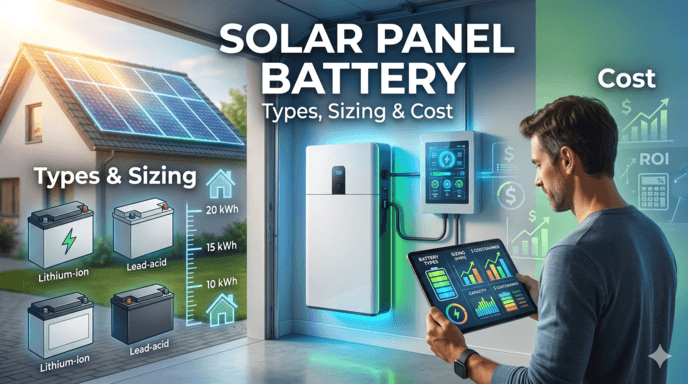
Choosing the right solar panel battery can help you store excess solar energy, reduce reliance on the electricity grid, and keep essential appliances running during power cuts. The best battery depends on your daily electricity use, the appliances you need to power, your solar system size, and your budget.
This guide covers the main types of solar batteries, how to calculate the capacity you need, the factors that affect cost, and how to choose a battery for your home or business.
What Is a Solar Panel Battery?
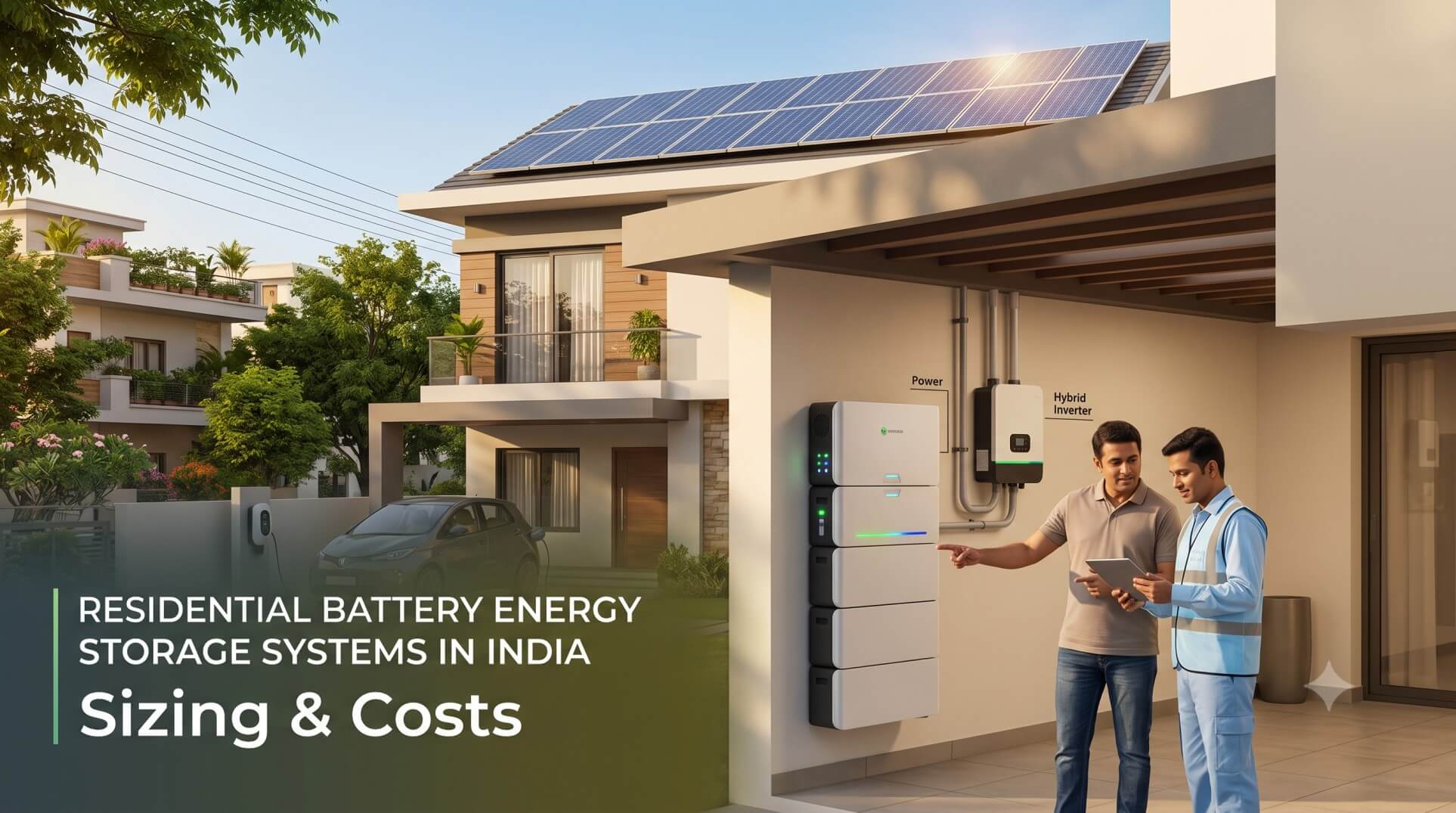
A solar panel battery stores electricity generated by solar panels so you can use it later. Instead of relying entirely on solar power while the sun is shining, you can save some of that energy for the evening, nighttime, or periods when the panels produce less electricity.
For example, a home may generate more solar power than it needs at midday. A battery can store some of that surplus energy for use after sunset, when lights, fans, televisions, refrigerators, and other appliances are still running.
A solar battery can help you:
- Use more of your own solar energy instead of exporting excess electricity to the grid.
- Keep essential appliances running during outages, if the system supports backup operation.
- Reduce grid electricity consumption when battery power replaces electricity you would otherwise purchase.
- Improve energy independence by reducing reliance on utility power.
However, a battery is not always necessary. If your primary goal is to lower electricity bills and your utility offers favorable net metering, a grid-connected solar system without storage may be more economical.
Types of Solar Panel Batteries
Solar batteries differ in their chemistry, storage capacity, lifespan, maintenance needs, and upfront price. The most common options for residential solar systems are lithium-ion and lead-acid batteries.
1. Lithium-Ion Solar Batteries
Lithium-ion batteries are a popular choice for modern home solar systems because they offer high usable capacity, good energy efficiency, and a long service life. Lithium iron phosphate (LiFePO4 or LFP) is a common chemistry used in stationary energy storage.
Advantages:
- High usable energy capacity.
- Long cycle life when operated within manufacturer specifications.
- Relatively low maintenance.
- Compact design compared with many lead-acid battery banks.
- Good efficiency when charging and discharging.
Limitations:
- Higher upfront cost.
- Requires compatible charging equipment and battery management.
- Performance and warranty depend on temperature, installation, and usage.
Best for: Homes and businesses that use battery storage regularly, experience frequent power cuts, or want to shift solar energy into the evening.
2. Lead-Acid Solar Batteries
Lead-acid batteries have been used for years in home inverters and backup power systems. Tall tubular models are common in India because they are widely available and have a lower purchase price than many lithium alternatives.
Advantages:
- Lower upfront investment.
- Broad availability through local dealers.
- Familiar technology with established service options.
Limitations:
- Lower usable capacity relative to rated capacity.
- Generally shorter cycle life than LFP batteries.
- Larger and heavier for comparable usable energy.
- Flooded models require ventilation and periodic maintenance.
Best for: Households with a limited initial budget and occasional backup needs.
3. AGM and Gel Batteries
AGM (absorbed glass mat) and gel batteries are types of sealed lead-acid batteries. They reduce some of the maintenance associated with flooded batteries, although their charging requirements differ.
AGM batteries can provide reliable backup for suitable loads, while gel batteries may suit applications requiring controlled deep-cycle operation. Neither should be assumed to outperform lithium on lifetime cost without comparing specific models.
Advantages:
- Sealed construction.
- Little routine maintenance.
- Suitable for some indoor backup installations when properly specified.
Limitations:
- Lower usable energy than many lithium batteries.
- Charging voltage must match the battery specifications.
- Typically shorter cycle life than LFP batteries under frequent cycling.
Best for: Smaller backup systems where sealed lead-acid technology meets the required operating conditions.
4. Flow and Sodium-Ion Batteries
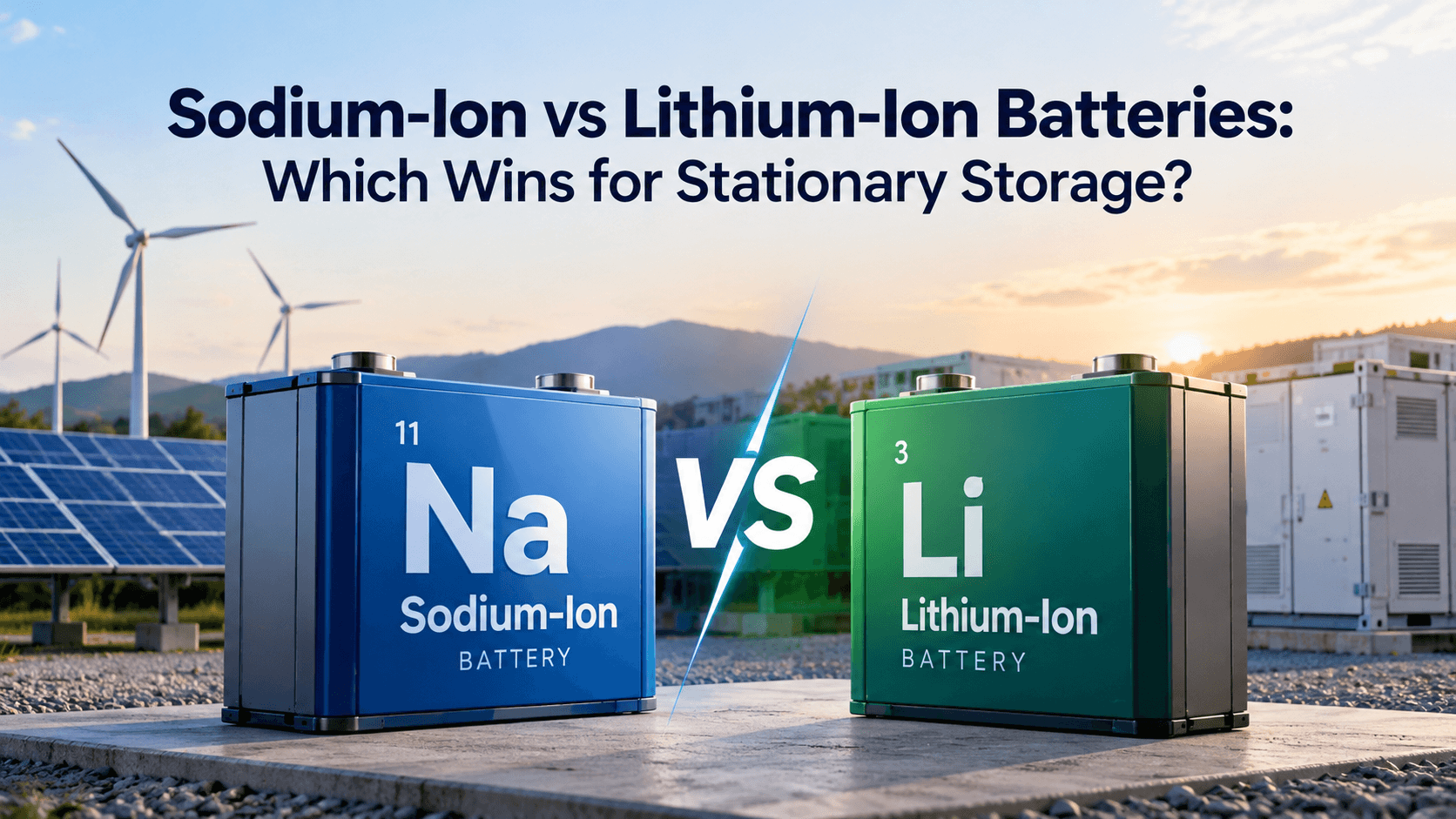
Flow batteries store energy in liquid electrolytes and can suit larger stationary storage installations. Sodium-ion batteries use sodium-based chemistry and are an emerging alternative for energy storage.
Both technologies may offer advantages for particular applications, but product availability, system cost, local support, and commercial maturity vary. They are not yet the default choice for most residential rooftop solar installations.
Best for: Selected commercial, industrial, or emerging storage applications rather than a typical home inverter replacement.
Solar Battery Types Compared
| Feature | Lithium-ion (LFP) | Lead-acid tubular | AGM or gel |
|---|---|---|---|
| Initial cost | High | Low to moderate | Moderate |
| Usable capacity | Usually high | Usually about 50% of rated capacity for conservative sizing | Model-dependent |
| Cycle life | Generally long | Generally shorter | Model-dependent |
| Maintenance | Usually minimal | Flooded types need maintenance | Usually minimal |
| Space required | Relatively compact | Larger and heavier | Model-dependent |
| Frequent daily cycling | Well suited | Less suited | Application-dependent |
Actual cycle life and usable capacity depend on the exact battery, discharge depth, temperature, charging conditions, and warranty terms. Compare manufacturer specifications rather than relying on chemistry alone.
How to Choose the Right Solar Battery Size
Battery sizing is one of the most important decisions when planning a solar energy system. A battery that is too small may run out of power before the night ends. An oversized battery can increase your project cost without providing much additional value.
The right capacity depends on three factors:
- The appliances you want to power.
- How long you need them to run.
- How much battery energy is available after accounting for discharge limits and system losses.
Step 1: Calculate Your Daily Backup Energy
List the appliances you want to run during a power cut and estimate their electricity consumption.
Repeat this calculation for each appliance, then add the results.
Here is an illustrative example for a household that wants to run essential appliances overnight.
| Appliance | Power | Daily backup use | Energy |
|---|---|---|---|
| LED lights | 40 W | 5 hours | 0.20 kWh |
| Two fans | 120 W | 8 hours | 0.96 kWh |
| Refrigerator | 100 W average | 8 hours | 0.80 kWh |
| Wi-Fi router | 12 W | 8 hours | 0.10 kWh |
| Television | 80 W | 3 hours | 0.24 kWh |
| Total | 2.30 kWh |
These figures are estimates. A refrigerator cycles on and off, and actual consumption depends on its size, condition, and ambient temperature.
Step 2: Account for Battery Discharge and Losses
The battery’s advertised capacity is not always the amount of energy your appliances can use.
For initial sizing, use:
\[ \text{Nominal capacity}= \frac{\text{Required energy}} {\text{Usable fraction}\times\text{Efficiency}} \]
Suppose you need 2.3 kWh, choose an LFP battery with 90% usable capacity, and allow 90% overall discharge-to-load efficiency.
\[ \frac{2.3}{0.90\times0.90} \approx2.84\text{ kWh} \]
A battery with approximately 3 kWh of nominal capacity is a reasonable starting point for this example. You may want additional capacity for unexpected loads, battery ageing, or longer outages.
For a lead-acid battery with a conservative 50% usable fraction, using the same efficiency assumption:
\[ \frac{2.3}{0.50\times0.90} \approx5.11\text{ kWh} \]
This illustrates why a lead-acid system may need considerably more rated capacity to provide the same amount of usable energy.
Step 3: Check the Inverter’s Power Rating
Battery capacity, measured in kilowatt-hours (kWh), tells you how much energy can be stored. Inverter power, measured in kilowatts (kW), tells you how much power the system can supply at once.
Both matter.
A 5 kWh battery might have enough energy to run appliances for several hours, but it may not support a large air conditioner if its inverter and battery discharge ratings are too low.
Before buying, check:
- Continuous inverter output.
- Peak or surge power for motors and compressors.
- Battery voltage and inverter compatibility.
- Maximum battery discharge current.
- Which circuits will receive backup power.
Air conditioners, pumps, and other motor-driven appliances can have high starting power requirements.
Step 4: Estimate the Battery Size You Need
Use these illustrative starting points for household backup. Actual requirements vary with appliance consumption and desired backup duration.
| Intended use | Approximate usable storage |
|---|---|
| Lights, router, and a few small devices | 1 to 2 kWh |
| Lights, fans, router, and TV | 2 to 3 kWh |
| Essential appliances with a refrigerator | 3 to 5 kWh |
| Longer overnight backup | 5 to 10 kWh |
| Larger loads or selected AC circuits | 6 kWh or more, depending on use |
These are not guaranteed backup durations. Calculate your own energy requirements before choosing a battery.
Solar Panel Battery Cost in 2026
Solar battery prices vary by brand, capacity, chemistry, warranty, installation requirements, and whether a compatible inverter is already available.
For buyers in India, the following figures provide a starting point for budgeting. They are indicative market estimates, not fixed quotations. Published 2026 price guides show a wide spread, particularly for lithium batteries and installed systems.
Estimated Solar Battery Prices in India
| Battery capacity | Lithium-ion (LFP) | Lead-acid battery system |
|---|---|---|
| 2 kWh | ₹50,000 to ₹1 lakh | ₹18,000 to ₹30,000 |
| 3 kWh | ₹75,000 to ₹1.5 lakh | ₹28,000 to ₹45,000 |
| 5 kWh | ₹1 lakh to ₹2.5 lakh | ₹45,000 to ₹70,000 |
| 10 kWh | ₹1.9 lakh to ₹4.8 lakh | ₹95,000 to ₹1.3 lakh |
Price guide: Indicative 2026 estimates for battery purchases and selected basic installation costs. These ranges combine different products and system configurations, so the figures are not directly comparable in every case. A new hybrid inverter, upgraded wiring, protection equipment, and complex installation can increase the total.
When comparing quotations, confirm whether each price includes GST, the battery management system, installation, cables, protection equipment, and any required inverter upgrades.
What Affects Solar Battery Cost?
1. Battery chemistry: LFP generally costs more upfront than lead-acid but can provide more usable energy and longer service life.
2. Storage capacity: Larger batteries typically cost more in total, although their cost per kWh can be lower.
3. Inverter compatibility: A system that needs a new hybrid inverter or substantial electrical upgrades will cost more than one using compatible existing equipment.
4. Brand and warranty: Established service networks and longer warranties may increase the purchase price. Review the actual warranty conditions, not just the advertised duration.
5. Installation and safety: Cabling, circuit protection, mounting, ventilation where required, and commissioning all affect the final quote.
6. Location and availability: Dealer pricing, delivery, and service coverage can vary across Indian cities.
Lithium vs Lead-Acid: Which Offers Better Value?
A lower purchase price does not always mean a lower cost over the battery’s lifetime.
For example, a lead-acid battery bank may require replacement sooner if it is cycled deeply every day. An LFP battery may have a higher initial cost but can deliver more usable energy over many more cycles.
Compare the following factors before deciding:
- Total purchase and installation cost.
- Usable kWh per charge.
- Expected cycles under your intended discharge depth.
- Warranty period and cycle-throughput limits.
- Replacement cost during the expected system life.
- Energy losses and maintenance requirements.
If your battery is used only during occasional outages, lead-acid may be financially reasonable. If it will charge and discharge almost every day, LFP is often worth considering for its longer cycle life and higher usable capacity.
How to Match Solar Panels With Battery Capacity
Your solar panels need to generate enough energy to power daytime loads and recharge the battery. A large battery does not help much if the panels cannot replenish it between outages.
Actual generation depends on weather, shade, panel orientation, temperature, and system losses. The estimate also does not mean all 10.1 kWh is available for battery charging, since daytime appliances may consume some of it.
When planning a solar-plus-battery system, size the panels, battery, and inverter together rather than treating them as separate purchases.
On-Grid, Off-Grid, or Hybrid: Do You Need a Battery?
Your system configuration determines how useful a battery will be.
On-Grid Solar System
An on-grid system works with the utility grid and typically exports excess solar electricity under the applicable billing arrangement. Most standard grid-tied inverters shut down during a grid outage for safety, so solar panels alone do not normally provide backup.
Choose this setup if: Your main goal is reducing electricity bills and grid supply is reliable.
Off-Grid Solar System
An off-grid system operates without a utility connection and relies on solar generation, batteries, and sometimes a backup generator.
Choose this setup if: Your property has no reliable grid access or needs independent power.
Hybrid Solar System
A hybrid system combines solar panels, grid connectivity, battery storage, and an inverter designed to manage these sources. It can provide backup during outages when correctly configured.
Choose this setup if: You want to lower electricity bills while keeping selected appliances powered during grid failures.
Battery economics also depend on local net-metering rules and electricity tariffs. If grid exports are credited favourably, a battery may be more valuable for backup than for bill savings.
Solar Battery Maintenance and Safety
Proper installation and routine checks can help extend battery life and reduce safety risks.
- Install the battery in a dry, suitable location with the ventilation and temperature conditions specified by the manufacturer.
- Use a compatible inverter and approved charging settings.
- Keep battery terminals and cables secure and protected.
- Follow manufacturer instructions for maintenance and inspection.
- Avoid exceeding recommended discharge limits.
- Use appropriate electrical protection and have the system installed by a qualified professional.
- Do not ignore swelling, unusual heat, chemical smells, or damaged wiring. Isolate the system only if safe to do so and contact a qualified technician.
For lithium batteries, check the battery management system, operating temperature range, and available service support. For flooded lead-acid batteries, follow the manufacturer’s instructions for electrolyte checks and ventilation.
Frequently Asked Questions
How many solar batteries do I need for a house?
It depends on your electricity use and the duration of backup required. A home that needs 2.5 kWh of usable energy may need roughly 3 kWh of LFP storage under suitable operating conditions. Larger homes or longer backup periods require more capacity.
Can a solar battery run an air conditioner?
Yes, if the battery, inverter, and electrical system are rated for the air conditioner’s running and starting loads. The battery also needs enough energy for the desired runtime. Air conditioning can increase storage requirements significantly.
How long does a solar panel battery last?
Battery life varies by chemistry, model, temperature, charging habits, and discharge depth. LFP batteries generally offer longer cycle life than lead-acid batteries. Check the manufacturer’s warranty and cycle-life conditions for a realistic estimate.
Is a lithium solar battery better than a lead-acid battery?
Lithium, especially LFP, is often a better fit for frequent cycling because it offers more usable energy and generally lasts longer. Lead-acid remains an option when upfront cost is the main concern and backup use is limited.
Can I add a battery to my existing solar panel system?
Often, yes. However, the existing inverter must support battery storage, or you may need a compatible hybrid inverter or an AC-coupled storage solution. Have an installer check the electrical configuration before purchasing a battery.
Does a solar battery eliminate electricity bills?
No. A battery can reduce grid consumption, but it does not guarantee a zero bill. Fixed charges, taxes, nighttime consumption, seasonal generation changes, and the local electricity tariff can all affect your bill.
Is a solar battery worth buying in India in 2026?
It can be worth buying if you experience frequent outages, need reliable backup, or have a strong reason to store daytime solar generation. If grid power is reliable and net metering is favourable, a battery-free on-grid system may offer better financial returns.
Final Thoughts
Choosing the right solar panel battery comes down to matching usable storage with your real electricity needs. Start by listing the appliances you need during an outage, estimating their energy consumption, and deciding how many hours of backup you want.
For frequent daily use, an LFP battery is often a strong long-term option. For occasional backup on a tight budget, a lead-acid battery may be sufficient. In either case, compare the full installed cost, inverter compatibility, warranty, and expected lifetime before making a decision.
The best solar battery is not necessarily the biggest or the cheapest. It is the one that delivers the right amount of reliable energy for your home at a cost you can justify.