
Sodium-Ion Batteries: Cost, Cycle Life & Grid Storage
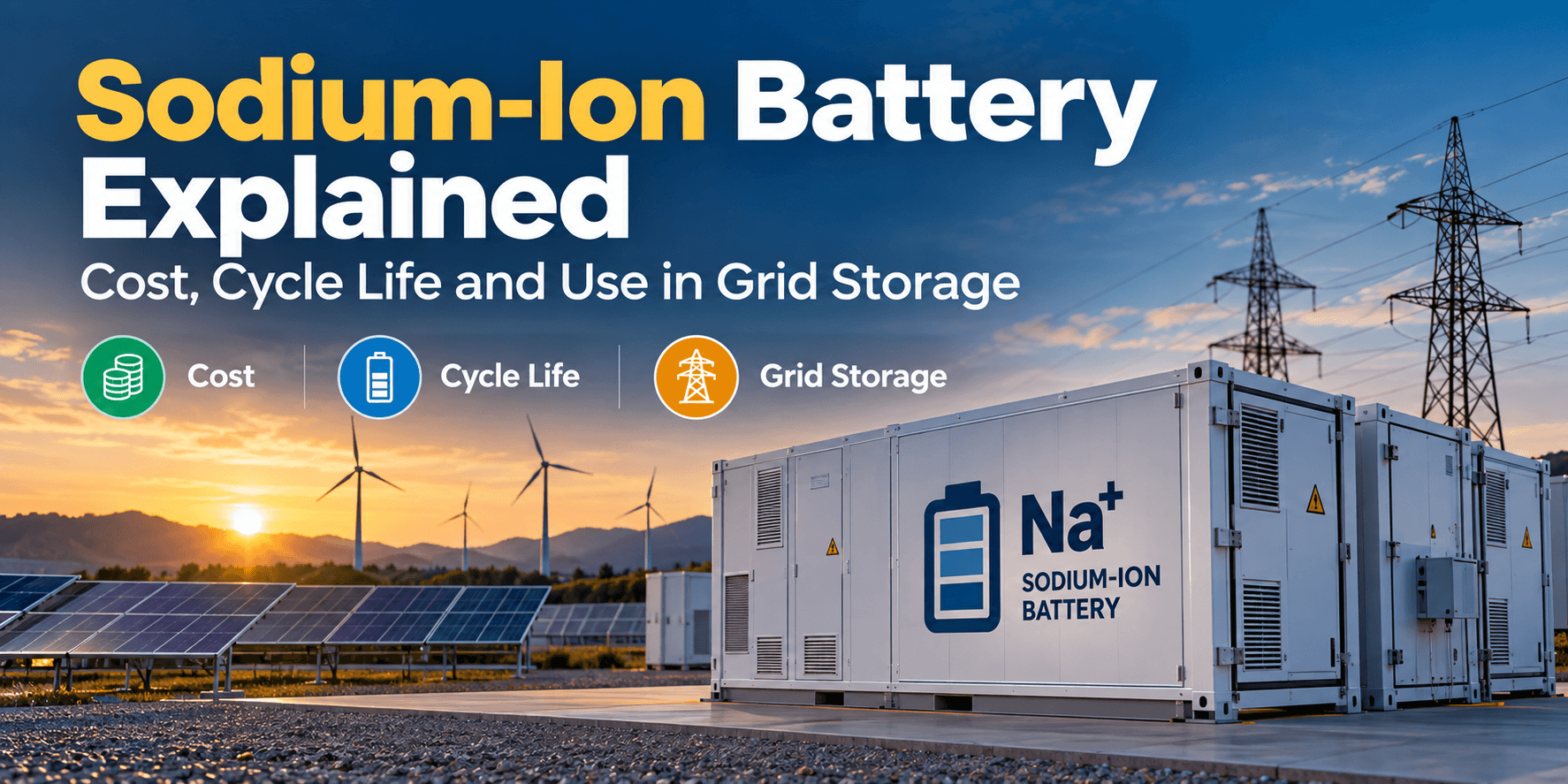
Sodium-ion batteries are rechargeable batteries that use sodium ions instead of lithium ions to store and release energy. The technology works on a principle similar to lithium-ion batteries, but it relies on sodium, a more abundant and widely available element.
That difference could matter for energy storage at scale. Grid operators need batteries that can store electricity reliably for hours, handle frequent charging and discharging, and remain cost-effective as storage capacity grows.
Sodium-ion batteries are not expected to replace lithium-ion batteries everywhere. Instead, they are emerging as a complementary technology, particularly for stationary storage where energy density is often less important than cost, safety, operating range, and supply-chain resilience.
How Sodium-Ion Batteries Work
A sodium-ion battery has several core components:
- Cathode: Stores and releases sodium ions during charging and discharging.
- Anode: Receives sodium ions during charging and releases them during discharge.
- Electrolyte: Allows sodium ions to move between the electrodes.
- Separator: Keeps the electrodes apart while allowing ions to pass through.
- Current collectors: Carry electrical current to and from the battery.
During charging, sodium ions move from the cathode through the electrolyte and into the anode. When the battery supplies electricity, the ions move back toward the cathode.
The basic operating principle is therefore familiar to anyone who understands lithium-ion batteries. The major difference is the chemistry used to move and store the ions.
Why Use Sodium Instead of Lithium?
The strongest argument for sodium-ion technology is the availability of its underlying materials.
Sodium is abundant and widely distributed. Lithium, by comparison, has become strategically important because it is used in electric vehicles, consumer electronics, and energy storage systems.
Sodium-ion batteries can also use materials that reduce dependence on some of the minerals associated with conventional lithium-ion chemistries.
This does not automatically make sodium-ion batteries cheaper. Battery cost depends on the complete cell design, manufacturing scale, materials, energy density, production yield, and supply chain.
Still, sodium’s abundance gives the technology an attractive foundation for applications where enormous quantities of battery capacity may be required.
Sodium-Ion Battery Cost
Cost is one of the main reasons companies are developing sodium-ion batteries for stationary energy storage.
However, there is no single price that applies to every sodium-ion battery. Costs vary by chemistry, manufacturer, production scale, battery capacity, and whether you are considering the cell, battery pack, or complete energy-storage system.
Sodium-ion batteries have historically faced a disadvantage because lithium-ion manufacturing has achieved enormous economies of scale. Lithium-ion batteries have benefited from decades of investment in factories, materials processing, supply chains, and manufacturing expertise.
Sodium-ion technology is newer and therefore has less manufacturing scale.
The potential cost advantage comes from the availability of sodium and the possibility of using less expensive or more readily available materials. As production volumes increase, manufacturers may be able to narrow the cost gap with established lithium-ion systems.
For grid storage, the more useful question is not simply “How much does a sodium-ion cell cost?”
It is:
How much does it cost to install and operate a storage system that delivers a specific amount of electricity for a specific period?
That calculation includes the battery, power-conversion equipment, thermal management, installation, controls, land, maintenance, financing, and eventual replacement.
Sodium-Ion Battery Cycle Life
Cycle life measures how many charge and discharge cycles a battery can complete before its usable capacity falls below a specified level.
Sodium-ion cycle life varies substantially between chemistries and cell designs. There is no single cycle-life number that represents the entire technology.
This is important when comparing sodium-ion with lithium-ion batteries.
A battery rated for 4,000 cycles, for example, cannot be evaluated properly without knowing the conditions behind that rating. Depth of discharge, temperature, charging rate, discharge rate, and the manufacturer’s end-of-life definition can all affect the result.
For grid storage, cycle life matters because some applications may require batteries to operate every day.
A storage system used for daily energy shifting could experience hundreds of cycles each year. A system designed primarily for backup or emergency capacity may cycle far less frequently.
The right battery therefore depends on the operating profile, not simply the maximum cycle-life figure.
Sodium-Ion vs. Lithium-Ion Batteries
Sodium-ion and lithium-ion batteries share similar operating principles, but their characteristics differ.
| Factor | Sodium-Ion | Lithium-Ion |
|---|---|---|
| Primary ion | Sodium | Lithium |
| Energy density | Generally lower | Generally higher |
| Material availability | Sodium is highly abundant | Lithium supply is more constrained |
| Manufacturing maturity | Emerging | Highly mature |
| Electric vehicle suitability | Improving, but limited by lower energy density | Strong |
| Grid storage suitability | Promising | Strong |
| Supply-chain diversification | Potential advantage | More established but mineral-dependent |
| Cold-temperature potential | Chemistry-dependent | Chemistry-dependent |
Lithium-ion remains the dominant battery technology for many applications, particularly electric vehicles where weight and space are critical.
Grid storage presents a different set of priorities. A stationary battery does not need to carry itself down the road, so lower energy density can be less of a problem.
Why Sodium-Ion Batteries Could Work Well for Grid Storage
Grid storage has become increasingly important as electricity systems add variable renewable generation.
Solar power, for example, produces the most electricity during daylight hours. Electricity demand does not always follow the same pattern.
A battery can charge when electricity is abundant and discharge when demand rises.
Sodium-ion batteries could play a role in applications such as:
Renewable Energy Storage
Solar and wind generation can fluctuate throughout the day. Batteries can absorb excess generation and release it when renewable output falls.
For solar projects, this could mean storing midday electricity for evening demand.
Peak Shaving
Commercial facilities and utilities can use batteries to reduce electricity consumption from the grid during periods of high demand.
A battery can charge during lower-demand periods and discharge during peak periods.
Backup Power
Battery systems can provide backup electricity when the grid experiences an outage.
For this application, energy density may be less important than reliability, cost, safety, and availability.
Grid Stabilization
Batteries can respond rapidly to changes in electricity supply and demand. Depending on their configuration, they can support grid frequency and other power-quality requirements.
Sodium-Ion Battery Energy Density
Energy density is one of the biggest disadvantages of sodium-ion batteries compared with many lithium-ion technologies.
Because sodium ions are larger and heavier than lithium ions, sodium-ion cells generally store less energy for a given weight or volume.
That matters greatly in electric vehicles.
It matters less in many stationary applications.
A grid-scale battery can occupy a larger physical footprint if the overall system economics make sense. Land, installation, and balance-of-system costs still matter, but the battery does not have the same strict weight constraint as a vehicle.
This is one reason sodium-ion technology can be interesting for stationary storage even if it cannot compete with lithium-ion on energy density.
Are Sodium-Ion Batteries Safer?
Battery safety depends on the specific chemistry and system design, so it is misleading to describe all sodium-ion batteries as inherently safe.
However, some sodium-ion chemistries offer characteristics that can be attractive from a safety perspective, including reduced reliance on certain materials used in conventional lithium-ion cells.
The complete storage system still needs appropriate battery management, thermal controls, electrical protection, enclosure design, monitoring, and fire-safety measures.
For grid projects, safety should therefore be evaluated at the system level, not based solely on the name of the battery chemistry.
The Role of Sodium-Ion Batteries in the Energy Storage Market
Sodium-ion batteries are best viewed as part of a broader battery-storage ecosystem.
Lithium-ion batteries have a major advantage in manufacturing scale, performance, and supply-chain maturity. Other technologies, including flow batteries and various emerging long-duration storage technologies, target different operating requirements.
Sodium-ion batteries could occupy the space between these technologies by offering a combination of:
- Lower dependence on lithium
- Potentially competitive costs at scale
- Adequate performance for stationary storage
- Strong material availability
- Useful operating characteristics for selected applications
The technology does not need to outperform lithium-ion on every metric to become commercially important.
It only needs to be economically and technically attractive for enough applications.
What Is Holding Sodium-Ion Batteries Back?
The biggest challenge is manufacturing scale.
Lithium-ion batteries have benefited from massive investment driven by electric vehicles and consumer electronics. Sodium-ion batteries do not yet have the same global production base.
Other challenges include:
- Lower energy density
- Less mature supply chains
- Limited long-term field data compared with established lithium-ion chemistries
- Fewer large-scale deployments
- Competition from increasingly optimized lithium-ion batteries
- The need to scale manufacturing while maintaining consistent quality
These challenges are significant, but they do not necessarily prevent sodium-ion batteries from finding a strong niche.
Are Sodium-Ion Batteries Good for Grid Storage?
For some grid-storage applications, yes.
Sodium-ion batteries are particularly interesting when the project prioritizes material availability, cost, safety characteristics, and stationary operation over maximum energy density.
They may be less attractive when space is extremely limited or when a project requires the highest possible energy density.
The decision should therefore consider the full project economics rather than comparing battery chemistries based on one specification.
The Future of Sodium-Ion Battery Technology
Sodium-ion batteries are moving from laboratory research toward commercial deployment and larger-scale manufacturing.
Their long-term success will depend heavily on manufacturing economics. If producers can achieve high production volumes, improve energy density and cycle life, and build reliable supply chains, sodium-ion batteries could become a meaningful part of the global energy-storage market.
For grid operators, the appeal is straightforward: stationary storage needs large quantities of affordable batteries, and it does not necessarily require the highest energy density available.
That creates an opportunity for sodium-ion technology.
The most realistic future is not a world where sodium-ion replaces lithium-ion. It is a market where different battery chemistries are selected according to the application, cost structure, operating conditions, and required performance.
Frequently Asked Questions
How much does a sodium-ion battery cost?
There is no universal price. Cost varies by cell chemistry, manufacturing scale, battery capacity, and whether the comparison covers cells, packs, or complete storage systems.
How long do sodium-ion batteries last?
Cycle life varies by chemistry and operating conditions. Depth of discharge, temperature, charging rate, and the manufacturer’s end-of-life criteria all affect actual battery life.
Are sodium-ion batteries better than lithium-ion batteries?
Not universally. Lithium-ion generally offers higher energy density and greater manufacturing maturity. Sodium-ion may offer advantages in material availability and could be well suited to selected stationary storage applications.
Can sodium-ion batteries be used for solar energy storage?
Yes. Their lower energy density is less restrictive in stationary applications, making solar and other grid-storage projects a potential use case.
Will sodium-ion batteries replace lithium-ion batteries?
Probably not across the entire battery market. Sodium-ion is more likely to complement lithium-ion by serving applications where its cost, materials, or operating characteristics provide an advantage.
Why are sodium-ion batteries important for grid storage?
Grid storage requires large quantities of batteries, and stationary systems can tolerate lower energy density than vehicles. Sodium-ion technology could therefore provide another option for building large-scale energy-storage capacity while reducing reliance on lithium-based supply chains.