

Why Chip Lead Times Are a BOM Risk Again in 2026
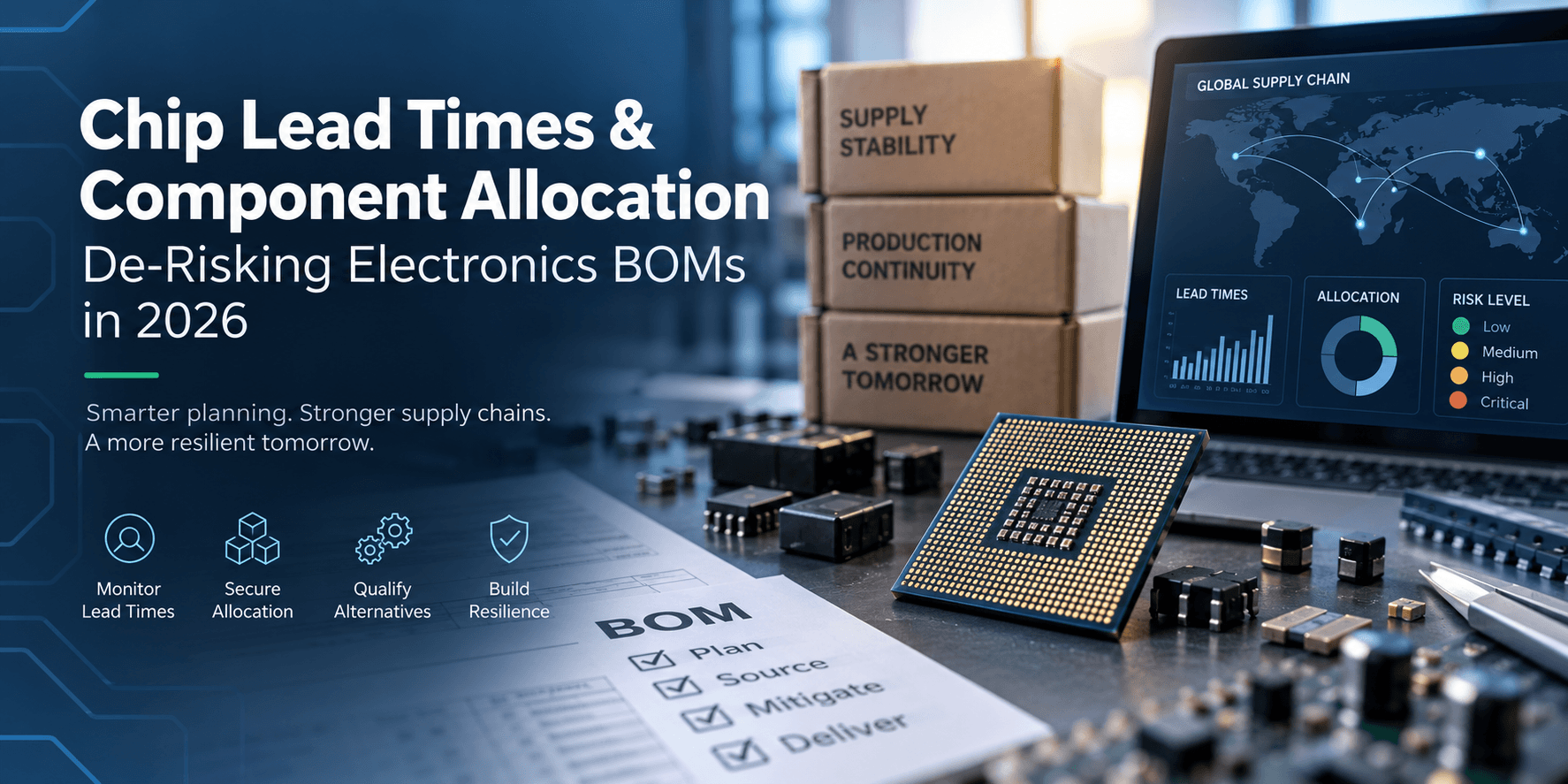
Electronics procurement in 2026 is less about finding out whether there is a “chip shortage” and more about identifying which exact components are exposed.
That distinction matters.
Many standard electronic components remain reasonably available, while specific memory devices, power semiconductors, automotive-qualified parts, networking components, and high-performance passive components are facing tighter supply. Industry reports also show that lead times can vary substantially between component families and even between different part numbers from the same manufacturer.
For OEMs and electronics manufacturers, this creates a difficult planning environment. A BOM can look healthy at the category level while containing a handful of components capable of delaying an entire production run.
The answer is not simply to buy more inventory.
A better approach is to make the BOM itself more resilient by identifying supply risks early, qualifying alternatives, securing allocation where necessary, and connecting procurement decisions with engineering and production planning.
What Is Driving Component Supply Risk in 2026?
Several forces are affecting electronics component availability at the same time.
AI infrastructure is changing component demand
AI data-center investment is creating demand well beyond advanced processors. Memory, power-management devices, networking components, interconnects, and high-performance passive components are increasingly affected by the infrastructure buildout. Sourceability reported in its Q2 2026 update that AI-driven demand was spreading beyond memory into power, interconnect, and high-performance passive markets.
Memory is a particularly visible example. Reuters reported in September 2026 that smaller electronics manufacturers were preparing for continued memory scarcity, with some industry participants expecting tight conditions to extend into 2027.
Allocation is becoming more important than headline lead time
A quoted lead time does not necessarily mean that a buyer can receive the required quantity.
Manufacturers may allocate constrained components among customers based on contractual commitments, order history, production requirements, and other commercial considerations. That means a component showing a nominal lead time can still create significant production risk if the manufacturer’s available capacity is committed elsewhere.
For procurement teams, “How many weeks?” should therefore be followed by “How many units can we actually secure?”
High-end specifications can be harder to source
Supply risk is also becoming more specification-dependent.
TrendForce, for example, reported that certain high-capacitance, high-temperature MLCC products had seen lead times extend from roughly eight weeks to as much as 20 weeks as AI accelerator designs increased their use of these components.
The same principle applies to semiconductors. Package, temperature rating, automotive qualification, voltage rating, memory density, process generation, and other specifications can all affect sourcing options.
Which BOM Components Deserve the Most Attention?
There is no universal 2026 lead-time number that can safely be applied to every BOM. Market data varies by source, supplier, geography, exact MPN, and date.
Still, several risk areas deserve closer monitoring.
| Component area | Common risk | What procurement teams should check |
|---|---|---|
| DRAM and other memory | Allocation, rising prices, capacity competition | Contract coverage, supplier allocation, approved alternatives |
| Power semiconductors | Long lead times on selected devices | Second sources, package compatibility, voltage/current ratings |
| Automotive MCUs | Qualification requirements and allocation | Approved vendors, lifecycle status, committed supply |
| Industrial analog ICs | Part-specific lead-time extensions | Exact MPN availability and alternate qualification |
| Networking ICs | AI infrastructure demand | Forecast coverage and manufacturer commitments |
| High-performance MLCCs | Concentrated demand and limited specifications | Dielectric, capacitance, voltage, package, temperature rating |
| Connectors | Customization and manufacturing capacity | Mechanical compatibility and alternate manufacturers |
| Legacy-node components | Limited fab capacity for some products | Lifecycle status and redesign options |
The important point is that category-level averages are only an early warning signal. Actual purchasing decisions should be based on the exact manufacturer part number, quantity, delivery requirement, and approved supplier list.
Build a Risk-Ranked BOM Instead of Treating Every Part Equally
A common procurement mistake is to treat every BOM line as equally important.
They are not.
A $0.10 resistor that has several approved sources is fundamentally different from a $12 MCU that has one qualified manufacturer and a 30-week lead time.
A useful BOM risk model should consider at least five variables:
- Lead time: How long does replenishment currently take?
- Source concentration: How many qualified manufacturers or distributors can supply the part?
- Allocation exposure: Is supply guaranteed, forecast-based, or dependent on spot availability?
- Substitution difficulty: Can engineering replace the part without a major redesign?
- Production impact: What happens if this component is unavailable?
You can then assign each component a practical risk category such as low, medium, high, or critical.
The goal is not to create another complicated procurement dashboard. The goal is to quickly identify the few BOM lines that can stop production.
Set a Critical Lead-Time Threshold
Lead time becomes especially important when it exceeds the time available between procurement and production.
For example, imagine an OEM has:
- A 12-week production forecast
- A component with a 20-week lead time
- No qualified alternative
- Only six weeks of inventory remaining
That component is already a production risk, even if the supplier technically lists it as “available to order.”
The purchasing team should compare supplier lead time against the actual manufacturing schedule, not against an arbitrary industry benchmark.
A simple calculation is:
Supply coverage = Available inventory ÷ Average weekly consumption
If the result is six weeks and replenishment takes 20 weeks, the BOM needs an immediate mitigation plan.
Use Component Allocation Strategically
Allocation is not always something procurement teams can eliminate.
Sometimes the better objective is to secure a predictable share of available production.
For strategically important components, companies can consider:
- Long-term supply agreements
- Scheduled orders
- Blanket purchase orders
- Non-cancellable, non-returnable commitments where commercially appropriate
- Supplier-managed inventory
- Strategic safety stock
- Multiple authorized distribution channels
The right approach depends on the component’s lifecycle, demand certainty, cash constraints, and risk of obsolescence.
The key is to make allocation decisions before production becomes urgent.
Qualify Alternatives Before You Need Them
A second source has limited value if engineering has never tested it.
This is one of the biggest gaps between procurement risk management and actual BOM resilience.
Engineering teams should identify potential alternatives while the original component is still available. Depending on the component, qualification may involve electrical testing, firmware changes, thermal validation, mechanical checks, EMC testing, regulatory requirements, or full product validation.
For simple passives, substitution may be relatively straightforward.
For an MCU, PMIC, FPGA, sensor, or power semiconductor, the process can be considerably more involved.
That is why alternate-component qualification should be treated as a design activity, not an emergency purchasing exercise.
Design for Availability, Not Just Functionality
Traditional electronics design often starts with the question:
What component gives us the required technical performance?
In a constrained supply environment, another question belongs in the design review:
Can we reliably source this component at production volume?
That shift can have a major impact on long-term supply resilience.
Design teams can consider:
- Components with multiple qualified manufacturers
- Standardized packages
- Common voltage and current ratings
- Widely supported interfaces
- Avoiding unnecessary proprietary components
- Footprint-compatible alternatives
- Firmware architectures that support multiple devices where practical
- Modular designs that allow individual components or boards to be replaced
This does not mean choosing the cheapest or most available component.
It means considering supply continuity alongside technical performance, cost, reliability, and compliance.
Don’t Confuse Buffer Stock With Risk Management
Building inventory can protect production, but excessive inventory creates its own problems.
Electronics components can become obsolete. Product designs change. Forecasts can be wrong. Working capital becomes tied up in inventory that may never be consumed.
A better approach is to concentrate buffers on components where the consequences of shortage are high and substitution is difficult.
For example, a company may reasonably carry additional inventory for a single-source MCU with a 30-week lead time while maintaining much lower safety stock for a standard resistor available from multiple manufacturers.
The objective is risk-adjusted inventory, not maximum inventory.
Connect Procurement Data to Engineering Decisions
Procurement teams often discover component risk before engineering does.
That information should flow directly into the product development process.
A practical workflow looks like this:
1. Identify exposed BOM lines
Flag parts with long lead times, single-source exposure, allocation status, lifecycle concerns, or limited distributor availability.
2. Quantify production impact
Determine how many finished products depend on each component and when inventory will run out.
3. Review alternatives with engineering
Identify technically suitable substitutes and determine what qualification work is required.
4. Secure supply for unavoidable single-source parts
Use supplier commitments, scheduled orders, safety stock, or other appropriate mechanisms.
5. Monitor changes continuously
Lead times and allocation conditions can change quickly. A BOM risk assessment should therefore be updated as part of normal procurement operations rather than performed only during a shortage.
Create a 90-Day Component Risk Review
A monthly or quarterly BOM review can provide a simple operating rhythm.
For every critical component, track:
| Metric | Question |
|---|---|
| Current lead time | How long is replenishment today? |
| Previous lead time | Is availability improving or deteriorating? |
| Inventory coverage | How many weeks of production are protected? |
| Open PO coverage | How much demand is already committed? |
| Allocation status | Is the supplier guaranteeing required quantities? |
| Approved sources | How many qualified alternatives exist? |
| Lifecycle | Is the component active, NRND, or approaching EOL? |
| Engineering status | Has an alternative actually been qualified? |
| Production impact | Which products are affected if supply stops? |
This turns a static BOM into an active supply-risk model.
Watch for Early Warning Signals
A component does not suddenly become a production crisis.
There are usually signals beforehand.
Watch for:
- Lead times increasing across consecutive supplier quotes
- Distributor inventory falling
- Quote validity becoming shorter
- Suppliers moving customers toward allocation
- Increasing minimum order quantities
- New NCNR requirements
- Price increases combined with longer lead times
- Manufacturer warnings about capacity
- Increasing dependence on brokers or spot-market supply
- End-of-life or last-time-buy announcements
- Forecasts exceeding confirmed supplier capacity
A combination of several signals deserves more attention than any single data point.
How Procurement Teams Can Reduce BOM Exposure
A practical 2026 strategy can be summarized in five actions.
Map risk at the MPN level
Do not rely solely on broad categories such as “MCU” or “power semiconductor.” Track the exact manufacturer part number, package, qualification, and approved source.
Prioritize the production-critical parts
Focus engineering and purchasing resources on components that can stop production.
Qualify alternatives early
A theoretical substitute is not the same as a production-ready second source.
Match inventory to risk
Hold more inventory where replacement is difficult and production impact is high. Avoid indiscriminate stockpiling.
Review supplier commitments regularly
Forecasts are useful, but confirmed supply commitments provide a much stronger foundation for production planning.
The Bigger Shift: BOMs Are Becoming Supply-Chain Assets
In 2026, the BOM is no longer just an engineering document.
It is also a supply-chain risk model.
AI-driven demand, selective semiconductor constraints, allocation practices, geopolitical disruption, and changing manufacturing priorities are creating a market where availability can differ sharply from one component to another.
That makes supply resilience a cross-functional responsibility.
Engineering controls technical alternatives. Procurement manages suppliers and commitments. Operations connects component availability to production schedules. Finance balances inventory against working capital and margin risk.
When these functions work from the same BOM risk data, companies can act before a component shortage becomes a production stoppage.
The goal is not to predict every disruption.
It is to make sure that when one component becomes constrained, the business already knows which products are exposed, how long inventory will last, what alternatives exist, and what action to take next.