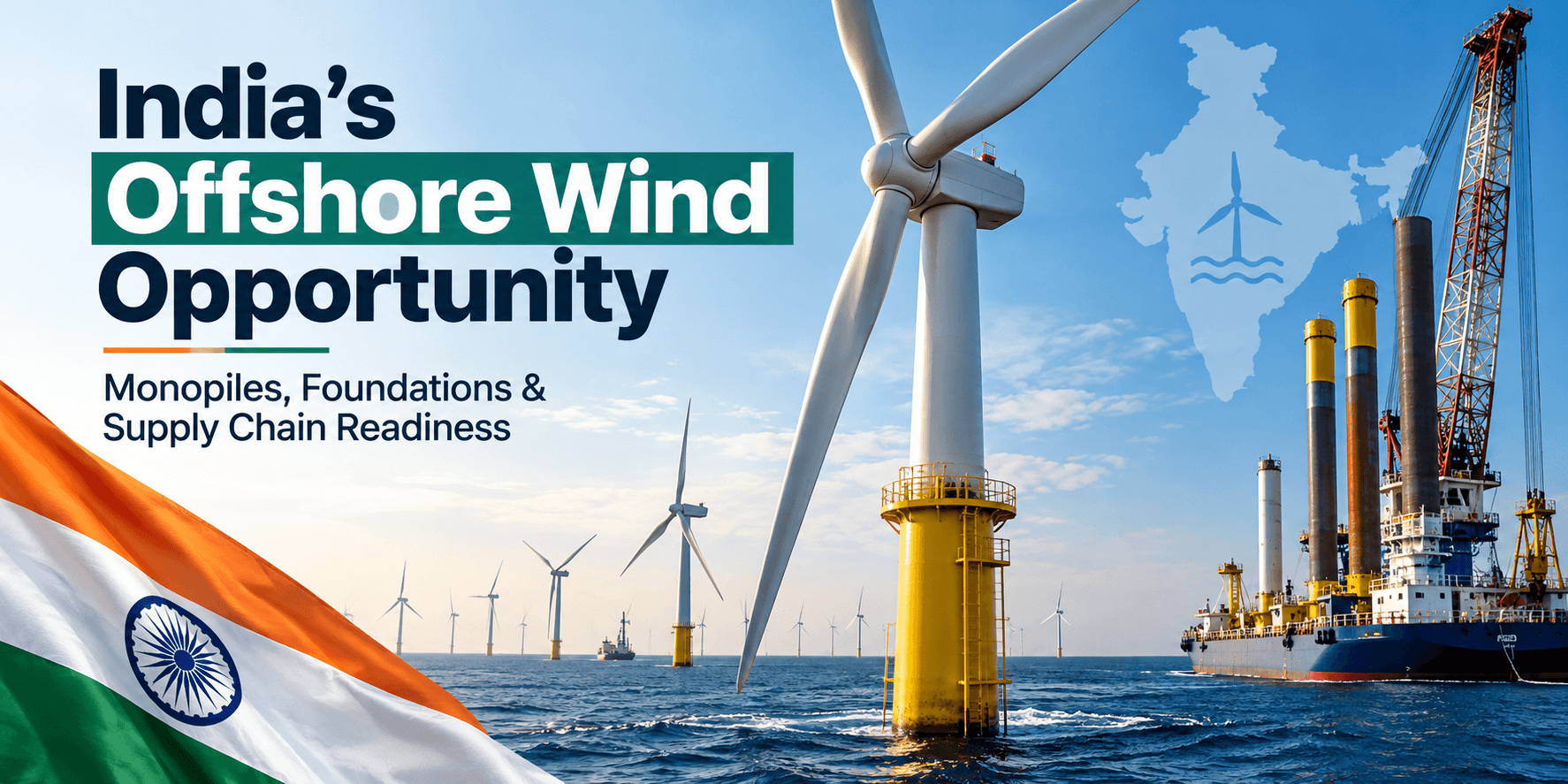
India’s Offshore Wind Opportunity: Monopiles, Foundations & Supply Chain Readiness
India is moving toward commercial-scale offshore wind, and the opportunity extends well beyond turbines.
The real industrial challenge lies underneath and around the turbine: foundations, steel fabrication, ports, heavy-lift equipment, installation vessels, subsea components, logistics, and the wider supplier network needed to build projects at scale.
For Indian manufacturers and infrastructure companies, this creates a potentially significant new market. But offshore wind has different requirements from onshore wind. Components are larger, tolerances are tighter, marine conditions are harsher, and project economics depend heavily on logistics and installation efficiency.
Monopile foundations are a particularly important part of this opportunity. Their manufacturing and installation can create demand for large-scale steel fabrication, welding, machining, coating, transportation, and port infrastructure.
The question is no longer simply whether India has the manufacturing capability to support offshore wind. It is whether the entire supply chain can become ready at the right cost, scale, quality, and speed.
India’s Offshore Wind Opportunity
India has a long coastline and strong offshore wind resources, particularly along the Gujarat and Tamil Nadu coasts. These regions are expected to form the early focus of the country’s offshore wind development.
The opportunity is attractive for several reasons:
- India already has a large onshore wind manufacturing ecosystem.
- Heavy engineering and steel fabrication capabilities are well established.
- Major ports provide a foundation for offshore construction logistics.
- Domestic renewable-energy demand continues to grow.
- Offshore wind can complement solar and onshore wind generation.
- Local manufacturing could reduce dependence on imported foundations and marine components.
However, offshore wind requires an industrial ecosystem that is more integrated than the supply chain used for onshore projects.
A turbine component that can be transported by road to an inland wind farm may require specialized vessels, port handling, temporary storage, and heavy-lift equipment offshore.
That changes the economics considerably.
Why Monopile Foundations Matter
Monopiles are among the most widely used foundation concepts for offshore wind turbines in relatively shallow waters.
The basic design is straightforward: a large steel pile is driven into the seabed, providing the structural support for the turbine and transition piece.
But manufacturing a modern offshore wind monopile is anything but simple.
As turbine capacity increases, foundation dimensions can grow substantially. Manufacturers must manage:
- Large-diameter steel plate forming
- Heavy-section welding
- Dimensional tolerances
- Non-destructive testing
- Corrosion protection
- Flange fabrication and machining
- Internal structures
- Lifting and handling
- Marine transportation
- Installation interfaces
This makes monopiles a natural opportunity for India’s heavy fabrication industry, particularly companies that already serve oil and gas, shipbuilding, power, or large infrastructure projects.
What Makes Offshore Wind Foundations Different?
Onshore wind foundations are primarily civil structures built at the project site. Offshore foundations combine structural engineering with marine engineering.
They must withstand:
- Wind loading
- Wave loading
- Currents
- Cyclic fatigue
- Corrosion
- Seabed conditions
- Installation stresses
Fatigue is particularly important.
An offshore wind foundation experiences repeated loading throughout its operating life. That means welding quality, material selection, inspection, and fabrication procedures are not simply manufacturing considerations. They directly affect long-term structural reliability.
For Indian suppliers entering this market, meeting an offshore project’s quality requirements may therefore require investment in processes, certification, inspection systems, and engineering capabilities.
India’s Existing Manufacturing Base
India does not have to build its offshore wind supply chain from scratch.
The country already has considerable expertise in large-scale steel fabrication and heavy engineering.
Potentially relevant industries include:
Steel
India has a large steel industry capable of producing the raw material required for large fabricated structures.
The challenge is not simply steel availability. Offshore wind projects need appropriate grades, thicknesses, traceability, weldability, and quality control.
Heavy Engineering
Companies serving sectors such as oil and gas, power generation, shipbuilding, and industrial infrastructure have experience with large welded structures.
These capabilities can provide a foundation for offshore wind manufacturing.
Shipbuilding
Shipyards have experience with marine structures, welding, blasting, coating, lifting, and complex logistics.
This makes shipbuilding clusters particularly relevant to the offshore wind ecosystem.
Ports
Ports can become strategic manufacturing and staging locations.
A port supporting offshore wind needs more than a quay. It may require sufficient water depth, laydown space, crane capacity, road connectivity, fabrication areas, and access to installation vessels.
The Port Infrastructure Challenge
Ports could become one of the most important bottlenecks in India’s offshore wind supply chain.
A monopile can weigh hundreds of tonnes and occupy substantial storage and handling space. Multiple foundations may need to be fabricated, temporarily stored, loaded onto vessels, and transported offshore in sequence.
This requires a coordinated logistics chain.
A port intended for conventional cargo may not automatically be suitable for offshore wind.
Key requirements can include:
- High-bearing-capacity quays
- Deep-water access
- Large laydown areas
- Heavy-lift cranes
- Fabrication facilities
- Storage and handling systems
- Specialized transport routes
- Weather-resistant operations planning
This is where India’s offshore wind opportunity becomes an infrastructure opportunity as well.
Building a Domestic Monopile Supply Chain
A competitive domestic monopile industry would likely need several layers of suppliers.
At the top is the foundation manufacturer. Around it sits a network of companies supplying steel, flanges, welding consumables, coatings, electrical systems, inspection services, lifting equipment, and logistics.
A simplified supply chain looks like this:
Steel mills → plate processing → fabrication → welding → machining → coating → assembly → port staging → marine transport → offshore installation
Each step needs to work reliably.
If one component must be imported or one manufacturing process creates a major bottleneck, the entire project schedule can be affected.
This is why supply-chain readiness should be measured at the system level, not simply by counting domestic manufacturers.
Can India Manufacture Monopiles Competitively?
Potentially, yes. But competitiveness will depend on more than labor costs.
The key variables include:
Material cost: Steel represents a major portion of foundation cost.
Factory utilization: Large fabrication facilities need enough project volume to justify investment.
Port proximity: Moving enormous structures over long distances can quickly erode cost advantages.
Equipment: Large cranes, plate-rolling equipment, welding systems, machining equipment, and coating facilities require substantial capital.
Quality assurance: Offshore projects demand rigorous inspection and documentation.
Installation capability: Foundations must be delivered in a sequence compatible with offshore installation operations.
Project pipeline: Manufacturers need confidence that the market will support long-term investment.
That final factor is particularly important.
Companies are unlikely to make major investments in specialized offshore manufacturing capacity if project awards remain too uncertain or irregular.
The Vessel Question
India’s offshore wind supply chain also needs to consider installation vessels.
A foundation can be manufactured domestically, but it still has to reach the project site and be installed offshore.
Installation may require specialized vessels equipped with:
- Heavy lifting systems
- Jack-up legs
- Pile-handling equipment
- Dynamic positioning
- Foundation installation tools
- Specialized cranes
The availability and cost of these vessels can have a major impact on project economics.
India therefore faces a strategic choice: rely heavily on international installation capacity during the early market phase, develop domestic vessels, or pursue a combination of both.
A domestic vessel ecosystem could eventually create another significant industrial opportunity, particularly for Indian shipyards.
The Importance of Local Content
Local content can support domestic manufacturing, but localization needs to be economically sustainable.
Simply requiring components to be manufactured domestically does not guarantee competitive projects.
A more effective approach is to build capabilities where India has a realistic advantage.
For example, India may have strong potential in:
- Steel
- Large-scale fabrication
- Structural components
- Electrical equipment
- Engineering services
- Port operations
- Marine logistics
- Vessel construction and repair
Other highly specialized components may initially continue to depend on global suppliers.
Over time, local capability can expand as project volumes increase and suppliers gain experience.
What Supply Chain Readiness Should Look Like
A useful way to assess India’s readiness is to divide the offshore wind supply chain into five areas.
1. Manufacturing Readiness
Can suppliers produce components at the required dimensions, quality, and volume?
2. Infrastructure Readiness
Can ports, yards, roads, cranes, and storage areas handle offshore wind components?
3. Installation Readiness
Are suitable vessels, offshore equipment, and trained marine crews available?
4. Standards and Certification
Can domestic manufacturers meet the engineering, inspection, certification, and documentation requirements expected by international developers and turbine suppliers?
5. Commercial Readiness
Is there enough project visibility to justify investment in factories, equipment, vessels, and workforce development?
India needs progress across all five.
A strong manufacturing base alone will not solve an installation bottleneck. Likewise, a capable port cannot compensate for insufficient fabrication capacity.
Where Indian Companies Could Find the Biggest Opportunities
The most obvious opportunity is monopile fabrication, but the market is broader.
Companies can potentially participate across the offshore wind value chain.
Heavy fabrication: Monopiles, transition pieces, secondary steel, and structural components.
Steel processing: Plate preparation, cutting, rolling, welding, and specialized treatment.
Coatings: Marine-grade corrosion protection and surface treatment.
Machining: Large flanges and precision components.
Marine services: Transportation, installation support, inspection, and maintenance.
Port services: Storage, staging, heavy lifting, and project logistics.
Engineering: Structural, geotechnical, marine, electrical, and project engineering.
Digital systems: Asset monitoring, inspection, predictive maintenance, and supply-chain management.
This creates opportunities for both established industrial companies and newer technology businesses.
The Workforce Challenge
Offshore wind requires a specialized workforce that combines industrial and marine expertise.
India already has engineers, welders, fabricators, electricians, marine workers, and offshore specialists. The challenge is developing enough people with experience specifically in offshore wind.
Training needs can cover:
- Offshore safety
- Foundation installation
- Marine operations
- High-integrity welding
- Non-destructive testing
- Corrosion protection
- Heavy lifting
- Offshore electrical systems
- Inspection and maintenance
Workforce development should happen alongside manufacturing and infrastructure investment rather than afterward.
Supply Chain Risks to Watch
India’s offshore wind ambitions also face several risks.
Project timing
A slow project pipeline can make specialized manufacturing investments difficult to justify.
Scale
Offshore wind components are large enough that logistics become a design constraint, not an afterthought.
Imported equipment
Dependence on imported installation vessels or specialized equipment could increase costs and create scheduling risks.
Standards
Suppliers unfamiliar with offshore certification requirements may face long qualification cycles.
Weather
Marine construction windows are constrained by weather and sea conditions, increasing the importance of reliable planning.
Financing
Offshore wind projects require significant upfront capital, and higher costs can affect project bankability.
What Needs to Happen Next?
India’s offshore wind supply chain will probably develop in stages.
The first stage is likely to rely on a combination of domestic manufacturing and international expertise.
As project volumes increase, Indian companies can build dedicated manufacturing capacity, while ports and shipyards adapt their infrastructure to support offshore construction.
Over time, the goal should be an integrated ecosystem in which a significant share of the project can be engineered, manufactured, transported, installed, and serviced within India.
That would create benefits beyond individual offshore wind projects.
It could strengthen India’s position as a manufacturing and export hub for offshore wind components across the wider Indian Ocean region.
The Bigger Opportunity for India
India’s offshore wind opportunity is not just about generating electricity at sea.
It is also about creating a new industrial value chain.
Monopiles are a useful example. Producing them domestically requires steel, fabrication, welding, machining, coatings, ports, cranes, logistics, vessels, engineering, and skilled workers.
The same pattern applies across the offshore wind industry.
If India can coordinate these capabilities, offshore wind could become an extension of the country’s existing strengths in steel, manufacturing, engineering, ports, and renewable energy.
The critical question is therefore not whether India can manufacture a monopile.
It is whether India can build the complete supply chain around the monopile, and do so competitively enough to support large-scale offshore wind deployment.
That is where the country’s biggest opportunity, and its biggest challenge, lies.