Understanding ASME Section VIII and PED Compliance
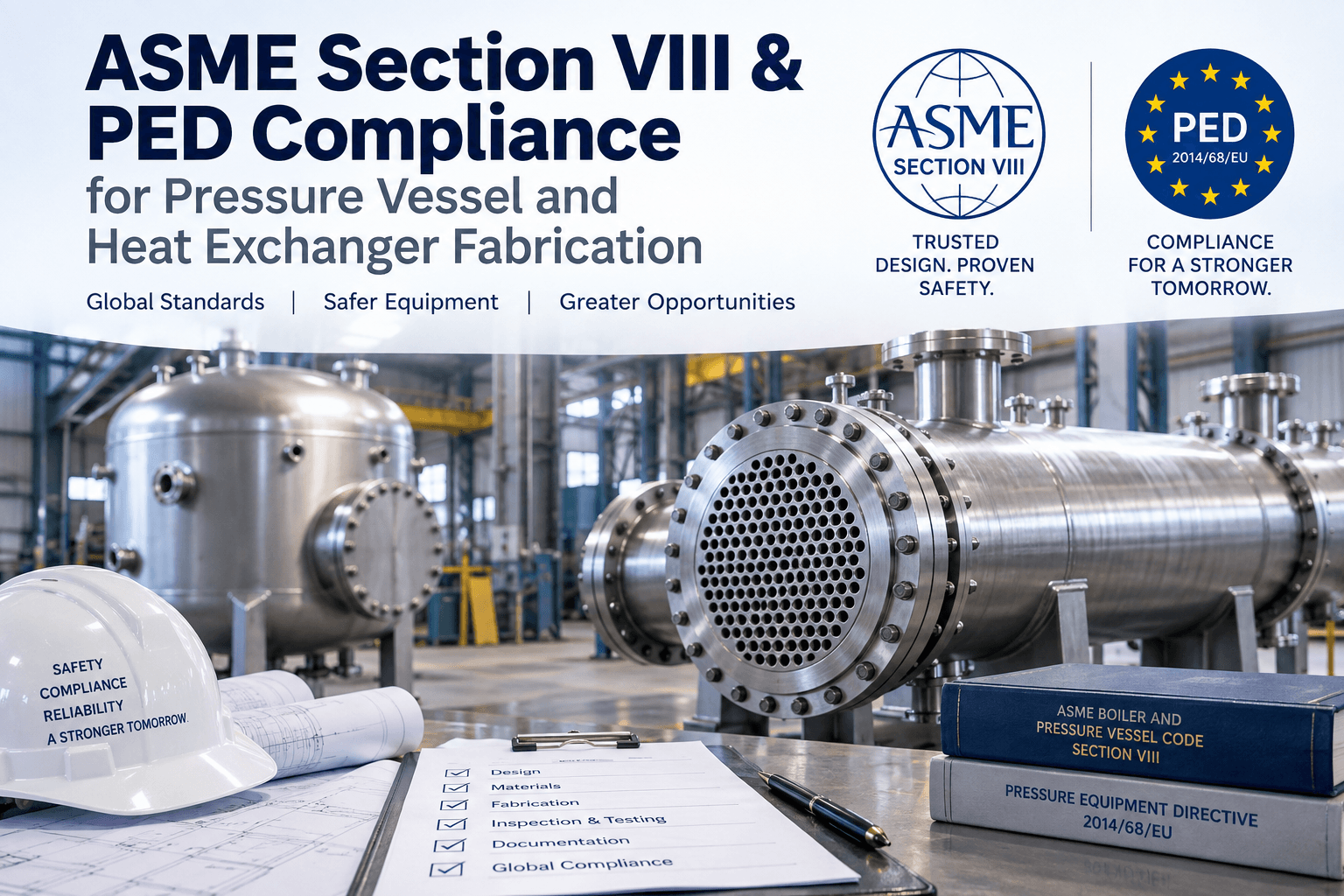
Pressure vessels and heat exchangers must meet strict requirements for design, fabrication, inspection, and testing. Two important regulatory frameworks used in international projects are the ASME Boiler and Pressure Vessel Code, Section VIII and the European Pressure Equipment Directive (PED) 2014/68/EU.
Although both address pressure equipment safety, they are not interchangeable. ASME Section VIII is a construction code, while PED establishes legal requirements for pressure equipment placed on the EU market.
For manufacturers serving global customers, understanding how these requirements overlap and differ is essential. A project may require ASME certification, PED conformity, or both, depending on the equipment, service conditions, destination market, and purchaser specifications.
What Is ASME Section VIII?
ASME Section VIII covers the construction of pressure vessels designed to operate at internal or external pressures exceeding specified limits.
It is divided into three divisions:
ASME Section VIII Division 1
Division 1 provides rules for the design, fabrication, inspection, testing, and certification of pressure vessels using established design methods.
It is widely used for industrial equipment such as:
- Process vessels
- Storage vessels
- Separators
- Reactors
- Shell-and-tube heat exchangers
- Filters and other pressurized equipment
ASME Section VIII Division 2
Division 2 provides alternative rules with more detailed design and analysis requirements.
It is often selected when equipment has demanding operating conditions or when a more rigorous design-by-analysis approach is appropriate.
ASME Section VIII Division 3
Division 3 addresses high-pressure vessels and uses specialized design and fabrication requirements.
The applicable division should be established during the early engineering stage because it affects calculations, materials, inspection, documentation, and fabrication procedures.
What Is the Pressure Equipment Directive?
The Pressure Equipment Directive 2014/68/EU, commonly called PED, establishes essential safety requirements for pressure equipment and assemblies placed on the European Union market.
PED applies to pressure equipment such as:
- Pressure vessels
- Heat exchangers
- Boilers
- Piping
- Safety accessories
- Pressure accessories
The directive considers factors including maximum allowable pressure, volume or nominal size, fluid properties, and equipment category.
Unlike ASME certification, PED compliance involves demonstrating conformity with European Union requirements before applicable equipment is placed on the EU market.
ASME vs. PED: Key Differences
ASME Section VIII and PED address many of the same engineering risks, but they approach compliance differently.
| Area | ASME Section VIII | PED |
|---|---|---|
| Primary purpose | Pressure vessel construction code | EU legal framework |
| Main focus | Design and construction rules | Essential safety requirements |
| Application | Used internationally | Required for applicable equipment placed on the EU market |
| Design approach | Code-specific design rules | Requires conformity with PED essential safety requirements |
| Conformity assessment | ASME certification where applicable | PED conformity assessment based on equipment category and module |
| Quality system | Depends on certification and project requirements | May require notified-body involvement depending on category and conformity route |
| Documentation | Code documentation and certification records | Technical documentation, conformity documentation, and CE marking requirements |
| Final marking | ASME code marking where applicable | CE marking where applicable |
The important point is that having an ASME stamp does not automatically mean that equipment is PED compliant. Similarly, PED compliance does not automatically make a vessel an ASME-certified pressure vessel.
Design Compliance for Pressure Vessels and Heat Exchangers
Compliance starts well before fabrication.
The design team should establish the applicable code, directive, standards, design conditions, and purchaser requirements before calculations are finalized.
Important design inputs typically include:
- Design pressure
- Design temperature
- Operating pressure and temperature
- Vacuum conditions
- Corrosion allowance
- Material specifications
- Joint efficiency
- External loads
- Wind and seismic loads where applicable
- Nozzle loads
- Thermal expansion
- Fatigue considerations
- Hydrostatic or pneumatic test conditions
For heat exchangers, engineers also need to consider the interaction between the pressure boundary and thermal performance requirements.
The shell side and tube side may have different design pressures and temperatures, meaning each pressure boundary must be evaluated appropriately.
Material Selection and Traceability
Material control is a major part of pressure equipment fabrication.
Materials should be selected according to the applicable design code and project specification. Depending on the equipment, this can include:
- Carbon steel
- Stainless steel
- Low-alloy steel
- Nickel alloys
- Duplex stainless steel
- Other qualified pressure-retaining materials
Material certificates should be reviewed against the purchase specification and applicable code requirements.
Traceability should normally be maintained from material receipt through fabrication and final documentation.
For example, a plate used to manufacture a vessel shell may need traceability through:
Material certificate → plate identification → cutting → forming → welding → inspection → final documentation
Loss of traceability can create significant problems during inspection and final certification.
Welding Requirements
Welding is one of the most closely controlled activities in pressure vessel fabrication.
ASME projects commonly require qualified welding procedures and qualified welders or welding operators in accordance with applicable ASME requirements.
Typical welding documentation includes:
- Welding Procedure Specifications (WPS)
- Procedure Qualification Records (PQR)
- Welder Qualification Records (WPQ)
- Welding consumable records
- Preheat and interpass temperature records
- Post-weld heat treatment records where required
- Weld maps
- Repair records
PED projects also require suitable permanent joining procedures and personnel qualifications according to the applicable conformity and quality requirements.
The exact qualification standard depends on the selected compliance route and applicable harmonized or referenced standards.
Non-Destructive Examination
Non-destructive examination helps verify the integrity of pressure-retaining welds and components without damaging the equipment.
Depending on the design and applicable requirements, inspection may include:
- Visual Testing (VT)
- Radiographic Testing (RT)
- Ultrasonic Testing (UT)
- Magnetic Particle Testing (MT)
- Liquid Penetrant Testing (PT)
The required extent of examination is not necessarily the same for every vessel or heat exchanger. It depends on factors such as design rules, material, weld category, joint efficiency, service conditions, and project specifications.
Inspection requirements should therefore be defined during engineering rather than treated as a final fabrication activity.
Heat Exchanger Fabrication Considerations
Heat exchangers introduce additional fabrication challenges because several components must work together while maintaining pressure integrity and thermal performance.
For shell-and-tube heat exchangers, important fabrication areas include:
Tube-to-Tubesheet Joints
Tube-to-tubesheet connections can be produced using methods such as:
- Expansion
- Welding
- Combined welding and expansion
The selected method depends on the design, service conditions, materials, and applicable specification.
Tube Sheet Fabrication
Tubesheets are critical pressure-retaining components. Dimensional accuracy, material integrity, drilling quality, flatness, and traceability can all affect exchanger performance.
Shell and Channel Fabrication
Shells, channels, heads, covers, and nozzle connections must satisfy the applicable pressure vessel design and fabrication requirements.
Pressure Testing
The completed exchanger may require separate or combined pressure tests of the applicable pressure boundaries, depending on the design and governing requirements.
PED Equipment Categories
PED classification is an important step in determining the conformity assessment route.
Pressure equipment is generally classified into Categories I, II, III, or IV, with increasing conformity assessment requirements.
Classification depends on factors such as:
- Type of pressure equipment
- Maximum allowable pressure
- Volume or nominal size
- Fluid group
- Applicable pressure-volume relationship
Some equipment falls under Article 4(3), commonly associated with sound engineering practice, rather than the higher PED categories.
Manufacturers should determine the applicable PED category before selecting the conformity assessment procedure.
CE Marking and PED Documentation
For applicable pressure equipment placed on the EU market, CE marking is part of the conformity process.
The manufacturer’s technical documentation may include:
- Design calculations
- Drawings
- Material certificates
- Welding qualifications
- Welder qualifications
- Inspection records
- NDE reports
- Heat treatment records
- Pressure test records
- Safety assessment documentation
- Operating instructions
- Declaration of Conformity
- Certificates from a notified body where required
The exact documentation depends on the equipment category and conformity assessment route.
Can ASME and PED Requirements Be Used Together?
Yes, but the relationship must be established carefully.
A manufacturer may use ASME Section VIII as the primary construction code while also addressing PED requirements for equipment intended for the EU market. However, the engineering and conformity assessment must demonstrate that the applicable PED essential safety requirements are satisfied.
A typical project may therefore involve:
ASME design and fabrication → PED gap assessment → additional requirements → conformity assessment → technical documentation → CE marking
This should be planned at the beginning of the project.
Trying to add PED compliance after fabrication can result in redesign, additional inspections, documentation gaps, or testing requirements.
Inspection and Quality Control Plan
A project-specific Inspection and Test Plan (ITP) helps coordinate manufacturing activities between the fabricator, purchaser, third-party inspector, and notified body where applicable.
A typical ITP may cover:
- Material receiving inspection
- Material identification and traceability
- Forming inspection
- Welding procedure verification
- Welder qualification verification
- Fit-up inspection
- Visual inspection
- NDE
- Heat treatment
- Dimensional inspection
- Hydrostatic or other required pressure testing
- Final inspection
- Nameplate and marking verification
- Documentation review
- Release for shipment
Hold points and witness points should be agreed before manufacturing begins.
Common Compliance Challenges
Several issues repeatedly create delays in international pressure equipment projects.
Choosing the Code Too Late
Changing the governing code after design work has started can affect calculations, materials, weld procedures, inspection requirements, and documentation.
Incomplete Material Traceability
Material identification should remain connected to the final pressure boundary throughout manufacturing.
Welding Documentation Gaps
Expired qualifications, incorrect material groupings, missing essential variables, or incomplete records can create certification issues.
Insufficient NDE Planning
NDE requirements should be incorporated into the design and ITP instead of being decided after welding is complete.
Treating CE Marking as a Labeling Exercise
PED compliance involves technical and conformity assessment requirements. Simply adding a CE mark to an ASME vessel does not establish PED conformity.
Documentation Mismatch
The equipment, drawings, calculations, certificates, inspection reports, and nameplate information should all describe the same final configuration.
A Practical Compliance Workflow
For manufacturers handling ASME and PED projects, the process can be organized into several stages.
1. Define the Market and Regulatory Requirements
Identify where the equipment will be installed and whether it will be placed on the EU market.
2. Establish the Governing Design Code
Determine whether ASME Section VIII Division 1, Division 2, another construction code, or a combination of standards applies.
3. Determine PED Applicability and Category
Establish whether PED applies and determine the relevant equipment category.
4. Complete the Design
Finalize pressure, temperature, materials, dimensions, corrosion allowance, loads, and other design inputs.
5. Prepare Fabrication Procedures
Develop and approve welding, forming, heat treatment, inspection, testing, and other manufacturing procedures.
6. Control Manufacturing
Maintain material traceability and inspection records throughout fabrication.
7. Complete NDE and Testing
Perform the required inspections and pressure tests according to the approved design and inspection plan.
8. Compile the Manufacturing Record
Bring together drawings, calculations, certificates, welding records, NDE reports, test records, inspection reports, and other required documentation.
9. Complete Conformity Assessment
Where PED requires third-party involvement, coordinate the applicable notified body activities.
10. Finalize Marking and Release
Complete applicable ASME certification and PED conformity documentation, including CE marking where required.
Why Compliance Should Be Planned During Engineering
ASME and PED compliance affects much more than the final inspection.
It influences material selection, design calculations, welding procedures, inspection levels, testing, documentation, and manufacturing controls from the beginning of the project.
For pressure vessel and heat exchanger manufacturers, early compliance planning can reduce redesign and certification problems while making the final documentation package easier to review.
For international projects, the most important principle is simple: define the regulatory pathway before fabrication starts, and maintain traceability between the approved design, manufactured equipment, inspections, and final certification.