
Storage Tank & Cryogenic Vessel Fabrication: API 620 vs API 650 Explained
Choosing the right fabrication standard is one of the first engineering decisions that affects a storage tank’s design, materials, welding procedures, inspection scope, cost, and service life. Two standards that are often compared are API 650 and API 620.
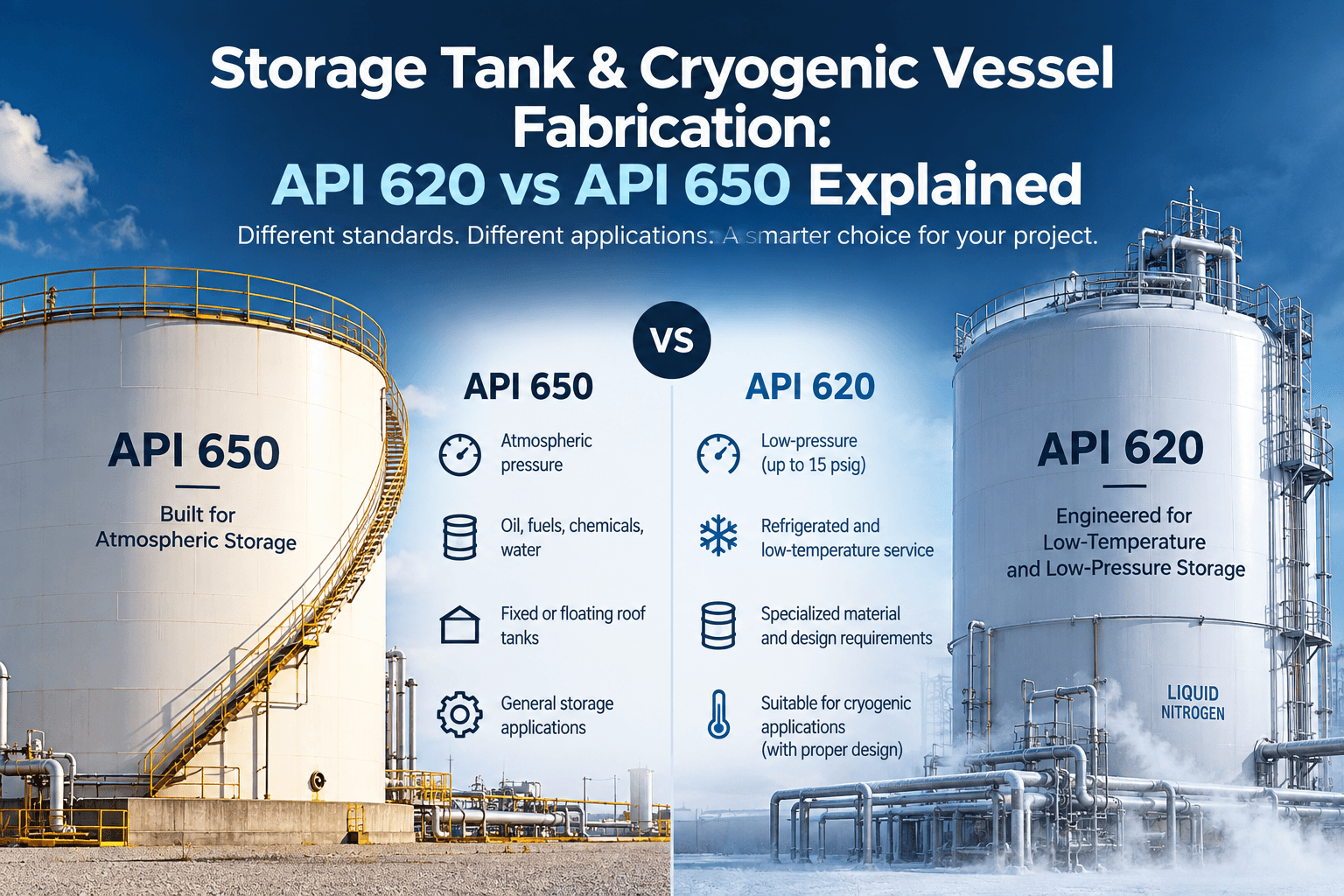
The key distinction is simple: API 650 is primarily intended for welded aboveground storage tanks operating at or near atmospheric pressure, while API 620 covers large welded low-pressure storage tanks where higher vapor-space pressure or more demanding low-temperature service requires a different design approach.
For cryogenic and refrigerated storage, however, the selection should not be made from the pressure number alone. The product, minimum design metal temperature, tank configuration, insulation system, and applicable project standards all need to be evaluated.
API 650: Designed for Atmospheric Storage
API 650, Welded Tanks for Oil Storage, establishes requirements for the material, design, fabrication, erection, and inspection of vertical cylindrical welded storage tanks. The current API catalog lists the 14th edition of API 650, published in August 2025.
API 650 is commonly selected for applications such as:
- Crude oil and petroleum products
- Diesel and fuel storage
- Water and process liquids
- Chemical storage
- Aboveground terminal tanks
- Refinery storage tanks
- Fixed-roof and floating-roof tanks
Its normal service envelope is close to atmospheric pressure. Higher internal pressure can be accommodated when the additional requirements of the standard are satisfied, but API 650 is not intended to replace a low-pressure tank or pressure-vessel design when the service demands exceed its scope.
When API 650 makes sense
If a tank stores a liquid at approximately atmospheric pressure and does not require specialized refrigerated or cryogenic construction, API 650 is often the appropriate starting point.
For example, a large aboveground diesel storage tank at a fuel terminal would generally fall within the type of service API 650 addresses.
API 620: Designed for Large Low-Pressure Storage
API 620 is titled Design and Construction of Large, Welded, Low-Pressure Storage Tanks. API describes it as covering large welded, aboveground carbon-steel storage tanks with a single vertical axis, with vapor-space pressures up to 15 psig and specified temperature limitations.
The standard is relevant when a project moves beyond conventional atmospheric storage, particularly when the tank needs to handle:
- Higher internal vapor pressure
- Refrigerated products
- Low-temperature service
- Certain liquefied gases
- Large-volume specialized storage
- Applications requiring additional low-temperature material and design controls
API’s current standards information also identifies API 620 and API 625 separately, with API 625 specifically covering tank systems for refrigerated liquefied gas storage.
That distinction matters for cryogenic projects. A cryogenic tank is not simply an API 650 tank made from colder-rated steel. The complete tank system, insulation, containment arrangement, materials, testing, and applicable project requirements must be considered.
API 620 vs API 650: Key Differences
| Parameter | API 650 | API 620 |
|---|---|---|
| Primary purpose | Welded tanks for oil and general atmospheric storage | Large welded low-pressure storage tanks |
| Typical pressure | Atmospheric to low pressure | Higher low-pressure service, up to 15 psig within its scope |
| Temperature | Non-refrigerated service within API 650 limits | Includes specialized low-temperature service provisions |
| Typical applications | Oil, water, chemicals, petroleum products | Refrigerated and specialized low-pressure storage |
| Design requirements | Primarily atmospheric tank design | More demanding pressure and low-temperature considerations |
| Fabrication | Standard welded tank fabrication | More stringent controls may be required depending on service |
| Material selection | Based on API 650 service and temperature requirements | Greater emphasis on low-temperature material performance where applicable |
| Cryogenic applications | Generally not the primary choice | Can form part of the design basis for refrigerated/cryogenic tank systems |
| Current API listing | API 650, 14th edition | API 620 with current addenda listed by API |
The exact requirements should always be checked against the edition and addenda specified in the project documents, rather than relying on older pressure or temperature summaries found in secondary sources. API’s standards plan currently lists API 620 Addendum 4 dated February 2025 and API 650 14th edition dated August 2025.
Why Cryogenic Service Changes the Fabrication Approach
Cryogenic storage introduces a problem that ordinary atmospheric tanks do not face: material behavior at very low temperatures.
As temperature falls, some steels can become less resistant to brittle fracture. That means the fabricator cannot simply select a conventional carbon-steel plate, weld it using the same procedure, and assume the tank will perform normally.
Material selection may need to consider:
- Minimum design metal temperature
- Impact toughness
- Plate thickness
- Welding consumables
- Heat input
- Welding procedure qualification
- Post-weld requirements
- NDE requirements
- Thermal contraction
- Insulation and vapor control
- Tank settlement and structural loads
API 620 contains specific provisions for low-temperature applications, including requirements associated with its refrigerated and cryogenic tank provisions.
Fabrication Differences Between API 620 and API 650
The difference between the two standards becomes particularly important once fabrication begins.
1. Material Selection
API 650 provides material requirements appropriate to its intended storage applications. API 620 can require more specialized material selection when low-temperature service is involved.
For a cryogenic project, the engineering team must verify that the selected plate, fittings, forgings, bolting, and welding consumables retain adequate mechanical properties at the specified design temperature.
This is one reason cryogenic tank fabrication typically requires tighter control of material certificates, traceability, impact testing, and welding procedures.
2. Welding
Both standards require controlled welding practices, but the consequences of poor welding become particularly significant in low-temperature and pressurized service.
A fabrication package may include:
- Qualified WPS and PQR documentation
- Qualified welders and welding operators
- Controlled welding consumables
- Preheat and interpass-temperature controls where applicable
- Weld traceability
- Visual inspection
- Radiographic or ultrasonic examination where specified
- Repair procedures
- Hydrostatic or other required testing
The actual inspection percentage and acceptance criteria depend on the applicable code, tank design, material, joint category, and project specification.
3. Tank Roof and Pressure Control
An API 650 tank is generally designed around atmospheric storage conditions. Roof design therefore focuses heavily on issues such as structural loads, vapor containment, wind, seismic effects, and the selected fixed or floating roof arrangement.
API 620 tanks have to account for a more significant pressure differential in the vapor space. This changes the engineering requirements for the shell, roof, openings, pressure relief system, and associated components.
The result can be a substantially different fabrication package even when two tanks have similar dimensions.
API 620 and Cryogenic Storage: An Important Distinction
One common mistake is treating API 620 as synonymous with “cryogenic tank.”
It is more accurate to think of API 620 as one part of the design and fabrication framework that may apply to certain large low-pressure, refrigerated, or low-temperature storage tanks.
For refrigerated liquefied gas storage systems, API 625 is also important. API’s current standards catalog identifies API 625 as Tank Systems for Refrigerated Liquefied Gas Storage.
Depending on the product and project, other standards may also enter the specification. For example, LNG storage projects can involve requirements covering containment, insulation, foundations, seismic design, piping, instrumentation, fire protection, and commissioning.
So the correct question is not simply:
“Should we fabricate this tank to API 620?”
The better question is:
“What complete code and standard framework applies to this product, pressure, temperature, tank configuration, and site?”
How to Choose Between API 650 and API 620
A practical selection process starts with the process data.
Step 1: Identify the Stored Product
Determine exactly what the tank will contain.
Important properties include:
- Product density
- Vapor pressure
- Boiling point
- Flash point
- Corrosivity
- Toxicity
- Compatibility with tank materials
- Required storage temperature
Step 2: Establish Design Pressure and Vacuum
Do not rely only on normal operating pressure.
The design basis should account for:
- Maximum operating pressure
- Design pressure
- Vacuum conditions
- Pressure-relief settings
- Thermal expansion
- Filling and emptying conditions
- Emergency scenarios
If the service requires pressure capability beyond conventional atmospheric storage, API 620 may become the appropriate design route.
Step 3: Establish the Minimum Design Metal Temperature
For refrigerated and cryogenic applications, this is critical.
A tank that looks acceptable based on pressure alone may require a completely different material and fabrication strategy once the minimum design temperature is established.
Step 4: Define the Tank System
Determine whether the project involves:
- Single-wall construction
- Double-wall construction
- Full containment
- Insulation
- Suspended deck
- Inner tank
- Outer tank
- Special foundation requirements
For large refrigerated liquefied-gas facilities, the tank system approach becomes especially important.
Step 5: Confirm the Applicable Code Edition
Always identify the exact edition and addenda in the purchase specification.
This is particularly important because API standards are revised over time. For example, API currently lists API 650’s 14th edition and recent API 620 addenda.
Common Mistakes in Tank Specification
Choosing the code based only on tank size
Tank diameter or capacity alone does not determine whether API 620 or API 650 is appropriate.
Pressure, temperature, product characteristics, configuration, and applicable project requirements matter just as much.
Treating cryogenic fabrication as ordinary tank fabrication
Cryogenic service can require specialized materials, welding controls, impact testing, inspection, insulation, and containment arrangements.
Using an outdated code edition
A fabricator may receive an RFQ that simply says “API 650 tank” or “API 620 tank.” That is not enough for a complete fabrication specification.
The purchase documents should identify the applicable edition, addenda, client specifications, design conditions, materials, NDE requirements, and testing requirements.
Assuming API 620 automatically means LNG
API 620 has a broader scope than LNG alone. Cryogenic and refrigerated liquefied-gas projects can involve additional standards, including API 625.
API 620 vs API 650: Which One Should You Use?
The simplest way to think about the choice is:
Choose API 650 when you are dealing primarily with conventional welded aboveground storage at or near atmospheric pressure and within the standard’s temperature and configuration limits.
Consider API 620 when the tank requires large welded low-pressure storage capability, higher vapor-space pressure, or specialized low-temperature service that takes the design beyond the normal API 650 envelope.
For cryogenic storage, do not stop at the API 620/API 650 comparison. Review the complete tank system requirements and determine whether API 625 or other applicable standards are also required.
Ultimately, the best fabrication standard is determined by the process conditions and engineering design basis, not by the tank’s name or capacity alone.
Frequently Asked Questions
Is API 620 better than API 650?
Neither standard is universally better. They address different storage conditions. API 650 is primarily suited to atmospheric storage, while API 620 addresses large welded low-pressure storage tanks with a broader pressure and low-temperature design envelope.
Can API 650 be used for cryogenic storage?
API 650 is not generally the primary standard for specialized cryogenic storage. Cryogenic projects require careful evaluation of temperature, material toughness, containment, insulation, and applicable refrigerated-storage standards.
What is the maximum pressure for API 620?
API’s published scope for API 620 identifies vapor-space pressure of 15 psig maximum for tanks covered by the standard. Applications beyond that range require evaluation against other applicable design codes and standards.
What is the main difference between API 620 and API 650?
The fundamental difference is their intended service envelope. API 650 addresses welded storage tanks primarily for atmospheric-pressure service, while API 620 addresses large welded low-pressure storage tanks where higher pressure and/or more demanding temperature conditions can apply.
Does API 620 apply to LNG tanks?
API 620 can be relevant to certain low-temperature storage designs, but an LNG tank project should be evaluated as a complete refrigerated liquefied-gas tank system. API 625 is specifically listed by API for tank systems for refrigerated liquefied gas storage.
Key Takeaway
API 650 and API 620 are not competing versions of the same tank standard. They solve different engineering problems.
API 650 is the conventional choice for atmospheric welded storage tanks. API 620 is intended for large welded low-pressure storage where pressure and temperature requirements demand a more specialized design approach.
For fabricators and EPC teams, getting this distinction right at the RFQ and engineering stage helps prevent material changes, welding requalification, redesign, inspection disputes, and costly fabrication delays.