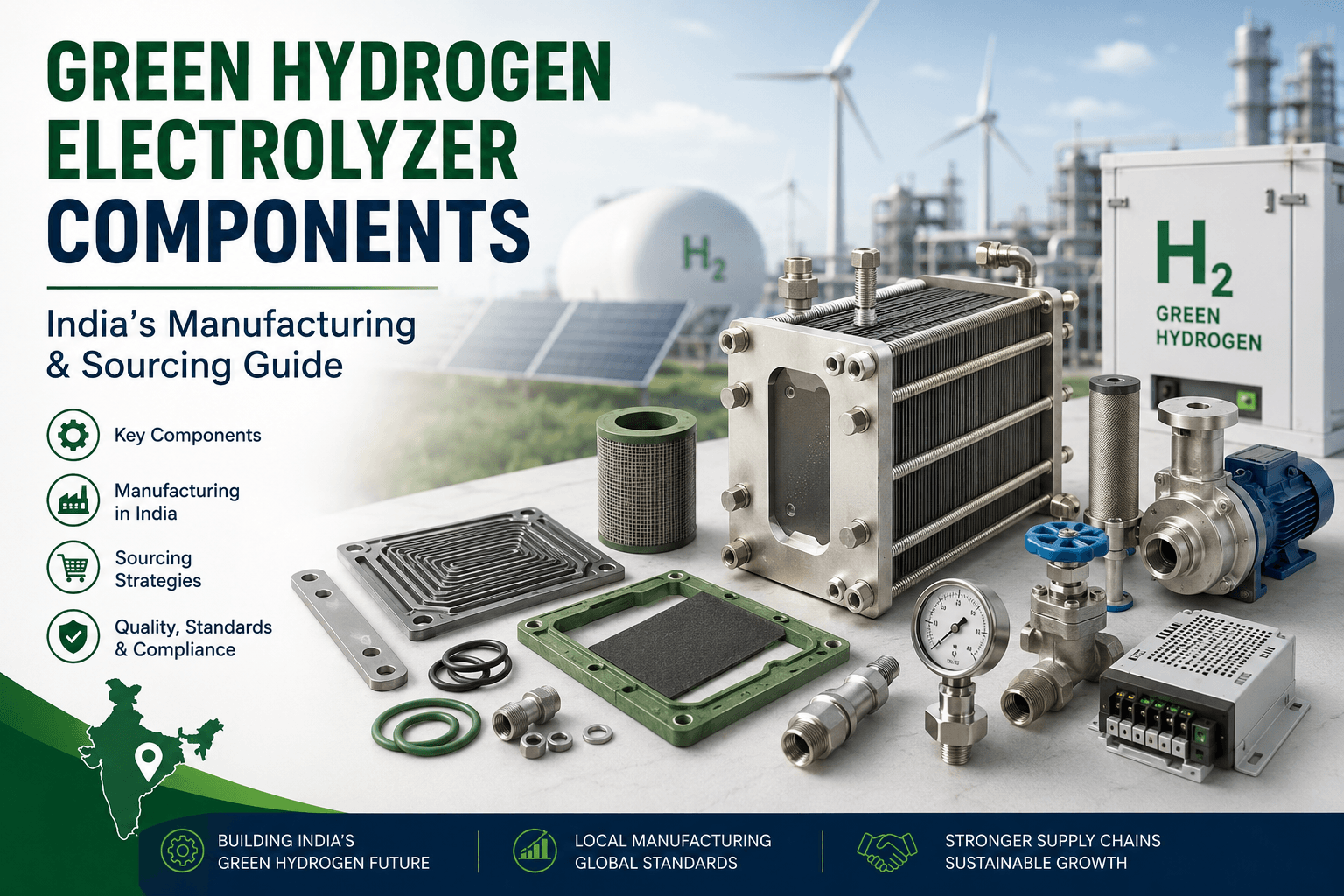
Green Hydrogen Electrolyzer Components: India’s Manufacturing & Sourcing Guide
India’s green hydrogen market is moving from pilot projects toward industrial-scale deployment. That shift is creating a second opportunity beyond hydrogen production itself: manufacturing and sourcing the components that make electrolyzers work.
The opportunity is significant. Under the National Green Hydrogen Mission, India has awarded incentives for 3,000 MW per year of electrolyzer manufacturing capacity across 15 companies, with ₹4,440 crore allocated under the electrolyzer manufacturing component of the SIGHT programme.
For equipment manufacturers, EPC companies, project developers, and industrial buyers, the question is no longer simply which electrolyzer should we buy?
It is also:
- Which components can be sourced reliably in India?
- Which parts should be imported?
- How much localization is practical?
- Which specifications matter most during vendor qualification?
- How should buyers compare component suppliers?
- What should an Indian electrolyzer supply chain look like over the next few years?
This guide breaks down the major electrolyzer components and explains how companies can approach manufacturing and sourcing in India.
What Is an Electrolyzer?
An electrolyzer uses electricity to split water into hydrogen and oxygen.
At a basic level:
2H₂O → 2H₂ + O₂
When the electricity comes from renewable sources such as solar or wind, the resulting hydrogen can qualify as green hydrogen under India’s applicable framework, provided the required emissions criteria are met.
An electrolyzer system is more than the stack itself. A commercial installation typically combines:
- Electrolyzer stack
- Power electronics
- Water treatment and circulation
- Gas separation and purification
- Cooling and thermal management
- Controls and instrumentation
- Hydrogen compression and associated equipment
- Safety systems
- Piping, valves, fittings, and other balance-of-plant equipment
This distinction matters for sourcing. A company may manufacture the core stack locally while purchasing pumps, sensors, power electronics, valves, compressors, membranes, catalysts, or other specialized components from different suppliers.
India’s Electrolyzer Manufacturing Market Is Expanding
The policy environment is helping create demand for domestic manufacturing.
The National Green Hydrogen Mission has a total SIGHT programme outlay of ₹17,490 crore. Of that, ₹4,440 crore is allocated to domestic electrolyzer manufacturing and ₹13,050 crore to green hydrogen production.
The government’s approved project list also shows that India’s manufacturing ecosystem is not limited to one technology.
Current approved SIGHT projects include manufacturers working with:
- Alkaline electrolyzers
- PEM electrolyzers
- Solid oxide technology
- Membrane-less electrolyzers
The first and second SIGHT tranches each represent 1,500 MW of annual manufacturing capacity, according to the National Green Hydrogen Mission portal.
That diversity has an important sourcing implication: there is no single Indian electrolyzer component supply chain. Requirements differ considerably depending on the stack technology.
Major Green Hydrogen Electrolyzer Components
The easiest way to understand the supply chain is to divide components into two groups:
Stack components and balance-of-plant (BoP) components.
The stack performs the electrochemical reaction. The balance of plant keeps the system supplied, controlled, cooled, purified, and operating safely.
1. Electrolyzer Stack
The stack is the heart of the system.
It contains multiple electrochemical cells assembled together to achieve the required hydrogen production capacity.
A stack typically includes:
- Electrodes
- Membrane or diaphragm
- Catalyst layers
- Bipolar plates or current-carrying plates
- Porous transport layers or related structures
- Seals and gaskets
- End plates
- Fasteners and compression hardware
- Current collectors
The exact architecture depends on the technology.
Alkaline electrolyzer stack
Alkaline systems use an alkaline electrolyte and a separator or diaphragm between the hydrogen and oxygen sides.
Common components include:
- Electrodes
- Diaphragm
- Bipolar plates
- Electrolyte circulation equipment
- Seals
- Frames
- End plates
- Current collectors
PEM electrolyzer stack
PEM, or proton exchange membrane, systems use a polymer electrolyte membrane.
Important components include:
- Proton exchange membrane
- Catalyst layers
- Membrane electrode assembly (MEA)
- Porous transport layers
- Bipolar plates
- Current collectors
- Seals
- End plates
The U.S. Department of Energy identifies membranes, catalysts, bipolar plates, seals, and MEA-related components among the major stack manufacturing requirements, while water management, thermal management, gas cleanup, reactant delivery, and controls form part of the balance of plant.
2. Membranes and Diaphragms
Membranes are among the most technically sensitive components in an electrolyzer.
In PEM systems, the membrane conducts protons while helping prevent hydrogen and oxygen from mixing.
In alkaline systems, a diaphragm separates the gases while allowing the required ionic transport.
For buyers, membrane specifications should cover more than price.
Evaluate:
- Chemical resistance
- Thickness
- Ionic conductivity
- Gas crossover
- Operating temperature
- Pressure tolerance
- Expected lifetime
- Manufacturing consistency
- Batch-to-batch variation
A cheaper membrane that produces higher gas crossover or degrades faster can increase the total cost of hydrogen production.
Sourcing recommendation: Treat membranes as strategic components. Qualify suppliers through technical testing and pilot production before moving to high-volume procurement.
3. Electrodes and Catalysts
Electrodes are where the electrochemical reactions take place.
Catalyst selection affects:
- Efficiency
- Operating voltage
- Degradation
- Current density
- Temperature performance
- Long-term operating cost
PEM technology has historically relied on precious-metal catalysts, particularly for oxygen evolution. That makes catalyst loading, availability, recycling, and material efficiency important procurement considerations.
Alkaline systems generally have different catalyst and electrode requirements and can provide greater flexibility in material selection.
For Indian manufacturers, catalyst and electrode manufacturing is therefore an important localization opportunity, but it also requires significant materials expertise and quality control.
4. Bipolar Plates
Bipolar plates distribute electrical current and help manage water, gases, and heat within the stack.
Depending on the technology and design, they may be manufactured from materials such as:
- Stainless steel
- Nickel-based materials
- Coated metals
- Other corrosion-resistant materials
Bipolar plates need to balance several competing requirements:
Low electrical resistance + corrosion resistance + mechanical strength + manufacturability + acceptable cost
This makes manufacturing quality critical.
Poor surface finishing, coating defects, dimensional variation, or inadequate corrosion resistance can reduce stack performance and lifetime.
For Indian suppliers, bipolar plates are an attractive area for localization because precision fabrication, machining, forming, coating, and quality inspection capabilities can be developed domestically.
5. Seals, Gaskets and O-Rings
These components are easy to underestimate.
An electrolyzer operates with water, gases, pressure, temperature, electrical potential, and potentially corrosive chemicals. Sealing failures can therefore create both performance and safety problems.
Common requirements include resistance to:
- Hydrogen
- Oxygen
- Alkaline electrolytes
- Temperature cycling
- Pressure cycling
- Chemical exposure
Material selection depends on the specific electrolyzer architecture.
Buyers should request:
- Material certificates
- Dimensional tolerances
- Compression characteristics
- Chemical compatibility data
- Temperature ratings
- Aging test results
- Lot traceability
For Indian sourcing, seals and gaskets are among the components where domestic manufacturing can often be developed faster than highly specialized electrochemical materials.
6. Current Collectors
Current collectors transfer electrical current between the electrochemical cells and the external electrical system.
They need:
- Low electrical resistance
- Corrosion resistance
- Mechanical stability
- Consistent contact pressure
- Dimensional precision
Material and coating choices differ between alkaline and PEM designs.
Because electrical losses directly affect system efficiency, current collectors should be evaluated as performance-critical components rather than generic metal parts.
7. End Plates and Structural Components
End plates compress the stack and maintain mechanical integrity.
They may look relatively straightforward compared with membranes or catalysts, but dimensional accuracy is essential.
Important specifications include:
- Flatness
- Parallelism
- Mechanical strength
- Bolt-hole accuracy
- Pressure distribution
- Surface finish
- Thermal characteristics
Indian engineering companies with precision machining and fabrication capabilities can potentially compete strongly in this category.
Balance-of-Plant Components
The stack cannot operate independently.
A commercial electrolyzer requires a significant balance-of-plant system around it.
8. Water Treatment System
Water quality directly affects electrolyzer performance and component lifetime.
Depending on system design, water treatment can include:
- Pretreatment
- Filtration
- Reverse osmosis
- Deionization
- Polishing
- Storage
- Recirculation
India’s green hydrogen standards ecosystem already includes requirements and standards relevant to water electrolysis systems and reagent-grade water. The National Green Hydrogen Mission portal lists IS 16509:2020 / ISO 22734:2019 for hydrogen generators using water electrolysis, as well as IS 1070:2023 for reagent-grade water.
For sourcing teams, water quality specifications should therefore be defined early in the project rather than treated as a utility-side detail.
9. Pumps and Circulation Equipment
Pumps move:
- Feedwater
- Electrolyte
- Cooling fluids
- Process streams
The appropriate pump depends on pressure, temperature, chemical compatibility, flow rate, and materials of construction.
For alkaline systems, chemical compatibility becomes especially important.
Domestic sourcing can be attractive here because India’s industrial pump and process-equipment industry is relatively mature. However, hydrogen-specific operating conditions still need to be validated.
10. Heat Exchangers and Cooling Systems
Electrolysis generates heat.
Thermal management systems remove excess heat and maintain the stack within its intended operating range.
Components can include:
- Heat exchangers
- Cooling loops
- Pumps
- Temperature sensors
- Control valves
- Radiators or cooling equipment
Heat exchanger material selection is particularly important where corrosive fluids are involved.
11. Gas-Liquid Separators
Hydrogen and oxygen streams can contain water and need to be separated before downstream processing.
Gas-liquid separation equipment can include:
- Separators
- Demisters
- Filters
- Drain systems
- Level sensors
- Pressure controls
A PEM system diagram published by the U.S. Department of Energy, for example, includes water and gas separators, a heat exchanger, dryer, back-pressure regulator, and hydrogen storage as part of the system architecture.
These are areas where conventional process-equipment manufacturers can potentially enter the hydrogen supply chain.
12. Hydrogen Purification and Drying
The hydrogen leaving an electrolyzer may require additional purification or drying depending on the application.
Potential equipment includes:
- Gas dryers
- Moisture removal systems
- Filters
- Purification units
- Gas analyzers
- Pressure control equipment
Purity requirements should be defined according to the end use.
Hydrogen intended for different industrial processes may have different purity specifications from hydrogen intended for fuel-cell applications.
13. Compressors
Electrolyzers typically produce hydrogen at a pressure that may not match the pressure required by storage, transportation, or the end-use process.
Compression may therefore be required.
The compressor becomes one of the major mechanical systems in the overall hydrogen project and should be evaluated based on:
- Required inlet pressure
- Required outlet pressure
- Flow rate
- Hydrogen compatibility
- Efficiency
- Oil contamination risk
- Maintenance requirements
- Availability of local service
For large projects, compressor selection should happen early because it affects electrical consumption, equipment layout, cooling requirements, and operating costs.
14. Power Electronics
Electricity is one of the largest operating inputs for electrolysis, so the electrical conversion system matters enormously.
Typical equipment can include:
- Transformers
- Rectifiers
- DC power supplies
- Switchgear
- Protection systems
- Power-quality equipment
- Energy-management systems
The power system needs to match the electrolyzer’s electrical characteristics and operating profile.
For renewable-powered projects, dynamic operation can add another layer of complexity. The power electronics must respond appropriately to variations in renewable generation while protecting the stack.
15. Sensors, Instrumentation and Controls
A commercial electrolyzer requires continuous monitoring.
Typical measurements include:
- Pressure
- Temperature
- Flow
- Water quality
- Voltage
- Current
- Gas composition
- Hydrogen purity
- Oxygen concentration
- Liquid level
- Differential pressure
The control system uses these signals to regulate the plant and identify abnormal conditions.
For EPC companies, instrumentation should not be selected solely on unit price. Reliability, calibration support, spare availability, communication protocols, and local service capability can have a much larger impact over the project’s operating life.
India’s Electrolyzer Component Supply Chain
India has a strong base of companies capable of manufacturing conventional industrial equipment, including:
- Stainless-steel fabrication
- Precision machining
- Pumps
- Valves
- Heat exchangers
- Electrical equipment
- Automation systems
- Pressure vessels
- Piping
- Instrumentation
- Power electronics
The more difficult localization challenge lies in specialized electrochemical components.
These include:
- Advanced membranes
- PEM MEAs
- Specialized catalysts
- Porous transport layers
- Specialized coatings
- High-performance diaphragms
- Certain stack materials
This creates a useful distinction for procurement teams:
Components that are generally easier to localize
- Frames
- End plates
- Piping
- Tanks
- Pumps
- Heat exchangers
- Structural systems
- Valves
- General instrumentation
- Electrical infrastructure
Components requiring deeper technology capabilities
- Membranes
- MEAs
- Catalysts
- Specialized electrodes
- Porous transport layers
- Advanced coatings
- High-performance separators
The best localization strategy is therefore not simply “source everything locally.” It is to localize according to technical maturity, supply risk, cost impact, and quality requirements.
Alkaline vs PEM: Sourcing Implications
| Factor | Alkaline | PEM |
|---|---|---|
| Electrolyte | Alkaline solution | Polymer electrolyte membrane |
| Key separator | Diaphragm | PEM membrane |
| Catalyst requirements | Generally less dependent on precious metals | Precious-metal catalysts can be important |
| Manufacturing maturity | High | Rapidly developing |
| Dynamic operation | Generally less flexible | Strong fit for variable renewable power |
| Component localization | Relatively favorable in several areas | More challenging for specialized components |
| Indian ecosystem | Currently larger | Smaller but expanding |
| Typical procurement focus | Electrodes, diaphragm, plates, electrolyte system | MEA, membrane, catalyst, PTL, bipolar plates |
India’s current SIGHT project pipeline reflects this difference. The approved project list contains substantially more alkaline manufacturing capacity than PEM capacity, although PEM projects are present and other technologies are also represented.
How to Source Electrolyzer Components in India
A successful sourcing strategy should begin with the technical specification, not the supplier shortlist.
Step 1: Freeze the Electrolyzer Technology
Start by defining:
- Alkaline
- PEM
- SOE
- Other technology
Do not request generic quotations for “electrolyzer components.”
The component specifications can differ substantially between technologies.
Step 2: Create a Component-Level BOM
Build a detailed bill of materials.
For each component, specify:
- Material
- Dimensions
- Operating pressure
- Operating temperature
- Chemical exposure
- Electrical requirements
- Expected lifetime
- Tolerance
- Testing requirements
- Certification requirements
- Annual quantity
This converts procurement from a price comparison exercise into an engineering qualification process.
Step 3: Classify Components by Risk
A useful classification is:
Tier 1: Critical technology components
Membranes, catalysts, MEAs, diaphragms, electrodes, PTLs and specialized coatings.
Tier 2: Performance-critical components
Bipolar plates, current collectors, seals, pumps and thermal-management components.
Tier 3: Standard industrial components
Piping, tanks, structural parts, conventional valves, electrical panels and general instrumentation.
The more critical the component, the more rigorous the supplier qualification process should be.
What to Check When Evaluating Indian Suppliers
Price should be only one part of the decision.
Technical capability
Ask whether the supplier has experience manufacturing the exact component or a technically comparable product.
Production capacity
A supplier capable of producing 1,000 units per month may not be capable of supporting a 100 MW electrolyzer manufacturing programme.
Check:
- Installed capacity
- Production lines
- Expansion plans
- Lead times
- Capacity utilization
Quality systems
Evaluate:
- Incoming inspection
- In-process inspection
- Final inspection
- Traceability
- Calibration
- Non-conformance management
- Corrective actions
Material traceability
For critical components, buyers should be able to trace material back to its source and production batch.
Testing capability
Ask what testing is performed internally and what is outsourced.
Engineering support
A strong supplier should be able to discuss tolerances, materials, failure modes, and design-for-manufacturing issues rather than simply quoting a price.
After-sales support
For equipment installed in India, local technical support can be a major advantage.
Local Manufacturing and the SIGHT Programme
The SIGHT programme is particularly relevant to India’s electrolyzer manufacturing ecosystem.
The government’s objective includes increasing indigenous electrolyzer manufacturing capacity and reducing the levelized cost of hydrogen production.
The first SIGHT tranche awarded 1,500 MW per year of manufacturing capacity, while the second tranche adds another 1,500 MW per year according to the National Green Hydrogen Mission’s approved project listings.
For component manufacturers, this creates an important second-order opportunity.
An electrolyzer OEM does not only need stacks. It needs a network of qualified suppliers for:
- Machined components
- Plates
- Seals
- Pumps
- Valves
- Heat exchangers
- Sensors
- Electrical equipment
- Power electronics
- Water treatment
- Gas processing equipment
- Automation
- Packaging and logistics
As manufacturing volumes increase, these supplier categories can become industries in their own right.
What About Local Value Addition?
Local value addition is an important consideration for companies participating in India’s electrolyzer manufacturing ecosystem.
The original SIGHT framework included local value-addition requirements, along with performance requirements such as specific energy consumption and lifecycle expectations.
However, manufacturers should not assume that a component being physically manufactured in India automatically satisfies every programme requirement.
Always use the latest MNRE scheme guidelines and applicable tender documents when determining eligibility or compliance.
The Ministry continues to update its hydrogen-related schemes and guidelines, including newer documentation published in 2025 and 2026.
Key Challenges in India’s Electrolyzer Component Sourcing
1. Limited supplier depth for advanced components
Conventional engineering suppliers are relatively easier to identify than companies with deep experience in electrochemical materials.
2. Quality consistency
Hydrogen equipment requires tight control over materials, surfaces, dimensions, seals, coatings, and electrochemical performance.
A supplier may be technically capable of producing a component but not yet capable of producing it consistently at scale.
3. Scaling from prototype to mass production
A component that works in a 10 kW prototype does not automatically translate into a reliable product for a 100 MW manufacturing programme.
Manufacturers need:
- Repeatable processes
- Automated inspection
- Statistical process control
- Supplier quality management
- Traceability
- Production testing
4. Imported critical materials
Some specialized materials may continue to require international sourcing in the near term.
The objective should therefore be strategic localization, rather than an unrealistic requirement that every raw material be domestically produced immediately.
5. Lack of long-term demand visibility
Component suppliers need confidence that investment in tooling, coating lines, testing equipment, and production capacity will generate sufficient demand.
Long-term offtake agreements and framework contracts can help solve this problem.
How Indian Buyers Can Reduce Supply-Chain Risk
A robust procurement strategy should avoid single-source dependency for critical components wherever practical.
For each high-risk component, consider maintaining:
Primary supplier + qualified secondary supplier + technical alternative
For example, a PEM electrolyzer manufacturer might qualify two suppliers for a critical metallic component while maintaining an approved international source for a specialized membrane until the domestic alternative reaches the required maturity.
Other useful measures include:
- Maintain strategic inventory for long-lead components
- Use dual sourcing for critical parts
- Establish incoming inspection protocols
- Audit supplier production facilities
- Require material certificates
- Perform sample validation
- Conduct accelerated life testing where appropriate
- Include change-control requirements in purchase contracts
A Practical Supplier Qualification Checklist
Before approving a new electrolyzer component supplier, ask:
Engineering
- Does the supplier understand the operating environment?
- Can it meet the required tolerances?
- Has the design been validated?
- Can it support engineering changes?
Manufacturing
- What is the monthly production capacity?
- What equipment is used?
- Which processes are automated?
- What is the expected production yield?
Quality
- What inspection equipment is available?
- Is every production batch traceable?
- What certifications are held?
- How are non-conforming parts handled?
Commercial
- What is the minimum order quantity?
- What is the lead time?
- How does pricing change with volume?
- What are the payment terms?
- What happens if demand increases sharply?
Supply chain
- Where are raw materials sourced?
- Are any critical inputs imported?
- What is the supplier’s backup plan?
- How quickly can production be scaled?
Where the Biggest Manufacturing Opportunities May Be
For Indian manufacturers entering the green hydrogen supply chain, the most attractive opportunity is not necessarily the most technologically sophisticated component.
There is substantial room for companies that can reliably manufacture high-volume, high-quality supporting equipment.
Potential areas include:
Precision metal components
Frames, plates, end plates, current collectors, manifolds and structural parts.
Sealing systems
Hydrogen-compatible gaskets, seals and engineered sealing assemblies.
Process equipment
Pumps, heat exchangers, separators, water-treatment systems and gas-handling equipment.
Power electronics
Rectifiers, converters, switchgear and associated control equipment.
Instrumentation
Pressure, temperature, flow, gas-quality and water-quality monitoring systems.
Automation
PLC, SCADA and energy-management systems tailored to electrolyzer plants.
Specialized materials
The longer-term opportunity includes domestic development of membranes, catalysts, electrodes, coatings and other electrochemical materials.
What Should Companies Import vs Source Locally?
A sensible approach is to use a technology-risk matrix.
| Component category | Recommended initial strategy |
|---|---|
| Structural components | Prioritize Indian sourcing |
| Tanks and piping | Prioritize Indian sourcing |
| Pumps | Indian sourcing where qualified |
| Heat exchangers | Indian sourcing where qualified |
| Valves | Indian sourcing where hydrogen-compatible |
| Electrical panels | Indian sourcing |
| Instrumentation | Indian sourcing plus global options |
| Bipolar plates | Develop and qualify Indian suppliers |
| Seals | Develop Indian suppliers |
| Electrodes | Evaluate based on technology |
| Membranes | Dual-source until domestic supply matures |
| MEAs | Strategic sourcing and technology partnerships |
| Catalysts | Maintain secure qualified supply |
| Specialized coatings | Evaluate local manufacturing capability |
The exact decision should always depend on the technology, performance requirements, production scale, and total cost of ownership.
India’s Standards and Compliance Landscape
Standards are becoming increasingly important as the domestic hydrogen market develops.
The National Green Hydrogen Mission maintains a standards and regulations framework covering hydrogen production, storage, transportation, safety, and related systems.
The government has also established a dedicated scheme to support testing facilities, infrastructure, and institutional support for standards and regulatory development under the National Green Hydrogen Mission.
For equipment buyers, this means compliance should be considered during product design rather than after manufacturing.
A good procurement specification should identify:
- Applicable Indian standards
- Relevant ISO standards
- Safety requirements
- Testing requirements
- Documentation requirements
- Certification requirements
- Acceptance criteria
The Bottom Line
India’s green hydrogen opportunity is creating demand for much more than electrolyzer manufacturers.
It is creating a component ecosystem.
The near-term opportunity is strongest in conventional industrial components that can be engineered for hydrogen applications: precision metal parts, seals, pumps, heat exchangers, piping, electrical systems, controls, water treatment, and gas-handling equipment.
The larger long-term opportunity lies further upstream in electrochemical technologies such as membranes, catalysts, MEAs, electrodes, diaphragms, porous transport layers, and advanced coatings.
India has already created a policy foundation for electrolyzer manufacturing. The SIGHT programme has awarded 3,000 MW per year of manufacturing capacity across its approved tranches, while the National Green Hydrogen Mission continues to develop standards, testing infrastructure, incentives, and market mechanisms.
For manufacturers and procurement teams, the winning strategy will be straightforward but demanding: qualify suppliers at the component level, build redundancy into critical parts of the supply chain, localize where India is already competitive, and invest selectively in technologies that can replace high-risk imports.
That is how India’s green hydrogen sector can move from assembling electrolyzers to building a genuinely competitive electrolyzer manufacturing ecosystem.
FAQs
What are the main components of a green hydrogen electrolyzer?
The main components include the electrolyzer stack, electrodes, membrane or diaphragm, catalysts, bipolar plates, current collectors, seals, end plates, power electronics, water-treatment equipment, pumps, heat exchangers, gas separators, purification equipment, controls, sensors, and other balance-of-plant equipment.
Which electrolyzer technology is most common in India’s current manufacturing pipeline?
Alkaline technology currently represents the largest share of the approved SIGHT manufacturing capacity. PEM projects are also present, along with other technologies such as solid oxide and membrane-less systems.
Can electrolyzer components be manufactured in India?
Yes. Many balance-of-plant and conventional engineering components can be manufactured domestically. More specialized electrochemical components may require technology partnerships, imported materials, or further development of India’s domestic manufacturing capabilities.
What should buyers consider when sourcing electrolyzer components?
Buyers should evaluate technical performance, material compatibility, manufacturing capacity, quality systems, traceability, testing, lead times, local service, scalability, and total lifecycle cost rather than comparing unit prices alone.
Is India offering incentives for electrolyzer manufacturing?
Yes. The SIGHT programme under the National Green Hydrogen Mission provides incentives for domestic electrolyzer manufacturing. The government has awarded 3,000 MW per year of manufacturing capacity across 15 companies under the programme, with ₹4,440 crore allocated to the manufacturing component.
What is the biggest opportunity for Indian component manufacturers?
In the near term, opportunities are particularly strong in precision engineering, plates, seals, pumps, heat exchangers, piping, water treatment, electrical equipment, instrumentation, controls, and other balance-of-plant systems. Specialized electrochemical materials represent a higher-value, longer-term opportunity.