
India’s Energy Storage Market Outlook: Capacity Targets and Opportunities to 2032
India’s energy storage market is moving from a policy-led concept to a critical part of the power system. Rapid solar and wind additions, rising peak demand, and the need to shift renewable electricity into evening hours are creating a large and increasingly visible market for batteries and pumped storage.
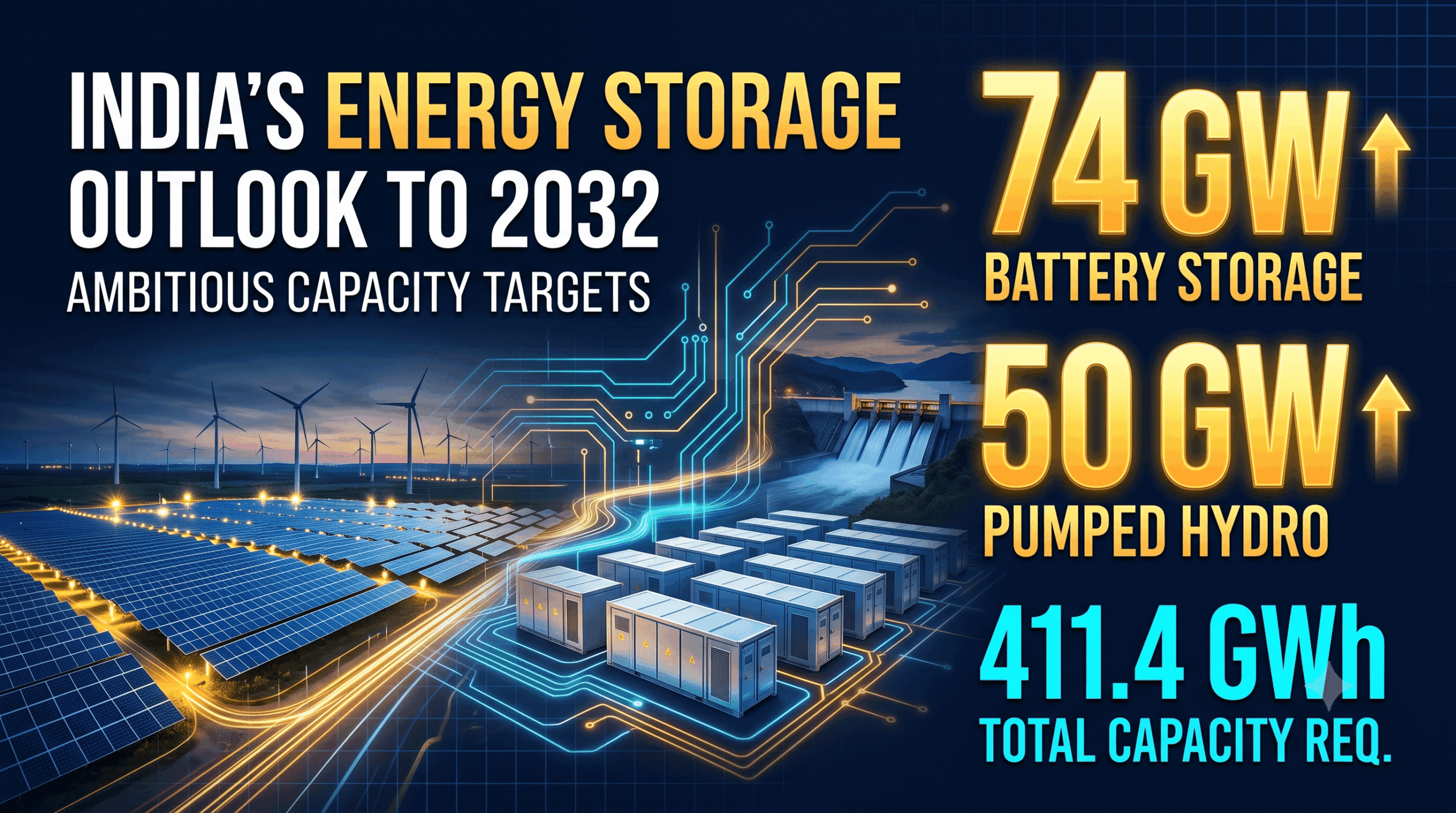
The scale is significant. The Central Electricity Authority (CEA) projects 47.24 GW / 236.22 GWh of BESS by 2031-32, alongside 26.69 GW / 175.18 GWh of pumped storage. That puts total planned storage at about 74 GW / 411 GWh for 2031-32.
Other market-oriented modelling points to an even larger opportunity. A 2025 study by the India Energy & Climate Center and Power Foundation of India estimates that India could need 97 GW / 362 GWh of cost-effective energy storage by 2032 to support roughly 600 GW of non-fossil generation.
For developers, equipment manufacturers, utilities, financiers, and software providers, the message is straightforward: India’s storage market is entering a major build-out phase.
India’s Energy Storage Capacity Targets Through 2032
The most useful way to understand India’s market is to separate battery storage, pumped storage, and the broader energy storage requirement.
| Period | BESS capacity | BESS energy | Pumped storage | Total storage energy |
|---|---|---|---|---|
| 2026-27 | 8.68 GW | 34.72 GWh | 7.45 GW | 82.37 GWh |
| 2030 | ~41.65 GW* | ~208 GWh* | ~18.98 GW* | ~60.63 GW* |
| 2031-32 | 47.24 GW | 236.22 GWh | 26.69 GW | 411.40 GWh |
| 2032 | ~97 GW** | ~362 GWh** | Included in broader storage estimate | ~362 GWh** |
* CEA’s Optimal Generation Mix 2030 estimate.
** IECC/Power Foundation modelling estimate, not a government target.
CEA’s National Electricity Plan provides the clearest official 2031-32 benchmark: 47.244 GW / 236.22 GWh of BESS and 26.686 GW / 175.18 GWh of pumped storage.
The distinction matters because these figures are based on different planning methodologies. Businesses should therefore treat 2032 estimates as a range rather than a single guaranteed market number.
Why India’s Storage Requirement Is Growing
India’s storage opportunity is closely tied to the changing generation mix.
CEA’s 2031-32 plan anticipates around 364.6 GW of solar and 121.9 GW of wind capacity, alongside 26.7 GW of pumped storage and 47.2 GW of BESS. Total installed generation capacity is projected at roughly 900 GW.
Solar creates a particularly important storage challenge.
Large amounts of solar generation arrive during the middle of the day, while electricity demand often remains high into the evening. Batteries can capture some of that daytime generation and discharge it when the grid needs power most.
This makes storage more than a backup technology. It becomes a mechanism for:
- Shifting renewable energy to higher-demand periods
- Reducing renewable curtailment
- Managing evening peaks
- Providing frequency and voltage support
- Improving grid flexibility
- Supporting firm and dispatchable renewable power
- Reducing the need for some peaking generation
- Improving reliability as renewable penetration rises
Recent power shortages have made this need more tangible. In October 2026, several Indian states sought additional power amid tight nighttime supply, with insufficient battery storage limiting the ability to shift surplus daytime solar into evening demand.
Battery Storage Is Scaling Quickly
India’s operational BESS base remains small compared with the requirement ahead.
As of June 2026, installed BESS capacity above 1 MWh was approximately 2.93 GW / 8.66 GWh.
The government’s own planning pipeline is much larger. CEA’s BESS monitoring data shows projects moving through operational, construction, awarded, and tender stages, while government-backed VGF programmes are supporting additional capacity.
The gap between today’s installed base and the 2031-32 requirement illustrates the size of the opportunity.
India does not simply need more batteries. It needs an entire ecosystem around them, including project development, cells, packs, power conversion systems, energy management software, grid integration, financing, operations, and recycling.
The Role of Pumped Storage
Batteries are not the only answer.
Pumped storage plants can provide large amounts of long-duration storage and are particularly relevant for India’s multi-hour and system-scale requirements. CEA’s 2031-32 plan calls for 26.69 GW of pumped storage with approximately 175 GWh of storage capacity.
The longer-term opportunity could be substantially larger. CEA’s 2026 roadmap examines the development of up to 100 GW of pumped storage projects, reflecting the technology’s expected role in India’s future power system.
The market is therefore likely to evolve around a combination of technologies rather than a battery-only model.
BESS is well suited to fast response, short-duration shifting, ancillary services, and locations where rapid deployment matters. Pumped storage can provide large-scale, longer-duration energy shifting where suitable geography and transmission access are available.
Government Policy Is Creating Market Demand
Policy support is one of the strongest drivers of India’s storage market.
Energy Storage Obligations
India’s Energy Storage Obligation is scheduled to increase from 1% in FY2023-24 to 4% by FY2029-30, with the obligation increasing by 0.5 percentage points each year. At least 85% of the stored energy used to meet the obligation must come from renewable sources.
This creates a structural source of demand rather than leaving storage deployment entirely dependent on individual projects.
Viability Gap Funding
The government has also used Viability Gap Funding to make early BESS projects more financially viable.
According to CEA, government-supported programmes now cover approximately 43.85 GWh of BESS capacity, including a 30 GWh PSDF-supported programme with ₹5,400 crore of financial support
This is important because early storage projects can face a financing problem: the grid needs the capacity, but project economics may not yet fully reflect the system-wide value of storage.
VGF helps close that gap.
Transmission Charge Waivers
The government has also extended 100% waivers of inter-state transmission charges for eligible co-located BESS projects commissioned by June 2028 and for qualifying pumped storage projects.
Lower transmission costs can materially improve project economics, particularly for renewable-plus-storage developments located away from demand centres.
The Manufacturing Opportunity Is Expanding
India’s opportunity is not limited to deploying imported batteries.
The government is building domestic manufacturing capability through the Production Linked Incentive programme for Advanced Chemistry Cells. The broader programme has an outlay of ₹18,100 crore for 50 GWh of ACC manufacturing capacity, including 10 GWh earmarked for grid-scale storage applications.
In 2026, the Ministry of Heavy Industries also moved forward with a dedicated procurement process for 10 GWh of ACC manufacturing capacity for grid-scale stationary storage.
That creates opportunities across the value chain.
Cell and battery manufacturing
Domestic cell production can reduce exposure to global supply chains and give Indian manufacturers a larger role as stationary storage demand grows.
Battery packs and containers
Large-scale BESS projects require more than cells. Pack integration, thermal management, fire protection, enclosures, monitoring, and controls all create potential manufacturing opportunities.
Power conversion systems
PCS equipment connects batteries to the grid and plays a central role in charging, discharging, voltage management, and grid services.
Energy management software
As storage portfolios become larger, software becomes increasingly important for forecasting, dispatch optimization, bidding, asset monitoring, and revenue stacking.
Where the Biggest Business Opportunities Could Emerge
The market should not be viewed simply as a race to manufacture the cheapest battery.
Several segments could develop into significant businesses by 2032.
Utility-scale BESS
Grid-scale projects are likely to remain the largest near-term opportunity.
Utilities and renewable developers can use BESS for peak shifting, renewable integration, ancillary services, and firm power contracts.
The government’s procurement and VGF mechanisms are already helping create a project pipeline.
Renewable-plus-storage projects
Solar and wind developers increasingly need to offer electricity when the grid requires it, rather than only when renewable resources are available.
That makes hybrid projects combining generation with storage increasingly attractive.
Long-duration storage
As renewable penetration rises, the market will need storage that can operate for longer periods.
This creates room for pumped hydro and potentially other long-duration technologies alongside conventional lithium-ion BESS.
Grid services
Storage can provide services beyond energy arbitrage.
Fast response, frequency regulation, voltage support, ramping, and other ancillary services can create additional revenue streams when market rules allow them.
Commercial and industrial storage
Large commercial and industrial users may adopt storage to manage peak demand, improve power quality, integrate rooftop solar, and reduce exposure to expensive grid electricity.
This market could become particularly interesting as battery costs and financing models improve.
Storage software and optimization
A larger installed fleet increases the need to optimize assets across multiple revenue streams.
Software companies can potentially capture value through:
- Energy forecasting
- Battery degradation modelling
- Dispatch optimization
- Electricity market bidding
- Asset monitoring
- Predictive maintenance
- Portfolio management
- Renewable-storage scheduling
The software opportunity is easy to overlook because it represents a smaller portion of project capex, but it can become strategically important as storage assets become more sophisticated.
India’s 2032 Storage Market Will Not Be Uniform
Storage requirements will vary substantially by state and grid region.
States with large renewable pipelines, growing industrial loads, transmission constraints, and significant evening demand are likely to see particularly strong demand.
Government-supported BESS allocations already span states including Rajasthan, Gujarat, Maharashtra, Tamil Nadu, Karnataka, Andhra Pradesh, Madhya Pradesh, Telangana, Uttar Pradesh, Kerala, and others.
That creates opportunities for regional developers and EPC companies, not just national-scale players.
It also means businesses need to understand state-level resource adequacy plans, transmission availability, DISCOM procurement strategies, and local regulatory frameworks.
The Economics Are Improving, But Developers Still Face Risks
Storage economics have improved significantly, but the market is not risk-free.
One important challenge is the mismatch between aggressively priced storage bids and the actual cost of delivering projects.
Reuters reported in July 2026 that Indian battery storage tariffs were under pressure from higher battery and commodity costs, raising concerns about the viability of some low-priced projects.
For developers, the lesson is important: low bid prices do not automatically create sustainable projects.
Projects need to account for:
- Battery replacement
- Degradation
- Financing costs
- Insurance
- Fire safety
- Balance-of-system costs
- Grid interconnection
- Transmission charges
- Operations and maintenance
- Revenue uncertainty
The strongest developers are likely to be those that can combine competitive capex with disciplined project economics.
A Key Market Shift: From Capacity to Usable Energy
One of the most important changes in India’s storage market will be the growing focus on GWh rather than GW alone.
A 1 GW battery can mean very different things depending on its duration.
A 1 GW / 1 GWh system can discharge at full power for roughly one hour. A 1 GW / 4 GWh system can theoretically sustain that output for four hours.
As India moves from managing short evening peaks toward managing longer renewable variability, storage duration becomes increasingly important.
The IECC study expects two-hour batteries to dominate through 2027, with four-hour systems becoming more important thereafter.
That shift could influence everything from battery chemistry and project design to financing and market rules.
What the Market Could Look Like by 2032
By 2032, India’s energy storage sector is likely to look substantially different from today’s early-stage market.
A mature market could include:
- Large utility-scale BESS fleets
- Gigawatt-scale pumped storage projects
- Solar-plus-storage and wind-plus-storage plants
- Firm and dispatchable renewable energy contracts
- More sophisticated electricity market participation
- Domestic battery and component manufacturing
- Specialized storage financing
- Software-driven battery optimization
- Growing C&I storage adoption
- A larger battery recycling and second-life ecosystem
The biggest change may be that storage stops being treated as an optional addition to renewable projects and becomes a core piece of power-system planning.
What Businesses Should Watch Between Now and 2032
For companies evaluating the Indian energy storage market, several indicators deserve close attention.
1. BESS tender volumes
Tender activity provides one of the clearest signals of near-term demand.
2. Storage tariffs
Falling tariffs can accelerate adoption, but excessively low bids may indicate financial stress within the sector.
3. Battery prices and raw materials
Lithium, graphite, copper, aluminum, and other input costs can influence project economics and manufacturing margins.
4. Storage market design
Rules governing ancillary services, energy arbitrage, capacity payments, and merchant storage will influence how many revenue streams projects can capture.
5. State-level procurement
National targets matter, but actual deployment will ultimately depend heavily on utilities, state governments, transmission systems, and individual projects.
6. Domestic manufacturing
The pace at which India builds cell and stationary-storage manufacturing capacity will affect supply security, costs, and the competitive landscape.
7. Storage duration
The transition from two-hour toward four-hour and longer-duration systems could create new technology and financing requirements.
The Bottom Line
India’s energy storage market is moving into a scale-up phase.
The government’s official planning framework points toward 74 GW of combined BESS and pumped-storage capacity and about 411 GWh of storage by 2031-32. Meanwhile, independent modelling suggests that the economically attractive requirement could reach 97 GW / 362 GWh by 2032 as India’s non-fossil generation base approaches 600 GW.
The opportunity therefore extends well beyond selling batteries.
Project developers, EPC providers, battery manufacturers, power electronics companies, software vendors, financiers, grid operators, and renewable developers all have roles to play.
The companies best positioned for the next phase will be those that understand storage as a power-system asset, not simply a battery product. The winners will need to manage duration, reliability, degradation, financing, grid constraints, and multiple revenue streams at the same time.
By 2032, energy storage is likely to be one of the defining infrastructure markets in India’s electricity transition.