
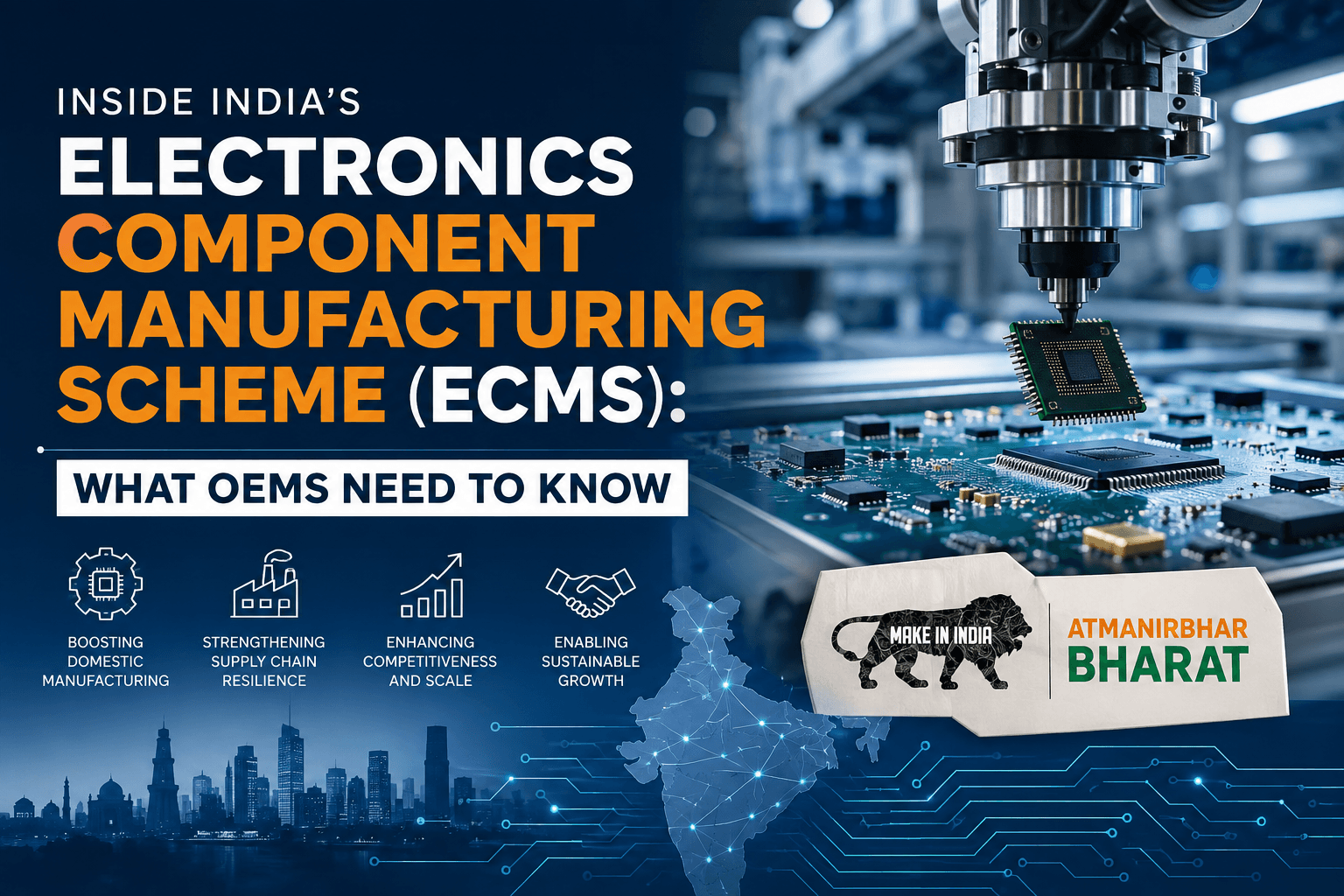
Inside India’s Electronics Component Manufacturing Scheme (ECMS): What OEMs Need to Know
India’s electronics manufacturing sector is moving beyond final assembly. With the Electronics Component Manufacturing Scheme (ECMS), the government is putting more emphasis on building a domestic supply base for components that OEMs have traditionally sourced from overseas.
For OEMs, this matters for more than government incentives. A stronger local component ecosystem could affect sourcing costs, supply-chain resilience, lead times, localization targets, and the economics of setting up or expanding manufacturing operations in India.
The key question is simple: What does ECMS actually mean for OEMs, and how should manufacturers respond?
What is the Electronics Component Manufacturing Scheme?
The Electronics Component Manufacturing Scheme is a Government of India initiative designed to expand domestic production of key electronic components and sub-assemblies.
The broader objective is to strengthen India’s electronics manufacturing ecosystem by encouraging investment in areas where the country remains heavily dependent on imports.
This is an important shift in policy direction.
India has already established itself as a major electronics assembly and manufacturing destination. However, a significant portion of the value chain still depends on imported components, materials, and sub-assemblies.
ECMS is intended to address that gap by making component manufacturing more commercially viable in India.
For OEMs, the eventual benefit is a deeper local supplier network rather than simply another incentive program.
Why ECMS matters to OEMs
OEMs are often the first companies to feel the effects of component supply-chain gaps.
A product can be assembled locally, but if its critical components have to travel thousands of kilometres before reaching the production line, the supply chain remains exposed to:
- International logistics disruptions
- Currency fluctuations
- Import-related costs
- Geopolitical uncertainty
- Longer replenishment cycles
- Minimum order constraints
- Supplier concentration risk
A larger domestic component ecosystem can reduce some of these dependencies.
It can also make it easier for OEMs to increase the percentage of locally sourced inputs over time.
Localization is becoming a strategic issue
For many OEMs, localization is no longer just about reducing landed cost.
It can support faster engineering changes, closer supplier collaboration, shorter logistics routes, and better control over production schedules.
Local suppliers can also make it easier to develop products specifically for the Indian market.
That is particularly relevant in industries such as consumer electronics, automotive electronics, industrial equipment, telecommunications, and appliances.
Which components does ECMS cover?
ECMS focuses on selected components and manufacturing activities that are considered important to the electronics ecosystem.
The scheme covers areas across the component value chain rather than concentrating exclusively on finished electronic products.
Depending on the applicable category and scheme guidelines, this can include areas such as:
- Electronic components
- Sub-assemblies
- Certain materials and manufacturing inputs
- Display-related components
- Camera and related modules
- Certain semiconductor-related components
- Passive components
- Selected high-value electronics manufacturing activities
The exact eligibility criteria, investment requirements, incentives, and performance conditions depend on the relevant category under the scheme.
For OEMs, the practical takeaway is that the value of ECMS is not limited to companies applying for the incentive themselves.
An OEM that does not directly participate in the scheme can still benefit if its existing or prospective suppliers use ECMS support to establish manufacturing capacity in India.
OEMs should look beyond the subsidy
It is tempting to evaluate ECMS purely through the lens of incentives.
That can lead to the wrong strategic conclusion.
For an OEM, the more important question is:
Will ECMS create a supplier base that improves our economics and resilience over the next five to ten years?
That requires looking at several factors together.
1. Total landed cost
Domestic sourcing does not automatically mean lower prices.
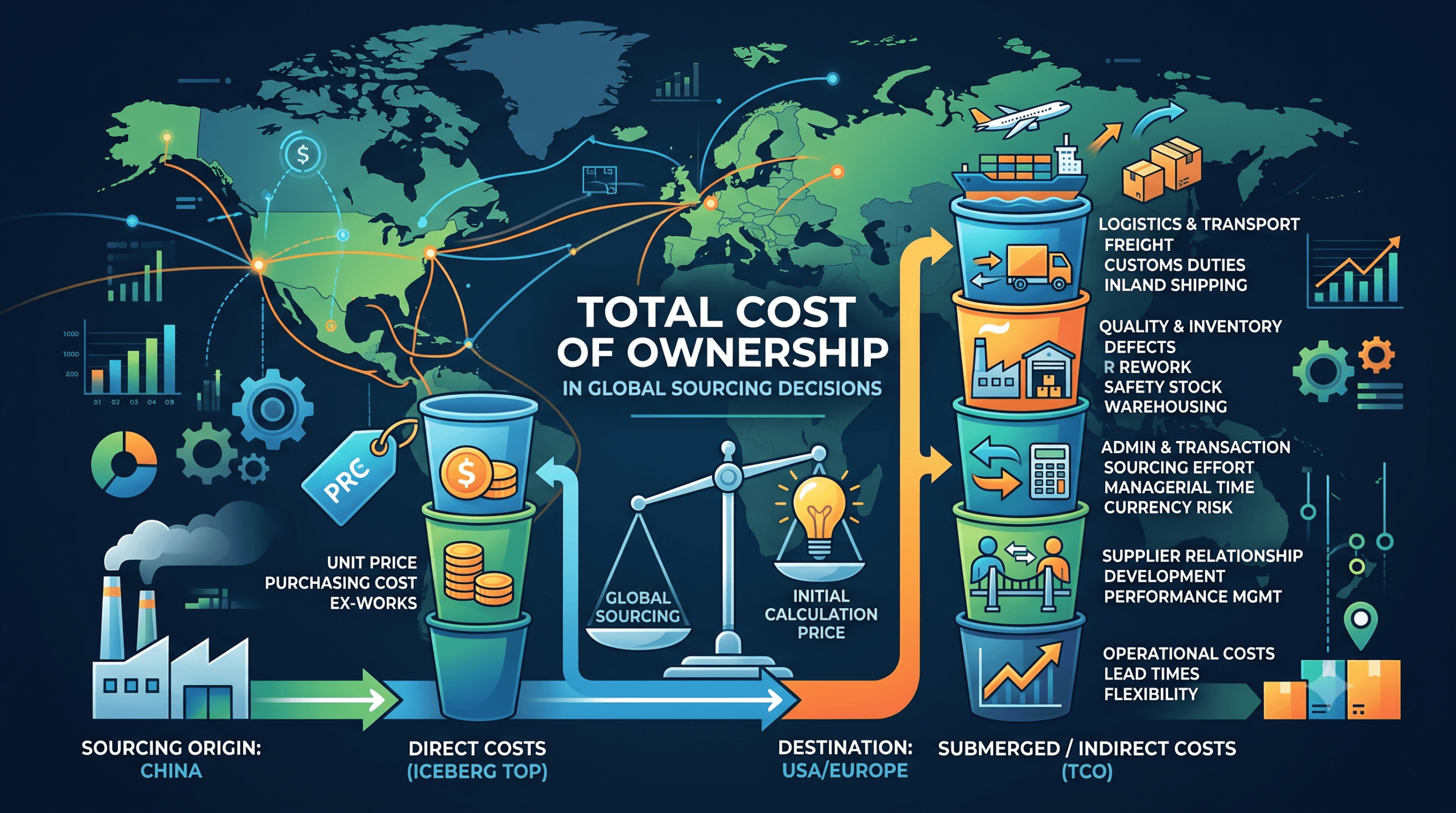
An OEM should compare the complete cost of imported and domestic components, including:
- Freight
- Insurance
- Duties and taxes
- Inventory carrying costs
- Working capital
- Quality-related costs
- Supplier development expenses
- Logistics variability
A component that appears more expensive at the factory gate may still be commercially attractive if it significantly reduces logistics and inventory costs.
2. Supply-chain resilience
The pandemic and subsequent disruptions demonstrated how quickly global electronics supply chains can be affected.
A domestic supplier does not eliminate risk, but it can reduce exposure to certain international disruptions.
OEMs should therefore assess localization as part of their broader supply-chain risk strategy.
3. Lead times
Shorter supply routes can create operational advantages.
For components with volatile demand or frequent engineering changes, reducing replenishment time can help OEMs maintain lower safety stocks without compromising production continuity.
This can be particularly valuable when products have short life cycles.
4. Engineering collaboration
Physical proximity can make supplier collaboration easier.
When an OEM and component manufacturer operate in the same market, engineering teams can potentially work more closely on:
- Design changes
- Product customization
- Failure analysis
- Prototyping
- Quality improvements
- New product introduction
This is harder to achieve when every component is sourced through a distant global supply chain.
ECMS could change supplier strategy
OEM procurement teams should not wait for component manufacturers to announce new capacity before thinking about localization.
Instead, they can identify which components make the most sense to localize first.
A useful approach is to divide components into three groups.
High-priority components
These are components where localization can materially improve cost, availability, or supply-chain resilience.
They should be the first candidates for supplier development or local sourcing.
Strategic components
These may not provide an immediate cost advantage but are important because of their technological value or supply risk.
OEMs may want to develop long-term partnerships with manufacturers entering these categories.
Low-priority components
Some components may remain more economical or practical to source globally.
There is little value in forcing localization simply to increase a localization percentage.
The objective should be a commercially sustainable supply chain, not localization for its own sake.
What OEM procurement teams should evaluate
When evaluating an ECMS-supported supplier, OEMs should go beyond the supplier’s eligibility for government incentives.
The supplier still needs to meet the OEM’s commercial and technical requirements.
Key evaluation areas include:
Capacity: Can the supplier support projected volumes as the OEM scales?
Quality: Does the supplier have the necessary quality systems, testing capabilities, and process controls?
Technology: Is the manufacturing technology competitive with established global suppliers?
Cost: Does the supplier have a credible path to competitive unit economics?
Scalability: Can capacity expand alongside OEM demand?
Financial strength: Can the supplier fund working capital and sustain operations during ramp-up?
Supply continuity: What happens if the supplier experiences a production interruption?
Traceability: Can the supplier provide the required component and production data?
Compliance: Does the supplier meet applicable regulatory, environmental, and customer-specific requirements?
Government support can improve the economics of a manufacturing investment. It does not replace supplier qualification.
The opportunity for supplier partnerships
ECMS could also encourage a different relationship between OEMs and component manufacturers.
Instead of treating component suppliers purely as procurement vendors, OEMs can work with them earlier in the product-development process.
For example, an OEM launching a new product could work with a domestic component manufacturer on specifications, tooling, testing, and production capacity before the product reaches mass production.
This approach can reduce the risk of discovering localization constraints after the product has already been designed around an imported component.
Early engagement also gives suppliers more confidence to invest in dedicated capacity.
What global OEMs should consider
Multinational OEMs operating in India face an additional question: How should India fit into the company’s global sourcing strategy?
ECMS can make India more attractive as part of a broader regional manufacturing network.
But companies should assess India against their existing manufacturing footprint rather than evaluating the incentives in isolation.
Relevant questions include:
- Which components can be sourced competitively from India?
- Can Indian suppliers meet global quality standards?
- Can domestic suppliers eventually export?
- How quickly can suppliers scale?
- Does localization support India’s domestic demand as well as export production?
- Can supplier relationships developed in India be integrated into the company’s global procurement network?
The strongest opportunity may not be replacing every imported component with an Indian alternative.
It may be building a dual-source or multi-country supply chain where Indian suppliers provide an additional source of capacity and resilience.
What Indian OEMs should do now
Indian OEMs can use ECMS as an opportunity to reassess their entire bill of materials.
Start with the components that have the greatest combination of:
- High import dependence
- High annual spend
- Long lead times
- Supply disruption risk
- Potential for competitive domestic production
From there, procurement and engineering teams can identify suppliers that are investing in domestic manufacturing capacity.
OEMs should also involve engineering, quality, finance, and supply-chain teams early.
Localization decisions made entirely by procurement can overlook technical qualification requirements or create unexpected manufacturing constraints.
A practical ECMS readiness checklist for OEMs
OEMs preparing for a more localized component ecosystem can start with a simple review.
Map your imported components.
Identify which parts of the bill of materials are currently dependent on imports.
Rank components by business impact.
Consider spend, lead time, criticality, supply risk, and localization potential.
Identify potential Indian suppliers.
Look for manufacturers with credible technology, capacity plans, quality systems, and financial capability.
Engage suppliers early.
Discuss forecast volumes, technical requirements, qualification timelines, and potential capacity commitments.
Recalculate the economics.
Compare total landed cost rather than simply comparing supplier quotations.
Plan qualification timelines.
New domestic suppliers may require substantial testing, validation, and customer approval before production use.
Build dual sourcing where appropriate.
Localization does not have to mean abandoning established global suppliers. A second source can provide additional resilience.
Track policy changes.
ECMS rules, eligible categories, application windows, incentives, and implementation details can evolve. OEM procurement teams should rely on current government notifications and official scheme documentation when making investment or sourcing decisions.
The bigger picture: India is moving up the electronics value chain
ECMS is part of a broader effort to deepen India’s electronics manufacturing capabilities.
The long-term opportunity is bigger than individual component factories.
If component manufacturers, material suppliers, EMS companies, OEMs, and technology providers develop together, India can move from an assembly-heavy model toward a more integrated electronics manufacturing ecosystem.
For OEMs, that could eventually mean more choices.
More local suppliers.
More competitive sourcing.
Shorter supply chains.
Greater manufacturing flexibility.
And potentially a stronger platform for exports.
But these benefits will not appear automatically.
OEMs will need to actively participate in supplier development, qualification, forecasting, and localization decisions.
What OEMs should take away from ECMS
The most important point is that ECMS should not be viewed simply as a subsidy available to component manufacturers.
For OEMs, it is a signal that India’s electronics supply chain is being built out around the components that sit underneath final products.
That creates an opportunity to rethink sourcing strategies before the market fully matures.
OEMs that map their component dependencies, identify strategic localization opportunities, and engage suppliers early will be better positioned to benefit from this shift.
The question is no longer just whether India can assemble electronics at scale.
It is whether India can build the component ecosystem needed to support the next stage of electronics manufacturing.
ECMS is an important step in that direction.
FAQs
What is ECMS in electronics manufacturing?
The Electronics Component Manufacturing Scheme is a Government of India initiative aimed at encouraging domestic manufacturing of specified electronic components and related manufacturing activities.
Does an OEM need to apply for ECMS to benefit from it?
Not necessarily. OEMs can potentially benefit indirectly as ECMS-supported manufacturers add domestic component capacity and expand the local supplier ecosystem.
How can ECMS help OEM supply chains?
A stronger domestic component base can potentially reduce import dependence, shorten certain supply chains, improve supplier access, and provide additional sourcing options.
Should OEMs completely replace imported components?
No. Localization should be based on commercial, technical, and supply-chain considerations. For some components, global sourcing or dual sourcing may remain the better strategy.
What should OEMs do first?
Start by mapping imported components across the bill of materials and ranking them according to cost, supply risk, lead time, technical criticality, and localization potential.