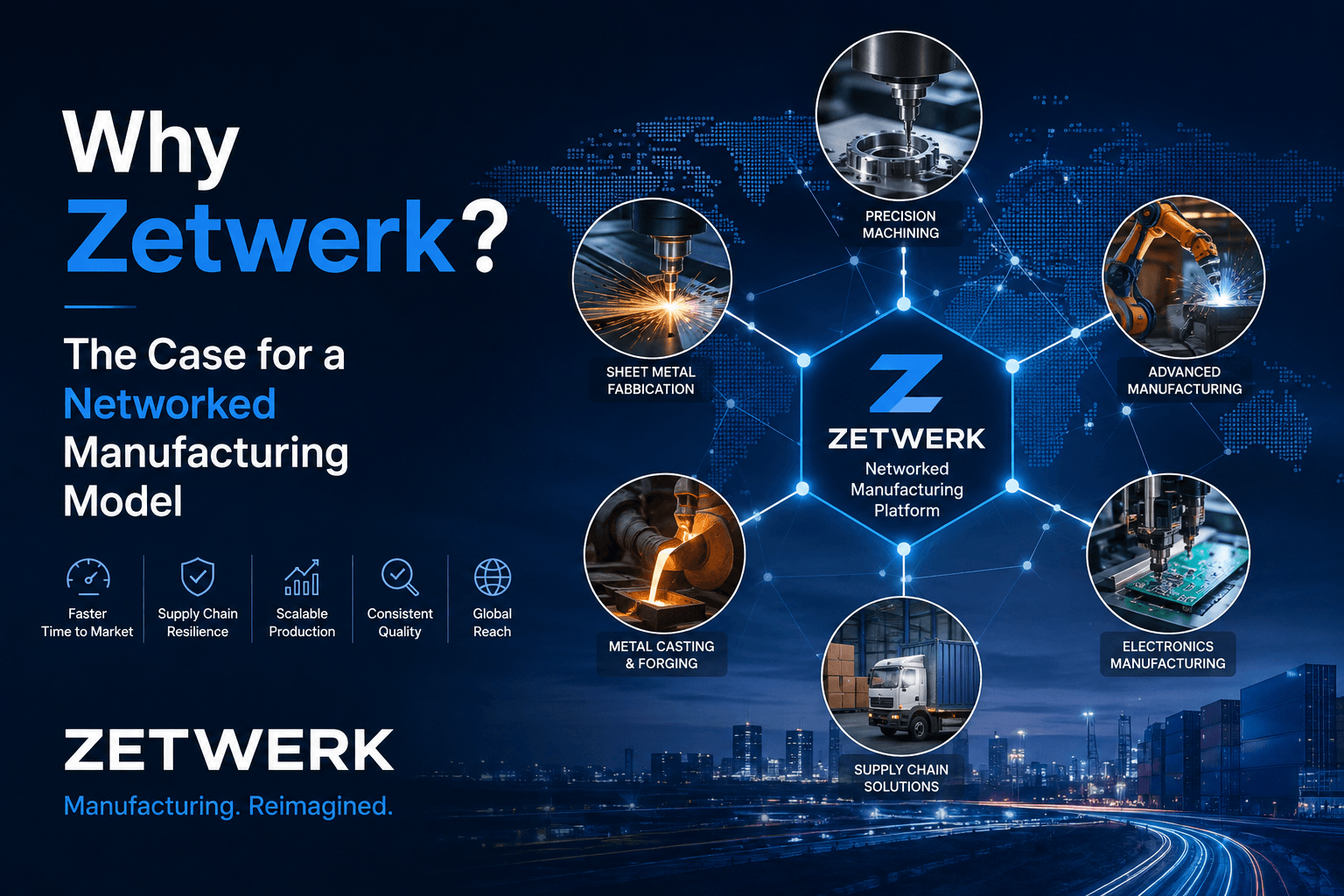
Why Zetwerk? The Case for a Networked Manufacturing Model
Manufacturing has traditionally been built around a simple idea: find the right factory, negotiate the right price, and build a long-term supplier relationship.
That model can work well when demand is predictable and supply chains are stable. But modern manufacturing is rarely that simple.
Companies increasingly need to launch products faster, source across regions, manage volatile demand, reduce dependence on individual suppliers, and maintain consistent quality across increasingly complex production programs.
This is where the networked manufacturing model becomes interesting.
Instead of relying on a single factory or a fixed group of suppliers, a networked manufacturer connects customers to a broader ecosystem of manufacturing capacity, capabilities, technology, quality systems, and logistics. The goal is not simply to find a supplier. It is to coordinate the manufacturing system around the customer’s requirements.
Zetwerk is building its business around this approach.
As of March 31, 2026, Zetwerk says its platform served 1,802 customers, worked with 6,979 third-party suppliers across 26 countries, and operated 26 owned manufacturing facilities across four countries.
The scale matters, but the more important question is why a networked model can be a better way to manufacture.
What is a networked manufacturing model?
A networked manufacturing model connects multiple manufacturing facilities and suppliers through a common operating layer.
In a traditional setup, a buyer might manage:
- Supplier discovery
- RFQs and price negotiations
- Production scheduling
- Quality inspections
- Inventory
- Freight and logistics
- Supplier communication
- Issue resolution
Each supplier may have its own systems, processes, timelines, and reporting methods.
A networked model attempts to put a layer of coordination across those activities.
The manufacturer becomes responsible for matching production requirements with available capacity, coordinating suppliers, monitoring quality, and managing delivery.
The result is closer to a manufacturing network as a service than a conventional supplier relationship.
This distinction is important.
The value of a network does not come simply from having more factories. It comes from being able to coordinate those factories effectively.
Why the traditional factory model is under pressure
The single-supplier model has an obvious advantage: simplicity.
A company knows who makes its parts, where they are produced, and who to contact when something goes wrong.
The problem appears when the assumptions behind that relationship change.
Demand can rise faster than expected. A supplier can run out of capacity. Raw material availability can change. Shipping routes can become less predictable. A customer may suddenly need production closer to a new market.
Moving production is also not easy.
A new supplier has to understand drawings, specifications, tooling, quality requirements, production processes, packaging standards, and delivery expectations. Qualification can take significant time, especially for regulated or high-precision products.
This creates a difficult tradeoff.
Companies want supplier redundancy, but managing dozens of suppliers can create more operational complexity.
A networked manufacturing platform aims to solve that tension by giving the customer access to a broader supplier base while maintaining a centralized operating relationship.
The Zetwerk model: network plus operating layer
Zetwerk describes itself as a technology-led, asset-light manufacturing platform that combines owned facilities with a global supplier network. Its current platform spans sectors including energy, electronics, aerospace and defence, capital goods, commodities, and precision manufacturing.
Its model has two important components.
1. A distributed manufacturing network
The first is physical capacity.
Zetwerk combines owned and operated manufacturing facilities with third-party suppliers. This allows production requirements to be matched with different capabilities, geographies, and capacity pools.
Its capabilities include CNC machining, die casting, forging, injection molding, sheet metal stamping, extrusions, investment casting, prototyping, and assemblies.
For a customer, this can reduce the need to independently build a large supplier ecosystem.
Instead of asking, “Which factory should we use?”, the question becomes, “What is the best manufacturing configuration for this requirement?”
That is a fundamentally different approach.
2. A technology and management layer
The second component is coordination.
Zetwerk’s Manufacturing OS is designed to support sourcing, production, quality, project management, and delivery across its manufacturing network. The company says its technology provides project updates, analytics, tracking, payment capabilities, supplier matching, and other operational functions.
This matters because a manufacturing network without coordination can quickly become a management headache.
The operating layer is what potentially turns distributed capacity into a usable manufacturing system.
1. Faster access to manufacturing capacity
One of the biggest advantages of a networked model is flexibility.
A traditional supplier relationship can become constrained when demand suddenly increases. The supplier may have limited machines, labor, floor space, or production slots.
A network gives the manufacturer more options.
Zetwerk says its combination of partner facilities and a global supplier base allows it to scale production up or down quickly.
For businesses, this can be especially valuable during the transition from prototype to production.
A company may begin with relatively small volumes. If the product gains traction, demand can change rapidly.
The ideal manufacturing partner needs to support that transition without forcing the company to rebuild its supply chain every time production volumes change.
2. Greater supply chain resilience
Resilience is another major argument for networked manufacturing.
A supply chain dependent on one facility has a single point of failure. A disruption at that location can affect the entire production schedule.
A distributed network creates alternatives.
Zetwerk’s manufacturing model is designed around multiple suppliers, facilities, and geographies. The company specifically positions this network as a way to build redundancy and reduce supply chain risk.
This does not mean a network eliminates disruption.
It means the system has more potential paths around a disruption.
That distinction matters. Resilience is not about preventing every problem. It is about reducing the impact when problems occur.
3. Better supplier consolidation for customers
More suppliers do not always mean a better supply chain.
For procurement teams, managing 20 specialized manufacturers can create significant administrative work.
Every additional supplier can introduce another contract, quality process, communication channel, invoice, shipment, and escalation path.
A networked manufacturing platform can consolidate that complexity behind a single relationship.
Instead of coordinating every supplier directly, the customer can work with one manufacturing partner that manages sourcing and production across the network.
Zetwerk describes its project management services as handling activities such as sourcing quotes, supplier management, production tracking, and downstream supply chain issues.
The benefit is not simply fewer suppliers.
It is fewer supplier-management tasks for the customer.
4. Quality becomes a system, not just a supplier promise
Quality is one of the hardest parts of scaling manufacturing.
A component can meet specifications when produced by one supplier and fail when production moves to another facility if processes, equipment, inspection standards, or documentation are inconsistent.
This is one reason manufacturing networks need standardized quality systems.
Zetwerk says its quality processes include inspections throughout production and certifications covering standards such as ISO 9001:2015, IATF 16949:2016, and AS9100D across relevant operations.
The company also describes its Zetwerk Quality Certified process as an additional quality assurance layer before parts are dispatched.
For buyers, the strategic advantage is consistency.
A networked model works best when customers do not have to lower their quality expectations simply because production is being distributed across multiple suppliers.
5. Manufacturing becomes more visible
Traditional manufacturing can involve a surprising amount of uncertainty.
A purchase order has been issued, but where is the production? Has material arrived? Has machining started? Did inspection pass? Is the shipment on schedule?
That lack of visibility becomes more expensive as supply chains become more complicated.
Technology can help create a shared operational view.
Zetwerk says its Manufacturing OS provides visibility into production through project updates, analytics, tracking, and other digital tools.
This changes the role of technology in manufacturing.
It is not simply about automating a factory machine.
It is about creating better information flow between customers, suppliers, quality teams, logistics providers, and manufacturing managers.
6. Geographic flexibility matters more than ever
Manufacturing location has become a strategic decision.
Companies increasingly consider tariffs, shipping costs, regional demand, geopolitical exposure, local content requirements, and proximity to customers when deciding where products should be manufactured.
A fixed factory footprint can make those decisions difficult.
A network gives manufacturers more geographic options.
Zetwerk’s current network includes suppliers across 26 countries and owned manufacturing facilities across four countries, according to company figures as of March 31, 2026.
That geographic reach can help companies evaluate different production configurations instead of treating manufacturing location as a permanent decision.
For global businesses, that flexibility can become a competitive advantage.
7. The model can support the entire manufacturing lifecycle
Another advantage is the ability to connect different stages of production.
Manufacturing rarely starts with mass production.
The journey may look like:
Design → Prototype → Tooling → Pilot Production → Quality Approval → Production → Assembly → Inventory → Distribution
A supplier that only performs one step can still be valuable. But coordinating multiple suppliers across the lifecycle can create handoffs and delays.
Zetwerk positions itself as an end-to-end manufacturing partner, with services spanning prototyping, production, assembly, quality, inventory, supply chain management, and logistics.
This is particularly relevant for companies that are moving from product development into commercial scale.
The manufacturing challenge changes as the product matures. A networked partner can potentially adjust the manufacturing configuration along with it.
What makes the model difficult to replicate?
At first glance, a manufacturing network can sound like a marketplace.
But simply listing thousands of suppliers would not create the same value.
The difficult part is coordination.
A useful network requires:
- Qualified suppliers
- Reliable production data
- Standardized quality processes
- Accurate costing and estimation
- Strong project management
- Supplier performance monitoring
- Logistics coordination
- Digital visibility
- Knowledge of manufacturing processes
Technology can improve those functions, but technology alone does not solve manufacturing problems.
The physical network and operational expertise still matter.
That combination is what makes the model more defensible.
Networked manufacturing vs. traditional outsourcing
It helps to compare the models directly.
| Traditional outsourcing | Networked manufacturing |
|---|---|
| Often centered on one primary supplier | Access to multiple suppliers and facilities |
| Capacity can be constrained by one factory | Capacity can be distributed across a network |
| Buyer manages more supplier relationships | Manufacturing partner can coordinate suppliers |
| Production location is relatively fixed | Production can be configured across locations |
| Supplier visibility may vary | Centralized technology can improve visibility |
| Scaling may require supplier changes | Network can provide additional capacity |
| Resilience depends heavily on supplier redundancy | Network structure can create built-in redundancy |
The networked model is not automatically better for every manufacturing requirement.
A long-term dedicated factory relationship can make sense for highly specialized products, proprietary processes, or extremely stable production volumes.
The advantage appears when flexibility, scale, supplier complexity, and speed are important.
Who benefits most from a networked manufacturing model?
The model is particularly relevant to companies facing one or more of these conditions:
High-growth product companies
Startups and growth-stage manufacturers often have uncertain demand.
They need to move quickly without investing heavily in factories and equipment before product-market fit is established.
Global manufacturers
Companies selling across multiple markets may need more flexibility around production geography, logistics, and regional supply chains.
Procurement teams managing complex categories
When a product contains components from many manufacturing processes, coordinating individual suppliers can consume substantial internal resources.
Companies entering new product categories
A business may have strong product expertise but limited manufacturing expertise in a new category.
A networked partner can provide access to specialized manufacturing capabilities without requiring the company to build that supplier ecosystem from scratch.
Businesses prioritizing resilience
Companies that cannot afford a single point of failure may benefit from diversified production capacity and multiple qualified suppliers.
The real value proposition is not “more factories”
This is perhaps the most important point.
A manufacturing network is not valuable simply because it contains thousands of suppliers.
The value comes from orchestration.
Imagine a company needs 100,000 precision-machined components.
The problem is not merely finding a factory capable of producing them.
The manufacturing partner needs to determine:
- Which suppliers have the right equipment?
- Who has available capacity?
- Which location offers the best landed cost?
- Can the supplier meet the required tolerances?
- What inspection process is required?
- How should production be split?
- What happens if one supplier falls behind?
- Where should inventory be held?
- How should finished components reach the customer?
That is a much more complex problem.
A networked manufacturing model attempts to solve the entire problem rather than only the supplier-selection step.
The business case for Zetwerk
The case for Zetwerk ultimately comes down to a shift in how manufacturing is organized.
The traditional model asks:
Which factory should make this product?
A networked model asks:
What combination of capabilities, suppliers, locations, technology, and logistics will produce this product most effectively?
That difference becomes increasingly important as manufacturing becomes more global and more complex.
Zetwerk’s scale gives the model substance. As of March 2026, the company reported 1,802 customers, 6,979 third-party suppliers across 26 countries, and 26 owned facilities across four countries.
Its technology layer is designed to coordinate that network, while its manufacturing capabilities span everything from precision machining and casting to electronics, assemblies, and larger industrial products.
The result is a manufacturing model built around access, coordination, and flexibility rather than dependence on a single production source.
What companies should evaluate before choosing a networked manufacturer
A networked model sounds attractive, but buyers should still conduct rigorous due diligence.
Before selecting a partner, ask:
- How are suppliers qualified?
Understand the technical, quality, financial, and compliance standards suppliers must meet. - Who owns quality accountability?
Make sure responsibility does not become unclear when multiple suppliers are involved. - How is production visibility provided?
Ask what information you can access during manufacturing, not just after delivery. - How is capacity allocated?
Understand how the manufacturer responds when demand changes or a supplier becomes constrained. - What happens during a disruption?
A resilient network should have defined contingency processes rather than relying on ad hoc supplier switching. - How are costs calculated?
Compare total landed cost, not just the quoted unit price. - Can the partner scale with you?
The right manufacturing relationship should work at prototype volumes and remain useful as production grows.
The future of manufacturing may be less about factories
The manufacturing industry is moving toward a more distributed operating model.
Factories will continue to matter. Machines, skilled workers, engineering expertise, and physical production capacity are still the foundation of manufacturing.
But the ability to coordinate those resources may become just as important.
That is the broader significance of Zetwerk’s approach.
It treats manufacturing capacity as a connected network rather than a collection of isolated factories. Technology provides the coordination layer, while quality systems, supplier relationships, and physical facilities provide the execution layer.
For companies facing volatile demand, complex supply chains, and pressure to launch faster, that combination can offer a compelling alternative to the traditional single-supplier model.
The strongest case for Zetwerk, then, is not simply that it can manufacture more products.
It is that manufacturing itself can become more flexible, distributed, and software-coordinated.
And as supply chains become harder to predict, that flexibility may be one of the most valuable capabilities a manufacturing partner can provide.
FAQs
What is Zetwerk?
Zetwerk is a technology-led manufacturing platform that connects customers with manufacturing capabilities across a network of owned facilities and third-party suppliers. Its services cover areas including precision manufacturing, electronics, energy, capital goods, aerospace and defence, commodities, assemblies, quality, inventory, and supply chain management.
What is networked manufacturing?
Networked manufacturing is a model where multiple manufacturing facilities and suppliers are coordinated through a common operating and technology layer. Instead of depending on one factory, companies can access a broader pool of manufacturing capacity and capabilities.
How is Zetwerk different from a traditional contract manufacturer?
A traditional contract manufacturer may operate primarily around its own facilities and production capacity. Zetwerk combines owned manufacturing facilities with a broader supplier network and uses technology and project management processes to coordinate manufacturing across that network.
Does Zetwerk manufacture products itself?
Yes. Zetwerk operates its own manufacturing facilities while also working with third-party suppliers. The company reported 26 owned manufacturing facilities across four countries as of March 31, 2026.
What are the benefits of networked manufacturing?
Potential benefits include greater access to production capacity, supplier diversification, geographic flexibility, faster scaling, centralized project management, improved production visibility, and stronger supply chain resilience.
Is a networked manufacturing model right for every company?
Not necessarily. Companies with highly specialized production requirements, stable volumes, or deeply integrated proprietary manufacturing processes may prefer dedicated supplier relationships. Networked manufacturing is most compelling when flexibility, scalability, supplier complexity, or supply chain resilience are strategic priorities.
Key Takeaway
The manufacturing industry does not have to choose between owning every factory and managing a fragmented supplier base.
A networked manufacturing model offers a third option: connect distributed manufacturing capacity through a centralized operating layer.
That is the core idea behind Zetwerk.
For companies trying to reduce manufacturing complexity while gaining access to broader capabilities, capacity, and geographies, the model is worth serious consideration.