
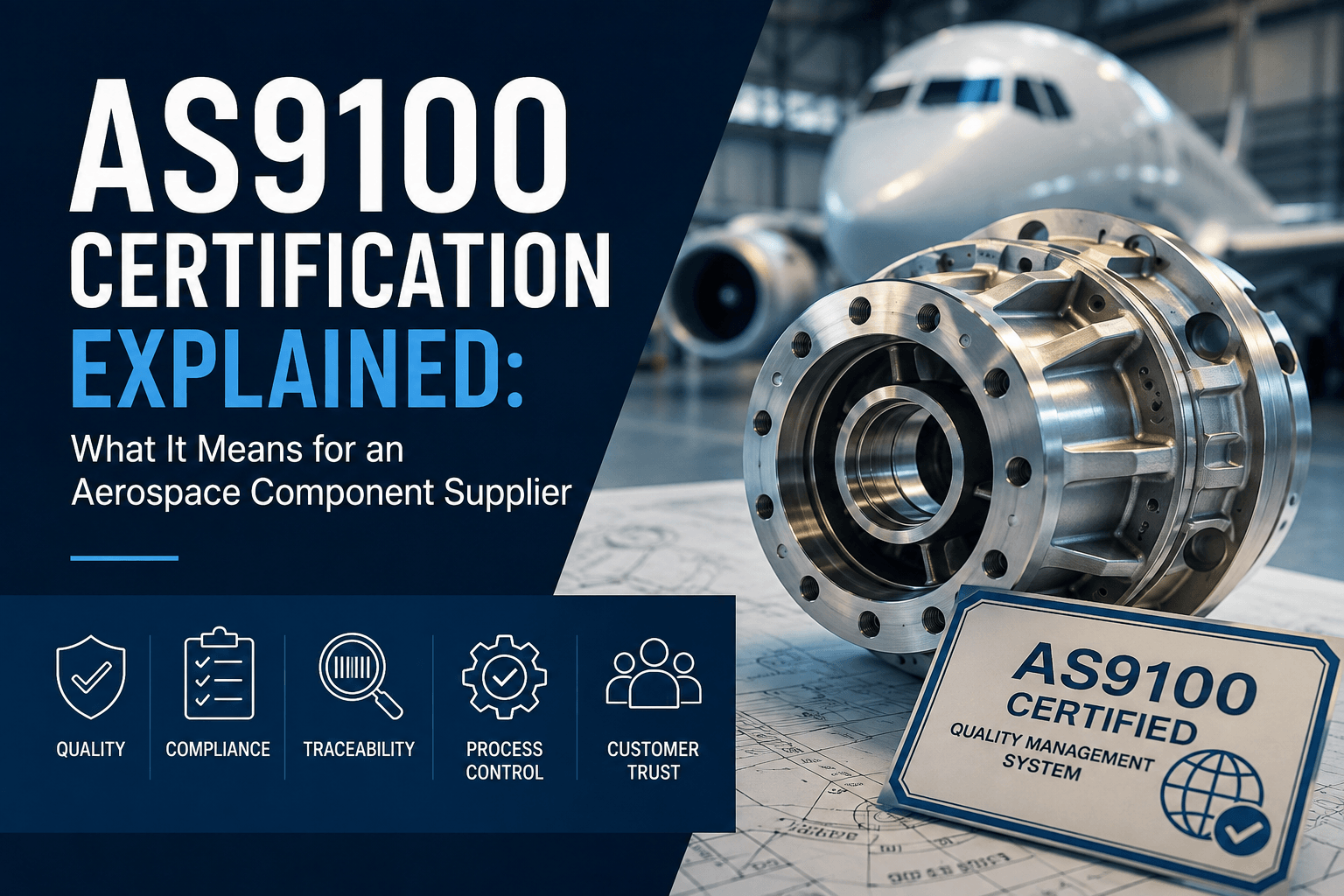
AS9100 Certification Explained: What It Means for an Aerospace Component Supplier
For an aerospace component supplier, quality is not simply about producing parts that meet a drawing. Customers need confidence that the supplier has a controlled, repeatable system for managing quality, risk, traceability, and compliance.
That is where AS9100 certification comes in.
AS9100 is the internationally recognized quality management standard for the aerospace, aviation, and defense industry. It builds on ISO 9001 requirements and adds controls designed around the risks and demands of aerospace manufacturing and supply chains.
For suppliers, certification can be an important qualification when pursuing aerospace contracts. It also signals that quality management is built into the company’s processes rather than relying solely on final inspection.
What is AS9100 certification?
AS9100 is a quality management system standard developed for organizations that design, manufacture, maintain, or otherwise provide products and services for the aviation, space, and defense sectors.
The standard incorporates the requirements of ISO 9001, with additional aerospace-specific requirements.
In practical terms, AS9100 requires an organization to establish controlled processes for areas such as:
- Quality planning
- Risk management
- Configuration management
- Product safety
- Supplier management
- Production controls
- Inspection and testing
- Traceability
- Nonconformance management
- Corrective action
- Change management
- Internal audits
- Employee competence
The goal is not simply to produce a compliant component once. It is to demonstrate that the organization has a reliable system for producing conforming products consistently.
Why AS9100 matters to aerospace component suppliers
Aerospace components often operate in environments where a quality issue can have consequences far beyond one rejected part.
A supplier may need to demonstrate exactly which material was used, which process was followed, who performed an inspection, which equipment was used, and whether the product met specified requirements.
AS9100 provides a framework for controlling these activities.
1. It can be a customer requirement
Many aerospace and defense organizations expect their suppliers to operate under an AS9100-certified quality management system, particularly for higher-risk or more complex work.
Certification does not automatically qualify a supplier for every contract. Customers can still impose additional requirements, audits, approvals, or technical specifications.
However, without the appropriate quality certification, a supplier may be excluded from opportunities before technical capabilities are even evaluated.
2. It strengthens process control
Aerospace manufacturing involves numerous interconnected processes. Machining, forming, heat treatment, surface finishing, inspection, packaging, and other activities may involve different personnel and external suppliers.
AS9100 encourages suppliers to define and control these processes rather than relying on informal practices.
That creates greater consistency from one production run to the next.
3. It supports traceability
Traceability is particularly important when components must be linked to specific materials, batches, processes, inspections, or production records.
For example, a supplier may need to trace a machined component back to its material certificate and manufacturing records.
A strong quality management system makes that information easier to control and retrieve.
4. It helps manage supply chain risk
Aerospace suppliers rarely operate in isolation. A component may depend on an outside processor, material supplier, calibration provider, or testing laboratory.
AS9100 includes requirements around external providers and purchasing controls.
The supplier therefore needs a process for determining what controls are appropriate for externally provided products and services, rather than treating every supplier relationship the same way.
What does an AS9100 audit look at?
An AS9100 certification audit examines whether the organization’s quality management system meets the standard’s requirements and whether those processes are actually implemented.
Auditors may review areas such as:
Leadership and quality objectives: Are management and employees aligned around quality requirements and business objectives?
Risk management: Does the organization identify and address risks that could affect product conformity or delivery?
Operational controls: Are manufacturing and inspection activities properly planned and controlled?
Supplier controls: Does the company evaluate and monitor external providers appropriately?
Documented information: Are important records controlled, maintained, and available when needed?
Nonconformities and corrective action: When something goes wrong, does the organization identify the cause and take effective corrective action?
Internal audits: Does the company regularly evaluate whether its own processes are working as intended?
Continual improvement: Does the organization use performance data, audit results, customer feedback, and other information to improve its processes?
An auditor is not simply looking for a collection of procedures. The important question is whether the quality management system works in practice.
AS9100 vs. ISO 9001
AS9100 and ISO 9001 are closely related, but they are not interchangeable.
ISO 9001 provides a general quality management framework that can apply to organizations across many industries. AS9100 incorporates ISO 9001 requirements and adds requirements specific to aviation, space, and defense.
For an aerospace component supplier, the distinction matters.
A company may have an ISO 9001-certified quality management system and still need AS9100 certification to meet a particular customer’s aerospace requirements.
The appropriate certification depends on the markets the supplier serves and the requirements imposed by its customers and contracts.
What AS9100 does not mean
AS9100 certification is valuable, but it is important not to overstate what it represents.
It does not certify every individual component. Certification applies to the organization’s quality management system and its defined scope.
It does not replace product specifications. Components still need to meet applicable drawings, specifications, customer requirements, and regulatory obligations.
It does not guarantee zero defects. No quality management system can eliminate every potential error.
It does not automatically make a supplier approved by every aerospace customer. Customers may have their own supplier qualification processes and requirements.
Understanding these distinctions helps buyers interpret an AS9100 certificate correctly.
What should buyers look for in an AS9100-certified supplier?
If you are evaluating an aerospace component supplier, the certification itself is only one part of the assessment.
Consider looking at:
- The scope of the supplier’s certification
- Whether the certification is current
- The processes and facilities covered by the certification
- Relevant manufacturing and inspection capabilities
- Experience with similar aerospace components
- Material and product traceability practices
- Supplier and subcontractor controls
- Calibration and inspection systems
- Nonconformance and corrective-action processes
- Customer-specific and regulatory requirements the supplier can support
It is also worth asking how the supplier’s quality system connects with day-to-day production.
A well-run QMS should not exist as a separate administrative function. It should be visible in purchasing, production, inspection, documentation, shipping, and customer communication.
How AS9100 can benefit an aerospace supplier
Certification can require significant effort, particularly when a company needs to formalize processes that previously depended on individual knowledge.
But the resulting discipline can create operational benefits beyond certification itself.
Better process control can reduce avoidable variation. Stronger traceability can make investigations faster. Structured corrective action can help prevent recurring problems. Clear supplier controls can reduce supply chain surprises.
The commercial benefit can be just as important.
For an aerospace component supplier competing for new business, a recognized quality management certification can provide evidence that the organization understands the quality expectations of the industry.
The Bottom Line
For an aerospace component supplier, AS9100 certification is more than a quality badge.
It demonstrates that the company has established a structured quality management system designed to address the higher levels of control, traceability, risk management, and process discipline expected across the aerospace supply chain.
Certification alone does not guarantee product quality or make a supplier suitable for every application. But when supported by strong manufacturing capabilities, experienced personnel, reliable inspection, and consistent process control, AS9100 can give aerospace customers greater confidence in the supplier behind the component.
Frequently Asked Questions
Is AS9100 mandatory for aerospace suppliers?
Not universally. AS9100 is a voluntary industry standard, but individual aerospace and defense customers may require suppliers to hold certification as part of their qualification or contracting requirements.
Is AS9100 the same as ISO 9001?
No. AS9100 incorporates ISO 9001 requirements and adds requirements tailored to the aviation, space, and defense industries.
Does AS9100 guarantee product quality?
No. Certification demonstrates conformity of the organization’s quality management system to the applicable standard. Products must still meet their specific technical and customer requirements.
How long does AS9100 certification last?
Certification is maintained through ongoing surveillance and recertification activities. The exact audit cycle depends on the certification arrangement and applicable certification rules.
Should an aerospace machine shop have AS9100 certification?
If the machine shop wants to serve aerospace customers, particularly customers that specify AS9100 certification, obtaining certification can be commercially important. The decision should be based on target customers, contract requirements, scope of work, and the company’s quality objectives.