
Wind Turbine Components: A Manufacturing Breakdown (Onshore & Offshore)
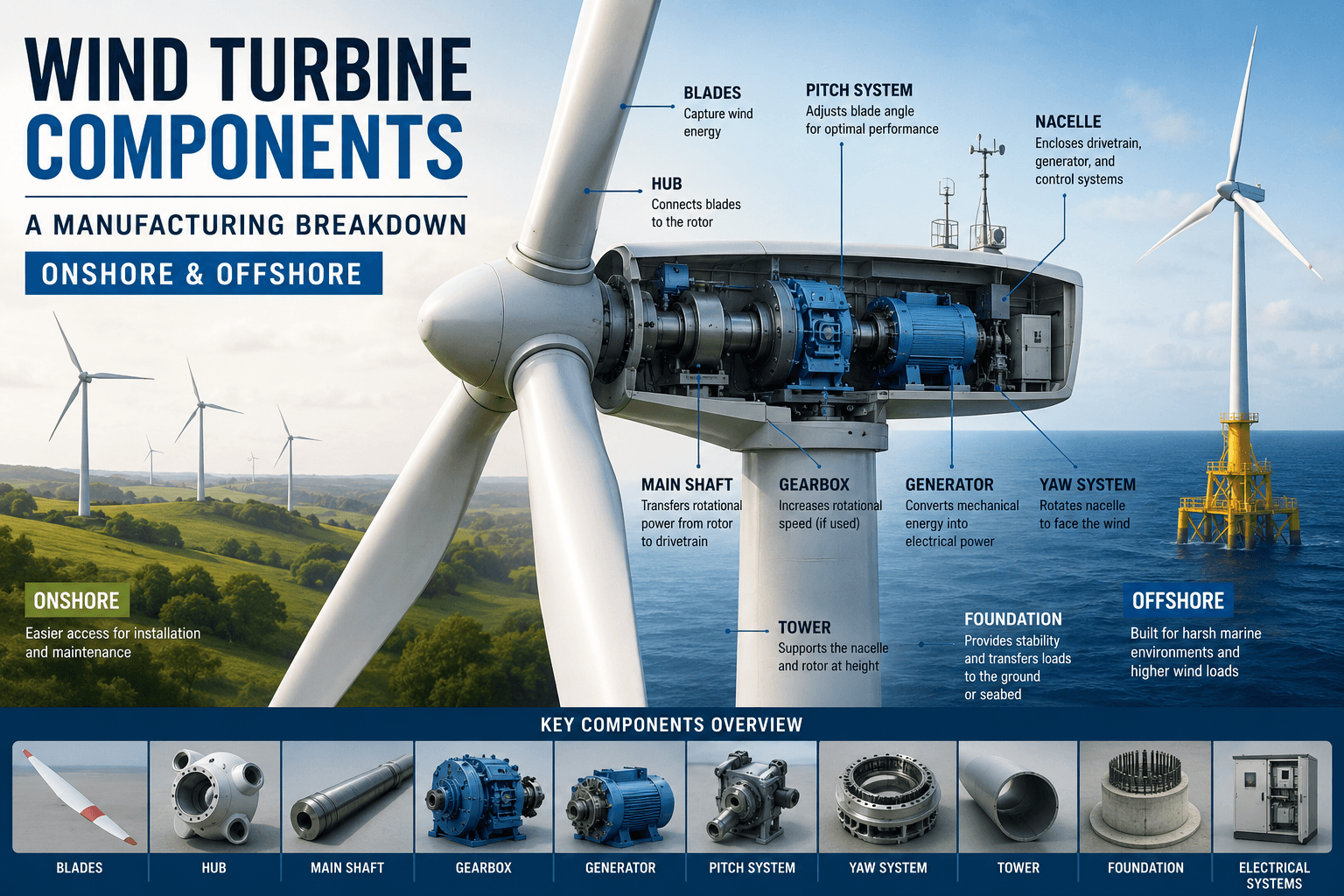
Wind turbines may look simple from a distance, but each one is built from thousands of precision-engineered parts that must withstand decades of continuous operation. Whether installed on land or at sea, every component plays a role in converting wind into reliable electricity.
While onshore and offshore turbines share the same core design, offshore installations demand larger structures, stronger materials, and tighter manufacturing tolerances to survive harsh marine environments. These differences influence everything from component selection to fabrication, testing, transportation, and maintenance.
This guide explains the major wind turbine components, how they are manufactured, and where onshore and offshore designs differ.
Wind Turbine Components at a Glance
A modern wind turbine consists of several major systems:
- Rotor blades
- Hub
- Nacelle
- Main shaft
- Gearbox (where applicable)
- Generator
- Power electronics
- Yaw system
- Pitch system
- Tower
- Foundation
- Electrical infrastructure
- Monitoring and control systems
Each subsystem requires specialized manufacturing processes and quality inspections before final assembly.
Rotor Blades
Rotor blades capture wind energy and convert it into rotational motion. They are among the largest composite structures manufactured today.
Manufacturing Process
Blade production typically involves:
- Mold preparation
- Fiberglass or carbon fiber layup
- Resin infusion
- Vacuum curing
- Structural bonding
- Surface finishing
- Lightning protection installation
- Balance and dimensional testing
Manufacturers increasingly use carbon fiber reinforcement in longer blades because it delivers high stiffness with lower weight.
Onshore vs Offshore
Onshore blades generally range from 40 to 80 meters, while offshore blades commonly exceed 100 meters. Larger offshore blades require more advanced composite materials, stricter quality control, and specialized transport solutions.
Hub
The hub connects the blades to the main shaft and transfers aerodynamic loads into the drivetrain.
Most hubs are manufactured from ductile cast iron or forged steel using:
- Precision casting or forging
- Heat treatment
- CNC machining
- Surface coating
- Non-destructive inspection
Because offshore turbines experience higher wind loads, hub designs often feature thicker walls and increased corrosion protection.
Nacelle
The nacelle houses the drivetrain, generator, braking system, cooling equipment, and control electronics.
Major manufacturing activities include:
- Steel frame fabrication
- Precision machining
- Mechanical assembly
- Electrical integration
- Factory acceptance testing
Offshore nacelles receive enhanced sealing systems and corrosion-resistant coatings to protect against saltwater exposure.
Main Shaft
The main shaft transfers rotational energy from the rotor into the gearbox or direct-drive generator.
Production typically includes:
- Steel forging
- Heat treatment
- CNC machining
- Surface hardening
- Ultrasonic inspection
- Dynamic balancing
Given the higher loads in offshore applications, shafts are generally larger and designed for longer fatigue life.
Gearbox
Many turbines use multi-stage gearboxes to increase rotational speed before power reaches the generator.
Manufacturing involves:
- Precision gear cutting
- Heat treatment
- Grinding
- Bearing installation
- Lubrication system assembly
- Performance testing
Although direct-drive turbines eliminate the gearbox, geared systems remain widely used because they can reduce generator size and weight.
Generator
The generator converts mechanical rotation into electrical energy.
Common manufacturing steps include:
- Rotor and stator production
- Copper winding
- Magnet installation
- Insulation
- Electrical testing
- Dynamic balancing
Large offshore turbines increasingly use permanent magnet generators due to their efficiency and reduced maintenance requirements.
Pitch System
The pitch system adjusts blade angles to maximize energy production while protecting the turbine during high winds.
Components include:
- Electric or hydraulic actuators
- Bearings
- Gear drives
- Controllers
- Sensors
Manufacturing focuses on precision machining and extensive functional testing to ensure reliable operation.
Yaw System
The yaw system rotates the nacelle so the rotor continuously faces the wind.
Typical components include:
- Yaw bearings
- Electric motors
- Drive gears
- Braking systems
- Position sensors
Large offshore turbines often incorporate redundant yaw drives to improve reliability and minimize maintenance visits.
Tower
The tower supports the nacelle and rotor while resisting wind and dynamic loading.
Manufacturing Process
Tower fabrication generally includes:
- Steel plate rolling
- Longitudinal welding
- Flange attachment
- Surface blasting
- Protective coating
- Dimensional inspection
Some manufacturers also produce hybrid concrete-steel towers for taller onshore installations.
Offshore Towers
Offshore towers use thicker steel sections and advanced marine coatings to resist corrosion and wave-induced fatigue.
Foundations
Foundation design depends heavily on installation location.
Onshore Foundations
Most onshore turbines use reinforced concrete foundations consisting of:
- Excavation
- Reinforcement placement
- Anchor cage installation
- Concrete pouring
- Curing
- Final inspection
Offshore Foundations
Offshore foundations vary depending on water depth and seabed conditions.
Common designs include:
- Monopiles
- Jackets
- Gravity-based structures
- Floating platforms
Manufacturing these structures requires heavy steel fabrication, robotic welding, corrosion protection, and rigorous structural testing.
Electrical Systems
Wind turbines include extensive electrical infrastructure that manages power conversion and grid integration.
Major components include:
- Transformers
- Switchgear
- Inverters
- Power converters
- Cables
- Protection systems
Manufacturing emphasizes insulation quality, thermal performance, and compliance with international electrical standards.
Sensors and Control Systems
Modern turbines rely on thousands of sensor readings every second.
Typical monitoring systems include:
- Wind sensors
- Vibration sensors
- Temperature monitoring
- Oil condition monitoring
- Blade load measurement
- Remote diagnostics
These systems improve energy production while supporting predictive maintenance strategies.
Materials Used in Wind Turbine Manufacturing
Different components require specialized materials to balance strength, weight, durability, and cost.
| Component | Primary Materials |
|---|---|
| Blades | Fiberglass, carbon fiber, epoxy resin |
| Hub | Cast iron, forged steel |
| Shaft | Alloy steel |
| Gearbox | Hardened steel |
| Generator | Copper, electrical steel, permanent magnets |
| Tower | Structural steel |
| Foundation | Reinforced concrete or structural steel |
| Electrical Systems | Copper, aluminum, insulation materials |
Material selection becomes even more critical for offshore turbines because of corrosion, fatigue, and environmental exposure.
Manufacturing Challenges
Wind turbine manufacturers face several technical challenges, including:
- Producing increasingly larger components
- Maintaining tight machining tolerances
- Controlling composite manufacturing quality
- Reducing transportation constraints
- Improving corrosion resistance
- Meeting international certification requirements
- Managing supply chain complexity
Automation, robotics, digital twins, and advanced inspection technologies are helping manufacturers improve consistency while reducing production costs.
Onshore vs Offshore Manufacturing Comparison
| Feature | Onshore | Offshore |
| Turbine Size | Medium to large | Very large |
| Blade Length | Typically shorter | Typically longer |
| Corrosion Protection | Standard industrial coatings | Marine-grade coatings |
| Foundation | Reinforced concrete | Steel monopiles, jackets, floating systems |
| Transportation | Road transport | Heavy-lift vessels and ports |
| Maintenance Access | Easier | More complex and weather-dependent |
| Manufacturing Cost | Lower | Higher |
Future Trends in Wind Turbine Manufacturing
The next generation of wind turbines will continue pushing manufacturing capabilities through:
- Larger modular blades
- Increased use of recyclable composite materials
- Additive manufacturing for selected components
- AI-driven quality inspection
- Robotic welding and machining
- Smart factories with real-time production monitoring
- Digital twins for manufacturing and lifecycle optimization
These innovations aim to reduce production costs while improving reliability, sustainability, and energy output.
Key Takeaways
Wind turbines are sophisticated machines built from highly engineered components that must operate reliably for decades. Although onshore and offshore turbines share the same fundamental architecture, offshore manufacturing requires larger components, enhanced corrosion resistance, and stricter quality standards to withstand demanding marine conditions.
As turbines continue to grow in size and efficiency, advances in materials, automation, and precision manufacturing will remain central to reducing costs and supporting the global expansion of renewable energy.
FAQs
Q. What are the main components of a wind turbine?
The primary components include the rotor blades, hub, nacelle, main shaft, gearbox (if used), generator, tower, foundation, pitch system, yaw system, electrical systems, and monitoring controls.
Q. Why are offshore wind turbine components more expensive?
Offshore components require larger dimensions, stronger materials, marine-grade corrosion protection, and more rigorous testing, all of which increase manufacturing complexity and cost.
Q. What materials are commonly used in wind turbine manufacturing?
Steel, fiberglass, carbon fiber, reinforced concrete, copper, aluminum, and epoxy resins are among the most common materials used across different turbine components.
Q. Do all wind turbines use gearboxes?
No. Direct-drive turbines eliminate the gearbox and connect the rotor directly to the generator, reducing mechanical complexity while increasing generator size.