
ISO 13485 and Quality Systems for Medical Device Manufacturing
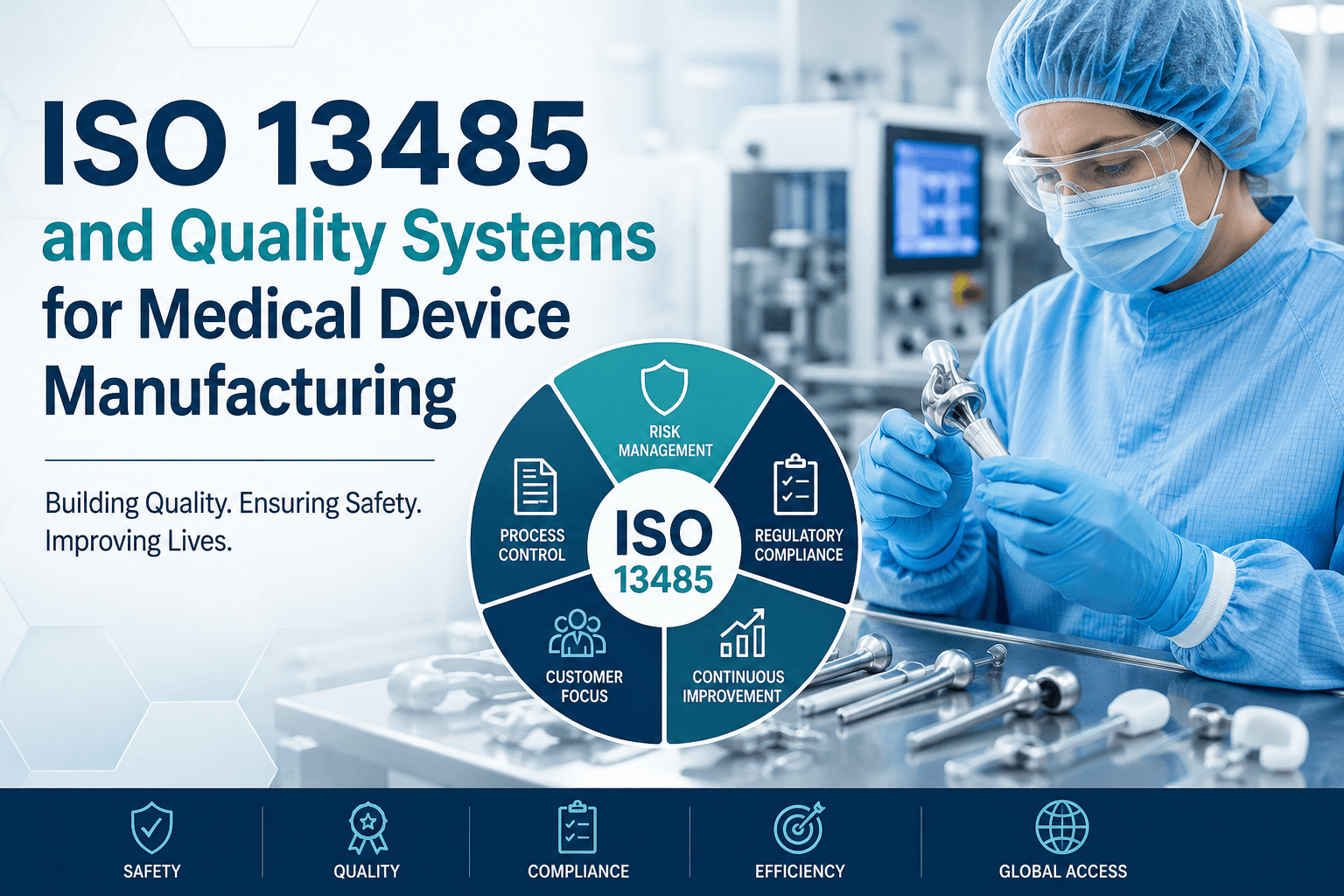
Medical devices must consistently meet strict safety, performance, and regulatory requirements. Whether a company manufactures surgical instruments, diagnostic equipment, implants, or software as a medical device (SaMD), maintaining a reliable quality management system (QMS) is essential.
ISO 13485 is the internationally recognized standard for quality management systems in the medical device industry. It provides a structured framework that helps manufacturers design, produce, distribute, and service medical devices while meeting regulatory requirements and reducing quality risks.
This guide explains what ISO 13485 is, why it matters, and how manufacturers can build an effective quality system that supports compliance and business growth.
What Is ISO 13485?
ISO 13485 is an international standard that specifies requirements for a quality management system used by organizations involved in the medical device lifecycle. It applies to manufacturers as well as suppliers, contract manufacturers, sterilization providers, distributors, and service organizations.
Unlike general quality standards, ISO 13485 focuses on:
- Product safety and effectiveness
- Regulatory compliance
- Risk management throughout product realization
- Process validation
- Traceability
- Documented quality controls
The latest version, ISO 13485:2016, aligns with regulatory expectations across many global markets, including the European Union, Canada, Australia, Japan, and several other regions.
Why ISO 13485 Matters
Medical devices directly affect patient health. Even minor manufacturing defects can lead to product recalls, regulatory action, or patient harm.
Implementing ISO 13485 helps organizations:
- Improve product quality and consistency
- Demonstrate regulatory compliance
- Reduce manufacturing defects
- Strengthen supplier management
- Improve customer confidence
- Simplify market access in many countries
- Support FDA and international regulatory expectations
Certification also demonstrates that an organization has established systematic controls for quality rather than relying on inspection alone.
Core Elements of an ISO 13485 Quality Management System
A compliant quality system integrates quality into every stage of the product lifecycle.
Document Control
Controlled documentation ensures employees always work from current procedures, specifications, and work instructions.
Typical controlled documents include:
- Quality manual
- Standard operating procedures (SOPs)
- Work instructions
- Device master records
- Forms and templates
- Validation reports
- Design documentation
Document revisions must be reviewed, approved, and traceable.
Risk Management
Risk management is integrated throughout the quality system rather than treated as a separate activity.
Manufacturers identify potential hazards, evaluate associated risks, implement mitigation measures, and verify that controls remain effective throughout the product lifecycle.
Risk management often follows ISO 14971, the international standard for medical device risk management.
Design and Development Controls
Organizations developing medical devices must maintain structured design controls.
These include:
- Design planning
- User requirements
- Design inputs
- Design outputs
- Design verification
- Design validation
- Design reviews
- Design transfer
- Design change management
Proper documentation demonstrates that products meet intended use and regulatory requirements.
Supplier Quality Management
Many manufacturers rely on external suppliers for components, raw materials, sterilization, packaging, or contract manufacturing.
ISO 13485 requires organizations to:
- Evaluate suppliers before approval
- Monitor supplier performance
- Define purchasing requirements
- Verify incoming materials
- Maintain supplier records
Supplier quality directly impacts final device safety.
Production and Process Controls
Manufacturing processes must consistently produce devices that meet specifications.
Key controls include:
- Process validation
- Equipment calibration
- Environmental monitoring
- Cleanroom controls
- Manufacturing instructions
- Operator training
- In-process inspections
Processes that cannot be fully verified through inspection alone must be validated.
Corrective and Preventive Action (CAPA)
CAPA helps organizations identify quality issues, investigate root causes, implement corrective actions, and prevent recurrence.
Common CAPA inputs include:
- Customer complaints
- Internal audits
- Product nonconformities
- Process deviations
- Regulatory findings
- Supplier issues
An effective CAPA system drives continuous improvement while reducing future quality risks.
Complaint Handling and Post-Market Surveillance
Quality management extends beyond manufacturing.
Manufacturers should establish procedures for:
- Receiving customer complaints
- Investigating reported issues
- Determining reportability
- Trend analysis
- Field corrective actions
- Product recalls when necessary
These activities help identify emerging risks and support regulatory compliance.
Validation Requirements
Validation demonstrates that critical processes consistently produce the intended results.
Typical validation activities include:
- Process validation
- Software validation
- Equipment qualification
- Cleaning validation
- Sterilization validation
- Packaging validation
- Test method validation
Validation records provide objective evidence during regulatory inspections and certification audits.
Internal Audits
Internal audits verify that the quality system operates as intended.
Auditors evaluate:
- Compliance with documented procedures
- Regulatory requirements
- Effectiveness of processes
- Opportunities for improvement
- Employee adherence to quality practices
Audit findings often generate corrective actions that strengthen the QMS before external inspections.
Management Responsibility
Leadership plays a central role in ISO 13485 compliance.
Top management is responsible for:
- Establishing quality objectives
- Providing adequate resources
- Reviewing QMS performance
- Promoting quality culture
- Supporting regulatory compliance
- Driving continual improvement
Management reviews should evaluate quality metrics, audit findings, complaints, CAPA status, supplier performance, and business risks.
Benefits of ISO 13485 Certification
Certification provides both regulatory and operational advantages.
Organizations often experience:
- Improved manufacturing consistency
- Better documentation practices
- Reduced quality costs
- Stronger supplier oversight
- Lower risk of recalls
- Increased customer trust
- Easier entry into international markets
- Greater readiness for regulatory inspections
While certification itself does not guarantee regulatory approval, it demonstrates a mature and well-managed quality system.
Common Implementation Challenges
Many organizations encounter similar obstacles during implementation.
These include:
- Managing extensive documentation
- Training employees across departments
- Integrating risk management into daily operations
- Maintaining complete design history files
- Validating manufacturing processes
- Controlling supplier quality
- Keeping documentation current during product changes
Successful implementation requires collaboration across engineering, manufacturing, quality assurance, regulatory affairs, and executive leadership.
Best Practices for Maintaining Compliance
Maintaining ISO 13485 certification requires ongoing effort.
Organizations should:
- Review procedures regularly
- Conduct scheduled internal audits
- Monitor quality performance indicators
- Maintain employee training records
- Review supplier performance
- Update risk assessments
- Perform management reviews
- Prepare for surveillance audits
- Encourage continuous improvement
A proactive approach helps organizations remain inspection-ready while improving operational efficiency.
The Relationship Between ISO 13485 and Regulatory Compliance
Although ISO 13485 is a voluntary international standard in many jurisdictions, regulators frequently recognize or reference it as a benchmark for quality management.
For example:
- Many manufacturers use ISO 13485 to support compliance with European medical device regulations.
- Canada incorporates ISO 13485 certification into its Medical Device Single Audit Program (MDSAP) framework.
- Many organizations align their ISO 13485 quality system with U.S. FDA Quality Management System expectations to streamline compliance activities.
A well-implemented QMS makes it easier to meet multiple regulatory requirements without creating separate quality systems for each market.
Frequently Asked Questions
Q. Is ISO 13485 mandatory?
Not universally. However, certification is often expected by regulators, customers, and distributors, particularly for companies selling medical devices internationally.
Q. Who should implement ISO 13485?
Manufacturers, contract manufacturers, component suppliers, sterilization providers, testing laboratories, distributors, and organizations involved in the medical device lifecycle can benefit from implementing ISO 13485.
Q. How long does ISO 13485 certification take?
Implementation timelines vary based on company size, product complexity, and the maturity of existing quality systems. Many organizations require several months to prepare for certification.
Q. Does ISO 13485 apply to software medical devices?
Yes. Organizations developing software as a medical device (SaMD) can implement ISO 13485 to establish quality processes that support development, validation, maintenance, and regulatory compliance.
Key Takeaways
ISO 13485 provides a comprehensive framework for building and maintaining a quality management system tailored to the medical device industry. By emphasizing risk management, documentation, process control, supplier oversight, and continual improvement, the standard helps manufacturers produce safe, effective, and compliant products.
For organizations operating in highly regulated markets, ISO 13485 is more than a certification. It serves as the foundation for consistent quality, regulatory readiness, and long-term business success.