
Total Cost of Ownership in Global Sourcing Decisions
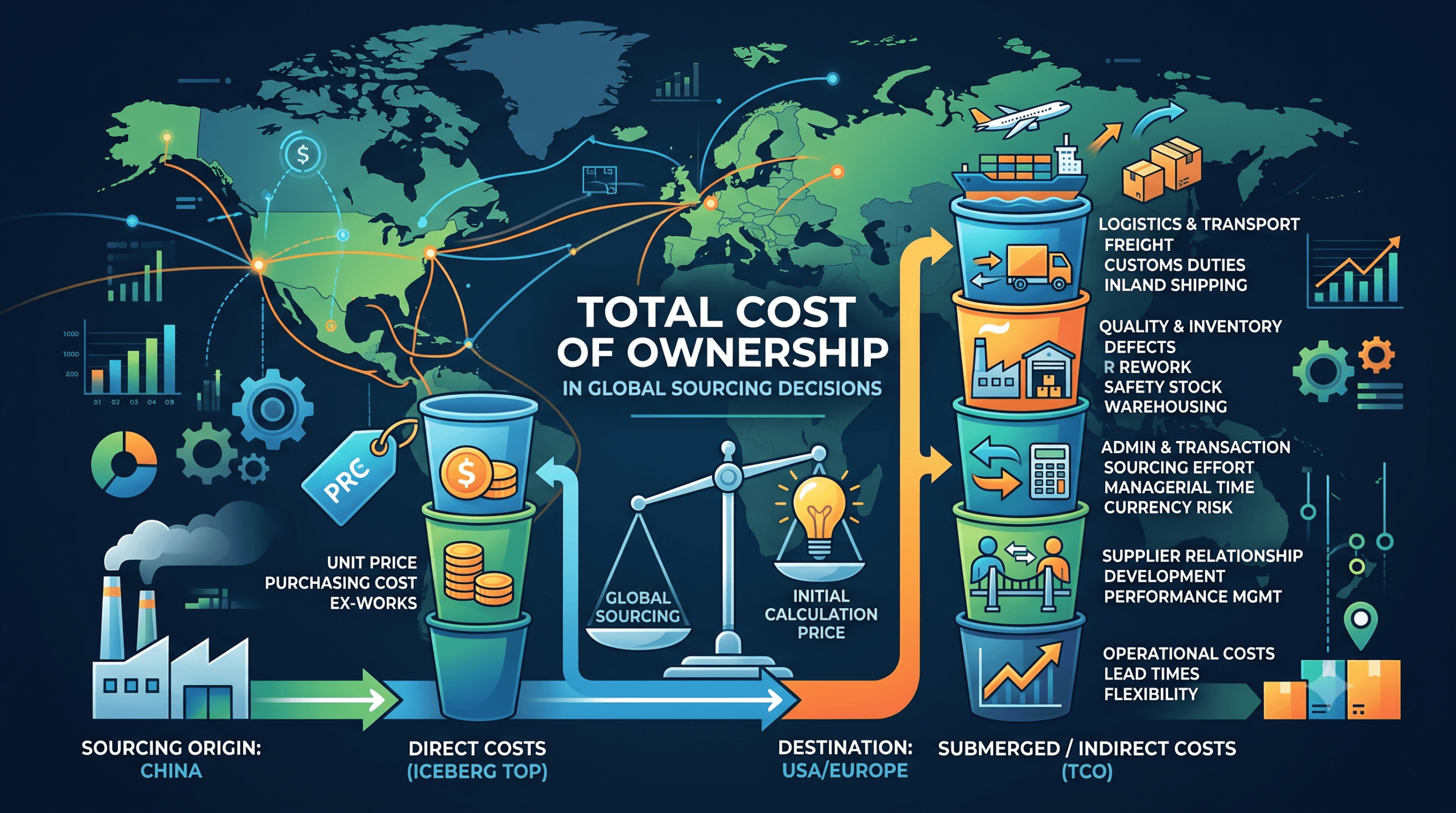
Choosing a supplier based on the lowest quoted price can lead to expensive surprises later. While unit cost is easy to compare, it often represents only a small portion of what a business ultimately spends to source a product or service.
That is why many procurement and supply chain teams rely on Total Cost of Ownership (TCO). Instead of focusing only on purchase price, TCO considers every cost associated with acquiring, transporting, storing, using, and supporting a product throughout its lifecycle. This broader view helps organizations make sourcing decisions that improve profitability, reduce risk, and strengthen long-term supplier relationships.
What Is Total Cost of Ownership?
Total Cost of Ownership (TCO) is a financial approach that calculates all costs involved in purchasing and managing a product or service over its entire lifecycle.
In global sourcing, TCO includes much more than the supplier’s quoted price. It accounts for hidden expenses that can significantly affect the actual value of a sourcing decision.
Rather than asking, “Which supplier offers the lowest price?” procurement teams ask, “Which supplier delivers the lowest overall cost while meeting our quality, service, and business requirements?”
Why TCO Matters in Global Sourcing
International sourcing introduces additional complexity compared to domestic purchasing. Products often travel across multiple countries, pass through customs, involve different currencies, and face varying regulatory requirements.
Ignoring these factors can create unexpected costs that eliminate any apparent savings from lower production prices.
Using a TCO approach helps businesses:
- Compare suppliers more accurately.
- Identify hidden procurement costs.
- Improve long-term profitability.
- Reduce operational risks.
- Make better strategic sourcing decisions.
- Strengthen supplier performance management.
Instead of reacting to unexpected expenses after purchase, organizations can anticipate them during supplier evaluation.
Components of Total Cost of Ownership
A complete TCO analysis evaluates every cost associated with the sourcing process.
Purchase Price
The purchase price remains an important component, but it should never be the only decision factor.
This includes:
- Product cost
- Tooling charges
- Packaging costs
- Minimum order quantities
- Volume discounts
Transportation Costs
International logistics can quickly increase overall procurement expenses.
Transportation costs may include:
- Ocean freight
- Air freight
- Inland transportation
- Fuel surcharges
- Container handling
- Freight insurance
Shipping delays can also create indirect costs through production disruptions.
Import Duties and Taxes
Global sourcing frequently involves:
- Customs duties
- Import taxes
- Tariffs
- Brokerage fees
- Regulatory inspections
Changes in trade policies can significantly alter long-term sourcing costs.
Inventory Holding Costs
Longer supply chains often require businesses to hold additional inventory.
Holding inventory creates costs such as:
- Warehouse storage
- Inventory financing
- Insurance
- Obsolescence
- Inventory shrinkage
Higher inventory levels tie up working capital that could be invested elsewhere.
Quality Costs
Poor quality can erase initial purchase savings.
Quality-related expenses include:
- Incoming inspections
- Product testing
- Rework
- Scrap
- Warranty claims
- Customer returns
- Production downtime
A supplier with a slightly higher purchase price may actually reduce total costs through consistent quality.
Supplier Management Costs
Managing overseas suppliers requires ongoing investment.
Examples include:
- Supplier audits
- Travel expenses
- Performance monitoring
- Compliance verification
- Communication and coordination
- Supplier development programs
These costs become increasingly important when sourcing from multiple international suppliers.
Risk Costs
Risk is one of the most overlooked aspects of TCO.
Potential risks include:
- Political instability
- Currency fluctuations
- Natural disasters
- Port congestion
- Labor shortages
- Regulatory changes
- Supplier bankruptcy
Although these costs may not occur regularly, they can have significant financial consequences.
Hidden Costs That Businesses Often Miss
Many sourcing projects underestimate indirect costs because they are difficult to measure.
Common hidden expenses include:
- Engineering support
- Product redesign
- Delayed product launches
- Increased administrative work
- Expedited shipping
- Language barriers
- Time zone coordination
- Intellectual property protection
- Cybersecurity requirements
- Sustainability compliance
These costs may appear small individually but become substantial over multiple sourcing cycles.
How to Calculate Total Cost of Ownership
A simple TCO calculation follows this approach:
Total Cost of Ownership = Purchase Price + Logistics + Duties + Inventory + Quality Costs + Supplier Management + Risk Costs + Operational Costs
Organizations can customize this formula by adding industry-specific cost categories.
For example, manufacturers may emphasize inventory and quality costs, while technology companies may focus more on implementation, support, licensing, and maintenance expenses.
Example of TCO in Global Sourcing
Imagine a company comparing two suppliers for electronic components.
Supplier A
- Unit price: $8
- Overseas supplier
- Longer shipping times
- Higher inventory requirements
- Higher defect rate
Supplier B
- Unit price: $9
- Regional supplier
- Faster delivery
- Lower inventory
- Better quality performance
Although Supplier A appears cheaper initially, additional freight, quality issues, inventory carrying costs, and production delays increase the overall expense.
After completing a TCO analysis, Supplier B may provide the lower overall cost despite the higher purchase price.
This example illustrates why procurement teams should evaluate total business impact rather than price alone.
Best Practices for Using TCO in Sourcing Decisions
Organizations can improve sourcing decisions by following several practical guidelines.
Build Cross-Functional Input
Procurement should work closely with:
- Finance
- Operations
- Manufacturing
- Logistics
- Engineering
- Quality assurance
Each department contributes costs that purchasing teams may not see independently.
Use Historical Data
Past purchasing records often reveal recurring expenses such as warranty claims, expedited freight, or supplier delays.
Historical performance improves future TCO estimates.
Monitor Supplier Performance
Regular supplier scorecards help measure:
- Delivery reliability
- Quality performance
- Cost consistency
- Responsiveness
- Compliance
Strong performance data makes future sourcing decisions more accurate.
Update TCO Regularly
Global markets change continuously.
Review TCO calculations whenever there are changes in:
- Freight rates
- Currency exchange rates
- Tariffs
- Labor costs
- Supplier performance
- Demand forecasts
Keeping models current ensures sourcing decisions remain aligned with market conditions.
Common Challenges in TCO Analysis
Despite its benefits, implementing TCO can be challenging.
Organizations often struggle with:
- Limited cost visibility
- Incomplete supplier data
- Difficulty measuring risk
- Cross-department data collection
- Rapid market changes
- Lack of standardized cost models
Investing in procurement analytics and digital sourcing tools can improve data accuracy and simplify ongoing TCO calculations.
The Strategic Value of TCO
Modern procurement is no longer focused solely on negotiating lower prices. It plays a strategic role in improving resilience, profitability, and operational efficiency.
A well-executed TCO approach helps organizations:
- Select suppliers based on long-term value.
- Reduce hidden procurement costs.
- Improve supply chain resilience.
- Support better budgeting and forecasting.
- Strengthen supplier partnerships.
- Align sourcing decisions with business objectives.
As global supply chains become more complex, organizations that consistently evaluate total ownership costs are better positioned to make informed, sustainable sourcing decisions.
Key Takeaways
Total Cost of Ownership provides a complete picture of what a sourcing decision will truly cost over time. By evaluating logistics, inventory, quality, supplier management, compliance, and risk alongside purchase price, procurement teams can avoid hidden expenses and make decisions that support long-term business performance.
Organizations that integrate TCO into their global sourcing strategy are more likely to reduce costs, improve supplier relationships, and build resilient supply chains in an increasingly competitive international market.
Frequently Asked Questions
Q. What is Total Cost of Ownership in procurement?
Total Cost of Ownership is a method of evaluating all costs associated with purchasing, operating, and maintaining a product or service throughout its lifecycle, rather than considering only the purchase price.
Q. Why is TCO important in global sourcing?
Global sourcing involves additional expenses such as freight, customs duties, inventory holding, compliance, and supply chain risks. TCO helps businesses account for these factors before selecting a supplier.
Q. What costs are included in TCO?
Typical TCO components include purchase price, transportation, import duties, inventory carrying costs, quality costs, supplier management, compliance expenses, operational costs, and risk-related costs.
Q. How does TCO improve supplier selection?
TCO enables businesses to compare suppliers based on overall value instead of unit price alone, leading to better long-term financial and operational outcomes.