India vs China Manufacturing Cost Comparison: The 2026 Numbers That Actually Matter
Introduction
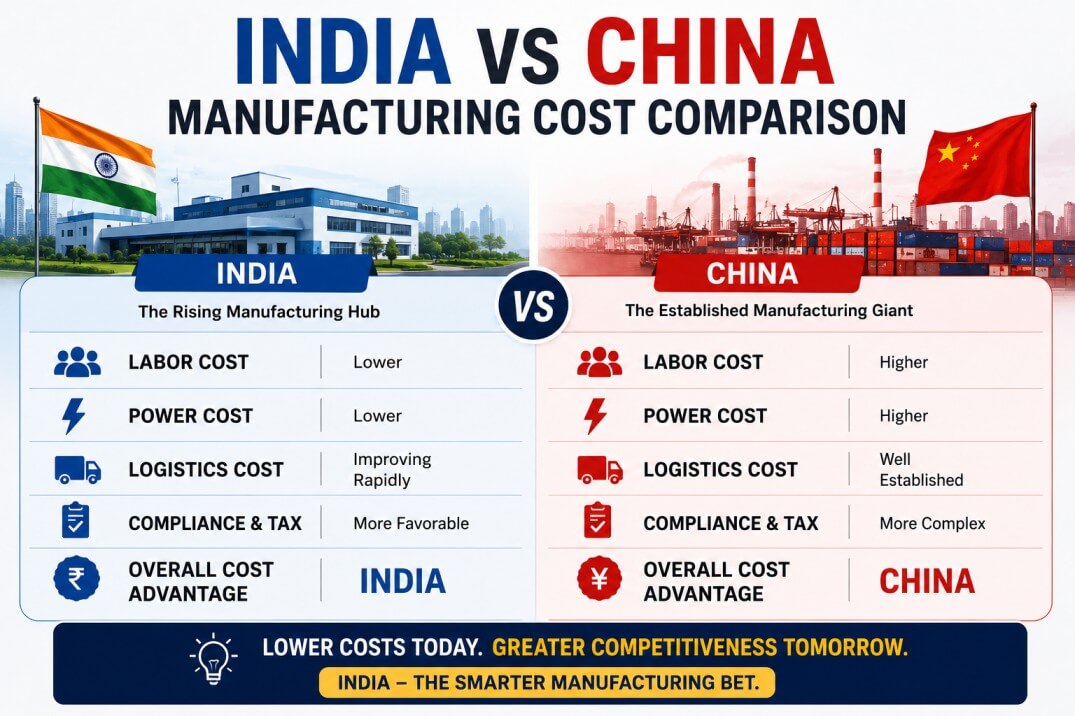
Every CFO has the same question: is India actually cheaper than China, or is it just cheaper labour wrapped in expensive logistics? The honest answer: India wins on direct labour, loses on component ecosystem depth, and comes out ahead on total cost of ownership for the right product categories. The mistake most procurement teams make is comparing wage rates in isolation. The number that matters is landed cost – fully loaded, including tooling amortisation, quality rework, logistics, import duties, and inventory carrying costs.
Direct Labour Cost: India’s Clearest Advantage
Labour cost comparison (2026 estimates, rates include statutory benefits, provident fund contributions, and average overtime. Source: Kearney, JETRO, IBEF):
Assembly Operator: China Coastal $4.50-6.00/hr | China Interior $2.80-3.50/hr | India Tier-1 $1.20-1.80/hr | India Tier-2 $0.80-1.20/hr
CNC Machinist: China Coastal $7.00-9.00/hr | China Interior $4.50-5.50/hr | India Tier-1 $2.50-3.50/hr | India Tier-2 $1.80-2.50/hr
Quality Inspector: China Coastal $5.50-7.50/hr | China Interior $3.50-4.50/hr | India Tier-1 $2.00-2.80/hr | India Tier-2 $1.40-2.00/hr
Process Engineer: China Coastal $12.00-16.00/hr | China Interior $8.00-11.00/hr | India Tier-1 $5.00-7.00/hr | India Tier-2 $3.50-5.00/hr
India Tier-2 cities (Pune, Coimbatore, Hosur, Vadodara) deliver 60-75% labour cost savings over Chinese coastal manufacturing. Even against Chinese interior factories – the lowest-cost tier in China – India Tier-2 saves 40-55%.
Material and Component Costs: China’s Persistent Advantage
China’s component ecosystem is 30 years deep. Resistors, capacitors, PCB laminates, connector housings, bearing raceways – China makes them domestically, and the supply density creates price competition that India cannot match today.
Typical component cost premium in India vs China:
- Passive electronics (resistors, capacitors): +15-25% (mostly imported from China/Japan)
- PCB bare boards: +10-20% (limited domestic substrate supply)
- Standard fasteners (commodity): At parity – India has strong fastener manufacturing
- Forgings and castings: At parity or India advantage for ferrous; China advantage for aluminium high-pressure die casting
- Injection moulded plastics: At parity for standard grades; China cheaper for specialist polymers
Tooling and NPI Costs
China’s tooling ecosystem – particularly for injection moulds, die casting dies, and stamping tools – remains the global benchmark for cost and speed. A Class A injection mould that costs $8,000-15,000 in China costs $12,000-22,000 in India. However, the gap is narrowing. For metal tooling, jigs, and structural fixtures, India is already at parity.
Logistics and Lead Time Costs
Sea freight to US East Coast (2026 spot estimates):
- China (Shanghai): 28-32 days transit, $3,200-4,800/40ft container
- India (JNPT/Mumbai): 22-26 days transit, $2,800-4,200/40ft container
India has a slight logistics distance advantage to the US East Coast. India’s slightly longer lead times (50-70 days total vs 45-65 days from China) are manageable with 2-3 weeks of additional safety stock, which is cheap relative to labour savings at volume.
Tariff and Duty Impact (2026)
US Section 301 tariffs on Chinese goods range from 7.5% to 145%. India faces standard MFN rates (0-5%) for most industrial goods.
Effective duty impact example (electronics assembly):
- Chinese product under 25% Section 301 tariff: adds $25 on a $100 landed cost
- Indian equivalent: $0-2.5% standard duty
For tariff-impacted categories, India’s effective cost advantage can reach 20-30 percentage points.
Quality Cost: The Hidden Variable
At vetted, certified suppliers in both countries, rework and scrap rates are typically 0.5-1.5%. The key cost driver is not country – it is supplier qualification rigour. Invest in FAI, PPAP, and incoming QC sampling regardless of country. For India, ensure suppliers hold IPC-A-610 (electronics), IATF 16949 (automotive), or AS9100 (aerospace) as appropriate.
Total Cost of Ownership Model: When India Wins
TCO analysis for representative electromechanical assembly (labour-intensity: medium-high; component value: 60% of BOM; annual volume: $500K):
Direct Labour: China $180,000 | India $72,000 | India saves $108,000
Components/Materials: China $300,000 | India $330,000 | India costs $30,000 more
Tooling (amortised): China $15,000 | India $18,000 | India costs $3,000 more
Logistics (sea freight): China $22,000 | India $20,000 | India saves $2,000
Tariffs (25% Section 301): China $125,000 | India $0 | India saves $125,000
Quality/Rework: China $12,000 | India $10,000 | India saves $2,000
Total Landed Cost: China $654,000 | India $450,000 | India saves 31%
Without the tariff effect alone, India still saves 3-5% on TCO. With tariffs applied, the saving exceeds 30%.
When China Still Wins
- Ultra-high-volume, component-dense electronics: The Shenzhen ecosystem (same-day components, sub-24-hour prototyping) is irreplaceable for products requiring rapid design iteration and high-volume runs above 100K units.
- Cosmetic-grade injection moulding: China’s mould-making and surface-finish capability for consumer-grade plastics is still ahead.
- Rare earth-dependent products: China controls 60%+ of rare earth processing.
- Established, mature programmes: If a product has been running in China for years with qualified processes and tooling, the switching cost may not justify the savings for stable, low-risk programmes.
Key Takeaways
- India beats China on direct labour by 50-70% – the advantage is real and durable.
- Component costs in India run 10-25% higher for electronics; India is at parity for metals.
- Logistics costs are roughly equivalent; India has a slight distance advantage to US East Coast.
- US Section 301 tariffs are the single biggest cost driver – for affected HTS codes, India can be 25-35% cheaper all-in.
- Run TCO, not wage comparisons – the right model accounts for all seven cost components.
- For labour-intensive, tariff-exposed, mechanically complex products: India wins clearly in 2026.
FAQ
Q: Is India cheaper than Vietnam for manufacturing?
A: Depends on category. Vietnam is competitive for garments, footwear, and simple electronics assembly. India is stronger for precision engineering, complex EMS, pharmaceuticals, and large-format fabrication.
Q: How accurate are the labour cost numbers above?
A: These are representative 2026 ranges from Kearney, JETRO, and IBEF data. Actual rates depend on city, skill level, shift pattern, and facility type. Validate with supplier quotes for specific programmes.
Q: Does the India cost advantage hold for small orders?
A: The percentage savings are consistent, but absolute savings are smaller on small orders. India most compelling at annual spend above ~$200K per part family.
Q: How do I find qualified Indian manufacturers?
A: Platforms like Zetwerk aggregate pre-qualified suppliers with capability databases, reducing qualification time significantly.