How to Choose a Contract Manufacturer: 12-Point Checklist + Red Flags
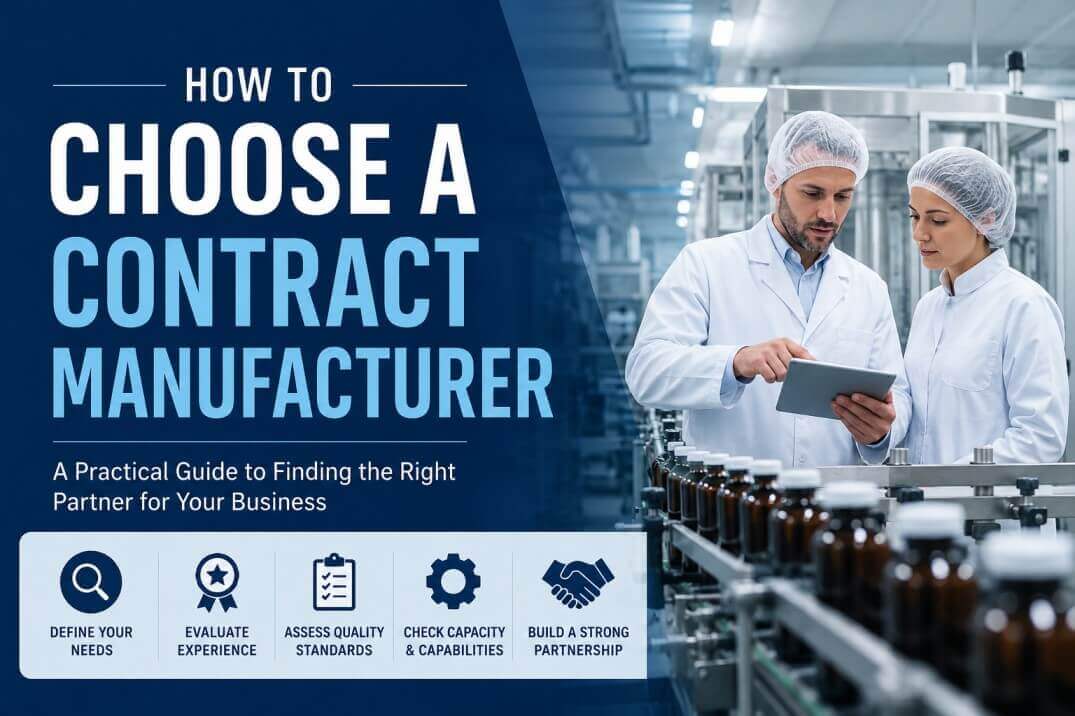
The contract manufacturer you choose will have more influence over your product quality, cost structure, and delivery reliability than almost any other operational decision you make. Most CM selection mistakes come from moving too quickly – being dazzled by a factory tour or a low price without interrogating what matters. This guide gives you a systematic framework to select a partner you can build on.
Why the Selection Decision Is So High-Stakes
A poor CM selection wastes months and hundreds of thousands of rupees in qualification costs, rework, and delay. More damaging are the second-order effects: a missed product launch, a quality crisis in the market, or an IP leak that hands your design to a competitor.
The right CM partner, on the other hand, becomes an extension of your operations – delivering consistent quality, managing supply chain complexity on your behalf, and scaling with you as you grow.
The 12-Point Evaluation Checklist
1. Technical Capabilities Match Your Product Requirements
This is the first and most non-negotiable filter. Does the manufacturer have the specific processes, equipment, and materials expertise your product demands? A precision aerospace casting specialist and a consumer electronics EMS provider are both “contract manufacturers” – but they have almost no overlap in actual capability.
Define your manufacturing requirements in detail before approaching any CM: processes required, materials, tolerances, certifications, production volumes, and lead time requirements. Then evaluate every candidate against this specification.
2. Quality Certifications (ISO 9001, IATF 16949, AS9100, IPC)
Certifications are not a guarantee of quality – but their absence is a red flag. Relevant certifications to look for:
- ISO 9001 – Baseline quality management system. Required for any serious CM.
- IATF 16949 – Automotive. Required if your product touches automotive supply chains.
- AS9100 / NADCAP – Aerospace and defence. Non-negotiable for aero components.
- IPC-A-610 / J-STD-001 – Electronics assembly. Required for PCB and EMS work.
- ISO 13485 – Medical devices.
Ask for certificates with expiry dates and registrar details. Verify them independently.
3. Industry Experience and Proven Track Record
Relevant industry experience matters more than general manufacturing years in business. Ask for:
- Customer references in your industry vertical
- Case studies or parts portfolio that are comparable in complexity and material to yours
- Evidence of production at your required volume range
A manufacturer who has produced 10,000 aerospace forgings a month is a very different proposition from one who has produced 100.
4. Production Capacity – Today and at Scale
Your CM must have not just the current capacity for your initial production volume but also a credible path to supporting your growth. A manufacturer where you are their largest customer by a factor of five carries concentration risk – they may not have the bandwidth to manage your programme with the attention it requires. Equally, being the smallest customer at a large manufacturer can leave you deprioritised.
Ask for current capacity utilisation across relevant production lines. A utilisation rate above 85% is a lead time risk.
5. IP Protection: NDAs, Confidentiality, and Data Security
Before any technical documents change hands, execute a comprehensive NDA covering:
- Ownership of designs, tooling, and drawings
- Restrictions on disclosure to sub-suppliers
- Data security obligations for digital files
- Post-termination confidentiality obligations
Ask how they manage sub-supplier disclosure. If your design needs to go to a raw material supplier, does your NDA cascade?
6. Regulatory Compliance for Your Target Markets
If your products are sold in the US, EU, or Japan, your CM must be able to produce to the regulatory requirements of those markets – RoHS, REACH, FDA, CE. Verify this before qualification, not after your first shipment is held at customs.
7. Location, Lead Time, and Logistics
Factory location affects lead time, freight cost, and the ease of in-person audits. Proximity to ports, industrial clusters, and logistics infrastructure matters. India’s major manufacturing clusters – Pune, Coimbatore, Chennai, Bangalore, Rajkot – offer good connectivity for export production.
Understand the actual factory-to-delivery lead time, not just the production lead time. Include inbound material lead times, production, quality inspection, and freight.
8. Communication, Reporting, and Documentation
Manufacturing problems rarely disappear if you stop asking about them. Your CM must have clear communication protocols: designated programme contacts, reporting cadence, escalation paths, and documentation standards. Ask specifically:
- Who is my day-to-day contact and what is their authority level?
- How are engineering changes communicated and confirmed?
- What is the process if a quality non-conformance is identified mid-production?
9. Financial Stability of the Manufacturer
A financially unstable CM is an operational risk. Cash flow problems delay material procurement and can halt production mid-order. Ask for evidence of financial health – trade references, bank references, or audited accounts for significant partnerships.
10. Pricing Model and Cost Transparency
A credible CM should be able to provide a detailed cost breakdown: material, labour, overhead, tooling amortisation, and margin. Lump-sum pricing with no visibility into cost drivers is a yellow flag – it makes cost reduction conversations impossible and hides where the real risks are.
Ask for a detailed quote with line-item breakdown. Compare quotes on like-for-like terms, not just the bottom-line unit price.
11. Cultural Fit and Long-Term Partnership Mindset
The best CM relationships function as genuine partnerships. Your manufacturer should be invested in understanding your product, your customer requirements, and your business goals – not just executing a purchase order. Look for evidence of proactive communication, process improvement suggestions, and willingness to work through problems collaboratively.
12. Digital Visibility and Platform Tools
In 2025, there is no acceptable reason for your CM to provide production visibility only via email updates. The best CM partners – and all platform-based manufacturing providers – offer real-time order tracking, in-process quality checkpoints, and supplier performance data accessible through digital interfaces. This is not a luxury; it is a baseline expectation.
How to Run a Proper Site Audit
A site visit before awarding significant production is not optional for critical components. An audit lets you see what a pitch deck cannot show.
What to Look for On the Factory Floor
- Is the facility clean, organised, and well-lit? Disorder on the shop floor is a proxy for disorder in the process.
- Is equipment well-maintained? Look for maintenance logs and calibration stickers on measurement equipment.
- Are quality documents visible at workstations, or is quality a back-office function?
- How does the workforce interact with supervisors? A healthy culture is observable.
Quality System Review
During the audit, review the quality management system directly:
- Non-conformance tracking: how are defects logged, investigated, and closed?
- CAPA (Corrective and Preventive Action) records: are problems being systematically addressed?
- First Article Inspection records: how rigorous is the FAIR process?
- Incoming material inspection: are materials verified against purchase specifications?
Key Questions to Ask During the Audit
- Walk me through your last major quality non-conformance and how you resolved it.
- How do you manage engineering changes from customers?
- What happens if you identify a material shortage 3 weeks before my delivery date?
- Can you show me the production plan for a comparable active programme?
7 Red Flags That Should End a Conversation
- Reluctance to sign an NDA before seeing drawings – any credible CM signs NDAs routinely. Reluctance signals either inexperience or IP risk.
- No documented QMS or expired certifications – quality systems require ongoing investment. Lapsed certs signal a business not investing in quality.
- Can’t provide references in your industry – experience claims without evidence are unverifiable.
- Lump-sum pricing with no breakdown – lack of cost transparency makes supplier development and cost reduction impossible.
- Capacity utilisation above 90% – you are at the back of the queue when problems arise.
- No escalation path for quality issues – if the only contact is a salesperson, quality problems will not be resolved at the right level.
- Vague answers about sub-supplier management – if they can’t tell you where your materials come from, your supply chain is not transparent.
Questions to Ask During the RFQ Process
- What is your on-time delivery rate for the last 12 months?
- What is your first-pass quality yield for comparable parts?
- How many active customers do you have in our industry?
- What is your capacity utilisation across the relevant production lines?
- Who would be our programme manager, and what is their experience?
- What digital systems do you use for production tracking and quality reporting?
Single CM vs. Multi-CM Strategy: Which Is Right?
For low-risk, non-critical components: a single, well-qualified CM is efficient and sufficient.
For critical components – those whose supply failure would halt your production or create a customer service failure – dual-source qualification is a best practice. The cost of qualifying a second source is small relative to the operational risk of single-source dependency.
Platform-based manufacturing solves this naturally. When your production is orchestrated through a platform with multiple pre-vetted manufacturers, you have inherent resilience without the overhead of managing dual-source relationships independently.
How Digital Manufacturing Platforms Simplify the Search
Pre-Vetted Supplier Networks
Platforms like Zetwerk have already performed the qualification work – capability assessment, certification verification, financial health review, and quality system audit – across a network of 5,400+ manufacturers. This compresses a 3–6 month independent qualification process to days.
Transparent Pricing and Quotes
Platform-based quoting provides structured, comparable quotes with cost breakdowns – removing the opacity that makes traditional CM procurement difficult to benchmark.
Real-Time Order Tracking and QA
Once in production, the platform provides real-time visibility into production milestones, in-process quality checkpoints, and delivery status – replacing the email-and-phone-call cadence of traditional CM management.
Key Takeaways
- Use the 12-point checklist as a systematic filter – don’t shortcut to price before confirming capability, certifications, and IP protection
- A site audit before awarding significant production is non-negotiable for critical components
- Red flags in a selection process are harder to fix after production has started
- Dual-sourcing critical components is resilience best practice
- Digital manufacturing platforms compress the qualification timeline and provide ongoing visibility that traditional CM relationships lack
FAQ
Q. How long does CM qualification typically take?
An independent qualification process – capability assessment, audit, DfM review, prototyping, FAI – typically takes 3–6 months for a new supplier. Platform-based manufacturing compresses this because the network has already been pre-qualified.
Q. Should I visit the factory before placing a first order?
For significant production programmes, yes. For small initial orders, a remote audit combined with a detailed questionnaire is a reasonable starting point, with an in-person visit before volume ramp.
Q. How many CMs should I shortlist?
Three to five is a practical number for a detailed evaluation. More creates evaluation overhead; fewer limits comparison.