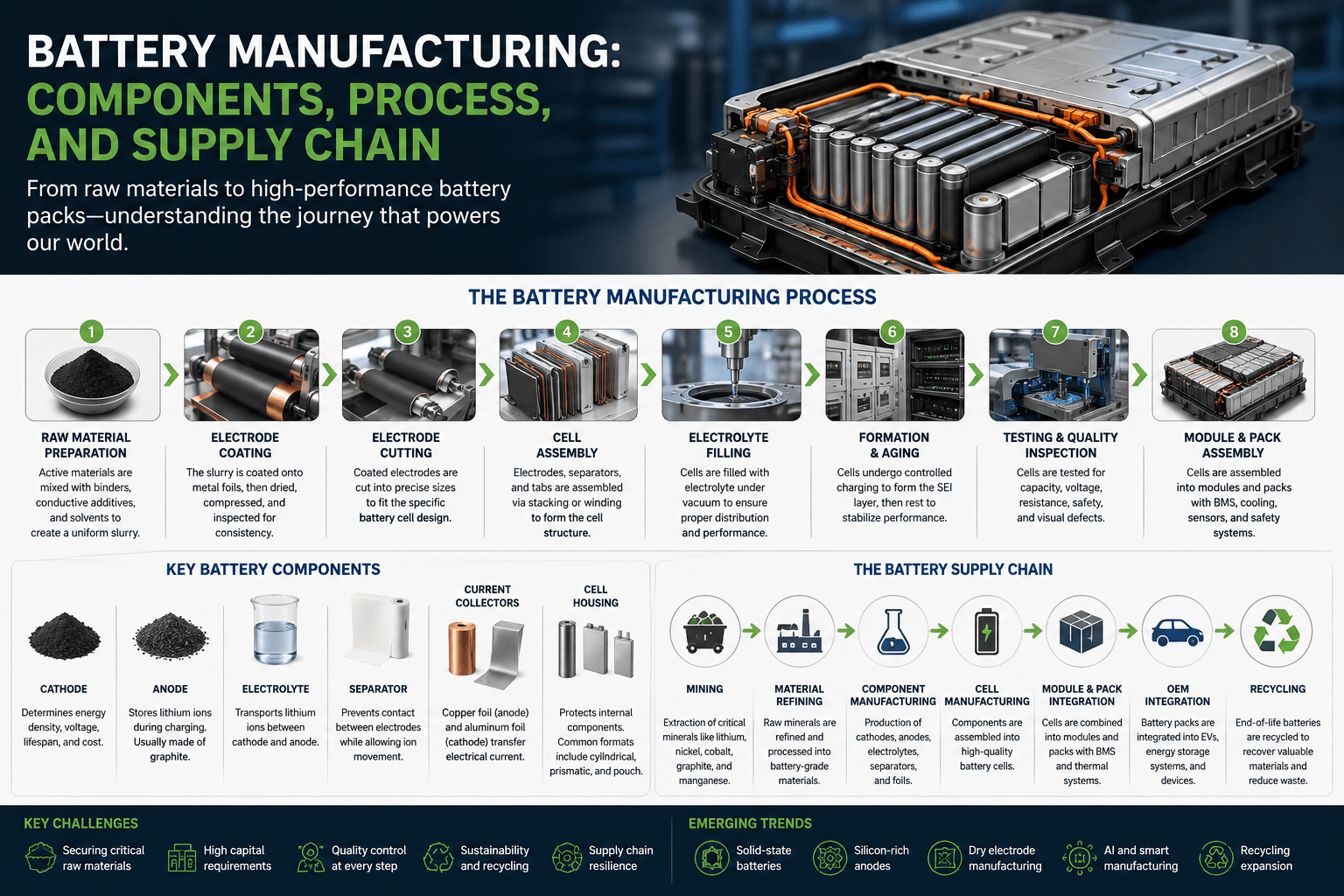
Battery Manufacturing: Components, Process, and Supply Chain

Battery manufacturing has become one of the fastest-growing industries in the world. Demand for electric vehicles (EVs), renewable energy storage, consumer electronics, and industrial equipment continues to increase, driving significant investments in battery production capacity.

Behind every battery is a complex manufacturing process that combines advanced materials, precision engineering, and strict quality control. From sourcing raw materials to assembling battery packs, every stage affects performance, safety, lifespan, and cost.

This guide explains the key components of batteries, how they are manufactured, and the supply chain that supports global battery production.

Why Battery Manufacturing Matters

Modern batteries power nearly every aspect of daily life. Smartphones, laptops, electric vehicles, drones, medical devices, and energy storage systems all depend on reliable battery technology.

As governments and businesses invest in electrification and clean energy, manufacturers face growing pressure to:

  • Increase production capacity
  • Lower manufacturing costs
  • Improve battery performance
  • Reduce environmental impact
  • Build resilient supply chains
  • Secure critical raw materials

These challenges make battery manufacturing both highly technical and strategically important.

Main Components of a Battery

Although battery chemistries vary, most rechargeable lithium-ion batteries share the same core components.

Cathode

The cathode is the positive electrode and one of the most expensive parts of a battery. It largely determines:

  • Energy density
  • Battery lifespan
  • Voltage
  • Safety
  • Overall cost

Common cathode materials include:

  • Lithium Iron Phosphate (LFP)
  • Nickel Manganese Cobalt (NMC)
  • Nickel Cobalt Aluminum (NCA)
  • Lithium Manganese Oxide (LMO)

Each chemistry offers different advantages depending on the application.

Anode

The anode stores lithium ions during charging.

Most commercial batteries use graphite because it offers:

  • High electrical conductivity
  • Long cycle life
  • Stable performance
  • Competitive cost

Manufacturers are increasingly introducing silicon-enhanced anodes to improve energy density.

Electrolyte

The electrolyte transports lithium ions between the anode and cathode.

It typically consists of:

  • Lithium salts
  • Organic solvents
  • Performance additives

Electrolyte quality directly affects charging speed, safety, and battery lifespan.

Separator

The separator prevents physical contact between the anode and cathode while allowing lithium ions to pass through.

High-quality separators improve:

  • Thermal stability
  • Safety
  • Cycle life
  • Internal resistance

Current Collectors

Metal foils collect and transfer electrical current.

Typical materials include:

  • Aluminum foil for the cathode
  • Copper foil for the anode

Battery Cell Housing

The housing protects internal components from moisture, contamination, vibration, and mechanical damage.

Common formats include:

  • Cylindrical cells
  • Prismatic cells
  • Pouch cells

Battery Manufacturing Process

Battery production requires tightly controlled manufacturing environments because moisture and contamination can significantly reduce battery performance.

1. Raw Material Preparation

Manufacturers prepare active materials by mixing powders with:

  • Conductive additives
  • Binders
  • Solvents

The resulting slurry must achieve precise viscosity and composition.

2. Electrode Coating

The slurry is coated onto metal foils using precision coating equipment.

The coated electrodes are then:

  • Dried
  • Compressed
  • Inspected

Uniform coating thickness is essential for consistent battery performance.

3. Electrode Cutting

Large coated sheets are cut into precise dimensions suitable for the target battery cell.

Automated cutting minimizes material waste and improves production efficiency.

4. Cell Assembly

Depending on the battery design, electrodes are:

  • Wound into cylindrical cells
  • Stacked into pouch cells
  • Layered into prismatic cells

Additional components, including separators and tabs, are inserted during assembly.

5. Electrolyte Filling

After the cell is sealed, electrolyte is injected under controlled vacuum conditions.

Proper electrolyte distribution is critical for battery performance.

6. Formation and Aging

Formation is one of the most important manufacturing stages.

During formation:

  • Cells undergo controlled charging
  • A stable solid electrolyte interphase (SEI) forms
  • Initial defects become detectable

Cells then rest during aging to stabilize their electrochemical performance.

7. Testing and Quality Inspection

Every battery cell undergoes multiple quality checks, including:

  • Capacity testing
  • Internal resistance measurement
  • Voltage verification
  • Leak detection
  • X-ray inspection
  • Visual inspection

Manufacturers reject defective cells before pack assembly.

8. Module and Pack Assembly

Battery cells are assembled into modules and then into complete battery packs.

Battery packs typically include:

  • Battery Management System (BMS)
  • Cooling system
  • Wiring harnesses
  • Sensors
  • Structural enclosure
  • Safety devices

The BMS monitors temperature, voltage, current, and cell balancing.

Types of Battery Manufacturing Facilities

Battery production generally occurs across several specialized facilities.

Material Processing Plants

These facilities refine and process:

  • Lithium compounds
  • Nickel
  • Cobalt
  • Graphite
  • Manganese

Cell Manufacturing Plants

These plants produce individual battery cells through electrode manufacturing, assembly, formation, and testing.

Module Assembly Plants

Cells are combined into standardized battery modules.

Battery Pack Assembly Plants

Final battery packs are assembled for:

  • Electric vehicles
  • Industrial equipment
  • Consumer electronics
  • Grid-scale energy storage

Battery Manufacturing Supply Chain

The battery supply chain spans multiple industries and countries.

1. Mining

Critical minerals include:

  • Lithium
  • Nickel
  • Cobalt
  • Graphite
  • Manganese

Mining locations are distributed globally, creating supply chain dependencies.

2. Material Refining

Raw minerals undergo chemical processing before they become battery-grade materials.

Purity is essential for battery performance.

3. Component Manufacturing

Specialized suppliers produce:

  • Cathodes
  • Anodes
  • Electrolytes
  • Separators
  • Copper foil
  • Aluminum foil

4. Cell Manufacturing

Battery manufacturers combine these materials into finished cells.

5. Module and Pack Integration

Cells are integrated into battery systems for end-use applications.

6. OEM Integration

Original equipment manufacturers integrate battery packs into products such as:

  • Electric vehicles
  • Home energy storage systems
  • Industrial machinery
  • Consumer electronics

7. Recycling

End-of-life batteries are collected and processed to recover valuable materials.

Recycling helps reduce dependence on newly mined resources while supporting a more circular battery economy.

Key Challenges in Battery Manufacturing

Battery manufacturers face several ongoing challenges.

Securing Raw Materials

Growing global demand has increased competition for lithium, nickel, cobalt, and graphite.

Manufacturing Scale

Large-scale battery production requires billions of dollars in investment, highly automated equipment, and skilled labor.

Quality Control

Even microscopic contamination can reduce battery safety and lifespan. Manufacturers rely on cleanrooms, automation, and advanced inspection systems.

Sustainability

The industry continues to improve:

  • Energy-efficient production
  • Water conservation
  • Lower-carbon manufacturing
  • Responsible sourcing
  • Battery recycling

Supply Chain Resilience

Geopolitical risks, transportation disruptions, and fluctuating commodity prices encourage manufacturers to diversify suppliers and localize production.

Emerging Trends in Battery Manufacturing

Several innovations are shaping the future of battery production.

Solid-State Batteries

Solid-state batteries replace liquid electrolytes with solid materials, offering the potential for higher energy density and improved safety.

Silicon-Rich Anodes

Adding silicon to graphite anodes can increase energy storage capacity and support longer driving ranges in electric vehicles.

Dry Electrode Manufacturing

Dry coating processes aim to reduce energy use, eliminate certain solvents, and simplify production.

AI and Smart Manufacturing

Artificial intelligence helps manufacturers optimize production by:

  • Predicting equipment failures
  • Detecting quality issues
  • Improving process control
  • Reducing waste
  • Increasing yield

Battery Recycling Expansion

Growing recycling capacity is expected to recover larger quantities of lithium, nickel, cobalt, and graphite, reducing reliance on virgin materials.

Best Practices for Battery Manufacturers

Successful manufacturers typically focus on:

  • Investing in automation and digital manufacturing
  • Maintaining rigorous quality assurance
  • Diversifying raw material suppliers
  • Designing batteries with recyclability in mind
  • Improving traceability across the supply chain
  • Continuously optimizing production efficiency

These practices help improve product quality while reducing operational costs and environmental impact.

Key Takeaways

Battery manufacturing is a sophisticated process that combines advanced materials, precision engineering, and extensive quality control. From mining and material refining to cell production, pack assembly, and recycling, each step influences battery performance, cost, and sustainability.

As demand for electric mobility and energy storage continues to grow, manufacturers that invest in efficient production methods, resilient supply chains, and next-generation battery technologies will be well positioned to meet future market needs.

Frequently Asked Questions

Q. What are the main components of a lithium-ion battery?

A lithium-ion battery typically consists of a cathode, anode, electrolyte, separator, current collectors, and a protective cell housing.

Q. Why is battery manufacturing performed in dry rooms?

Lithium-ion battery materials are highly sensitive to moisture. Dry rooms help prevent contamination that can reduce battery performance, safety, and lifespan.

Q. What is battery formation?

Formation is the initial controlled charging process that creates a stable solid electrolyte interphase (SEI) on the anode. This step is critical for long-term battery performance and reliability.

Q. Which industries rely most on battery manufacturing?

Battery manufacturing supports electric vehicles, consumer electronics, renewable energy storage, aerospace, medical devices, industrial automation, and telecommunications.

Q. Why is battery recycling becoming more important?

Recycling recovers valuable materials such as lithium, nickel, cobalt, and graphite, reducing waste, lowering demand for newly mined resources, and supporting a more sustainable battery supply chain.
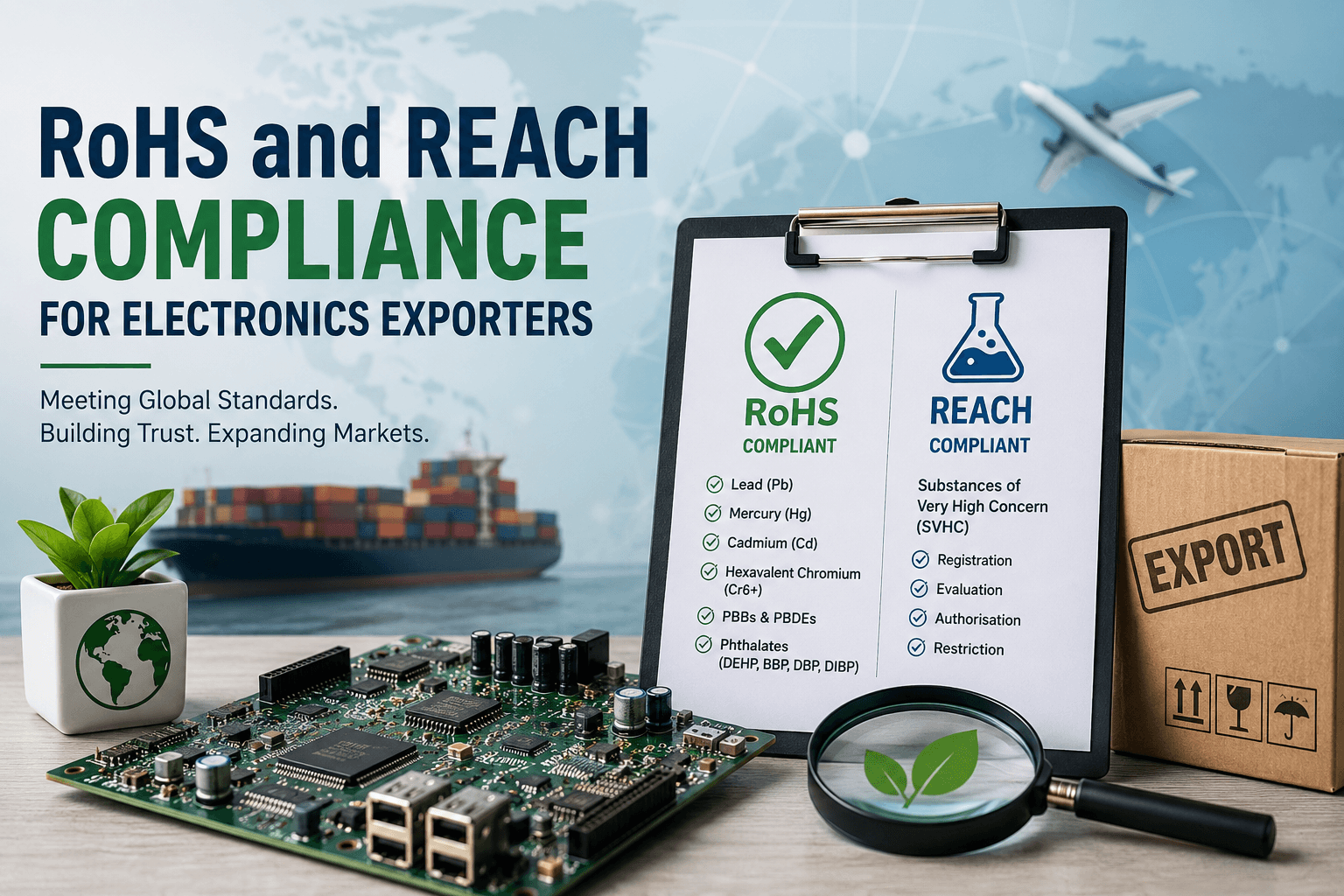
RoHS and REACH Compliance for Electronics Exporters

Exporting electronic products to international markets involves more than meeting technical performance standards. Manufacturers and exporters must also comply with environmental regulations that restrict hazardous substances and improve chemical safety throughout the supply chain.

Two of the most important regulations are RoHS (Restriction of Hazardous Substances) and REACH (Registration, Evaluation, Authorisation and Restriction of Chemicals). While both originated in the European Union, their impact extends far beyond Europe because many global manufacturers and buyers expect compliance regardless of the destination.

Understanding the differences between RoHS and REACH helps electronics exporters avoid shipment delays, product recalls, penalties, and lost business opportunities.

What Is RoHS?

RoHS is an EU directive that restricts the use of specific hazardous substances in electrical and electronic equipment (EEE). The goal is to reduce environmental pollution and improve the recyclability of electronic products.

RoHS applies to a wide range of products, including:

  • Consumer electronics
  • Industrial control equipment
  • Medical devices
  • Telecommunications equipment
  • Lighting products
  • Household appliances
  • Electrical tools
  • Monitoring instruments

Restricted Substances Under RoHS

Current RoHS regulations restrict the following substances above specified concentration limits:

  • Lead (Pb)
  • Mercury (Hg)
  • Cadmium (Cd)
  • Hexavalent Chromium (Cr6+)
  • Polybrominated Biphenyls (PBB)
  • Polybrominated Diphenyl Ethers (PBDE)
  • Bis(2-ethylhexyl) phthalate (DEHP)
  • Butyl benzyl phthalate (BBP)
  • Dibutyl phthalate (DBP)
  • Diisobutyl phthalate (DIBP)

These restrictions apply to homogeneous materials rather than the finished product as a whole.

What Is REACH?

REACH is the European Union’s comprehensive chemicals regulation. Unlike RoHS, which restricts specific hazardous substances in electronics, REACH governs the manufacture, import, and use of chemicals across nearly all industries.

For electronics exporters, REACH primarily focuses on substances contained in products, especially Substances of Very High Concern (SVHCs).

Manufacturers must determine whether their products contain SVHCs above regulatory thresholds and meet any required communication or notification obligations.

RoHS vs. REACH: Understanding the Difference

Although both regulations address chemical safety, they serve different purposes.

RoHSREACH
Focuses on electrical and electronic equipmentCovers chemicals used in all industries
Restricts a fixed list of hazardous substancesRegulates thousands of chemical substances
Product-specific regulationChemical-specific regulation
Concentration limits apply to homogeneous materialsRequirements often depend on article composition and SVHC content
Primarily addresses manufacturing complianceCovers the entire chemical supply chain

Many electronics products must comply with both regulations simultaneously.

Why Compliance Matters for Electronics Exporters

Failure to comply can have serious commercial consequences.

Potential risks include:

  • Customs clearance delays
  • Product recalls
  • Import restrictions
  • Financial penalties
  • Contract cancellations
  • Loss of customer trust
  • Damage to brand reputation

Many original equipment manufacturers (OEMs) also require suppliers to provide RoHS and REACH declarations before approving products.

Products Commonly Affected

RoHS and REACH apply to many electronic components, including:

  • Printed circuit boards (PCBs)
  • Connectors
  • Integrated circuits
  • Semiconductors
  • Cables and wiring
  • Plastic housings
  • Power supplies
  • Batteries (subject to additional regulations)
  • Sensors
  • Displays
  • Industrial automation equipment

Even seemingly minor components such as adhesives, coatings, solder, inks, and plastic additives may affect compliance.

Documentation Required

Most importers request documentation demonstrating compliance before accepting shipments.

Typical documents include:

  • RoHS Declaration of Conformity (DoC)
  • REACH Declaration
  • Material Declaration
  • Test reports from accredited laboratories
  • Supplier declarations
  • Bill of Materials (BOM)
  • Technical documentation
  • Certificates of Analysis (where applicable)

Maintaining complete records simplifies audits and customer reviews.

Material Testing and Verification

Testing plays an important role in verifying compliance, particularly when suppliers cannot provide sufficient documentation.

Common testing methods include:

X-Ray Fluorescence (XRF)

Used as a rapid screening method to detect restricted metals such as lead, mercury, and cadmium.

ICP-OES and ICP-MS

Laboratory methods that accurately measure metal concentrations.

GC-MS

Often used to identify phthalates and brominated flame retardants.

Testing is generally performed by ISO/IEC 17025-accredited laboratories to ensure reliable and internationally recognized results.

Supply Chain Challenges

Compliance depends on the entire supply chain rather than the final assembly process alone.

Common challenges include:

  • Incomplete supplier declarations
  • Frequent updates to REACH SVHC lists
  • Material substitutions without notification
  • Limited visibility into lower-tier suppliers
  • Inconsistent documentation formats
  • Managing products sourced from multiple countries

A structured supplier compliance program helps reduce these risks.

Best Practices for Maintaining Compliance

Electronics exporters can strengthen compliance by building robust internal processes.

Key practices include:

  • Collect compliance declarations from every supplier.
  • Maintain an up-to-date material database.
  • Review REACH SVHC updates regularly.
  • Conduct periodic risk-based testing.
  • Keep technical documentation organized.
  • Train procurement and quality teams on regulatory requirements.
  • Audit high-risk suppliers.
  • Include compliance clauses in supplier agreements.

These practices reduce the likelihood of non-compliant materials entering production.

Common Mistakes to Avoid

Many compliance issues result from preventable process gaps.

Examples include:

  • Assuming supplier certificates never expire
  • Using outdated REACH SVHC lists
  • Testing only finished products instead of critical materials
  • Missing documentation for replacement components
  • Failing to verify subcontractor materials
  • Overlooking packaging materials that may have separate compliance requirements

Regular reviews help identify issues before products reach customers.

Future Trends

Environmental regulations continue to evolve.

Electronics exporters should expect:

  • Expansion of restricted substances
  • More frequent updates to SVHC lists
  • Increased digital product compliance documentation
  • Greater supply chain transparency requirements
  • Stronger sustainability reporting expectations
  • Enhanced due diligence requirements for global supply chains

Companies that invest in proactive compliance systems are generally better positioned to adapt to future regulatory changes.

Frequently Asked Questions

Q. Is RoHS mandatory for all electronics exports?

No. RoHS is mandatory in jurisdictions that have adopted RoHS regulations, such as the European Union and several other countries. However, many international buyers require RoHS compliance regardless of destination.

Q. Does REACH apply to products manufactured outside Europe?

Yes. REACH obligations can apply to products imported into the European Union, regardless of where they were manufactured.

Q. Is third-party testing always required?

Not always. Many manufacturers rely on supplier declarations and material documentation. However, independent testing is often used to verify compliance or satisfy customer requirements.

Q. How often should REACH compliance be reviewed?

Because the list of Substances of Very High Concern (SVHCs) is updated periodically, exporters should review compliance whenever the list changes and whenever product materials or suppliers change.

Key Takeaways

RoHS and REACH compliance has become a standard expectation for electronics exporters serving global markets. While RoHS restricts specific hazardous substances in electrical and electronic equipment, REACH addresses the broader management of chemicals throughout the supply chain.

Maintaining accurate documentation, working closely with suppliers, monitoring regulatory updates, and implementing risk-based testing can help manufacturers reduce compliance risks, improve customer confidence, and support uninterrupted access to international markets.

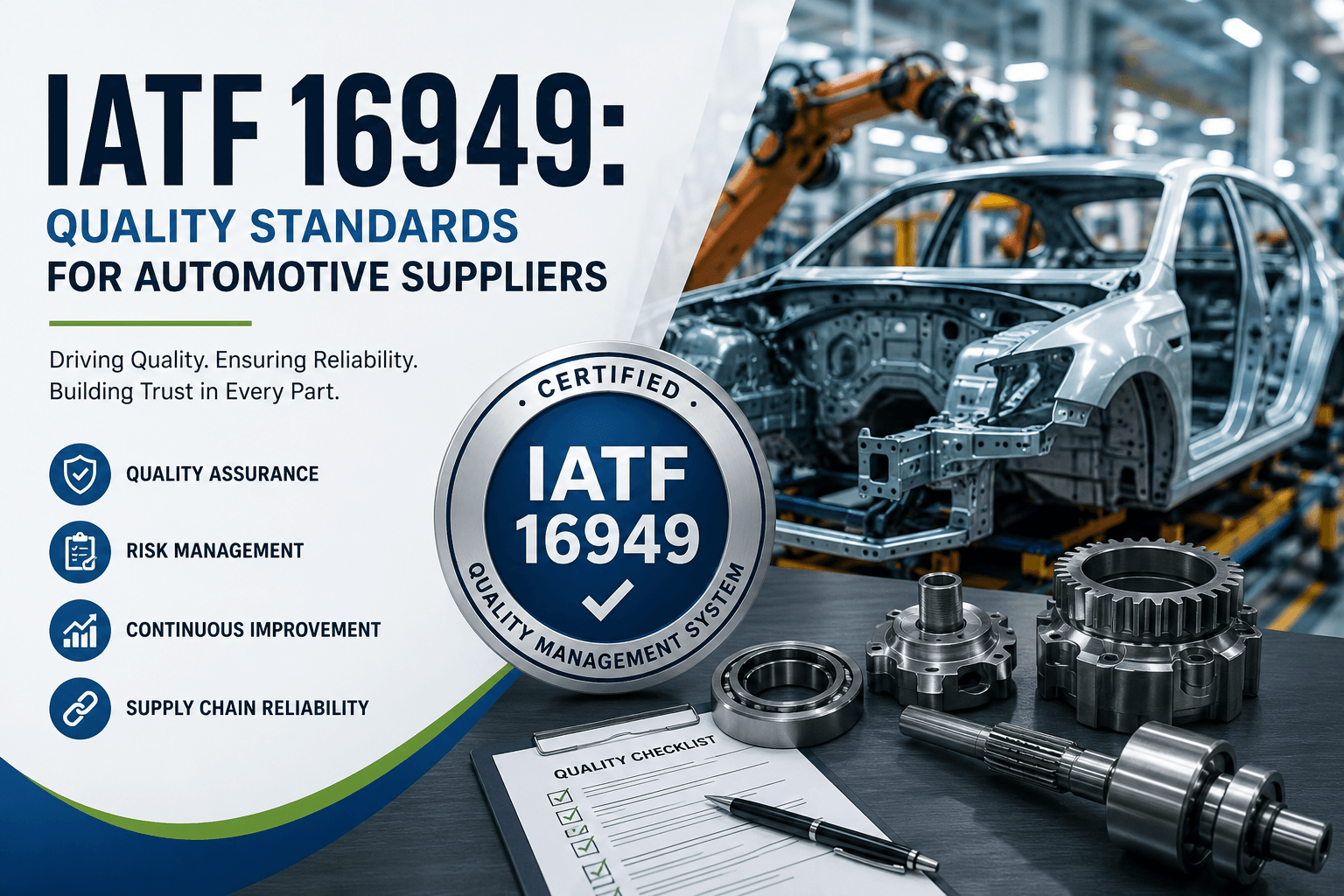
IATF 16949: Quality Standards for Automotive Suppliers

Quality expectations in the automotive industry are among the highest in manufacturing. A single defective component can lead to production delays, costly recalls, or safety issues that affect thousands of vehicles. That’s why automotive manufacturers expect suppliers to follow a standardized quality management system that emphasizes consistency, risk reduction, and continuous improvement.

IATF 16949 is the globally recognized quality management standard designed specifically for the automotive supply chain. It builds on ISO 9001 while adding industry-specific requirements that help suppliers improve product quality, reduce waste, strengthen traceability, and meet customer-specific expectations.

Whether you’re preparing for certification or evaluating supplier requirements, understanding IATF 16949 is essential for long-term success in the automotive industry.

What Is IATF 16949?

IATF 16949 is an international quality management standard developed by the International Automotive Task Force (IATF). It defines the requirements for a quality management system (QMS) for organizations that manufacture automotive parts, components, assemblies, and related services.

The standard is intended to:

  • Improve product and process quality
  • Prevent defects rather than detect them later
  • Reduce variation across manufacturing operations
  • Minimize waste throughout production
  • Increase customer satisfaction
  • Support continuous improvement

Rather than replacing ISO 9001, IATF 16949 works alongside it. Organizations seeking certification must first comply with ISO 9001 requirements while meeting the additional automotive-specific requirements outlined in IATF 16949.

Why IATF 16949 Matters

Automotive manufacturers operate highly complex global supply chains. Suppliers must consistently deliver parts that meet strict quality, safety, and regulatory requirements.

IATF 16949 helps organizations create standardized processes that reduce production risks while improving operational performance.

Many original equipment manufacturers (OEMs) either require or strongly prefer suppliers that hold IATF 16949 certification. Certification demonstrates that an organization has established quality controls capable of supporting demanding automotive production environments.

Who Needs IATF 16949 Certification?

The standard applies to organizations that manufacture products for the automotive industry, including:

  • Tier 1 suppliers
  • Tier 2 and Tier 3 suppliers
  • Component manufacturers
  • Parts manufacturers
  • Assembly plants
  • Heat treatment facilities
  • Surface finishing providers
  • Injection molding companies
  • Metal fabrication manufacturers

Organizations providing design, manufacturing, installation, or servicing activities related to automotive production may also benefit from certification.

Core Principles of IATF 16949

The standard is built around several quality management principles.

Customer Focus

Meeting customer requirements remains the highest priority. Organizations must understand customer expectations, monitor performance, and respond quickly to quality concerns.

Risk-Based Thinking

Instead of reacting to problems after they occur, companies identify risks early and implement preventive controls throughout production.

Process Approach

Every activity is managed as part of an interconnected process. Improving one process supports improvements across the entire organization.

Continuous Improvement

Organizations regularly analyze performance data, investigate root causes, and implement corrective actions to improve quality over time.

Defect Prevention

The emphasis shifts from inspection to prevention through standardized processes, error-proofing techniques, and robust quality planning.

Key Requirements of IATF 16949

Advanced Product Quality Planning (APQP)

Suppliers must use structured planning methods to ensure products meet customer expectations before production begins.

Planning includes:

  • Product design reviews
  • Manufacturing feasibility
  • Process planning
  • Validation testing
  • Production readiness

Failure Mode and Effects Analysis (FMEA)

FMEA helps identify potential failures before they affect customers.

Organizations evaluate:

  • Possible failure modes
  • Causes of failures
  • Severity
  • Occurrence
  • Detection methods
  • Preventive actions

Production Part Approval Process (PPAP)

PPAP verifies that production processes consistently produce parts that meet engineering requirements.

Typical documentation includes:

  • Dimensional reports
  • Material certifications
  • Process flow diagrams
  • Control plans
  • Capability studies
  • Sample approvals

Statistical Process Control (SPC)

SPC uses statistical methods to monitor manufacturing performance and detect variation before defects occur.

Benefits include:

  • Improved consistency
  • Lower scrap rates
  • Better production stability
  • Early identification of process changes

Measurement System Analysis (MSA)

Organizations must verify that inspection and measurement equipment provides accurate and repeatable results.

MSA evaluates:

  • Accuracy
  • Repeatability
  • Reproducibility
  • Calibration
  • Measurement variation

Traceability

Suppliers must maintain complete traceability for products, materials, and production records. Effective traceability enables faster investigations and supports targeted recalls when necessary.

Benefits of IATF 16949 Certification

Organizations often experience measurable improvements after implementing the standard.

Higher Product Quality

Standardized processes reduce defects and improve production consistency.

Greater Customer Confidence

Certification demonstrates commitment to internationally recognized quality practices.

Improved Operational Efficiency

Organizations eliminate unnecessary activities, improve workflows, and reduce process variation.

Lower Costs

Preventing defects is significantly less expensive than correcting problems after production.

Common cost reductions include:

  • Less rework
  • Reduced scrap
  • Fewer warranty claims
  • Lower recall risk

Better Risk Management

Structured risk assessment helps organizations identify potential issues before they become major problems.

Stronger Supplier Relationships

Automotive manufacturers prefer suppliers that follow recognized quality standards because they reduce supply chain risks.

Steps to Achieve IATF 16949 Certification

1. Understand the Standard

Review IATF 16949 requirements alongside ISO 9001 to identify applicable obligations.

2. Perform a Gap Analysis

Compare existing quality processes with the standard to identify missing controls or documentation.

3. Build or Update the Quality Management System

Develop documented procedures, work instructions, quality objectives, and process controls.

4. Train Employees

Everyone involved in production should understand quality responsibilities, procedures, and continuous improvement practices.

5. Conduct Internal Audits

Internal audits verify compliance before certification and help identify opportunities for improvement.

6. Complete Management Review

Leadership evaluates system performance, customer feedback, audit findings, risks, and improvement opportunities.

7. Certification Audit

An accredited certification body performs a two-stage audit to verify compliance with IATF 16949 requirements.

Common Implementation Challenges

Although certification offers significant benefits, implementation can be demanding.

Organizations often face challenges such as:

  • Managing extensive documentation
  • Integrating customer-specific requirements
  • Training employees across multiple departments
  • Maintaining supplier quality
  • Collecting reliable process data
  • Managing corrective actions effectively

Strong leadership support and cross-functional collaboration are critical to overcoming these challenges.

Best Practices for Maintaining Compliance

Certification is only the beginning. Organizations should continually improve their quality management systems through regular monitoring and evaluation.

Recommended practices include:

  • Monitor key performance indicators (KPIs)
  • Perform scheduled internal audits
  • Review customer feedback regularly
  • Analyze nonconformities and root causes
  • Update risk assessments as processes change
  • Maintain employee training programs
  • Work closely with suppliers to improve quality

Organizations that treat IATF 16949 as an ongoing management system rather than a one-time certification project typically achieve better long-term performance.

Frequently Asked Questions

Q. Is IATF 16949 the same as ISO 9001?

No. IATF 16949 includes all applicable ISO 9001 requirements along with additional automotive-specific quality requirements focused on defect prevention, risk management, and continuous improvement.

Q. Is certification mandatory?

While not legally required, many automotive OEMs and Tier 1 suppliers require IATF 16949 certification as a condition of doing business.

Q. How long does certification take?

Implementation timelines vary depending on company size, process maturity, and existing quality systems. Many organizations require between 6 and 18 months to prepare for certification.

Q. Which industries use IATF 16949?

The standard is designed specifically for the automotive industry and applies throughout the automotive supply chain, from raw material providers to component manufacturers and assembly operations.

Final Thoughts

IATF 16949 provides a structured framework for building reliable, efficient, and customer-focused quality management systems in the automotive industry. By combining ISO 9001 principles with automotive-specific requirements, the standard helps suppliers reduce defects, improve operational performance, and strengthen relationships with manufacturers.

For companies aiming to compete in the global automotive market, implementing IATF 16949 is more than a certification milestone. It is a long-term investment in quality, operational excellence, and customer confidence.

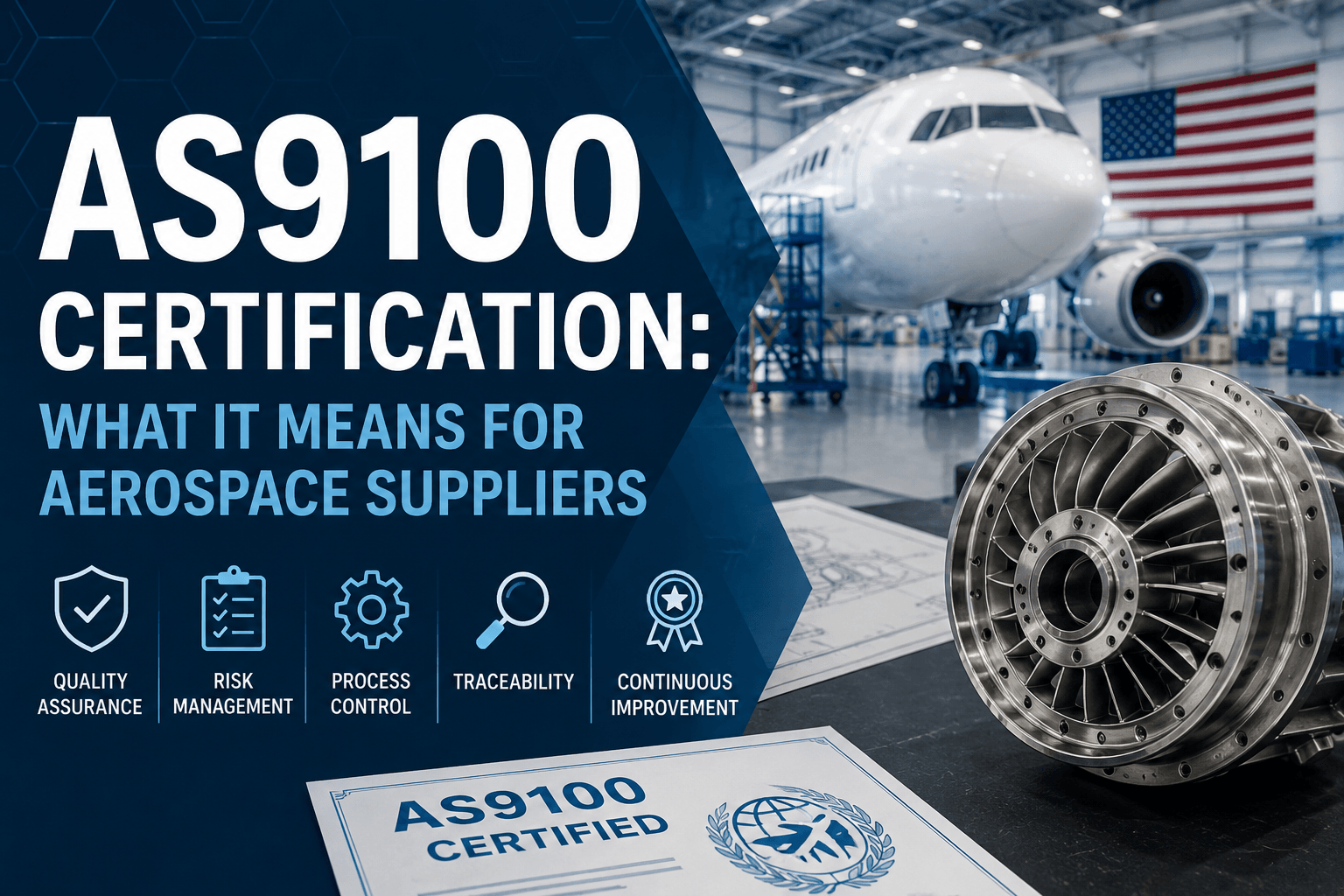
AS9100 Certification: What It Means for Aerospace Suppliers

Quality is non-negotiable in the aerospace industry. A single manufacturing error can affect safety, performance, and regulatory compliance across an entire supply chain. That’s why many aerospace manufacturers require their suppliers to hold AS9100 certification before they can bid on contracts or become approved vendors.

Whether you’re a machine shop, electronics manufacturer, component supplier, or precision engineering company, understanding AS9100 can help you compete for more business while improving your internal processes.

What Is AS9100 Certification?

AS9100 is an internationally recognized Quality Management System (QMS) standard developed specifically for the aerospace, aviation, and defense industries. It builds on ISO 9001 by adding industry-specific requirements that address product safety, risk management, configuration management, counterfeit parts prevention, and regulatory compliance.

The standard was created by the International Aerospace Quality Group (IAQG) to establish consistent quality expectations across global aerospace supply chains.

Companies that achieve AS9100 certification have demonstrated that their quality management system meets rigorous industry requirements and is capable of consistently delivering safe, reliable, and compliant products.

Why AS9100 Matters for Aerospace Suppliers

Many aerospace manufacturers only work with suppliers that are AS9100 certified. Certification demonstrates that a supplier has implemented standardized processes to reduce defects, improve traceability, and maintain consistent product quality.

For suppliers, certification offers more than regulatory compliance. It provides a competitive advantage when pursuing contracts with aerospace original equipment manufacturers (OEMs), defense contractors, and Tier 1 suppliers.

It also gives customers greater confidence that products will meet strict quality and safety requirements throughout production.

Key Requirements of AS9100

AS9100 includes all ISO 9001 requirements while introducing additional controls designed for aerospace manufacturing.

Some of the most important requirements include:

Risk-Based Thinking

Organizations must identify, evaluate, and manage risks throughout design, production, and delivery. This proactive approach helps reduce quality issues before they affect customers.

Product Safety

Companies must establish documented processes that protect product integrity throughout manufacturing, handling, storage, and delivery.

Configuration Management

Manufacturers must control product configurations to ensure every design change is documented, approved, and traceable throughout the product lifecycle.

Counterfeit Parts Prevention

Suppliers must implement procedures to prevent counterfeit or suspect components from entering production.

Traceability

Materials, components, inspections, and production records must be traceable from raw material through finished product.

Operational Planning

Organizations must define controlled manufacturing processes, inspection activities, quality objectives, and acceptance criteria before production begins.

Benefits of AS9100 Certification

Certification can deliver measurable improvements across both operations and business development.

Improved Product Quality

Documented processes reduce variation, improve consistency, and minimize manufacturing defects.

Increased Customer Confidence

Customers know certified suppliers follow internationally recognized quality standards and undergo regular independent audits.

Better Risk Management

Organizations identify potential failures earlier, reducing costly rework, delays, and quality escapes.

Access to New Business Opportunities

Many aerospace contracts require AS9100 certification as a prerequisite for supplier approval.

Greater Operational Efficiency

Standardized procedures reduce waste, improve communication, and support continuous improvement initiatives.

Stronger Regulatory Compliance

AS9100 helps organizations align with aviation regulations and customer-specific quality requirements.

Who Needs AS9100 Certification?

AS9100 is intended for organizations that manufacture products or provide services within the aerospace supply chain.

Examples include:

  • Precision machining companies
  • Aerospace component manufacturers
  • Electronics suppliers
  • Composite material manufacturers
  • Metal fabrication companies
  • Assembly and integration providers
  • Maintenance, repair, and overhaul (MRO) organizations
  • Aerospace distributors with value-added processes
  • Defense contractors
  • Special process providers

Even companies that supply indirect products or services may benefit if certification is expected by major customers.

Steps to Become AS9100 Certified

Certification is achieved through a structured implementation and audit process.

1. Understand the Standard

Review AS9100 requirements and compare them with your existing quality management system.

2. Perform a Gap Analysis

Identify areas where current processes do not meet certification requirements.

3. Develop or Update Your Quality Management System

Document procedures, define responsibilities, establish quality objectives, and implement required controls.

4. Train Employees

Ensure employees understand documented procedures and their responsibilities within the quality management system.

5. Conduct Internal Audits

Verify that processes are working effectively and identify opportunities for improvement before the certification audit.

6. Hold a Management Review

Leadership should evaluate quality performance, audit results, risks, and improvement initiatives.

7. Complete the Certification Audit

An accredited certification body performs a two-stage audit to evaluate compliance with AS9100 requirements.

8. Maintain Certification

Organizations must complete regular surveillance audits and continually improve their quality management system.

Common Challenges During Implementation

Many organizations encounter similar obstacles when preparing for certification.

These may include:

  • Creating complete process documentation
  • Managing extensive records
  • Meeting traceability requirements
  • Integrating risk management into daily operations
  • Training employees across departments
  • Maintaining consistent supplier controls
  • Preparing for external audits

A phased implementation plan and strong management support can help overcome these challenges.

AS9100 vs. ISO 9001

Although AS9100 is based on ISO 9001, it includes additional requirements specifically for aerospace organizations.

FeatureISO 9001AS9100
General quality management
Risk managementBasicEnhanced
Product safetyLimitedComprehensive
Configuration managementNoYes
Counterfeit parts preventionNoYes
Aerospace regulatory focusNoYes
Supplier traceabilityLimitedExtensive

Organizations already certified to ISO 9001 often find it easier to transition to AS9100 because many core quality management requirements are already in place.

Best Practices for Maintaining AS9100 Compliance

Certification should be viewed as an ongoing commitment rather than a one-time achievement.

Organizations that maintain compliance successfully often:

  • Review quality objectives regularly.
  • Conduct scheduled internal audits.
  • Monitor supplier performance.
  • Analyze customer feedback and nonconformities.
  • Update risk assessments as operations evolve.
  • Train employees continuously.
  • Use corrective actions to prevent recurring issues.

These practices help sustain certification while supporting long-term operational excellence.

Frequently Asked Questions

Q. Is AS9100 mandatory?

No. However, many aerospace manufacturers and defense contractors require suppliers to be AS9100 certified before awarding contracts.

Q. How long does AS9100 certification take?

Implementation typically takes between six and twelve months, depending on the organization’s size, existing quality management system, and operational complexity.

Q. Does AS9100 replace ISO 9001?

No. AS9100 includes all ISO 9001 requirements while adding aerospace-specific controls.

Q. How often is AS9100 certification renewed?

Certification is generally valid for three years, with surveillance audits conducted annually to verify continued compliance.

Key Takeaways

AS9100 certification is more than a quality badge. It demonstrates that an aerospace supplier has implemented disciplined processes designed to meet the industry’s demanding expectations for safety, quality, and reliability.

For suppliers looking to grow within the aerospace and defense sectors, certification can open doors to new contracts, strengthen customer relationships, improve operational efficiency, and reduce quality risks. While achieving certification requires time and commitment, the long-term benefits often extend well beyond compliance, helping organizations build a stronger reputation and compete more effectively in a highly regulated market.

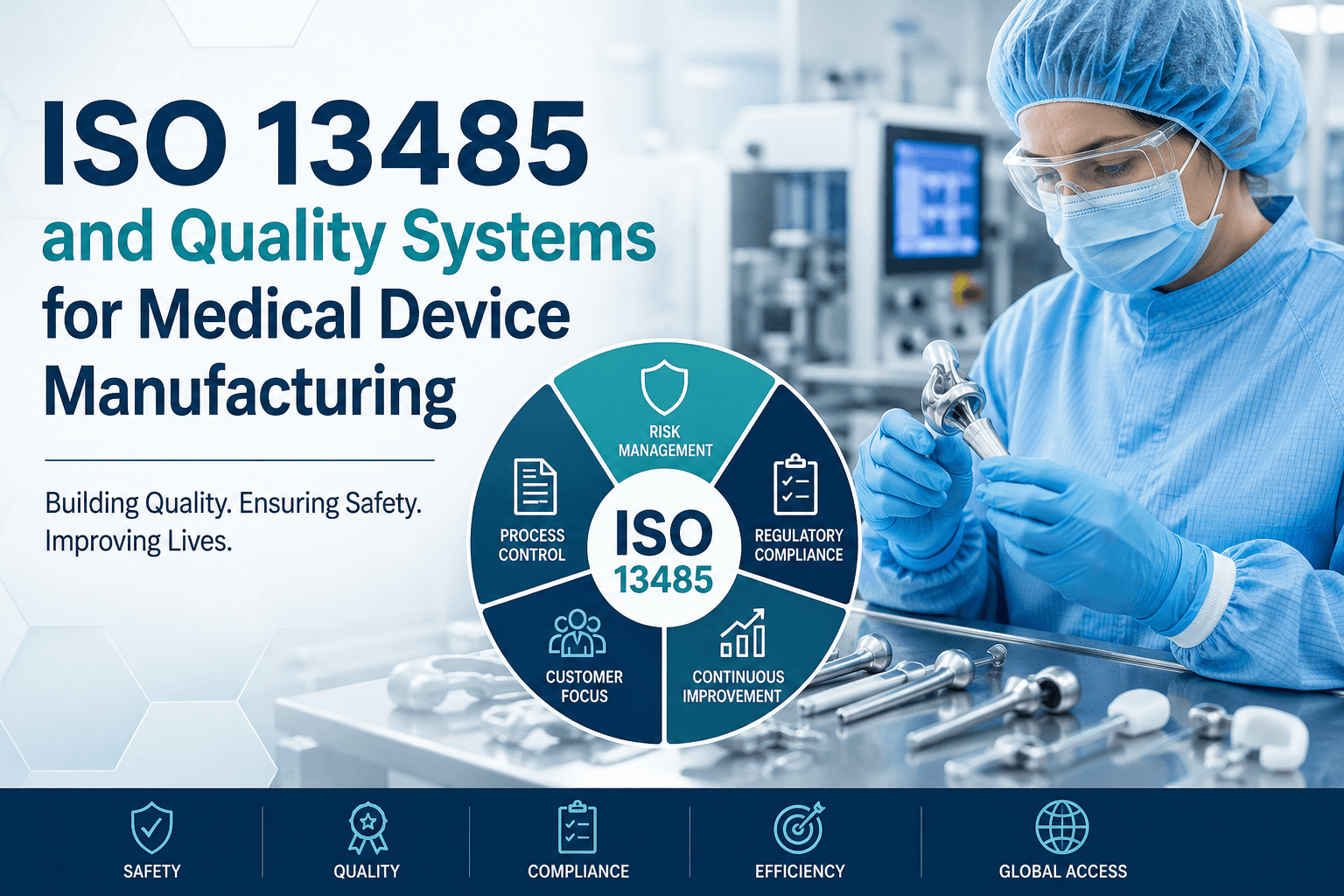
ISO 13485 and Quality Systems for Medical Device Manufacturing

Medical devices must consistently meet strict safety, performance, and regulatory requirements. Whether a company manufactures surgical instruments, diagnostic equipment, implants, or software as a medical device (SaMD), maintaining a reliable quality management system (QMS) is essential.

ISO 13485 is the internationally recognized standard for quality management systems in the medical device industry. It provides a structured framework that helps manufacturers design, produce, distribute, and service medical devices while meeting regulatory requirements and reducing quality risks.

This guide explains what ISO 13485 is, why it matters, and how manufacturers can build an effective quality system that supports compliance and business growth.

What Is ISO 13485?

ISO 13485 is an international standard that specifies requirements for a quality management system used by organizations involved in the medical device lifecycle. It applies to manufacturers as well as suppliers, contract manufacturers, sterilization providers, distributors, and service organizations.

Unlike general quality standards, ISO 13485 focuses on:

  • Product safety and effectiveness
  • Regulatory compliance
  • Risk management throughout product realization
  • Process validation
  • Traceability
  • Documented quality controls

The latest version, ISO 13485:2016, aligns with regulatory expectations across many global markets, including the European Union, Canada, Australia, Japan, and several other regions.

Why ISO 13485 Matters

Medical devices directly affect patient health. Even minor manufacturing defects can lead to product recalls, regulatory action, or patient harm.

Implementing ISO 13485 helps organizations:

  • Improve product quality and consistency
  • Demonstrate regulatory compliance
  • Reduce manufacturing defects
  • Strengthen supplier management
  • Improve customer confidence
  • Simplify market access in many countries
  • Support FDA and international regulatory expectations

Certification also demonstrates that an organization has established systematic controls for quality rather than relying on inspection alone.

Core Elements of an ISO 13485 Quality Management System

A compliant quality system integrates quality into every stage of the product lifecycle.

Document Control

Controlled documentation ensures employees always work from current procedures, specifications, and work instructions.

Typical controlled documents include:

  • Quality manual
  • Standard operating procedures (SOPs)
  • Work instructions
  • Device master records
  • Forms and templates
  • Validation reports
  • Design documentation

Document revisions must be reviewed, approved, and traceable.

Risk Management

Risk management is integrated throughout the quality system rather than treated as a separate activity.

Manufacturers identify potential hazards, evaluate associated risks, implement mitigation measures, and verify that controls remain effective throughout the product lifecycle.

Risk management often follows ISO 14971, the international standard for medical device risk management.

Design and Development Controls

Organizations developing medical devices must maintain structured design controls.

These include:

  • Design planning
  • User requirements
  • Design inputs
  • Design outputs
  • Design verification
  • Design validation
  • Design reviews
  • Design transfer
  • Design change management

Proper documentation demonstrates that products meet intended use and regulatory requirements.

Supplier Quality Management

Many manufacturers rely on external suppliers for components, raw materials, sterilization, packaging, or contract manufacturing.

ISO 13485 requires organizations to:

  • Evaluate suppliers before approval
  • Monitor supplier performance
  • Define purchasing requirements
  • Verify incoming materials
  • Maintain supplier records

Supplier quality directly impacts final device safety.

Production and Process Controls

Manufacturing processes must consistently produce devices that meet specifications.

Key controls include:

  • Process validation
  • Equipment calibration
  • Environmental monitoring
  • Cleanroom controls
  • Manufacturing instructions
  • Operator training
  • In-process inspections

Processes that cannot be fully verified through inspection alone must be validated.

Corrective and Preventive Action (CAPA)

CAPA helps organizations identify quality issues, investigate root causes, implement corrective actions, and prevent recurrence.

Common CAPA inputs include:

  • Customer complaints
  • Internal audits
  • Product nonconformities
  • Process deviations
  • Regulatory findings
  • Supplier issues

An effective CAPA system drives continuous improvement while reducing future quality risks.

Complaint Handling and Post-Market Surveillance

Quality management extends beyond manufacturing.

Manufacturers should establish procedures for:

  • Receiving customer complaints
  • Investigating reported issues
  • Determining reportability
  • Trend analysis
  • Field corrective actions
  • Product recalls when necessary

These activities help identify emerging risks and support regulatory compliance.

Validation Requirements

Validation demonstrates that critical processes consistently produce the intended results.

Typical validation activities include:

  • Process validation
  • Software validation
  • Equipment qualification
  • Cleaning validation
  • Sterilization validation
  • Packaging validation
  • Test method validation

Validation records provide objective evidence during regulatory inspections and certification audits.

Internal Audits

Internal audits verify that the quality system operates as intended.

Auditors evaluate:

  • Compliance with documented procedures
  • Regulatory requirements
  • Effectiveness of processes
  • Opportunities for improvement
  • Employee adherence to quality practices

Audit findings often generate corrective actions that strengthen the QMS before external inspections.

Management Responsibility

Leadership plays a central role in ISO 13485 compliance.

Top management is responsible for:

  • Establishing quality objectives
  • Providing adequate resources
  • Reviewing QMS performance
  • Promoting quality culture
  • Supporting regulatory compliance
  • Driving continual improvement

Management reviews should evaluate quality metrics, audit findings, complaints, CAPA status, supplier performance, and business risks.

Benefits of ISO 13485 Certification

Certification provides both regulatory and operational advantages.

Organizations often experience:

  • Improved manufacturing consistency
  • Better documentation practices
  • Reduced quality costs
  • Stronger supplier oversight
  • Lower risk of recalls
  • Increased customer trust
  • Easier entry into international markets
  • Greater readiness for regulatory inspections

While certification itself does not guarantee regulatory approval, it demonstrates a mature and well-managed quality system.

Common Implementation Challenges

Many organizations encounter similar obstacles during implementation.

These include:

  • Managing extensive documentation
  • Training employees across departments
  • Integrating risk management into daily operations
  • Maintaining complete design history files
  • Validating manufacturing processes
  • Controlling supplier quality
  • Keeping documentation current during product changes

Successful implementation requires collaboration across engineering, manufacturing, quality assurance, regulatory affairs, and executive leadership.

Best Practices for Maintaining Compliance

Maintaining ISO 13485 certification requires ongoing effort.

Organizations should:

  • Review procedures regularly
  • Conduct scheduled internal audits
  • Monitor quality performance indicators
  • Maintain employee training records
  • Review supplier performance
  • Update risk assessments
  • Perform management reviews
  • Prepare for surveillance audits
  • Encourage continuous improvement

A proactive approach helps organizations remain inspection-ready while improving operational efficiency.

The Relationship Between ISO 13485 and Regulatory Compliance

Although ISO 13485 is a voluntary international standard in many jurisdictions, regulators frequently recognize or reference it as a benchmark for quality management.

For example:

  • Many manufacturers use ISO 13485 to support compliance with European medical device regulations.
  • Canada incorporates ISO 13485 certification into its Medical Device Single Audit Program (MDSAP) framework.
  • Many organizations align their ISO 13485 quality system with U.S. FDA Quality Management System expectations to streamline compliance activities.

A well-implemented QMS makes it easier to meet multiple regulatory requirements without creating separate quality systems for each market.

Frequently Asked Questions

Q. Is ISO 13485 mandatory?

Not universally. However, certification is often expected by regulators, customers, and distributors, particularly for companies selling medical devices internationally.

Q. Who should implement ISO 13485?

Manufacturers, contract manufacturers, component suppliers, sterilization providers, testing laboratories, distributors, and organizations involved in the medical device lifecycle can benefit from implementing ISO 13485.

Q. How long does ISO 13485 certification take?

Implementation timelines vary based on company size, product complexity, and the maturity of existing quality systems. Many organizations require several months to prepare for certification.

Q. Does ISO 13485 apply to software medical devices?

Yes. Organizations developing software as a medical device (SaMD) can implement ISO 13485 to establish quality processes that support development, validation, maintenance, and regulatory compliance.

Key Takeaways

ISO 13485 provides a comprehensive framework for building and maintaining a quality management system tailored to the medical device industry. By emphasizing risk management, documentation, process control, supplier oversight, and continual improvement, the standard helps manufacturers produce safe, effective, and compliant products.

For organizations operating in highly regulated markets, ISO 13485 is more than a certification. It serves as the foundation for consistent quality, regulatory readiness, and long-term business success.

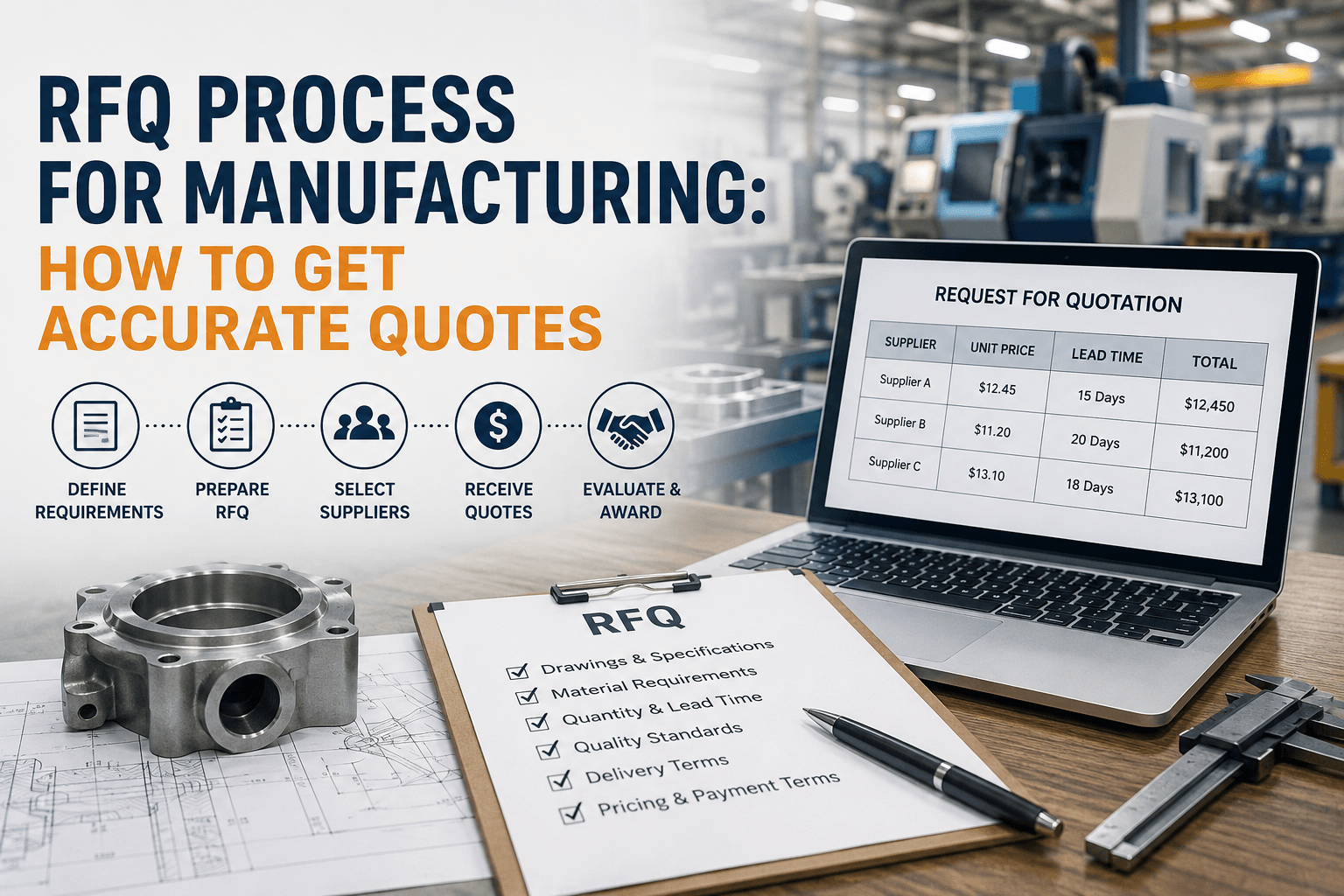
RFQ Process for Manufacturing: How to Get Accurate Quotes

Getting competitive pricing from suppliers starts with a well-written Request for Quotation (RFQ). Yet many manufacturers struggle with inaccurate quotes, unexpected costs, and long negotiation cycles because the information they provide is incomplete or unclear.

An effective RFQ process helps suppliers understand exactly what you need. That leads to faster responses, more accurate pricing, and fewer surprises during production.

This guide explains how the manufacturing RFQ process works, what information every RFQ should include, common mistakes to avoid, and practical ways to improve quote accuracy.

What Is an RFQ in Manufacturing?

A Request for Quotation (RFQ) is a formal document sent to suppliers asking them to provide pricing for specific products, materials, or manufacturing services.

Unlike a Request for Proposal (RFP), which focuses on finding the best solution to a business problem, an RFQ is used when the product specifications are already defined. Suppliers respond primarily with pricing, delivery timelines, and commercial terms.

Manufacturers commonly use RFQs for:

  • Custom machined parts
  • Sheet metal fabrication
  • Plastic injection molding
  • Electronics manufacturing
  • Raw materials
  • Production tooling
  • Contract manufacturing

The more detailed your RFQ, the more reliable the supplier’s quotation will be.

Why Accurate RFQs Matter

An incomplete RFQ creates uncertainty for suppliers. When critical details are missing, suppliers often:

  • Add extra cost to cover risk
  • Estimate instead of calculating actual production costs
  • Ask multiple clarification questions
  • Delay submitting quotations
  • Deliver quotes that cannot be fairly compared

A detailed RFQ reduces these issues and allows procurement teams to compare suppliers based on consistent information.

The Manufacturing RFQ Process

1. Define Your Requirements

Before contacting suppliers, gather all technical and commercial requirements.

This includes:

  • Product specifications
  • Engineering drawings
  • Material requirements
  • Quantity
  • Quality standards
  • Delivery schedule
  • Packaging instructions

Internal alignment between engineering, purchasing, production, and quality teams prevents conflicting requirements later.

2. Prepare the RFQ Package

The RFQ should answer every question a supplier would normally ask before preparing pricing.

A complete package typically includes:

  • Part numbers
  • CAD files or engineering drawings
  • Bill of Materials (BOM)
  • Material specifications
  • Surface finish requirements
  • Tolerances
  • Inspection requirements
  • Certifications
  • Target production volume
  • Delivery location
  • Required lead time

Providing complete documentation minimizes back-and-forth communication.

3. Select Qualified Suppliers

Price should not be the only selection factor.

Choose suppliers based on factors such as:

  • Manufacturing capabilities
  • Industry experience
  • Quality certifications
  • Production capacity
  • Financial stability
  • Previous performance
  • Geographic location

Sending RFQs only to qualified suppliers increases response quality and saves time.

4. Allow Enough Time for Quoting

Complex manufacturing projects require suppliers to review drawings, estimate labor, calculate material usage, and coordinate with subcontractors.

Rushing the process often results in rough estimates rather than accurate quotations.

Provide realistic deadlines, especially for complex assemblies or custom products.

5. Evaluate Supplier Responses

The lowest quote is not always the best choice.

Compare suppliers across multiple criteria, including:

  • Unit pricing
  • Tooling costs
  • Setup fees
  • Shipping costs
  • Production lead time
  • Payment terms
  • Quality certifications
  • Warranty
  • Production capacity

Looking at total cost rather than unit price helps avoid expensive surprises later.

6. Clarify and Negotiate

If quotations differ significantly, discuss the assumptions behind each quote.

Questions to ask include:

  • Are tooling costs included?
  • What production volume was assumed?
  • Are shipping charges included?
  • Are inspection costs included?
  • What happens if volumes increase?
  • Are material price changes covered?

Clarification ensures you’re comparing equivalent offers.

7. Award the Purchase Order

Once the supplier is selected, convert the accepted quotation into a purchase order with clearly documented specifications, pricing, delivery dates, and commercial terms.

Maintaining documentation helps prevent future disputes.

What Information Should Every Manufacturing RFQ Include?

A high-quality RFQ typically contains the following information:

Product Information

  • Part name
  • Part number
  • Product description
  • Revision number

Technical Documentation

  • Engineering drawings
  • CAD models
  • Bill of Materials
  • Assembly instructions
  • Quality standards

Material Specifications

Clearly define:

  • Material grade
  • Approved alternatives
  • Heat treatment
  • Surface finish
  • Coatings

Production Requirements

Include:

  • Annual volume
  • Initial order quantity
  • Batch size
  • Prototype requirements
  • Expected future demand

Quality Requirements

Specify:

  • Inspection procedures
  • Dimensional tolerances
  • Industry certifications
  • Testing requirements
  • Documentation requirements

Commercial Terms

Include:

  • Delivery location
  • Required lead time
  • Payment terms
  • Incoterms (if applicable)
  • Currency
  • Quote validity period

The more complete these details are, the easier it becomes for suppliers to provide comparable quotes.

Common RFQ Mistakes That Lead to Inaccurate Quotes

Many purchasing teams unintentionally create delays by leaving out important details.

Common mistakes include:

Missing Drawings

Incomplete or outdated drawings force suppliers to make assumptions.

Unclear Material Specifications

General descriptions such as “steel” or “plastic” are usually insufficient.

Instead, specify exact grades and standards.

Undefined Quantities

Pricing changes significantly based on production volume.

Always provide expected order quantities and annual forecasts.

Ignoring Quality Requirements

Inspection standards and certification requirements directly affect manufacturing costs.

Include these requirements from the beginning.

Frequent RFQ Revisions

Changing specifications after suppliers begin preparing quotes wastes time and often delays procurement.

Finalize engineering documents before issuing the RFQ whenever possible.

Best Practices for Getting More Accurate Supplier Quotes

Organizations that consistently receive accurate quotations often follow a structured process.

Some proven practices include:

  • Use standardized RFQ templates.
  • Attach complete engineering documentation.
  • Keep revision control up to date.
  • Invite only qualified suppliers.
  • Ask suppliers to identify assumptions.
  • Compare total landed cost instead of unit price alone.
  • Establish clear communication channels.
  • Maintain a centralized record of supplier quotations.

These practices improve consistency while reducing administrative work.

How Digital RFQ Management Improves Manufacturing Procurement

Many manufacturers now manage RFQs using procurement software instead of spreadsheets and email.

Digital RFQ management can help teams:

  • Standardize RFQ templates
  • Store engineering documents in one place
  • Track supplier responses
  • Compare quotations automatically
  • Manage approval workflows
  • Maintain revision history
  • Improve collaboration between engineering and procurement

For organizations handling hundreds of RFQs each year, automation can reduce manual effort and improve visibility throughout the sourcing process.

Frequently Asked Questions

Q. What is the difference between an RFQ and an RFP?

An RFQ requests pricing for products or services with clearly defined specifications. An RFP is used when the buyer is looking for suppliers to propose different solutions to a broader business need.

Q. How many suppliers should receive an RFQ?

Many manufacturers invite three to five qualified suppliers. This typically provides enough competition while keeping the evaluation process manageable.

Q. How long should suppliers have to respond?

Simple RFQs may require only a few business days, while complex manufacturing projects often need one to three weeks, depending on the level of technical review involved.

Q. What makes an RFQ successful?

A successful RFQ includes complete technical specifications, realistic timelines, clear commercial requirements, and sufficient detail for suppliers to prepare accurate, comparable quotations.

Key Takeaways

The quality of supplier quotes depends largely on the quality of the RFQ. Clear specifications, complete documentation, and realistic expectations help suppliers provide accurate pricing and reliable delivery commitments.

By following a structured RFQ process, manufacturers can reduce procurement delays, improve supplier comparisons, and make more informed sourcing decisions. Over time, consistent RFQ practices also strengthen supplier relationships and contribute to smoother production planning.

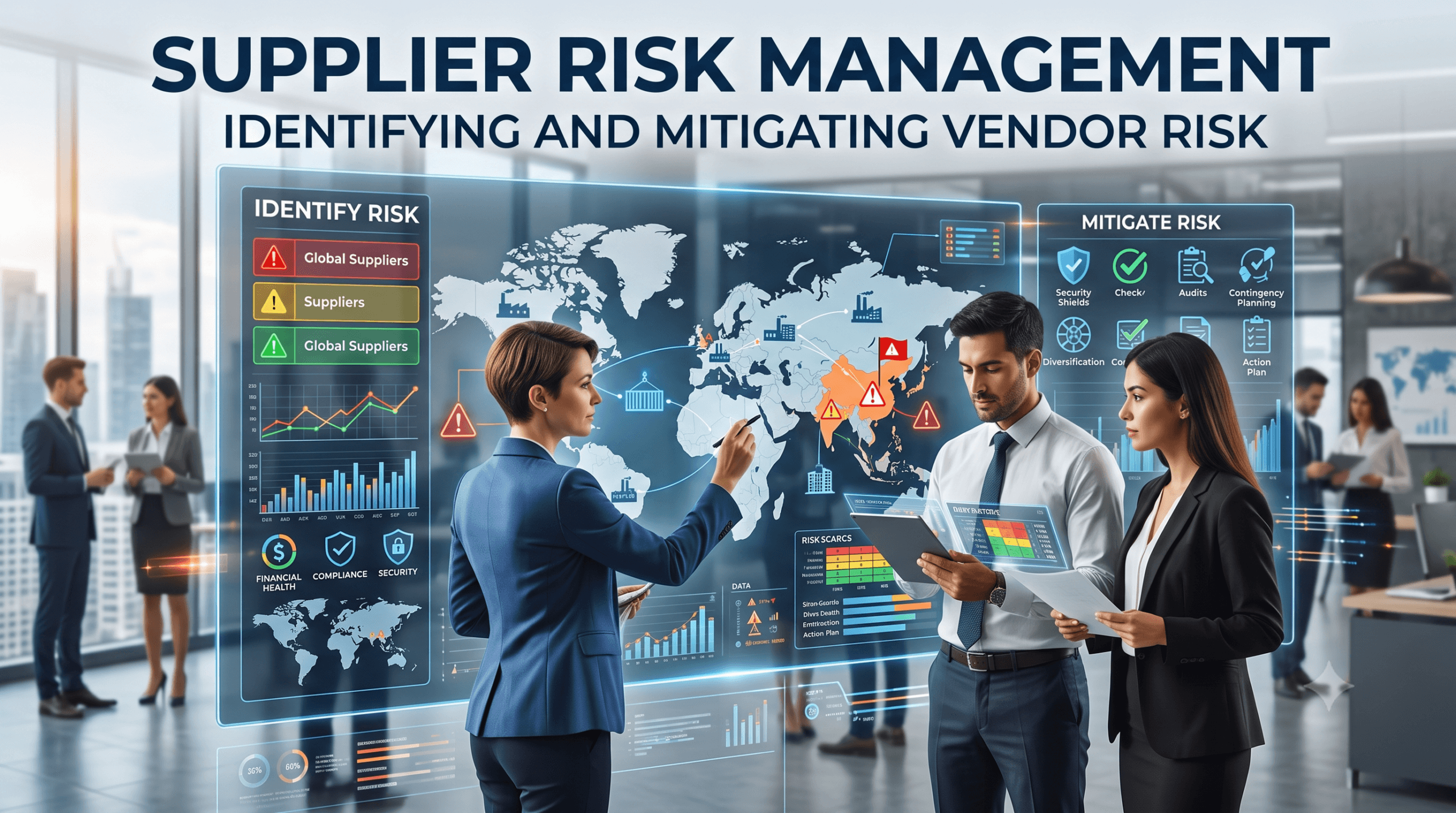
Supplier Risk Management: Identifying and Mitigating Vendor Risk

Every business depends on suppliers. Whether they provide raw materials, software, logistics, or professional services, vendors play a critical role in day-to-day operations. But every supplier also introduces some level of risk.

A delayed shipment, cybersecurity breach, financial failure, or compliance issue at a single vendor can disrupt operations, increase costs, and damage customer trust. That is why supplier risk management has become a core part of business resilience.

This guide explains what supplier risk management is, why it matters, the most common vendor risks, and practical steps organizations can take to reduce them.

What Is Supplier Risk Management?

Supplier risk management is the process of identifying, assessing, monitoring, and reducing risks associated with third-party vendors and suppliers.

The goal is not to eliminate every risk. Instead, organizations aim to understand potential threats, prioritize high-risk suppliers, and put controls in place before issues affect the business.

An effective supplier risk management program combines ongoing monitoring with clear governance, regular communication, and data-driven decision making.

Why Supplier Risk Management Matters

Businesses today rely on larger and more complex supplier networks than ever before. A single product or service may depend on dozens of third-party vendors spread across multiple regions.

Without proper oversight, organizations may face:

  • Supply chain disruptions
  • Financial losses
  • Regulatory penalties
  • Data security incidents
  • Operational downtime
  • Reputational damage
  • Customer dissatisfaction

A proactive approach helps organizations respond faster, improve supplier relationships, and maintain business continuity during unexpected events.

Common Types of Supplier Risk

Understanding different categories of risk helps organizations build a more comprehensive mitigation strategy.

Operational Risk

Operational risks occur when suppliers fail to deliver products or services as expected. Common causes include manufacturing delays, labor shortages, transportation disruptions, or poor quality control.

Financial Risk

A supplier experiencing financial instability may struggle to fulfill contracts or cease operations altogether. Monitoring financial health helps organizations identify warning signs before disruptions occur.

Cybersecurity Risk

Suppliers often have access to sensitive systems or business data. Weak cybersecurity practices can expose organizations to ransomware attacks, data breaches, and unauthorized access.

Vendor security assessments, regular audits, and contractual security requirements help reduce these risks.

Compliance and Regulatory Risk

Suppliers must comply with industry regulations, environmental standards, labor laws, and privacy requirements. Non-compliance can create legal and financial consequences for both the supplier and the purchasing organization.

Geopolitical Risk

Political instability, trade restrictions, sanctions, and regional conflicts can interrupt global supply chains and increase procurement costs.

Diversifying suppliers across different regions can improve resilience.

Environmental and Sustainability Risk

Customers and regulators increasingly expect organizations to work with responsible suppliers. Environmental violations or unethical labor practices can negatively affect brand reputation.

How to Identify Supplier Risks

Effective supplier risk management begins with structured risk identification.

1. Create a Complete Supplier Inventory

Develop a centralized list of all suppliers, including:

  • Products or services provided
  • Contract values
  • Geographic locations
  • Business criticality
  • Data access levels
  • Contract renewal dates

A complete supplier inventory provides visibility across the entire vendor ecosystem.

2. Classify Suppliers by Criticality

Not every supplier presents the same level of risk.

Classify vendors based on factors such as:

  • Impact on business operations
  • Access to confidential information
  • Regulatory exposure
  • Revenue dependency
  • Availability of alternative suppliers

Critical suppliers should receive more frequent reviews and monitoring.

3. Perform Risk Assessments

Assess suppliers using standardized criteria, including:

  • Financial stability
  • Information security
  • Compliance history
  • Operational performance
  • Business continuity planning
  • Geographic exposure
  • ESG performance

Using consistent scoring models helps prioritize risk mitigation efforts.

4. Conduct Due Diligence

Before onboarding new vendors, verify important information such as:

  • Business licenses
  • Insurance coverage
  • Security certifications
  • Regulatory compliance
  • Financial statements
  • Customer references
  • Audit reports

Thorough due diligence reduces onboarding risks.

Strategies to Mitigate Vendor Risk

Identifying risks is only the first step. Organizations must also implement effective controls.

Diversify Suppliers

Relying on a single supplier creates unnecessary vulnerability.

Maintaining qualified backup suppliers helps reduce disruptions caused by unexpected events.

Strengthen Contracts

Contracts should clearly define:

  • Service level agreements (SLAs)
  • Security requirements
  • Compliance obligations
  • Incident reporting timelines
  • Audit rights
  • Performance expectations
  • Termination clauses

Well-written contracts establish accountability and reduce uncertainty.

Continuously Monitor Suppliers

Supplier risk changes over time.

Monitor vendors regularly through:

  • Performance reviews
  • Security assessments
  • Financial monitoring
  • Compliance checks
  • News monitoring
  • Risk score updates

Continuous monitoring enables early detection of emerging risks.

Develop Business Continuity Plans

Prepare response plans for high-impact scenarios, including:

  • Supplier bankruptcy
  • Natural disasters
  • Cyberattacks
  • Transportation delays
  • Regulatory changes

Organizations that plan ahead recover faster during disruptions.

Improve Supplier Collaboration

Strong supplier relationships improve transparency and communication.

Regular business reviews encourage suppliers to discuss challenges early, allowing both parties to work together on solutions.

The Role of Technology in Supplier Risk Management

Manual spreadsheets are difficult to maintain as supplier networks grow.

Modern supplier risk management platforms help organizations:

  • Centralize supplier information
  • Automate vendor onboarding
  • Track compliance documents
  • Monitor supplier performance
  • Identify emerging risks
  • Generate audit reports
  • Send automated assessment reminders
  • Create risk dashboards

Automation reduces administrative work while improving visibility across the supplier lifecycle.

Key Metrics to Track

Monitoring the right metrics helps organizations measure the effectiveness of their supplier risk management program.

Useful KPIs include:

  • Percentage of high-risk suppliers
  • Supplier assessment completion rate
  • Average vendor risk score
  • On-time delivery rate
  • Compliance audit success rate
  • Security incident frequency
  • Supplier contract renewal rate
  • Time to resolve supplier issues

Tracking trends over time supports better decision making and continuous improvement.

Best Practices for Supplier Risk Management

Organizations with mature vendor risk programs typically follow several proven practices:

  • Standardize supplier assessments across departments.
  • Review supplier risk regularly rather than only during onboarding.
  • Prioritize critical vendors based on business impact.
  • Keep supplier information current.
  • Automate repetitive risk management tasks where possible.
  • Include cybersecurity, compliance, financial, and operational risks in every assessment.
  • Maintain clear communication with suppliers.
  • Regularly test business continuity and incident response plans.

These practices create a stronger and more resilient supplier ecosystem.

Common Challenges

Supplier risk management often becomes more difficult as organizations grow.

Common challenges include:

  • Limited visibility into supplier networks
  • Manual tracking processes
  • Inconsistent risk assessments
  • Increasing regulatory requirements
  • Expanding global supply chains
  • Resource constraints
  • Incomplete supplier documentation

Technology, standardized processes, and executive support can help address these challenges.

Conclusion

Supplier risk management is no longer just a procurement responsibility. It is an essential business function that protects operations, customers, and long-term growth.

By identifying supplier risks early, performing structured assessments, continuously monitoring vendor performance, and strengthening supplier relationships, organizations can reduce disruptions and build more resilient supply chains.

As supplier ecosystems become increasingly interconnected, businesses that invest in proactive vendor risk management will be better positioned to navigate uncertainty while maintaining operational stability.

Key Takeaways

  • Supplier risk management identifies and reduces risks associated with third-party vendors.
  • Vendor risks include operational, financial, cybersecurity, compliance, geopolitical, and sustainability concerns.
  • Risk assessments and supplier classification help prioritize mitigation efforts.
  • Continuous monitoring provides early visibility into emerging supplier issues.
  • Technology improves efficiency through automation, centralized data, and real-time risk monitoring.

Frequently Asked Questions

Q. What is supplier risk management?

Supplier risk management is the process of identifying, assessing, monitoring, and mitigating risks associated with third-party suppliers throughout the vendor lifecycle.

Q. Why is vendor risk management important?

Vendor risk management helps organizations reduce operational disruptions, strengthen compliance, protect sensitive data, improve supplier performance, and maintain business continuity.

Q. How often should suppliers be assessed?

Critical suppliers should typically be reviewed at least annually, with continuous monitoring for financial, cybersecurity, and operational changes. Higher-risk vendors may require more frequent assessments.

Q. What are the biggest supplier risks?

The most common supplier risks include operational disruptions, financial instability, cybersecurity threats, regulatory non-compliance, geopolitical events, and environmental or sustainability issues.

Q. How can software improve supplier risk management?

Supplier risk management software centralizes vendor information, automates assessments, monitors compliance, tracks performance, and provides real-time visibility into supplier risks across the organization.

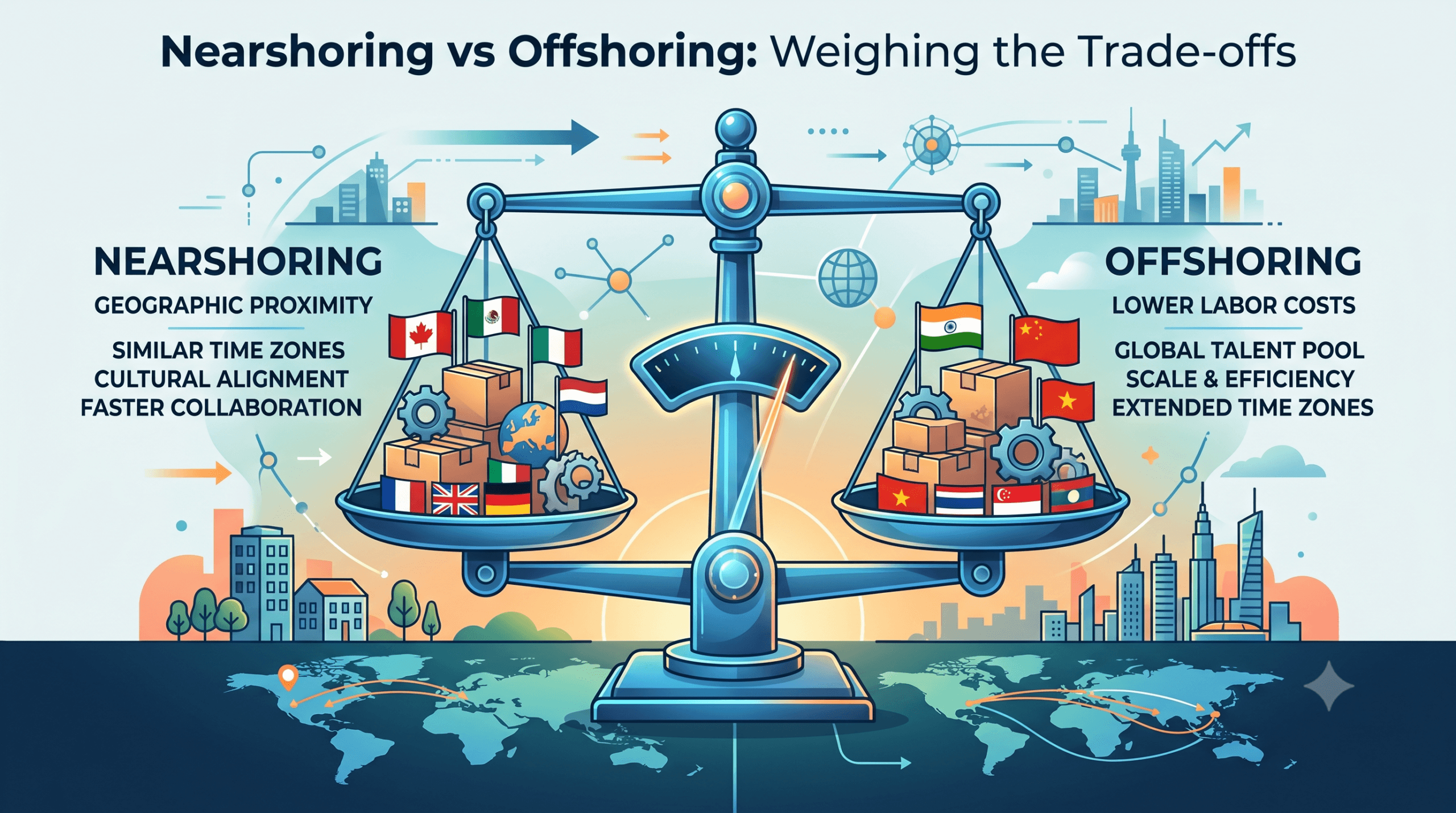
Nearshoring vs Offshoring: Weighing the Trade-offs

Choosing where to build your software team is no longer just about finding the lowest hourly rate. Companies today must balance cost, collaboration, speed, security, and access to specialized talent. That’s why many organizations are comparing nearshoring and offshoring before making long-term outsourcing decisions.

While both models help businesses scale development without hiring entirely in-house, they solve different problems. Understanding the trade-offs can help you choose the approach that aligns with your budget, timelines, and business goals.

What Is Nearshoring?

Nearshoring means outsourcing work to a nearby country, usually within the same region or a similar time zone.

For example:

  • A US company hiring developers in Mexico or Colombia
  • A German company partnering with a software team in Poland
  • An Australian business working with developers in New Zealand

The biggest advantage is proximity. Teams often share overlapping work hours, similar business cultures, and shorter travel times.

What Is Offshoring?

Offshoring involves outsourcing work to countries that are geographically farther away, often across multiple time zones.

Common examples include:

  • US companies hiring development teams in India, Vietnam, or the Philippines
  • UK businesses outsourcing projects to Pakistan or Bangladesh
  • European organizations working with teams across Asia

Offshoring is often chosen to reduce development costs and gain access to large pools of technical talent.

Nearshoring vs Offshoring at a Glance

FactorNearshoringOffshoring
Time zone overlapHighLow to moderate
CommunicationEasier real-time collaborationOften asynchronous
TravelShorter and more convenientLonger and more expensive
Development costsModerateUsually lower
Cultural alignmentTypically strongerCan require more adaptation
Talent availabilityGoodVery large global talent pool
Project managementEasier for agile teamsRequires structured coordination

Cost Comparison

Cost is often the first factor companies consider, but it should not be the only one.

Offshoring generally offers lower hourly rates because labor costs are lower in many overseas markets. For organizations with tight budgets or large-scale development needs, this can significantly reduce operating expenses.

Nearshoring usually costs more than offshoring but less than hiring locally. Many businesses find the additional investment worthwhile because smoother communication and faster decision-making can improve productivity.

The lowest hourly rate does not always translate into the lowest overall project cost. Delays, rework, and communication challenges can offset initial savings.

Collaboration and Communication

Software development depends on continuous collaboration between developers, designers, product managers, and stakeholders.

Nearshore teams typically work during similar business hours, making it easier to:

  • Hold daily stand-ups
  • Resolve issues quickly
  • Review code in real time
  • Make faster product decisions

Offshore teams often rely more on asynchronous communication. This approach can work well with mature processes, but questions may take hours instead of minutes to resolve.

Organizations using agile development often benefit from greater time zone overlap.

Talent Availability

Both models provide access to skilled professionals, but the available talent pools differ.

Nearshoring gives companies access to regional experts who may have experience with similar markets, regulations, and customer expectations.

Offshoring opens the door to one of the largest global talent markets. Businesses can often find specialists in areas such as:

  • Artificial intelligence
  • Cloud engineering
  • Cybersecurity
  • Mobile development
  • DevOps
  • Data engineering

For projects requiring niche technical expertise, offshoring often provides more hiring flexibility.

Cultural and Language Considerations

Successful outsourcing depends on more than technical ability.

Shared business culture, communication styles, and language proficiency influence how smoothly projects progress.

Nearshore teams often have:

  • Similar workplace expectations
  • Better cultural familiarity
  • Fewer communication misunderstandings

Offshore partnerships can also be highly successful, particularly when vendors invest in English proficiency, project management training, and cross-cultural communication.

The quality of the vendor usually matters more than geography alone.

Security and Compliance

Organizations handling sensitive customer data should evaluate security practices before selecting any outsourcing partner.

Important considerations include:

  • Data protection policies
  • Regulatory compliance
  • Secure development practices
  • Access controls
  • Intellectual property protection
  • Security certifications

Whether nearshore or offshore, vendors should demonstrate mature security processes and clear contractual protections.

Project Management Requirements

Nearshore partnerships generally require less coordination because teams share working hours and can collaborate throughout the day.

Offshore engagements often benefit from:

  • Detailed documentation
  • Clearly defined workflows
  • Regular progress reports
  • Project management tools
  • Well-established escalation procedures

Companies with mature development processes can successfully manage distributed offshore teams at scale.

When Nearshoring Makes Sense

Nearshoring is often the better choice if your business values:

  • Frequent stakeholder collaboration
  • Fast decision-making
  • Agile software development
  • Easier travel for on-site meetings
  • Strong cultural alignment

It is especially useful for projects where requirements evolve frequently and close communication is essential.

When Offshoring Makes Sense

Offshoring is often the better fit when your priorities include:

  • Lower development costs
  • Scaling engineering capacity quickly
  • Accessing specialized technical skills
  • Supporting round-the-clock development
  • Building long-term dedicated teams

Organizations with well-defined requirements and established delivery processes often realize substantial benefits from offshore development.

How to Choose the Right Model

There is no universal answer. The best outsourcing strategy depends on your priorities.

Choose nearshoring if collaboration speed, shared working hours, and regional alignment are your biggest concerns.

Choose offshoring if cost efficiency, access to specialized talent, and large-scale hiring are more important.

Many companies also adopt a hybrid approach, combining nearshore product management with offshore engineering teams. This model balances communication efficiency with access to broader technical expertise.

Key Takeaways

Nearshoring and offshoring each offer clear advantages. Nearshoring simplifies collaboration through closer proximity and overlapping time zones, making it well suited for agile projects and teams that need frequent interaction.

Offshoring offers greater cost savings and access to a larger global talent pool, making it an attractive option for organizations looking to scale efficiently or hire specialized expertise.

Rather than focusing only on hourly rates, evaluate the total value each model delivers. Consider communication, productivity, security, project complexity, and long-term business goals. The right choice is the one that supports sustainable delivery while helping your organization achieve its strategic objectives.

Frequently Asked Questions

Q. Is nearshoring more expensive than offshoring?

In most cases, yes. However, improved collaboration and fewer delays can reduce the total cost of ownership over the life of a project.

Q. Which model is better for agile software development?

Nearshoring often works better for agile teams because overlapping work hours support continuous collaboration, sprint planning, and rapid feedback.

Q. Does offshoring reduce software quality?

Not necessarily. Software quality depends on the vendor’s expertise, engineering practices, quality assurance processes, and project management, rather than geographic location.

Q. Can companies combine nearshoring and offshoring?

Yes. Many organizations use a hybrid delivery model, keeping customer-facing roles and product management nearshore while leveraging offshore teams for software development and specialized engineering.

Total Cost of Ownership in Global Sourcing Decisions

Choosing a supplier based on the lowest quoted price can lead to expensive surprises later. While unit cost is easy to compare, it often represents only a small portion of what a business ultimately spends to source a product or service.

That is why many procurement and supply chain teams rely on Total Cost of Ownership (TCO). Instead of focusing only on purchase price, TCO considers every cost associated with acquiring, transporting, storing, using, and supporting a product throughout its lifecycle. This broader view helps organizations make sourcing decisions that improve profitability, reduce risk, and strengthen long-term supplier relationships.

What Is Total Cost of Ownership?

Total Cost of Ownership (TCO) is a financial approach that calculates all costs involved in purchasing and managing a product or service over its entire lifecycle.

In global sourcing, TCO includes much more than the supplier’s quoted price. It accounts for hidden expenses that can significantly affect the actual value of a sourcing decision.

Rather than asking, “Which supplier offers the lowest price?” procurement teams ask, “Which supplier delivers the lowest overall cost while meeting our quality, service, and business requirements?”

Why TCO Matters in Global Sourcing

International sourcing introduces additional complexity compared to domestic purchasing. Products often travel across multiple countries, pass through customs, involve different currencies, and face varying regulatory requirements.

Ignoring these factors can create unexpected costs that eliminate any apparent savings from lower production prices.

Using a TCO approach helps businesses:

  • Compare suppliers more accurately.
  • Identify hidden procurement costs.
  • Improve long-term profitability.
  • Reduce operational risks.
  • Make better strategic sourcing decisions.
  • Strengthen supplier performance management.

Instead of reacting to unexpected expenses after purchase, organizations can anticipate them during supplier evaluation.

Components of Total Cost of Ownership

A complete TCO analysis evaluates every cost associated with the sourcing process.

Purchase Price

The purchase price remains an important component, but it should never be the only decision factor.

This includes:

  • Product cost
  • Tooling charges
  • Packaging costs
  • Minimum order quantities
  • Volume discounts

Transportation Costs

International logistics can quickly increase overall procurement expenses.

Transportation costs may include:

  • Ocean freight
  • Air freight
  • Inland transportation
  • Fuel surcharges
  • Container handling
  • Freight insurance

Shipping delays can also create indirect costs through production disruptions.

Import Duties and Taxes

Global sourcing frequently involves:

  • Customs duties
  • Import taxes
  • Tariffs
  • Brokerage fees
  • Regulatory inspections

Changes in trade policies can significantly alter long-term sourcing costs.

Inventory Holding Costs

Longer supply chains often require businesses to hold additional inventory.

Holding inventory creates costs such as:

  • Warehouse storage
  • Inventory financing
  • Insurance
  • Obsolescence
  • Inventory shrinkage

Higher inventory levels tie up working capital that could be invested elsewhere.

Quality Costs

Poor quality can erase initial purchase savings.

Quality-related expenses include:

  • Incoming inspections
  • Product testing
  • Rework
  • Scrap
  • Warranty claims
  • Customer returns
  • Production downtime

A supplier with a slightly higher purchase price may actually reduce total costs through consistent quality.

Supplier Management Costs

Managing overseas suppliers requires ongoing investment.

Examples include:

  • Supplier audits
  • Travel expenses
  • Performance monitoring
  • Compliance verification
  • Communication and coordination
  • Supplier development programs

These costs become increasingly important when sourcing from multiple international suppliers.

Risk Costs

Risk is one of the most overlooked aspects of TCO.

Potential risks include:

  • Political instability
  • Currency fluctuations
  • Natural disasters
  • Port congestion
  • Labor shortages
  • Regulatory changes
  • Supplier bankruptcy

Although these costs may not occur regularly, they can have significant financial consequences.

Hidden Costs That Businesses Often Miss

Many sourcing projects underestimate indirect costs because they are difficult to measure.

Common hidden expenses include:

  • Engineering support
  • Product redesign
  • Delayed product launches
  • Increased administrative work
  • Expedited shipping
  • Language barriers
  • Time zone coordination
  • Intellectual property protection
  • Cybersecurity requirements
  • Sustainability compliance

These costs may appear small individually but become substantial over multiple sourcing cycles.

How to Calculate Total Cost of Ownership

A simple TCO calculation follows this approach:

Total Cost of Ownership = Purchase Price + Logistics + Duties + Inventory + Quality Costs + Supplier Management + Risk Costs + Operational Costs

Organizations can customize this formula by adding industry-specific cost categories.

For example, manufacturers may emphasize inventory and quality costs, while technology companies may focus more on implementation, support, licensing, and maintenance expenses.

Example of TCO in Global Sourcing

Imagine a company comparing two suppliers for electronic components.

Supplier A

  • Unit price: $8
  • Overseas supplier
  • Longer shipping times
  • Higher inventory requirements
  • Higher defect rate

Supplier B

  • Unit price: $9
  • Regional supplier
  • Faster delivery
  • Lower inventory
  • Better quality performance

Although Supplier A appears cheaper initially, additional freight, quality issues, inventory carrying costs, and production delays increase the overall expense.

After completing a TCO analysis, Supplier B may provide the lower overall cost despite the higher purchase price.

This example illustrates why procurement teams should evaluate total business impact rather than price alone.

Best Practices for Using TCO in Sourcing Decisions

Organizations can improve sourcing decisions by following several practical guidelines.

Build Cross-Functional Input

Procurement should work closely with:

  • Finance
  • Operations
  • Manufacturing
  • Logistics
  • Engineering
  • Quality assurance

Each department contributes costs that purchasing teams may not see independently.

Use Historical Data

Past purchasing records often reveal recurring expenses such as warranty claims, expedited freight, or supplier delays.

Historical performance improves future TCO estimates.

Monitor Supplier Performance

Regular supplier scorecards help measure:

  • Delivery reliability
  • Quality performance
  • Cost consistency
  • Responsiveness
  • Compliance

Strong performance data makes future sourcing decisions more accurate.

Update TCO Regularly

Global markets change continuously.

Review TCO calculations whenever there are changes in:

  • Freight rates
  • Currency exchange rates
  • Tariffs
  • Labor costs
  • Supplier performance
  • Demand forecasts

Keeping models current ensures sourcing decisions remain aligned with market conditions.

Common Challenges in TCO Analysis

Despite its benefits, implementing TCO can be challenging.

Organizations often struggle with:

  • Limited cost visibility
  • Incomplete supplier data
  • Difficulty measuring risk
  • Cross-department data collection
  • Rapid market changes
  • Lack of standardized cost models

Investing in procurement analytics and digital sourcing tools can improve data accuracy and simplify ongoing TCO calculations.

The Strategic Value of TCO

Modern procurement is no longer focused solely on negotiating lower prices. It plays a strategic role in improving resilience, profitability, and operational efficiency.

A well-executed TCO approach helps organizations:

  • Select suppliers based on long-term value.
  • Reduce hidden procurement costs.
  • Improve supply chain resilience.
  • Support better budgeting and forecasting.
  • Strengthen supplier partnerships.
  • Align sourcing decisions with business objectives.

As global supply chains become more complex, organizations that consistently evaluate total ownership costs are better positioned to make informed, sustainable sourcing decisions.

Key Takeaways

Total Cost of Ownership provides a complete picture of what a sourcing decision will truly cost over time. By evaluating logistics, inventory, quality, supplier management, compliance, and risk alongside purchase price, procurement teams can avoid hidden expenses and make decisions that support long-term business performance.

Organizations that integrate TCO into their global sourcing strategy are more likely to reduce costs, improve supplier relationships, and build resilient supply chains in an increasingly competitive international market.

Frequently Asked Questions

Q. What is Total Cost of Ownership in procurement?

Total Cost of Ownership is a method of evaluating all costs associated with purchasing, operating, and maintaining a product or service throughout its lifecycle, rather than considering only the purchase price.

Q. Why is TCO important in global sourcing?

Global sourcing involves additional expenses such as freight, customs duties, inventory holding, compliance, and supply chain risks. TCO helps businesses account for these factors before selecting a supplier.

Q. What costs are included in TCO?

Typical TCO components include purchase price, transportation, import duties, inventory carrying costs, quality costs, supplier management, compliance expenses, operational costs, and risk-related costs.

Q. How does TCO improve supplier selection?

TCO enables businesses to compare suppliers based on overall value instead of unit price alone, leading to better long-term financial and operational outcomes.

Minimum Order Quantities (MOQ) in Contract Manufacturing: How They’re Set

Minimum Order Quantities (MOQs) are one of the first topics that come up when discussing contract manufacturing. Whether you’re launching a new product or scaling an existing one, understanding how MOQs work can help you plan production, manage costs, and choose the right manufacturing partner.

While many buyers view MOQs as fixed requirements, they’re usually based on the manufacturer’s production economics. Knowing what drives these numbers can help you negotiate more effectively and avoid unexpected costs.

What Is a Minimum Order Quantity?

A Minimum Order Quantity (MOQ) is the smallest number of units a manufacturer is willing to produce in a single production run. The purpose is simple. Manufacturers need to cover setup costs, labor, materials, machine time, and overhead while maintaining profitable operations.

MOQs vary widely depending on the product, manufacturing process, and industry. A simple plastic component may have an MOQ of a few hundred units, while a custom electronic assembly may require several thousand units before production becomes cost effective.

Why Manufacturers Set MOQs

Manufacturers invest significant time and resources before the first product is even produced. These upfront costs remain relatively constant regardless of whether the order is for 100 units or 10,000 units.

Common reasons for setting MOQs include:

  • Production setup and machine calibration
  • Material sourcing requirements from suppliers
  • Tooling and mold preparation
  • Labor allocation
  • Quality inspection and testing
  • Packaging and logistics planning
  • Inventory management

Without an MOQ, manufacturers may struggle to recover these fixed costs, making small production runs financially unsustainable.

Key Factors That Influence MOQ

Product Complexity

Products with multiple components, custom finishes, or strict quality requirements typically have higher MOQs. More complex products require additional engineering, setup time, and inspection processes.

Raw Material Requirements

Many raw material suppliers have their own minimum purchase requirements. If a manufacturer must buy large quantities of material to fulfill your order, that directly affects the MOQ offered to customers.

For example, a supplier may only sell aluminum sheets in bulk quantities. Even if your order requires only half the material, the manufacturer still has to purchase the full amount.

Manufacturing Process

Different production methods have different cost structures.

Injection molding usually involves higher tooling costs but lower per-unit costs at larger volumes. CNC machining often supports smaller production runs because it requires less dedicated tooling. Assembly-based manufacturing may fall somewhere in between depending on labor requirements.

Tooling Costs

Custom molds, dies, fixtures, or specialized equipment increase the manufacturer’s upfront investment. These costs are often spread across the total production volume, resulting in higher MOQs.

Production Capacity

Manufacturers schedule production to maximize equipment utilization. Very small orders can interrupt production schedules, making them less attractive than larger, more efficient production runs.

Packaging and Shipping

Packaging materials are often purchased in bulk. Likewise, transportation costs become more economical when spread across larger shipments.

How MOQs Affect Buyers

MOQs influence more than just the order size. They affect purchasing budgets, inventory planning, cash flow, and time to market.

Higher MOQs can lead to:

  • Larger upfront investments
  • Increased inventory holding costs
  • Greater storage requirements
  • Higher financial risk for new products
  • Reduced flexibility when product demand changes

However, larger production runs often reduce the cost per unit, improving overall profitability for established products.

Can MOQs Be Negotiated?

In many cases, yes.

Manufacturers understand that startups and growing businesses may not initially require large production volumes. While they may not eliminate the MOQ entirely, they often offer alternatives that work for both parties.

Negotiation options may include:

  • Higher unit pricing for smaller orders
  • Shared production runs with other customers
  • Phased production schedules
  • Partial inventory releases
  • Standardized materials instead of custom components
  • Long-term purchasing agreements

Strong communication about future demand can also improve negotiation outcomes.

Tips for Managing MOQ Challenges

Forecast Demand Accurately

Reliable sales forecasts help determine whether meeting an MOQ makes financial sense and reduce the risk of excess inventory.

Standardize Product Designs

Using standard materials and components can lower manufacturing complexity and make smaller production runs more feasible.

Consolidate Orders

Combining multiple product variations or purchase orders into one production run may help satisfy MOQ requirements more efficiently.

Build Long-Term Relationships

Manufacturers are often more flexible with customers who demonstrate consistent ordering patterns and long-term growth potential.

Understand Total Cost

A lower MOQ does not always result in lower overall costs. Consider factors such as unit pricing, shipping, storage, inventory carrying costs, and future production needs before making a decision.

Questions to Ask a Contract Manufacturer About MOQ

Before selecting a manufacturing partner, ask questions such as:

  • What factors determine your MOQ?
  • Is the MOQ based on units, material usage, or production hours?
  • Can MOQs change as order volumes increase?
  • Are pilot production runs available?
  • Are there price differences for lower-volume orders?
  • Can inventory be produced at once but shipped in stages?
  • Are there opportunities to reduce MOQ through design changes?

These conversations help establish realistic expectations and identify opportunities for cost savings.

Finding the Right Balance

MOQs exist to balance manufacturing efficiency with production costs. They are not arbitrary numbers but reflect the realities of sourcing materials, operating equipment, and maintaining profitability.

For buyers, understanding how MOQs are calculated makes it easier to compare manufacturers, negotiate favorable terms, and develop a production strategy that supports both business growth and financial stability.

The most successful manufacturing partnerships are built on transparency. By discussing production volumes, future demand, and operational requirements early in the process, both manufacturers and customers can find solutions that support long-term success.

Key Takeaways

  • MOQs represent the minimum production quantity a manufacturer can produce profitably.
  • Product complexity, tooling, materials, and production setup all influence MOQ requirements.
  • Higher MOQs often reduce per-unit costs but require larger upfront investments.
  • Many manufacturers are willing to negotiate MOQs through pricing adjustments, phased production, or long-term agreements.
  • Understanding the reasons behind MOQs helps businesses make better sourcing and inventory decisions.

Frequently Asked Questions

Q. What is a typical MOQ in contract manufacturing?

There is no universal MOQ. It can range from a few hundred units for simple products to several thousand units for custom or highly engineered products.

Q. Why do custom products usually have higher MOQs?

Custom products often require specialized tooling, unique materials, engineering support, and additional quality checks, all of which increase upfront production costs.

Q. Can startups work with manufacturers that have high MOQs?

Yes. Many manufacturers offer pilot runs, phased production, or higher per-unit pricing to accommodate smaller initial orders.

Q. Does a higher MOQ always mean lower costs?

Not necessarily. While the cost per unit often decreases, businesses should also consider storage costs, inventory carrying costs, and cash flow before placing large orders.