

Telecom & Networking Equipment Manufacturing in India: GPONs, POS Machines & Beyond
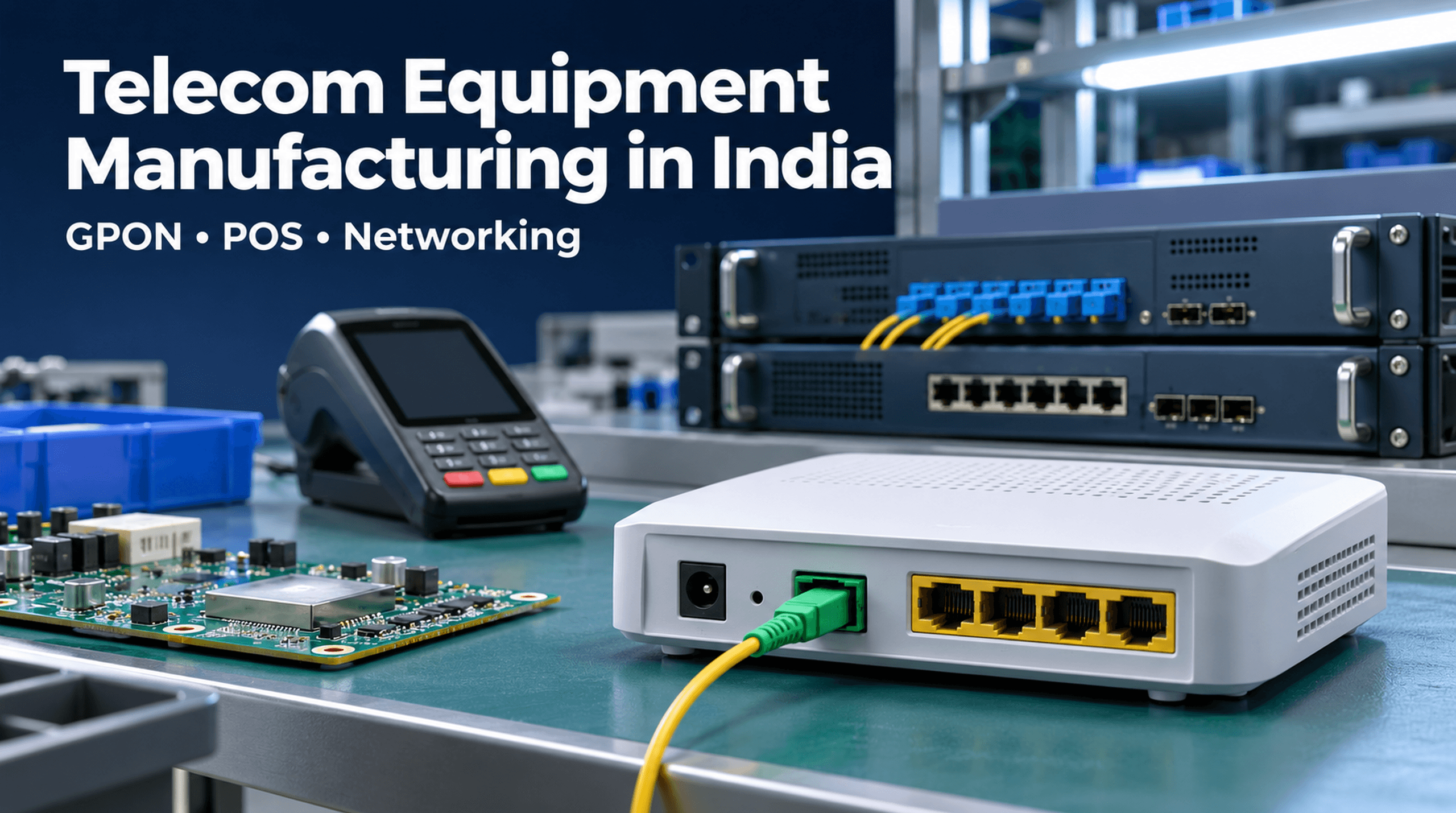
A telecom device can leave the assembly line looking finished while the buying decision is still unfinished. The board powers up, the enclosure fits, and the packaging is ready. But who has verified compatibility with the operator’s network? Which product configuration is covered by the approvals? Who will be responsible for maintaining the firmware after shipment?
These questions belong in the manufacturing brief. For original equipment manufacturers (OEMs), choosing a production partner means agreeing how a product will be built, tested, documented, and supported throughout its working life.
This guide helps Indian procurement, engineering, and quality teams evaluate telecom and networking equipment manufacturers in India, focusing on GPON equipment, point-of-sale (POS) terminals, and related hardware. It explains the product distinctions, Indian approval checks, and outsourcing decisions that make supplier comparisons more useful, with principles that international buyers can adapt to their destination markets.
India’s Telecom and Networking Manufacturing Landscape
Start a supplier search with the work package. A company that assembles printed circuit boards may suit an established design, while another assignment may require component sourcing, enclosure integration, production-test development, and finished-product delivery. Design support and ownership of the underlying product technology also need separate agreements.
For buyers, three questions make the landscape easier to navigate:
- What product and configuration must the manufacturer deliver?
- Which engineering, testing, and sourcing activities are included?
- Which responsibilities remain with the OEM, operator, or another specialist?
Use these answers to build a shortlist. A broad electronics portfolio can justify an initial conversation; evidence of the relevant product process should determine the next stage.
For an international programme, add destination-market requirements to the brief from the start. Ask the supplier to clarify which requirements their quotation covers and which may need additional testing or documentation. An Indian approval should not be treated as automatic permission to sell elsewhere.
GPON Explained: OLTs, ONTs/ONUs, and Splitters
A gigabit-capable passive optical network (GPON) connects operator-side equipment to multiple subscriber endpoints through a fibre distribution network. The word “passive” refers to the optical distribution section, rather than the powered equipment at either end.
The main elements have different jobs:
| Element | Role in the Network |
| Optical line terminal (OLT) | Operator-side equipment connecting the optical access network to the wider network. |
| Passive optical splitter | Divides the optical path to serve multiple endpoints without an electrical power supply. |
| Optical network terminal (ONT) | Terminates the optical connection for a subscriber and provides service interfaces. |
| Optical network unit (ONU) | Broader endpoint term; an ONT is a particular kind of ONU. |
These distinctions follow the architecture and terminology in ITU-T G.984.1 on GPON general characteristics. They matter because a requirement for “GPON manufacturing” leaves the actual equipment and production scope unclear.
The splitter distributes the optical connection; the OLT and subscriber terminals require power. Three terminals are shown to explain the topology, rather than specify a deployment’s split ratio.
Turn the architecture into a manufacturing brief
Identify the actual product first: an OLT assembly, a finished ONT, or a passive optical component. Then define the interfaces, enclosure, power arrangement, firmware version, and intended network environment.
For active equipment, ask how the supplier will demonstrate optical-interface performance, functional operation, and compatibility with the intended network configuration. Specify the test conditions and acceptance criteria rather than accepting “fully tested” as a complete answer.
If the programme includes a move to another PON generation, identify it explicitly. Ask engineering teams to confirm what changes are needed in the hardware, software, test fixtures, and approval plan. Keep that migration work separate from an assumption that an existing GPON production process covers every future product.
POS Machines and Other Networking Hardware
POS machines combine payment acceptance with the hardware needed to operate in the intended environment. The manufacturing brief should specify the payment interfaces, connectivity, display, power system, enclosure, and any printer or battery configuration.
That makes POS sourcing a different assignment from sourcing optical access equipment. A common circuit-board assembly process does not settle the payment-device security work or the customer’s acceptance requirements.
The PCI PIN Transaction Security Point of Interaction standard addresses device security for protecting PINs and other sensitive payment data. PCI SSC maintains an approval programme for relevant device categories. Buyers should establish the applicable device scope and payment-partner requirements before selecting the production configuration.
For routers, switches, and other connected hardware, apply the same product-first approach. Record the ports, connectivity, operating environment, software requirements, and customer acceptance process. Ask for a test plan for that configuration, with clear ownership of any specialist work.
PLI and Trusted-Source Requirements: What Buyers Should Verify
Manufacturing incentives and security-related procurement requirements answer different questions. Keep them separate in supplier discussions and commercial evaluations.
PLI: verify the eligible entity and product
The Department of Telecommunications’ Production Linked Incentive scheme guidelines for telecom and networking products identify specified product segments and conditions for approval and incentive claims. The listed segments include GPON OLTs and ONTs, alongside other telecom and networking equipment.
Producing a listed type of equipment in India does not, by itself, establish entitlement to an incentive. Before allowing an assumed benefit to influence the business case, request confirmation of the approved entity, relevant product coverage, applicable scheme period, and conditions governing the claim, including subsequent amendments.
Ask how any expected incentive is reflected in the quotation. Record who bears the commercial consequences if it is delayed, reduced, or unavailable. Keep the underlying manufacturing price and any conditional benefit transparent.
Trusted sources: establish applicability to the deployment
Trusted-source and trusted-product requirements concern security-related procurement for covered telecom deployments. TRAI’s discussion of the National Security Directive and associated licence provisions distinguishes notified equipment categories, sources, and associated products.
For the proposed deployment, confirm the applicable requirements with the operator and responsible compliance team. Request evidence relevant to the source and product being procured. Domestic assembly, PLI participation, and a general supplier assurance should not be used as substitutes for that verification
In the request for quotation (RFQ), ask who will provide the required supply chain information and manage changes to critical components or sources. Clarify those responsibilities before approving substitutions.
TEC and MTCTE: Define the Product-Specific Approval Route
The Telecommunication Engineering Centre (TEC) administers Mandatory Testing and Certification of Telecommunication Equipment (MTCTE). The Department of Telecommunications’ MTCTE service page provides the procedure and relevant notifications. For notified products, identify the applicable essential requirements and current conformity-assessment obligations.
Security assessment also needs attention. The MTCTE framework includes a ComSec security-certification route, with the National Centre for Communication Security involved in telecom security assessment. For an OLT or ONT programme, confirm the applicable security requirements and current notifications alongside the other product tests.
Ask for a product-specific compliance matrix covering the model, hardware and software configuration, applicant, relevant requirements, test evidence, and approval status. Review the current amendments and exemptions before finalising the launch schedule.
For POS terminals, assess the payment-device requirements described earlier and any other requirements applicable to the actual configuration. Avoid applying a single telecom certificate description to every product in a mixed portfolio.
Agree on responsibility before submitting samples
Outsourcing production still requires clear ownership of compliance, testing, and lifecycle support. A manufacturing agreement should name who prepares the evidence, pays for testing, manages applications, and approves the final configuration. Those contractual allocations must also reflect the responsibilities imposed by the applicable rules.
Build change control into that agreement. If a component, enclosure, firmware image, or manufacturing process changes, require a documented review of the effect on performance, customer acceptance, and approvals. Do not assume every change requires recertification, or that every substitution is covered automatically.
Contract Manufacturing vs In-House Production
The decision depends on the product, available engineering resources, demand, and degree of process control required. Compare the complete production programme, including the work retained by the OEM.
| Decision Area | In-House Production | Contract Manufacturing |
| Equipment and fixtures | OEM plans investment, upkeep, and utilisation. | Confirm available equipment, dedicated tooling, and charges. |
| Engineering control | OEM manages production decisions directly. | Agree approval rights and escalation routes. |
| Component sourcing | OEM manages procurement and inventory. | Define approved sources, substitutions, and inventory liability. |
| Testing | OEM develops or commissions the test process. | Agree test coverage, fixtures, software, records, and ownership. |
| Demand changes | OEM manages its own capacity constraints. | Confirm capacity commitments and forecast-change terms. |
| Support | OEM organises repair, spares, and updates. | Specify included services and retained OEM responsibilities. |
Compare like-for-like quotations. One may include component procurement and final testing, while another assumes the buyer supplies material and test software. A lower unit price has limited meaning until those differences are reconciled.
Include tooling, engineering work, fixtures, logistics, inventory exposure, repair arrangements, and end-of-life support in the evaluation. Use programme-specific figures rather than assumed percentage savings from outsourcing.
Choosing a Manufacturing Partner: A Buyer’s Checklist
Use the checklist to move from a capability presentation to a reviewable production proposal. Request evidence appropriate to the product and protect confidential information through agreed access arrangements.
| Requirement | Evidence to Request | Responsibility to Clarify |
| Product scope | Model list, drawings, interfaces, and deliverables | Who controls the design and specification? |
| Component sourcing | Bill of materials and approved-source list | Who approves alternatives and bears excess-stock costs? |
| Assembly process | Process flow, inspection stages, and relevant equipment | Who approves process changes? |
| Functional testing | Test plan, acceptance limits, and sample records | Who supplies fixtures and test software? |
| GPON compatibility | Validation plan for the intended network configuration | Who coordinates operator acceptance? |
| Firmware provisioning | Version-control and authorised programming process | Who releases firmware and controls access? |
| Traceability | Example record linking a unit to build and test history | Who retains records and for how long? |
| Compliance | Model-specific matrix and supporting evidence | Who manages applications and change assessment? |
| Ramp-up | Pilot-build results and proposed capacity plan | Who authorises volume release? |
| Lifecycle support | Repair process, spares plan, and escalation route | Who owns updates and failure analysis? |
Use a pilot build to test the proposal
Agree on the pilot’s purpose before it starts. It should help the buyer assess whether the proposed process can repeatedly meet the specification and produce usable records.
Review failures and rework as well as accepted units. Ask the supplier to explain defects, proposed corrective actions, and how effectiveness will be checked. A working demonstration unit answers a narrower question than a controlled production run.
Set the evidence needed for volume release: agreed test results, closed critical issues, approved work instructions, and a signed configuration baseline. Where customer or regulatory acceptance remains outstanding, record its effect on the release decision.
Write an RFQ that suppliers can price consistently
Provide the product specification, bill of materials where available, drawings, firmware responsibilities, quantity ranges, forecast assumptions, testing requirements, packaging, and destination markets. Distinguish a target launch date from a confirmed approval schedule.
Ask suppliers to separate recurring unit costs from engineering, tooling, and test-development charges. Request explicit exclusions, assumptions, payment terms, and treatment of material purchased against forecasts. This creates a clearer basis for negotiation and reduces scope disputes after the award.
Final Thoughts: Choosing the Right Manufacturing Partner
A useful shortlist starts with the product and the evidence needed to manufacture it consistently. For GPON equipment, POS machines, and other networking hardware, agree on the configuration, test coverage, approval route, and support responsibilities before committing to volume. Outsourcing can allocate production work effectively when ownership of these decisions remains clear.
To discuss an India-based manufacturing programme, share the product specifications, expected volumes, target markets, and testing needs with ZETWERK’s electronics team. This discussion will help define the proposed scope and enable you to request pertinent evidence related to your product.
Frequently Asked Questions (FAQs)
What is the difference between an OLT, an ONT, and an ONU?
The optical line terminal (OLT) sits on the operator side of the optical access network. An optical network terminal (ONT) serves a subscriber endpoint. Optical network unit (ONU) is the broader endpoint term; an ONT is a particular kind of ONU. Specify the actual equipment when discussing manufacturing.
Does a contract manufacturer need to own the product design?
No. A contract manufacturer can produce equipment to an OEM’s approved design. The agreement should define design ownership, permitted use of technical files, engineering support, and responsibility for changes. If design services are included, specify their scope and ownership separately.
Which GPON products require MTCTE certification in India?
Verify the notified product category and configuration, particularly the applicable PON equipment requirements for OLTs and ONTs. Establish the essential requirements, security-assessment obligations, and current exemptions for the model. Treat “GPON” as a network description rather than a single certificate covering every component.
Does Indian manufacturing automatically establish trusted-source status?
No. Manufacturing location alone does not establish the applicable trusted-source or trusted-product status. For a covered telecom deployment, confirm the requirements and evidence for the proposed source and product with the operator and responsible compliance team.
Can outsourcing automatically qualify a product for telecom PLI benefits?
No. Outsourcing does not establish eligibility by itself. The relevant entity, product, approval, investment and sales conditions, scheme period, and applicable amendments need assessment. Request documented confirmation before including an expected incentive in the commercial evaluation.
Do POS terminals follow the same approval requirements as GPON equipment?
No. Their requirements are not identical. POS terminals need assessment against the applicable payment-device security and acceptance requirements, alongside other obligations relevant to the configuration. GPON equipment needs assessment against its telecom requirements. A supplier should provide a separate compliance matrix for each product.
What should an OEM provide when requesting a manufacturing quotation?
Provide the product specification, design files and bill of materials where available, quantity ranges, target markets, testing requirements, firmware responsibilities, and packaging and delivery assumptions. Ask the manufacturer to identify exclusions and separate unit pricing from engineering, tooling, and test-development charges.