
Solar Tracker and Mounting Structure Manufacturing: Fixed-Tilt vs Single-Axis vs Dual-Axis
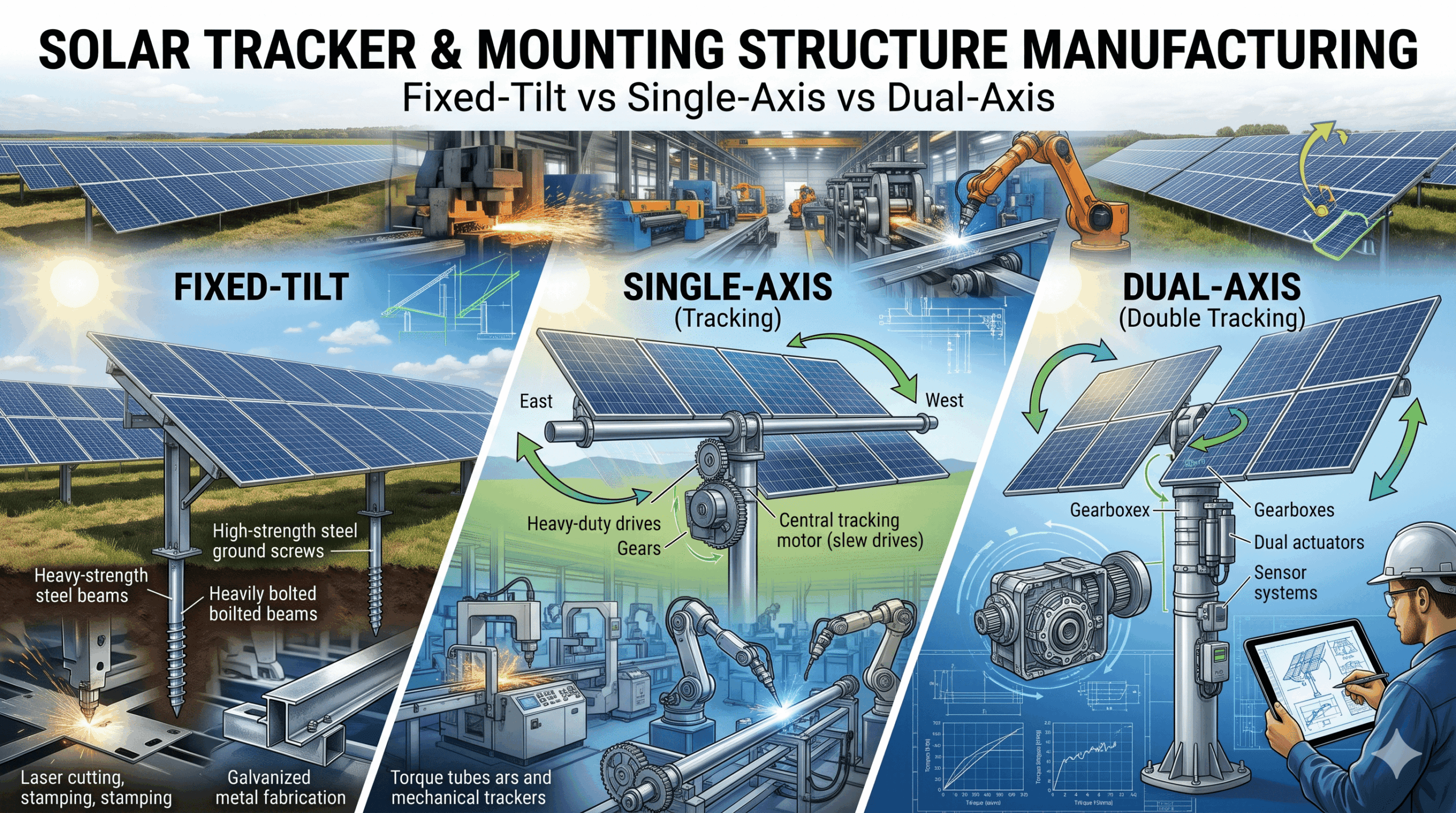
Solar mounting structures and tracking systems play a critical role in the performance, reliability, and long-term cost of a solar power plant. While fixed-tilt structures keep solar panels at a set angle, tracking systems move panels to follow the sun and capture more sunlight throughout the day.
For solar project developers, EPC contractors, and manufacturers, choosing between fixed-tilt, single-axis, and dual-axis systems involves more than comparing energy output. Manufacturing cost, structural strength, site conditions, installation time, maintenance needs, and lifetime return on investment all influence the right choice.
This guide compares the three technologies from both a manufacturing and project-planning perspective, helping solar businesses understand where each system fits best.
What Is Solar Tracker and Mounting Structure Manufacturing?
Solar tracker and mounting structure manufacturing involves designing and producing the mechanical systems that support photovoltaic (PV) modules and position them to receive sunlight efficiently.
A mounting structure must do more than hold solar panels in place. It must withstand wind pressure, support module weight, maintain alignment, resist corrosion, and remain stable throughout the operating life of the solar plant.
For manufacturers, the main product categories are:
- Fixed-tilt mounting structures: Steel or aluminum frameworks that hold modules at a predetermined angle.
- Single-axis solar trackers: Mechanized structures that rotate modules along one axis to follow the sun.
- Dual-axis solar trackers: Systems that adjust module orientation along two axes for more precise solar tracking.
The manufacturing process varies with each design. Fixed-tilt systems focus on structural fabrication and installation efficiency, while tracker manufacturing also involves moving assemblies, drive mechanisms, controls, and electrical integration.
Fixed-Tilt vs Single-Axis vs Dual-Axis Solar Mounting Systems
1. Fixed-Tilt Mounting Structure
Fixed-tilt structures keep solar panels at a selected angle and orientation throughout the day.
Best suited for: Projects prioritizing low complexity, predictable maintenance, and straightforward installation.
Manufacturing focus: Galvanized steel or aluminum members, purlins, bracing, fasteners, foundations, and corrosion protection.
2. Single-Axis Solar Tracker
Single-axis trackers rotate modules around one axis, typically moving panels from east to west as the sun travels across the sky.
Best suited for: Utility-scale solar farms seeking additional energy generation without the complexity of two-axis movement.
Manufacturing focus: Torque tubes, bearings, slew drives or other drive systems, actuators, controllers, structural supports, and tracker-specific wiring.
3. Dual-Axis Solar Tracker
Dual-axis trackers adjust both azimuth and elevation, allowing panels to follow the sun in two directions.
Best suited for: Specialized installations, research facilities, and applications where additional solar capture justifies the higher mechanical and operating costs.
Manufacturing focus: Two-axis drive assemblies, rotating joints, actuators, control systems, robust supports, cable management, and more demanding alignment tolerances.
The central trade-off is straightforward: fixed-tilt systems emphasize simplicity, single-axis trackers balance additional energy production with manageable complexity, and dual-axis trackers offer more precise tracking at the cost of additional engineering and maintenance.
Key Differences Between Fixed-Tilt, Single-Axis, and Dual-Axis Systems
The following comparison summarizes the practical differences for solar project developers and mounting structure manufacturers.
| Parameter | Fixed-Tilt | Single-Axis | Dual-Axis |
|---|---|---|---|
| Panel movement | None | One axis | Two axes |
| Mechanical complexity | Low | Medium | High |
| Initial equipment cost | Generally lowest | Higher | Generally highest |
| Potential energy generation | Baseline | Higher | Often highest |
| Installation requirements | Relatively simple | More alignment and commissioning | More complex alignment and commissioning |
| Maintenance needs | Generally low | Higher due to moving parts | Higher due to additional mechanisms |
| Control system | Not required for tracking | Required | Required |
| Manufacturing difficulty | Lower | Moderate to high | High |
| Typical application | Utility-scale, commercial, and rooftop PV | Utility-scale solar farms | Specialized and smaller tracking applications |
These are general comparisons, not universal project specifications. Actual costs, energy yield, and maintenance requirements depend on system design, location, scale, and operating conditions.
1. Fixed-Tilt Solar Mounting Structure Manufacturing
Fixed-tilt mounting structures remain an important option for solar projects because they are mechanically simple and do not require a tracking motor or control system.
How fixed-tilt structures are manufactured
A typical manufacturing workflow includes:
- Structural design: Engineers determine the tilt angle, row spacing, member sizes, and support arrangement based on site conditions and module specifications.
- Material selection: Manufacturers select suitable structural steel or aluminum, depending on project requirements, corrosion exposure, and cost.
- Cutting and punching: Steel sections are cut, drilled, punched, or otherwise processed to achieve the required dimensions and connection points.
- Fabrication: Members, brackets, purlins, and bracing components are fabricated according to approved drawings.
- Surface protection: Steel components may receive hot-dip galvanizing or another specified corrosion-protection treatment. Aluminum parts may use appropriate surface finishes.
- Quality inspection: Dimensions, hole positions, coating quality, material certificates, and assembly fit are checked before dispatch.
- Packaging and installation: Components are labeled and packed to support efficient transportation and site assembly.
Advantages for manufacturers
Fixed-tilt systems typically require fewer specialized mechanical components than tracking systems. This makes it easier to standardize product designs, plan production batches, and manage inventory.
Their simpler structure also reduces the number of moving parts that could fail during operation.
Limitations to consider
The main limitation is that the modules cannot automatically follow the sun. Depending on the location and system design, this can result in lower annual energy generation than a well-designed tracking system.
Fixed-tilt projects may also require careful optimization of row spacing to reduce inter-row shading while making effective use of available land.
Where fixed-tilt systems make sense
Fixed-tilt structures are often a strong choice for commercial rooftops, industrial facilities, smaller ground-mounted plants, and utility-scale projects where simplicity, terrain constraints, or maintenance access are major considerations.
2. Single-Axis Solar Tracker Manufacturing
Single-axis trackers introduce mechanical movement to improve the angle at which sunlight reaches the PV modules. Horizontal single-axis tracking is widely used in utility-scale solar projects.
Major components of a single-axis tracker
Torque tube and structural members
Support the module rows and transmit rotational movement along the tracker axis.
Drive mechanism
Uses a motor, gearbox, slew drive, or another engineered mechanism to rotate the array.
Bearings and connection assemblies
Support movement, transfer loads, and maintain alignment under operating conditions.
Controller and electrical system
Coordinates tracker movement and may support position feedback, monitoring, fault detection, and protective stow functions.
How single-axis trackers are manufactured
Manufacturing starts with structural design and load analysis, followed by fabrication of torque tubes, posts, brackets, and other steel components.
The drive system, bearings, motor assemblies, and controller are then integrated into the mechanical design. Manufacturers must pay particular attention to dimensional tolerances, shaft alignment, connection strength, and repeatable assembly.
Factory testing can include drive operation, rotation range, position feedback, controller response, and verification of mechanical clearances. Site commissioning is still necessary to validate the complete installation.
Why single-axis trackers are popular
Single-axis systems offer a practical middle ground between fixed mounting and more complex dual-axis tracking. They can increase annual electricity generation, particularly where direct sunlight is strong and the tracker can operate reliably.
For manufacturers, the opportunity lies in standardized designs, modular assemblies, repeatable production, and engineering improvements that reduce installation time and lifetime maintenance.
However, moving parts introduce additional failure modes. Motor or gearbox faults, bearing wear, misalignment, controller problems, and communication failures can reduce system availability if they are not managed properly.
3. Dual-Axis Solar Tracker Manufacturing
Dual-axis solar trackers move modules along two axes, commonly described as azimuth and elevation. This allows them to follow changes in the sun’s horizontal direction and vertical position.
Major manufacturing requirements
Dual-axis systems typically require:
- A structural frame designed for the module load and expected environmental forces.
- Two drive mechanisms or an equivalent two-axis actuation arrangement.
- Bearings, pivots, joints, and connection assemblies suitable for the intended loads and movement.
- Position sensors or a suitable tracking control strategy.
- Controller hardware, wiring, and protective functions.
- Foundation and anchoring arrangements designed for the complete moving structure.
The exact configuration depends on tracker geometry, module area, design wind speed, and operating requirements.
Manufacturing challenges
Dual-axis systems require more coordination between mechanical, structural, and electrical engineering teams. Both axes must operate within the specified movement range without creating interference, excessive stress, or cable damage.
The structure must also remain stable as its orientation changes. A panel assembly presents different wind-loading conditions at different positions, so engineers must evaluate the required operating and stow configurations.
Factory quality control should cover both drive systems, mechanical stops, position sensing, control logic, cable routing, and repeatable tracking movement.
When dual-axis trackers are worth considering
Dual-axis tracking can be useful where additional direct-beam solar capture has substantial value, or where the application requires precise orientation.
For conventional utility-scale PV, however, the additional energy must justify the higher structural, equipment, installation, and maintenance burden. More movement does not automatically mean a better financial return.
Energy Generation: How Much More Power Can Trackers Produce?
Energy generation is one of the main reasons project developers consider solar tracking systems. However, the additional output depends on the site’s solar resource, climate, tracker design, module configuration, and system availability.
Research from the National Renewable Energy Laboratory (NREL) and other technical studies shows that tracking can increase energy generation compared with fixed-tilt systems, although the results vary considerably by location.
Illustrative annual energy comparison
Example only, using a fixed-tilt system producing 1,600 kWh per kWp annually. The tracking gains below are illustrative assumptions, not a site-specific forecast.
Fixed-tilt
1,600 kWh/kWp
Baseline
Single-axis
1,920 kWh/kWp
Illustrative gain: 20%
Dual-axis
2,080 kWh/kWp
Illustrative gain: 30%
For a 1 MWp plant, the same assumptions would translate into the following annual output:
| System | Illustrative annual output |
|---|---|
| Fixed-tilt | 1.60 GWh |
| Single-axis | 1.92 GWh |
| Dual-axis | 2.08 GWh |
These figures are examples for explaining the calculation. They are not guaranteed production levels, and the 30% dual-axis assumption should not be interpreted as a universal advantage over single-axis tracking.
For an actual project, use location-specific solar resource data and an energy-yield simulation that accounts for shading, tracker backtracking, wind stow, electrical losses, equipment availability, and other relevant factors.
Manufacturing Cost Comparison
Manufacturing cost is influenced by more than the amount of steel or aluminum used. The number of components, machining requirements, drive mechanisms, assembly time, testing procedures, and quality-control requirements all affect the final cost.
| Cost factor | Fixed-Tilt | Single-Axis | Dual-Axis |
|---|---|---|---|
| Structural material | Standardized members | Structural members plus rotating assemblies | More complex support and rotating assemblies |
| Mechanical components | Relatively few | Motor, gearbox, bearings, and drive parts | Two-axis drive and additional joints |
| Electrical components | Minimal for the structure | Controller, sensors, wiring, and power supply | More extensive control and actuation |
| Factory assembly | Relatively straightforward | Requires mechanical integration | Requires two-axis integration |
| Testing | Mainly dimensional and structural checks | Structural, drive, and control checks | Structural, dual-drive, and control checks |
| Maintenance provision | Usually lower | Requires planned inspection of moving parts | Requires additional mechanical inspection |
What drives the cost of a solar mounting structure?
For manufacturers, the biggest cost drivers usually include:
- Raw materials: Steel prices, aluminum grades, material thickness, and material utilization.
- Fabrication: Cutting, punching, drilling, welding, forming, and finishing operations.
- Corrosion protection: Galvanizing, coating specifications, and site exposure requirements.
- Mechanical and electrical components: Motors, gearboxes, bearings, actuators, sensors, and controllers.
- Engineering: Structural calculations, prototype development, testing, and design validation.
- Logistics and installation: Packaging, transportation, site assembly, lifting requirements, and commissioning.
A useful way to evaluate competing designs is to compare both the manufacturing cost per installed watt and the expected lifetime cost per unit of electricity generated.
A lower-cost structure may be the right choice for one project, while a more expensive tracker may deliver better financial results elsewhere. The decision should be based on total project economics, not component price alone.
Quality Control and Standards in Solar Mounting Structure Manufacturing
Quality control is essential because mounting structures must remain secure under changing environmental conditions throughout their intended service life. For trackers, mechanical reliability and control-system performance are additional concerns.
Structural strength and wind resistance
Manufacturers should design structures around site-specific wind loads, module dimensions, soil conditions, foundation design, and applicable structural codes.
For tracker systems, the engineering assessment should also consider the loads experienced in different orientations and the selected protective stow position. Wind-tunnel testing or computational fluid dynamics analysis may be relevant, depending on the design and project requirements.
Corrosion resistance
Corrosion protection should match the installation environment. Inland sites, industrial areas, humid regions, and coastal locations can require different material and coating specifications.
Hot-dip galvanizing, suitable aluminum alloys, compatible fasteners, and appropriate isolation of dissimilar metals can help improve durability. Coating thickness and material quality should be verified against the approved specification.
Manufacturing tolerances
Incorrect hole positions, inconsistent member lengths, or poor alignment can create installation delays. These issues become particularly important in single-axis and dual-axis systems, where mechanical components must move freely and remain correctly aligned.
Quality inspections should cover:
- Material grade and traceability.
- Dimensions, hole positions, and fit-up.
- Weld quality, where applicable.
- Coating thickness and surface condition.
- Fastener specifications and connection integrity.
- Drive movement, control response, and mechanical clearances for trackers.
Relevant standards
For projects in India, manufacturers may need to consider applicable provisions of IS 875 for design loads and wind loads, IS 800 for structural steel design, and IS 4759 for hot-dip zinc coatings. Project specifications may also reference IEC 62817 for solar tracker design qualification. The governing requirements should be confirmed for the project and current standard editions.
How to Choose the Right System for a Solar Project
The best mounting technology depends on the project’s engineering requirements and commercial objectives.
Choose fixed-tilt when…
- Low mechanical complexity is a priority.
- The project has limited maintenance resources.
- Terrain, foundations, or site conditions make moving structures difficult.
- A simple, standardized structure offers the best project economics.
Choose single-axis when…
- Additional energy generation has meaningful commercial value.
- The site can accommodate the tracker geometry and row spacing.
- Reliable operation, maintenance, and spare-parts support are available.
- The project benefits from a balance of tracking performance and system complexity.
Consider dual-axis when…
- Precise solar orientation is particularly valuable.
- The application can justify the extra mechanical and control requirements.
- Site conditions and operating budgets support more complex equipment.
- A project-specific energy and financial model demonstrates sufficient value.
For conventional utility-scale PV plants, fixed-tilt and single-axis systems are generally the first options worth comparing. Dual-axis systems deserve consideration when the application and economics support their additional complexity.
Solar Mounting Structure Manufacturing: Opportunities for Manufacturers
As solar deployment expands, manufacturers can compete through more than pricing. Product reliability, engineering support, installation efficiency, and supply-chain consistency can all help differentiate a mounting structure business.
Standardization and modular design
Standardized parts can simplify procurement, reduce inventory complexity, and make production planning more predictable. Modular designs can also help installers assemble structures more efficiently across large projects.
Automation in fabrication
Automated cutting, punching, drilling, and repeatable fabrication processes can improve dimensional consistency and production throughput. The right automation strategy depends on factory volume, product variety, and capital availability.
Design for easier installation
Reducing the number of unique components, simplifying connections, and making parts easier to identify can reduce assembly time and the risk of site errors.
For tracking systems, designs should also make drive assemblies, bearings, and control components accessible for inspection and replacement.
Reliability and after-sales support
Tracker manufacturers can build customer confidence through validated designs, clear installation documentation, commissioning support, spare-parts availability, and practical maintenance guidance.
These capabilities matter because equipment performance over the project lifetime is more important than achieving a low purchase price at the outset.
Frequently Asked Questions
Which is better, fixed-tilt or single-axis solar tracking?
Fixed-tilt is generally better when simplicity and lower maintenance requirements are priorities. Single-axis tracking is often worth evaluating for utility-scale projects where increased energy generation can offset additional equipment and operating costs.
The right choice depends on site-specific energy modeling and financial analysis.
How much more electricity can a solar tracker generate?
The gain varies with location, system design, climate, and operating conditions. Published studies report a wide range of results, so a fixed percentage should not be applied to every project. Use an annual energy-yield simulation to estimate the expected gain.
Why is dual-axis tracking more expensive?
Dual-axis systems require additional movement mechanisms, joints, structural engineering, controls, and maintenance. These requirements can increase manufacturing, installation, and operating costs.
Which materials are commonly used in solar mounting structures?
Galvanized structural steel and aluminum are common choices. Material selection depends on structural loads, corrosion exposure, manufacturing requirements, weight, and project specifications.
What should buyers evaluate when selecting a mounting structure manufacturer?
Buyers should assess structural engineering capability, material traceability, corrosion protection, dimensional accuracy, applicable testing, production capacity, delivery reliability, installation support, and warranty terms. For trackers, drive-system reliability and control integration are also important.
Are single-axis trackers suitable for Indian solar projects?
They can be, depending on the location, solar resource, terrain, wind conditions, module configuration, and project economics. A project in Rajasthan may have different tracking economics from one in a region with more persistent cloud cover. Site-specific analysis is essential.
Conclusion
Fixed-tilt, single-axis, and dual-axis systems each serve a different purpose in solar mounting structure manufacturing.
Fixed-tilt systems offer mechanical simplicity and straightforward production. Single-axis trackers add movement to increase energy capture while retaining a practical balance of complexity and performance. Dual-axis trackers provide more precise solar orientation but demand additional engineering, equipment, and maintenance.
For manufacturers and project developers, the most effective choice is the one that balances structural reliability, manufacturing cost, installation efficiency, energy production, and lifetime operating expenses.
The goal is not simply to manufacture a structure that follows the sun. It is to deliver a reliable system that performs well under real site conditions and makes commercial sense over the life of the solar project.