

Solar Plus Storage, FDRE and RTC Power: How Hybrid Projects Use BESS
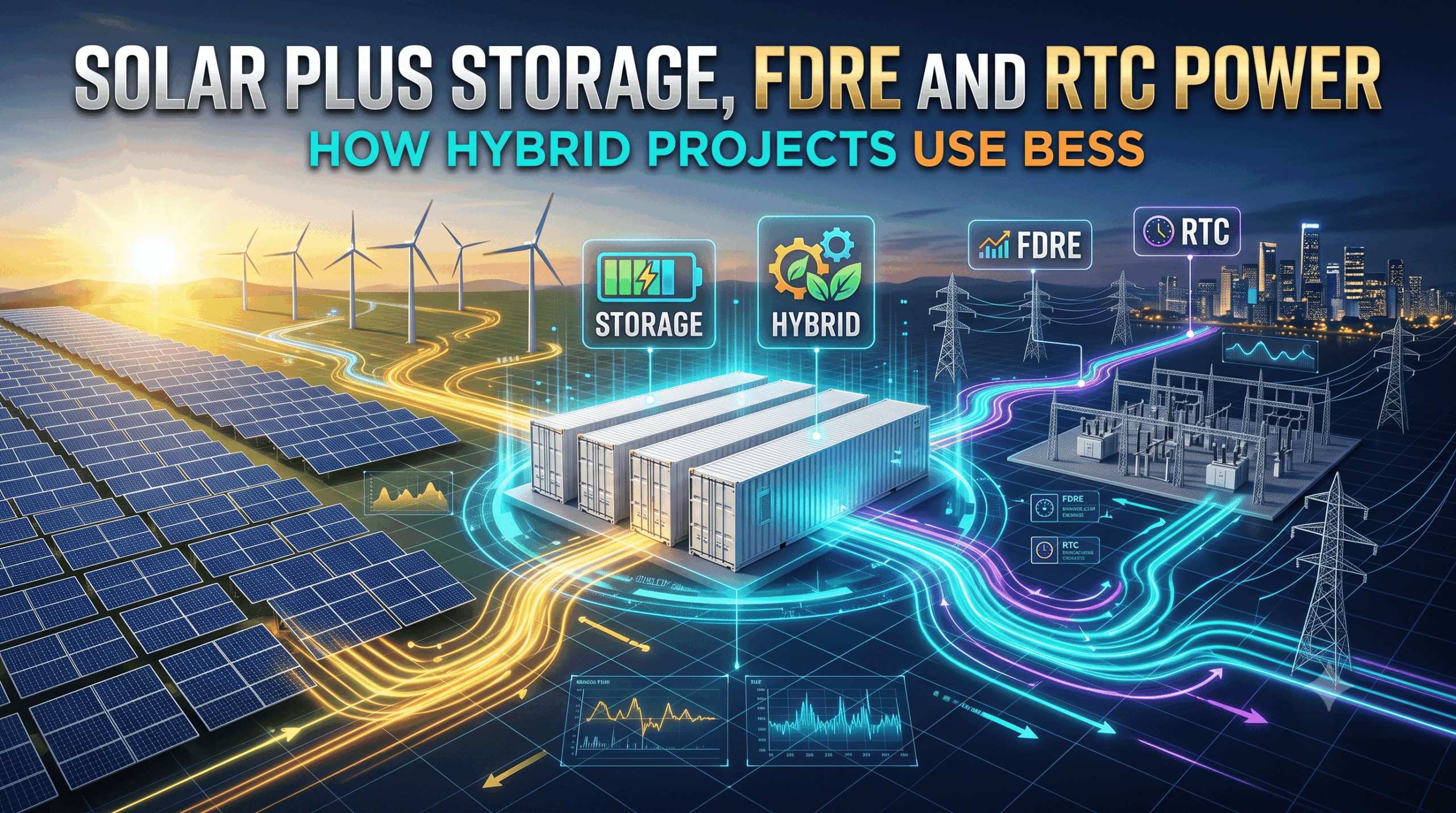
Solar power is affordable and scalable, but its output changes throughout the day. Electricity demand, however, does not always follow the sun. Businesses and distribution companies need reliable power in the evening, during peak demand, and when renewable generation falls.
Battery Energy Storage Systems (BESS) help bridge this gap. By storing surplus electricity and releasing it when needed, batteries make solar-plus-storage projects more flexible and support renewable power models such as Firm and Dispatchable Renewable Energy (FDRE) and Round-the-Clock (RTC) power.
In India, this shift is gaining momentum as power buyers look beyond standalone solar generation toward more predictable renewable electricity. Government policy and procurement guidelines increasingly support renewable energy paired with storage and dispatchable supply models.
For project developers, utilities, and commercial and industrial (C&I) energy buyers, the key question is no longer just how much renewable energy a project can generate. It is also when that energy can be delivered.
What Is Solar Plus Storage?
Solar plus storage combines a solar photovoltaic (PV) plant with a battery energy storage system. The solar plant generates electricity during daylight hours, while the battery stores some of that energy for use later.
Instead of relying entirely on immediate solar generation or exporting all surplus power to the grid, a project can shift part of its generation to periods when electricity is more valuable or demand is higher.
A typical solar-plus-storage project includes:
- Solar PV modules: Convert sunlight into electricity.
- Battery Energy Storage System (BESS): Stores electricity for later use.
- Power conversion system (PCS): Converts electricity between the battery’s DC supply and the AC system.
- Energy management system (EMS): Coordinates charging, discharging, and power delivery.
- Grid connection and control equipment: Support safe operation, metering, and power export.
The project may be located at a single site, with solar and batteries connected behind the same grid connection, or it may use a broader portfolio of renewable generation and storage assets.
How BESS Changes Solar Power Delivery
Consider a solar plant that generates more electricity than its buyer needs at noon. Without storage, the project may have to export the surplus, accept a lower-value sale, or curtail generation if the grid cannot absorb the power.
With BESS, the project can charge its batteries during periods of excess generation and discharge later in the day.
This creates several potential benefits:
- Shifts renewable electricity from midday to evening demand.
- Helps meet scheduled power delivery requirements.
- Reduces some forms of renewable energy curtailment.
- Improves flexibility at the point of grid connection.
- Supports better alignment between generation and consumption.
These benefits depend on battery capacity, charging opportunities, operating limits, grid conditions, and the project’s commercial contract.
What Is FDRE Power?
Firm and Dispatchable Renewable Energy (FDRE) is a procurement model designed to make renewable electricity more dependable and controllable.
Under an FDRE arrangement, a developer combines renewable generation, energy storage, and sometimes complementary generation resources to meet specified power delivery requirements. The exact requirements depend on the tender and power purchase agreement (PPA).
Unlike a conventional solar project, which generates electricity when sunlight is available, an FDRE project is designed around the buyer’s required delivery profile.
For example, a distribution company may need renewable electricity during the evening, when solar generation declines but household and commercial demand remains high. A project combining solar, wind, and BESS can use different generation patterns and stored energy to help meet that requirement.
How BESS Supports FDRE Projects
BESS is particularly useful when renewable generation and contracted delivery schedules do not align.
Its main functions include:
1. Shifting energy to required hours
The battery stores electricity when renewable generation exceeds the project’s immediate delivery needs and releases it during contracted supply periods.
2. Managing short-term generation fluctuations
Battery controls can respond to changes in generation and help keep output within specified operating limits, subject to available power and energy capacity.
3. Supporting scheduled dispatch
The energy management system can schedule battery charging and discharging around forecast generation, demand, and contractual delivery obligations.
4. Reducing exposure to supply shortfalls
Stored energy can cover some periods of low renewable output. However, a battery cannot compensate indefinitely for extended periods of weak solar and wind generation.
Solar, Wind and BESS: A Practical FDRE Combination
Solar and wind can complement each other because their generation profiles may differ by time of day and season. A battery adds another layer of flexibility by storing surplus energy for later delivery.
A simplified operating strategy looks like this:
- During high solar generation, solar power supplies demand and charges the battery.
- During periods of stronger wind generation, wind power supplies the project and may create additional charging opportunities.
- During evening demand peaks, the battery discharges alongside available renewable generation.
- During extended low-generation periods, the project relies on its remaining stored energy and other permitted supply arrangements.
The actual design must account for the renewable resource profile, contracted supply hours, battery losses, and the frequency and duration of low-generation periods.
India’s Ministry of Power has issued specific bidding guidelines for grid-connected FDRE projects with energy storage systems, providing a procurement framework for these arrangements.
What Is RTC Power, and How Does BESS Help?
Round-the-Clock (RTC) power refers to a power supply arrangement designed to meet an agreed delivery profile across the day and night.
For renewable energy buyers, RTC supply is more demanding than purchasing electricity from a standalone solar or wind project. Renewable generation varies with weather and time, while the buyer’s required supply may continue overnight.
A battery helps bridge short-duration gaps between renewable generation and demand. However, BESS alone does not automatically make a solar project capable of delivering power around the clock.
A full RTC solution may combine solar, wind, batteries, pumped hydro storage, or other permitted sources of electricity. The combination depends on the required supply profile, project economics, and contractual rules.
The Role of BESS in RTC Projects
BESS helps RTC projects in three important ways.
Bridging the evening and overnight gap
Solar generation falls after sunset. Batteries charged during the day can supply part of the evening demand, although overnight coverage depends on battery size and the energy available for charging.
Managing hourly imbalances
Renewable generation does not always match the planned delivery schedule. Storage can help compensate for some short-term differences between forecast and actual generation.
Supporting power supply during peak demand
A project can reserve battery capacity for high-demand periods when power is more valuable or when the PPA requires a specific delivery commitment.
The main limitation is energy duration. A battery rated at 100 MW with 400 MWh of usable energy can theoretically discharge at 100 MW for four hours. Actual delivery will depend on usable capacity, conversion losses, auxiliary consumption, and operating limits.
For longer supply gaps, the developer may need additional storage, more renewable generation, or other contracted resources.
FDRE vs RTC vs Solar Plus Storage
Although these models overlap, they serve different purposes.
| Feature | Solar Plus Storage | FDRE | RTC Power |
|---|---|---|---|
| Primary objective | Shift solar energy across time | Deliver renewable power to defined requirements | Meet an agreed supply profile throughout the day |
| Role of BESS | Stores surplus solar energy | Supports firm, scheduled delivery | Bridges gaps between generation and demand |
| Renewable sources | Usually solar | Solar, wind, or a combination | Often a combination of renewable and complementary resources |
| Supply profile | Depends on system design | Defined by tender or PPA | Designed for round-the-clock delivery requirements |
| Main design challenge | Battery sizing and charging strategy | Meeting dispatch and firmness obligations | Balancing supply across long periods, including overnight |
Solar plus storage describes a technical configuration. FDRE and RTC describe power procurement and delivery objectives. A single project can therefore be a solar-plus-storage project that also participates in an FDRE or RTC arrangement.
How Developers Size BESS for Hybrid Projects
Battery sizing is one of the most important decisions in a hybrid renewable energy project. An undersized battery may not meet delivery commitments, while an oversized system can increase capital expenditure without creating enough additional value.
Two ratings are central to battery design.
1. Power Capacity: MW
Power capacity describes how much electricity the battery can deliver at a given moment.
A 100 MW battery can deliver up to 100 MW, subject to its operating conditions and equipment limits.
Power capacity matters when a project must meet a specific peak demand or deliver a defined output during particular hours.
2. Energy Capacity: MWh
Energy capacity describes how much electricity the battery can store and deliver over time.
For example, a battery with 100 MW of power capacity and 400 MWh of usable energy has a theoretical four-hour discharge duration at full power.
The basic relationship is:
Discharge duration = Usable energy capacity (MWh) ÷ Discharge power (MW)
This is a simplified calculation. A real project must also account for depth of discharge, round-trip efficiency, battery degradation, reserve requirements, and auxiliary loads.
An Illustrative BESS Sizing Example
Suppose a hybrid project must deliver 50 MW of additional power for four evening hours.
The required delivered energy is:
50 MW × 4 hours = 200 MWh.
The project therefore needs at least 200 MWh of delivered energy for that requirement. The installed battery capacity will generally need to be higher to account for usable state-of-charge limits, conversion losses, degradation, and any operating reserves.
The project also needs sufficient charging energy during the day. If solar generation is insufficient to recharge the battery, the system may not be able to repeat the same delivery profile every day.
This is why battery sizing should begin with an hourly generation and demand model, rather than a simple percentage of solar plant capacity.
The Economics of Solar Plus Storage, FDRE and RTC
BESS can improve the value of renewable generation, but it also adds capital and operating costs. Developers need to assess the entire project rather than comparing battery costs with solar costs in isolation.
Key Cost Considerations
Battery capital expenditure: Includes battery cells, racks, enclosures, thermal management, fire protection, and related equipment.
Power conversion and integration: Covers inverters, transformers, switchgear, controls, and grid connection requirements.
Battery replacement and augmentation: Storage capacity declines over time. The financial model should account for degradation and any planned augmentation or replacement.
Charging and conversion losses: Some electricity is lost during charging, storage, and discharge. More renewable generation may be needed to deliver the contracted quantity.
Financing and project life: Interest rates, construction timelines, warranties, and the expected operating period affect the overall cost of delivered electricity.
Grid and transmission charges: These depend on project configuration, location, applicable regulations, and the relevant commissioning and eligibility conditions.
Where the Value Comes From
A well-designed hybrid project can create value by:
- Supplying electricity during higher-demand periods.
- Meeting contractual delivery requirements that standalone solar may not satisfy.
- Reducing curtailment when surplus generation can be stored and used later.
- Improving the commercial usefulness of renewable power for utilities and C&I buyers.
- Potentially reducing reliance on expensive short-term power purchases.
These benefits are project-specific. Storage does not guarantee lower tariffs, and the business case depends on utilization, charging costs, battery life, financing, and the value of meeting the required delivery profile.
India’s Policy and Market Direction
India’s renewable energy procurement framework increasingly recognizes storage as part of the transition from variable generation toward more dispatchable electricity.
The Ministry of New and Renewable Energy maintains policies and guidelines covering energy storage, while the Ministry of Power has issued bidding frameworks for RTC and FDRE procurement.
In February 2025, the government published an advisory on co-locating energy storage with solar projects to improve grid stability and cost efficiency. The government has also introduced viability gap funding measures to support BESS deployment.
In February 2026, the Ministry of New and Renewable Energy reported that the Central Electricity Authority’s Optimal Generation Mix 2030 assessment estimated a requirement of 41.65 GW of BESS capacity by 2029-30, alongside 18.98 GW of pumped storage capacity. These are planning estimates, not a statement of capacity already commissioned.
For developers and buyers, the implication is clear: storage design, dispatch planning, and commercial contracting are becoming increasingly important parts of renewable energy procurement.
Key Challenges in Hybrid Renewable Projects
Despite its benefits, BESS introduces technical and commercial challenges that need to be addressed during project development.
Battery Degradation
Battery performance declines with use and time. Developers need to model capacity degradation across the contract period and determine whether augmentation will be necessary to maintain delivery obligations.
Renewable Generation Uncertainty
Solar and wind output can vary significantly with weather conditions. A project must be designed around realistic generation profiles, including periods when both resources produce less than expected.
Charging Energy Availability
A battery needs sufficient energy to charge. If the project has limited surplus renewable generation, it may struggle to maintain the required state of charge for the next dispatch period.
Contractual and Scheduling Requirements
FDRE and RTC contracts may include specific delivery schedules, availability requirements, and consequences for non-performance. Developers must align the battery’s technical capabilities with the applicable PPA and bidding conditions.
Safety and Thermal Management
Large battery installations require appropriate fire detection and suppression systems, thermal management, electrical protection, monitoring, and emergency response procedures.
Addressing these issues early helps reduce operating risk and improves the chances of meeting long-term contractual commitments.
How to Evaluate a BESS-Enabled Hybrid Project
Before investing in a solar-plus-storage, FDRE, or RTC project, developers and power buyers should evaluate the system as an integrated energy solution.
A practical assessment should cover:
- Hourly generation modelling: Understand expected solar and wind output across seasons.
- Delivery requirements: Translate the PPA into hourly or block-wise power obligations.
- Battery sizing: Determine the required MW, MWh, and discharge duration.
- Charging strategy: Identify when the battery can charge and whether sufficient renewable energy is available.
- Lifecycle economics: Include efficiency losses, degradation, augmentation, financing, and operating costs.
- Grid integration: Assess transmission access, interconnection limits, and scheduling requirements.
- Contract and regulatory review: Confirm applicable bidding conditions, compliance requirements, and treatment of shortfalls.
The goal is to find the most cost-effective configuration that can meet the required power delivery profile over the full contract period.
Conclusion
Solar plus storage, FDRE, and RTC power represent different ways to make renewable electricity more useful and dependable. Solar-plus-storage provides the technical foundation for shifting energy across time. FDRE uses renewable generation and storage to meet defined delivery requirements, while RTC procurement targets a broader, round-the-clock supply profile.
BESS is central to these models because it gives developers control over when stored electricity is delivered. However, batteries are only one part of the solution. Renewable resource diversity, charging availability, battery sizing, grid access, and commercial contract design all influence project performance.
For India’s renewable energy market, successful hybrid projects will depend on more than adding batteries to solar plants. They will require integrated planning that balances generation, storage, dispatch, and the cost of delivering electricity when buyers need it.
Frequently Asked Questions
What does BESS stand for in renewable energy?
BESS stands for Battery Energy Storage System. It stores electricity in batteries and releases it when required, helping manage the timing of renewable power delivery.
What is the difference between FDRE and RTC power?
FDRE focuses on delivering renewable electricity according to defined firmness and dispatch requirements. RTC power targets an agreed supply profile across the day and night. The exact obligations depend on the relevant tender and PPA.
Can solar plus BESS provide 24/7 power?
It can contribute to round-the-clock supply, but solar and batteries alone may not be sufficient for every hour of the year. Continuous supply depends on battery duration, renewable generation, charging opportunities, and any complementary power sources.
How is BESS capacity measured?
Battery power capacity is measured in megawatts (MW), while energy capacity is measured in megawatt-hours (MWh). Dividing usable energy capacity by discharge power gives the theoretical discharge duration.
Why combine wind, solar, and BESS?
Solar and wind can have different generation profiles. Combining them can diversify renewable supply, while BESS shifts available energy to periods when it is needed. The benefit depends on local resource conditions and system design.
Is BESS mandatory for every FDRE or RTC project?
Not necessarily in every possible configuration. Requirements depend on the applicable procurement framework, tender, and PPA. Storage is one way to support dispatchability, but some arrangements may use other permitted resources or combinations of technologies.