
BESS Cost in India (2026): Price per kWh, per MW and What Drives It
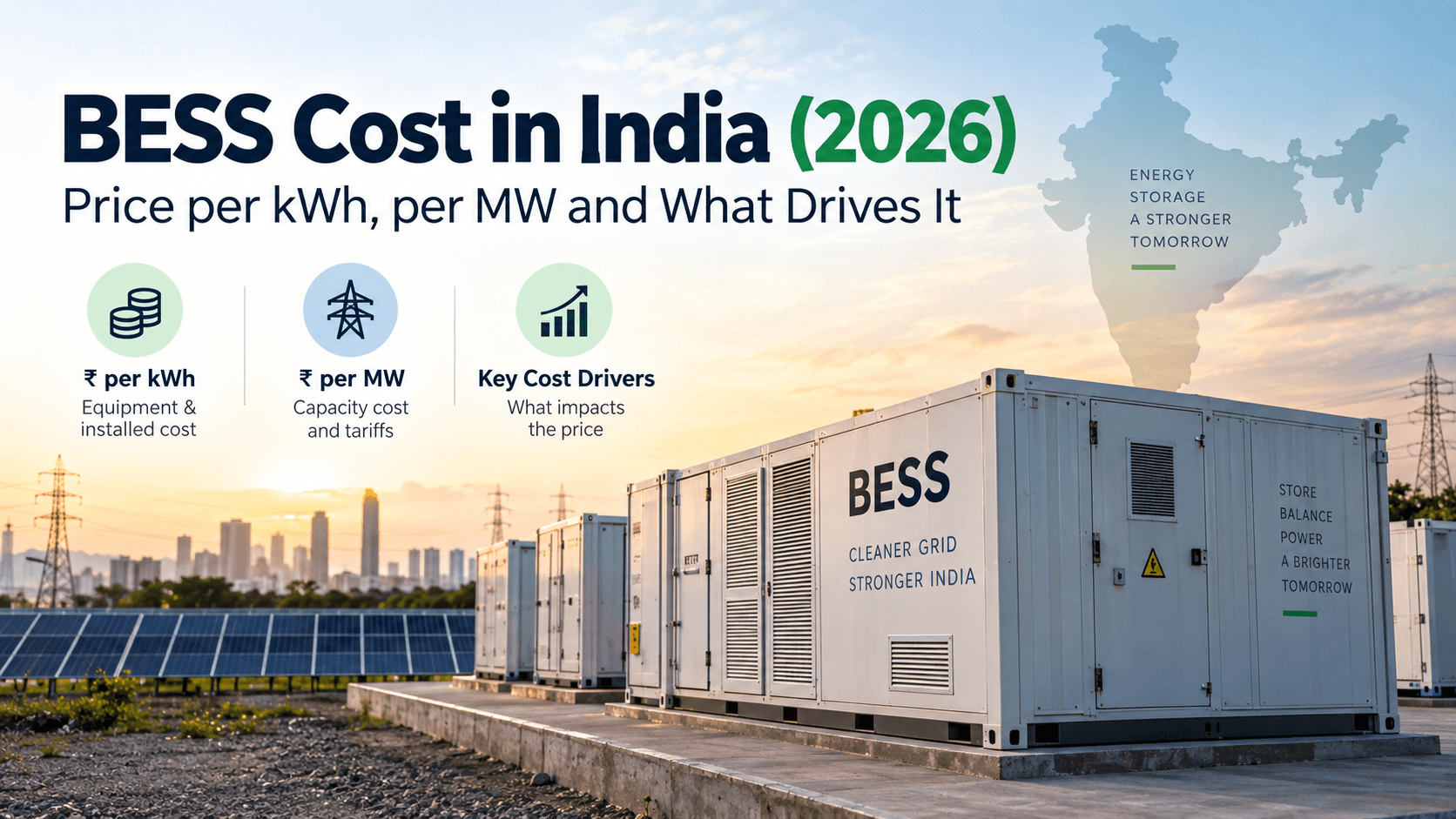
Battery Energy Storage Systems (BESS) are becoming a major part of India’s power infrastructure. Utilities are using them to shift renewable power, manage peak demand and improve grid flexibility, while commercial and industrial users are evaluating BESS for peak shaving, solar optimisation and backup power.
But there is no single BESS price in India.
The cost can look very different depending on whether you are talking about battery hardware, turnkey installed CAPEX, project cost, or the tariff paid for storage capacity.
For 2026, indicative Indian C&I BESS pricing is broadly in the ₹15,000 to ₹40,000+ per kWh range for installed systems, depending heavily on project size and scope. Larger utility-scale systems can have a different cost structure, while competitive storage tenders report much lower figures in ₹/kWh because those figures represent the cost of delivering a storage service, not simply buying the battery.
Understanding that distinction is essential when comparing BESS quotations.
BESS Cost in India in 2026: Quick Overview
| Cost measure | Indicative 2026 range | What it means |
|---|---|---|
| Small C&I BESS | ₹30,000 to ₹40,000+/kWh | Installed system, typically smaller projects |
| 500 kWh to 2 MWh | ₹25,000 to ₹32,000/kWh | Larger commercial and industrial systems |
| 2 MWh to 10 MWh | ₹20,000 to ₹28,000/kWh | Larger C&I or distributed projects |
| 10 MWh+ | Around ₹15,000 to ₹20,000/kWh or lower | Larger projects benefit from scale |
| Utility BESS project benchmarks | Highly variable | Depends on duration, procurement model and scope |
| Recent storage tariffs | Around ₹1.5 lakh to ₹3 lakh+/MW/month in some tenders | Service tariff, not equipment CAPEX |
These ranges should be treated as indicative market benchmarks rather than quotations. Actual pricing depends on battery chemistry, duration, PCS rating, grid connection, cooling, fire protection, civil works, taxes, financing and the commercial structure of the project.
What Does BESS Cost Per kWh in India?
For a business purchasing and installing a BESS, the most useful starting point is usually installed cost per kWh.
Current 2026 market estimates put larger C&I installations roughly around ₹15,000 to ₹25,000 per kWh, while smaller systems can reach ₹30,000 to ₹40,000 per kWh or more because fixed engineering, installation and balance-of-system costs are spread across fewer battery cells.
For example, a hypothetical 1 MWh system priced at ₹25,000 per kWh would have:
1,000 kWh × ₹25,000 = ₹2.5 crore
At ₹30,000 per kWh:
1,000 kWh × ₹30,000 = ₹3 crore
This gives a useful way to sanity-check quotations, but it should not be treated as a universal market price.
Why the price per kWh changes with project size
A 100 kWh system and a 10 MWh system both contain battery capacity, but they do not have proportionally different costs for every component.
Both may require:
- Battery management systems
- Power conversion equipment
- Energy management controls
- Fire detection and suppression
- Thermal management
- Protection equipment
- Communications and monitoring
- Engineering and commissioning
- Electrical integration
- Site preparation
As system size increases, these fixed costs are distributed across more kWh.
That is one reason larger BESS projects generally achieve lower cost per kWh.
What Does BESS Cost Per MWh?
Since 1 MWh equals 1,000 kWh, converting a per-kWh price into a per-MWh figure is straightforward.
| Cost per kWh | Cost per MWh |
|---|---|
| ₹15,000 | ₹1.5 crore |
| ₹20,000 | ₹2 crore |
| ₹25,000 | ₹2.5 crore |
| ₹30,000 | ₹3 crore |
| ₹40,000 | ₹4 crore |
So, for example, a BESS priced at ₹20,000/kWh has an equipment and installation benchmark of approximately ₹2 crore per MWh.
However, a quotation needs to specify whether this figure is based on nominal battery capacity or usable energy capacity. The distinction can materially change the economics.
What Does BESS Cost Per MW?
This is where BESS pricing becomes more complicated.
MW measures power. MWh measures energy.
A 10 MW / 20 MWh BESS can deliver 10 MW for approximately two hours.
A 10 MW / 40 MWh BESS can deliver the same 10 MW power for approximately four hours.
The two projects have the same MW rating but twice the energy capacity.
That means you cannot meaningfully calculate BESS cost from MW alone without knowing the storage duration.
Example: 10 MW BESS
Assume a project costs ₹20,000/kWh.
2-hour BESS:
10 MW × 2 hours = 20 MWh
20,000 kWh × ₹20,000 = ₹40 crore
4-hour BESS:
10 MW × 4 hours = 40 MWh
40,000 kWh × ₹20,000 = ₹80 crore
The second project has the same 10 MW power rating but approximately twice the battery energy capacity.
This is why a BESS quotation should normally be expressed as MW/MWh, rather than simply MW.
Why India’s BESS Tender Prices Look Much Lower
One of the biggest sources of confusion in the Indian storage market is the difference between BESS CAPEX and storage tariffs.
The Ministry of Power reported in December 2025 that the cost of BESS discovered through tariff-based competitive bidding had fallen from around ₹10.18/kWh in 2022-23 to approximately ₹2.1/kWh in recent bidding without VGF, assuming two cycles per day. It estimated around ₹2.8/kWh when assuming 1.5 cycles per day.
Those numbers do not mean that a company can buy and install a BESS for ₹2.1 per kWh.
They represent the cost of providing storage under a particular procurement and utilisation model.
This distinction matters.
BESS CAPEX
CAPEX answers:
“How much does it cost to build and install this battery system?”
It can include:
- Battery cells and modules
- Containers or cabinets
- BMS
- PCS
- EMS
- HVAC or liquid cooling
- Fire protection
- Transformers
- Switchgear
- Cabling
- Civil works
- Installation
- Testing and commissioning
Storage tariff
A storage tariff answers something closer to:
“How much does the procurer pay the storage provider for the contracted storage service?”
It may be quoted in:
- ₹/kWh
- ₹/MW/month
- ₹/MW/year
The contract duration, cycling requirements, charging arrangements, availability guarantees and government support all affect this number.
What Are Current BESS Tender Prices in India?
Competitive bidding has pushed storage tariffs down sharply.
Research from IEEFA and JMK found that India’s lowest discovered standalone BESS tariff in 2025 reached approximately ₹1.48 lakh/MW/month for a two-hour system. Four-hour systems reached approximately ₹2.85 lakh/MW/month at the low end.
The numbers vary substantially by tender.
Recent market data also shows that standalone BESS prices fell from approximately ₹10.83 lakh/MW/month in 2022 to ₹2.02 lakh/MW/month for two-hour storage and ₹3.59 lakh/MW/month for four-hour storage by summer 2025, with VGF and other support mechanisms contributing to the reduction.
These figures should not be compared directly with an EPC quote for a behind-the-meter industrial BESS.
They represent different commercial structures.
Why BESS Prices Are Changing in 2026
Battery prices have fallen dramatically over the past several years, but 2026 is not simply a continuation of the same downward trend.
Current market conditions are more mixed.
JMK reported LFP cell prices of approximately US$55/kWh in China in July 2026, while landed LFP cell and container costs in India remained around 10% to 25% above Chinese prices.
At the same time, Reuters reported in July 2026 that Indian storage developers were facing higher battery input costs, with lithium, copper and aluminium prices and changes in Chinese export incentives affecting project economics.
That means buyers should be cautious about assuming that a 2026 BESS quotation will automatically be cheaper than a 2025 quotation.
1. Battery Cell Cost
Battery cells are one of the largest components of BESS cost.
For large stationary systems, lithium iron phosphate (LFP) chemistry has become particularly important because of its combination of cost, cycle life and safety characteristics.
A change in cell pricing can therefore have a meaningful impact on the total project cost.
But cell price alone does not determine BESS pricing.
The buyer also pays for everything required to turn cells into a functioning, grid-connected storage system.
2. Battery Chemistry
Different chemistries have different cost and performance characteristics.
LFP is widely used for stationary storage because it offers:
- Good cycle life
- Strong thermal stability
- High suitability for frequent cycling
- Competitive cost
Other chemistries can make sense for particular applications, but comparing BESS systems only on ₹/kWh without considering chemistry can produce misleading conclusions.
3. Storage Duration
Duration is one of the most important cost variables.
A 10 MW / 20 MWh system and a 10 MW / 40 MWh system have identical power capacity but very different energy capacity.
Longer-duration systems require more battery cells and therefore generally have higher total CAPEX.
However, the relationship is not perfectly linear because some components, such as PCS and grid connection equipment, are sized primarily around MW rather than MWh.
4. Power Conversion System
The PCS converts electricity between AC and DC.
Its size is determined primarily by the BESS power rating.
A system designed for high power output needs a larger PCS, transformers, switchgear and associated electrical infrastructure.
This is why two batteries with identical MWh capacity can have different prices if their MW ratings are different.
5. Thermal Management
Battery cells operate within defined temperature ranges.
Large BESS installations therefore require thermal management, which may include air conditioning or liquid cooling.
Cooling requirements increase with system size, operating conditions and battery configuration.
The choice between air-cooled and liquid-cooled architecture can affect both upfront cost and operating performance.
6. Fire Detection and Suppression
Fire safety is an important part of utility and commercial BESS design.
A complete system may require:
- Smoke and heat detection
- Gas detection
- Fire suppression
- Emergency shutdown systems
- Ventilation
- Compartmentalisation
- Monitoring and alarms
The cost depends on the battery technology, enclosure design, site requirements and applicable standards.
7. EMS and Software
The Energy Management System determines how the battery operates.
For example, an industrial customer may use the BESS to:
- Reduce peak demand
- Shift solar generation
- Charge during lower-cost periods
- Discharge during expensive periods
- Provide backup power
- Participate in grid services
More sophisticated controls and integration requirements can increase project cost.
8. Grid Interconnection
A BESS connected directly to the grid may require substantial electrical infrastructure.
Depending on the project, this can include:
- Transformers
- MV or HV switchgear
- Protection systems
- Metering
- Cabling
- Substation equipment
- Grid studies
- Interconnection works
A battery quote that excludes these items can appear significantly cheaper than an all-in project cost.
9. Civil Works and Installation
Containerised BESS systems still require suitable sites.
Project costs may include:
- Foundations
- Equipment platforms
- Cable trenches
- Drainage
- Fencing
- Roads and access
- Earthing
- Installation
- Testing
- Commissioning
These costs vary significantly by site.
A greenfield utility project can therefore have a very different cost profile from a BESS installed inside an existing industrial facility.
10. Taxes, Duties and Logistics
The final Indian price can also be affected by:
- GST
- Customs duties
- Import costs
- Freight
- Insurance
- Port handling
- Local transportation
- Currency movements
This is particularly relevant when cells, containers or power electronics are imported.
VGF Is Changing BESS Economics in India
Government support has played an important role in accelerating BESS deployment.
The Ministry of Power’s VGF schemes support large-scale BESS development, with the government reporting support for tens of thousands of MWh of planned storage capacity. The 2025 expansion included support for an additional 30 GWh through the Power System Development Fund.
VGF can materially reduce the effective capital burden for eligible projects.
That helps explain why some tender prices can be substantially below the cost a private commercial buyer might see for a standalone BESS installation.
What Is the Levelized Cost of BESS in India?
CAPEX tells you what the battery costs to build.
It does not tell you what each delivered unit of stored electricity ultimately costs.
For that, developers often use Levelized Cost of Storage (LCOS).
LCOS incorporates factors such as:
- Initial CAPEX
- Financing costs
- Operating expenses
- Battery degradation
- Efficiency losses
- Number of cycles
- Useful life
- Replacement costs
- Energy throughput
ICRA’s 2026 assessment puts the levelized cost of storage for typical two- to four-hour BESS projects at around ₹4 to ₹7/kWh, while noting that economics remain closely linked to capital cost.
This is a more useful metric for comparing storage economics than looking at battery CAPEX alone.
BESS Cost Example: 1 MW / 2 MWh System
Consider a hypothetical 1 MW / 2 MWh BESS.
Assume an installed CAPEX of ₹25,000/kWh.
The energy capacity is:
2 MWh = 2,000 kWh
Estimated CAPEX:
2,000 × ₹25,000 = ₹5 crore
The system can theoretically deliver:
1 MW for 2 hours
The actual usable energy will be lower than the nameplate capacity depending on the manufacturer’s operating window, reserve requirements, efficiency and degradation assumptions.
This is why a proper financial model should use usable MWh and expected annual throughput, not simply the nameplate figure.
BESS Cost Example: 10 MW / 40 MWh System
Now consider a 10 MW / 40 MWh utility-scale system.
At ₹20,000/kWh:
40,000 kWh × ₹20,000 = ₹80 crore
At ₹25,000/kWh:
40,000 kWh × ₹25,000 = ₹100 crore
The difference is ₹20 crore.
That illustrates why even a relatively small change in the assumed cost per kWh can have a major effect on a large project.
However, utility-scale procurement may achieve lower unit costs than smaller C&I installations because of scale and procurement volume.
What Should a BESS Buyer Include in a Cost Comparison?
Do not compare two BESS quotations based only on the headline ₹/kWh number.
Check whether both quotations include the same scope.
A useful comparison should cover:
| Cost item | Quote A | Quote B |
|---|---|---|
| Battery capacity, MWh | ||
| Usable capacity, MWh | ||
| Power rating, MW | ||
| Battery chemistry | ||
| PCS | ||
| BMS | ||
| EMS | ||
| HVAC / liquid cooling | ||
| Fire protection | ||
| Transformer | ||
| MV/HV equipment | ||
| Civil works | ||
| Installation | ||
| Commissioning | ||
| Grid interconnection | ||
| GST and duties | ||
| Warranty | ||
| Expected degradation | ||
| Guaranteed round-trip efficiency | ||
| Cycle warranty | ||
| Replacement assumptions |
Without this information, a lower quoted price may simply reflect a narrower scope.
CAPEX Is Only One Part of the BESS Business Case
For an industrial or commercial buyer, the key question is not:
“How cheap is the battery?”
It is:
“How much value can this battery create over its operating life?”
Potential value streams include:
Peak demand reduction
The BESS can discharge during periods when electricity demand would otherwise create a high peak.
Time-of-use arbitrage
Where tariff structures create meaningful price differences, the battery can charge during lower-cost periods and discharge during higher-cost periods.
Solar energy shifting
Excess solar generation can be stored and used later rather than exported or curtailed.
Backup power
BESS can provide fast backup for critical loads, although the required architecture depends on whether the system is designed for seamless backup, partial backup or grid-connected operation.
Grid services
Larger systems may participate in grid-balancing or other services where the applicable market and regulations allow it.
The economic value of these applications depends heavily on the site and tariff structure.
What Is the Outlook for BESS Costs in India?
India’s storage market is expanding rapidly, but 2026 is also showing why buyers should not assume that battery prices will decline in a straight line.
India’s awarded BESS capacity, including projects under construction and operational projects, reached around 90 GWh by June 2026, according to ICRA reporting.
At the same time, higher input costs have begun putting pressure on some aggressively priced projects. Reuters reported in July 2026 that some previously bid projects were facing difficulties because suppliers were no longer honouring earlier battery price commitments.
For buyers, the practical takeaway is that price, warranty and supply certainty need to be evaluated together.
How to Estimate Your BESS Cost
A simple first-pass calculation is:
BESS CAPEX = Power capacity × storage duration × cost per kWh
For example:
5 MW × 4 hours = 20 MWh
If the assumed installed cost is ₹20,000/kWh:
20,000 kWh × ₹20,000 = ₹40 crore
Then add or verify any costs excluded from the quoted price, such as:
- Grid connection
- Land and civil works
- Taxes and duties
- Financing
- Development costs
- Transmission infrastructure
- Replacement reserves
- O&M
For a serious investment decision, move from this simple CAPEX calculation to an LCOS and project cash-flow model.
Key Takeaways
BESS cost in India in 2026 depends on much more than battery capacity.
For commercial and industrial systems, indicative installed costs can range from roughly ₹15,000 to ₹40,000+ per kWh, with larger systems generally achieving lower unit costs.
For utility-scale projects, competitive tender tariffs can appear dramatically lower, but these are storage service prices rather than battery purchase prices. Recent Indian tenders have reported tariffs as low as approximately ₹1.48 lakh/MW/month for two-hour standalone BESS projects.
The biggest factors affecting the final project cost are battery cell prices, storage duration, MW rating, PCS, thermal management, fire protection, grid interconnection, civil works, financing, taxes and government incentives.
Most importantly, buyers should compare BESS systems using usable MWh, MW power, expected degradation, efficiency, warranty, lifecycle throughput and total installed cost, rather than relying on a single ₹/kWh number.