What Is a Battery Energy Storage System (BESS)?
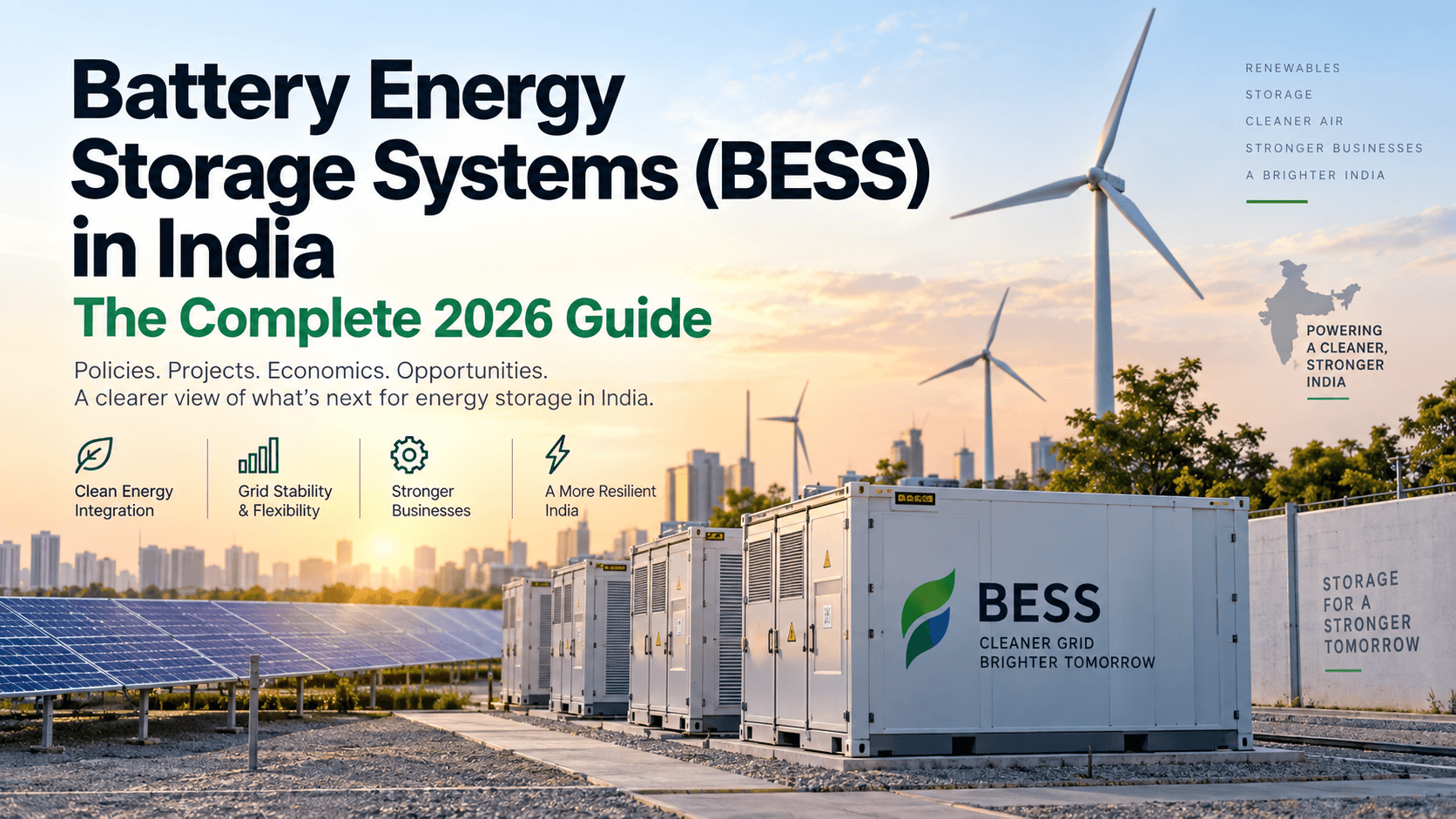
A Battery Energy Storage System (BESS) stores electricity in batteries and releases it when power is needed. Unlike a conventional generator, a BESS does not generate electricity. It shifts electricity across time, helping the grid use power when and where it is most valuable.
A typical BESS includes:
- Battery cells and modules
- Battery Management System (BMS)
- Power Conversion System (PCS)
- Energy Management System (EMS)
- Thermal management
- Fire detection and suppression
- Transformers and switchgear
- Grid connection equipment
- Monitoring and control software
In India, BESS is becoming increasingly important as solar and wind capacity grows. Solar generation is concentrated during daylight hours, while electricity demand often remains high during the evening. Batteries can store excess electricity and discharge it during periods of higher demand.
The Central Electricity Authority (CEA) projects a BESS requirement of 34.72 GWh in 2026-27, increasing to 236.22 GWh by 2031-32.
Why Does India Need BESS?
India’s power system is undergoing a major shift toward renewable energy. The country has set a target of 500 GW of non-fossil fuel-based installed generation capacity by 2030.
That creates a practical challenge: renewable generation does not always occur when consumers need electricity.
For example, a solar-heavy grid may have abundant electricity at noon but face a steep increase in demand after sunset. BESS can charge during periods of surplus generation and discharge during peak demand.
The main applications include:
Renewable Energy Integration
BESS can store surplus solar or wind generation and release it later. This can reduce the mismatch between renewable generation and demand.
Peak Demand Management
A battery can discharge during peak periods, reducing the amount of electricity that must be purchased or generated from other sources.
Grid Balancing
Fast-response batteries can help manage short-term changes in supply and demand.
Ancillary Services
Storage can support services such as frequency regulation and other grid-balancing functions. India has already established a regulatory pathway for storage-based resources to participate in ancillary services.
Energy Arbitrage
Where market and tariff structures permit it, a battery can charge when electricity is cheaper and discharge when electricity has greater value.
Transmission and Distribution Support
Strategically located storage can potentially reduce congestion and defer some grid infrastructure investments.
How Does BESS Work?
The basic operating cycle is straightforward:
Electricity source → PCS → Battery → PCS → Grid/load
During charging, electricity enters the BESS through the power conversion system. The batteries store that energy chemically.
During discharge, the process reverses. The battery sends DC electricity to the PCS, which converts it into AC electricity suitable for the grid or connected load.
The EMS determines when the system should charge or discharge, based on factors such as:
- Electricity prices
- Solar or wind generation
- Load demand
- Grid conditions
- State of charge
- Battery degradation
- Contractual requirements
Key Components of a BESS
Battery Cells
The cells are the core energy storage component. Lithium-ion technology currently dominates many utility-scale BESS projects because of its energy density, response speed and commercial maturity.
Different battery chemistries have different characteristics around cost, safety, cycle life, energy density and operating conditions.
Battery Management System
The BMS monitors battery voltage, temperature, current and state of charge.
It also helps protect the battery from unsafe operating conditions.
Power Conversion System
The PCS converts electricity between AC and DC.
During charging:
AC → DC
During discharge:
DC → AC
PCS performance has a direct impact on system efficiency and grid performance.
Energy Management System
The EMS controls how the BESS operates.
For a utility-scale project, the EMS may coordinate thousands of battery modules while following dispatch instructions and contractual operating requirements.
Thermal Management
Battery temperature affects both performance and safety. Utility-scale systems therefore require appropriate cooling and thermal monitoring.
Safety Systems
A utility-scale BESS needs multiple layers of protection, including monitoring, alarms, isolation, fire detection and emergency response systems.
India has introduced updated CEA requirements relating to BESS safety and construction standards in 2026.
Types of BESS Projects in India
BESS projects can be classified based on how they are connected and used.
Standalone BESS
A standalone BESS connects directly to the grid without being physically paired with a renewable generation plant.
This configuration is becoming increasingly visible in India’s utility-scale market.
According to Mercom India Research, standalone systems accounted for 83% of cumulative installed battery storage capacity as of June 2026.
Solar-Plus-Storage
A battery can be paired with a solar project.
During periods of high solar generation, excess electricity can charge the battery. The stored energy can then be supplied later.
Wind-Plus-Storage
The same principle can be applied to wind generation, particularly where generation patterns and demand profiles create a useful opportunity for storage.
Renewable Energy Plus BESS for Firm Power
Storage can help renewable projects deliver electricity according to a more predictable schedule.
This is particularly relevant to firm and dispatchable renewable energy procurement.
Behind-the-Meter BESS
Commercial and industrial customers can install batteries on their premises to manage demand, improve backup capability or optimize electricity consumption.
The business case depends heavily on local tariffs, demand charges, operating patterns and applicable regulations.
BESS Applications for Indian Businesses
BESS is not limited to large power utilities.
Commercial and industrial businesses can consider storage for several use cases.
Peak Load Management
A battery can reduce grid consumption during periods of high demand.
Backup Power
BESS can provide backup electricity when the grid fails, although the required system design depends on the critical loads and desired backup duration.
Solar Self-Consumption
Businesses with rooftop solar can use BESS to shift excess daytime generation into evening consumption.
Power Quality
Appropriately designed storage systems can support power quality requirements for sensitive loads.
Microgrids
BESS can become an important component of microgrids combining solar, generators, loads and intelligent controls.
India’s BESS Market in 2026
India’s storage market has moved beyond the early demonstration phase.
Mercom India Research reported 9.3 GWh of cumulative installed battery storage capacity by June 2026. It also reported 8.2 GWh of additions during the first half of 2026.
The same research reported 28 GW of battery storage tenders during the first half of 2026, compared with 15 GW during the same period in 2025. Approximately 9 GW was auctioned during the period.
That difference between tendered and auctioned capacity is important. A tender announcement does not automatically translate into a commissioned project.
Developers still need to manage:
- Financing
- Land and site development
- Grid connectivity
- Equipment procurement
- Battery supply
- Construction
- Testing
- Contract execution
- Commissioning
BESS Capacity Outlook for India
India’s long-term storage requirement is substantial.
The National Electricity Plan projects:
| Year | BESS Requirement |
|---|---|
| 2026-27 | 34.72 GWh |
| 2031-32 | 236.22 GWh |
| 2047 | 1,840 GWh |
These are projected requirements rather than guaranteed installed capacity. They indicate the scale of storage that India’s power system may need as renewable penetration increases.
The government has also stated that the projected BESS requirement for 2026-27 is about 8.68 GW / 34 GWh, rising to 47.24 GW / 236 GWh by 2031-32.
Government Policies Supporting BESS in India
India has developed several policy mechanisms to accelerate energy storage deployment.
Energy Storage as Part of the Power System
Electricity Rules were amended in 2022 to explicitly recognize Energy Storage Systems as part of the power system.
This allows storage to participate across generation, transmission and distribution functions.
National Framework for Energy Storage
The Ministry of Power issued a National Framework for Promotion of Energy Storage Systems in September 2023.
The framework provides direction around storage deployment, market participation and regulatory facilitation.
Energy Storage Obligations
India has also established an Energy Storage Obligation trajectory.
The notified trajectory increases the ESO from 1% in FY 2023-24 to 4% by FY 2029-30, with an annual increase of 0.5 percentage points. At least 85% of the energy stored for compliance must come from renewable energy sources.
Viability Gap Funding
VGF has become one of the major mechanisms supporting utility-scale BESS development.
The government’s programs have expanded to support approximately 43.85 GWh of BESS capacity across different components. A 2025 PSDF-supported program added 30 GWh of BESS capacity with ₹5,400 crore of financial support.
The exact support available depends on the applicable scheme, project structure and eligibility requirements.
ISTS Charge Waiver
Inter-State Transmission System charge waivers can materially affect project economics.
For example, the government has extended a 100% ISTS charge waiver for qualifying co-located BESS projects commissioned up to June 2028.
Project developers should verify the latest eligibility conditions before including any waiver in their financial model.
BESS Costs in India
There is no single “BESS cost” in India.
The total project cost depends on:
- Battery chemistry
- Energy capacity
- Power capacity
- Duration
- Number of cycles
- Battery augmentation strategy
- PCS specifications
- HVAC requirements
- Fire protection
- Land
- Grid interconnection
- EPC scope
- Financing costs
- Taxes and duties
- Warranty requirements
- Degradation assumptions
A 100 MW / 200 MWh system is fundamentally different from a 100 MW / 400 MWh system even though both have the same power rating.
This is why BESS projects should be evaluated using both MW and MWh.
MW vs MWh in BESS
This distinction is essential.
MW measures power.
It tells you how quickly a battery can charge or discharge.
MWh measures energy.
It tells you how much electricity the battery can store.
For example, a:
100 MW / 200 MWh BESS
can theoretically discharge at 100 MW for about two hours when fully charged, before accounting for operating constraints and usable capacity.
The ratio between energy and power is commonly expressed as duration.
Duration = MWh ÷ MW
So:
- 100 MW / 100 MWh = 1 hour
- 100 MW / 200 MWh = 2 hours
- 100 MW / 400 MWh = 4 hours
What Is BESS Tariff?
Utility-scale BESS procurement in India can use different commercial structures.
One common approach is to pay for available storage capacity, often expressed in terms such as ₹/MW/month.
Other contracts may focus on:
- Stored energy
- Energy discharge
- Availability
- Capacity
- Renewable energy plus storage
- Firm power
- Ancillary services
Therefore, comparing two BESS tariffs requires looking at the entire contract rather than comparing one headline number.
Important variables include contract duration, cycles per day, availability guarantees, degradation obligations, augmentation responsibilities and payment structure.
BESS Project Economics
A BESS business case should account for the entire lifecycle.
A simplified model looks like:
Revenue = Capacity payments + Energy payments + Ancillary service revenue + Other permitted revenue
Against:
Costs = Capex + Financing + O&M + Replacement/Augmentation + Grid charges + Insurance + Land + Taxes + End-of-life costs
Battery degradation is particularly important.
A battery does not maintain its original capacity indefinitely. Capacity gradually declines with cycling, temperature, operating conditions and time.
A project model therefore needs explicit assumptions for:
- Initial usable capacity
- Annual degradation
- Guaranteed availability
- Cycles per day
- Depth of discharge
- Round-trip efficiency
- Augmentation
- End-of-life capacity
Round-Trip Efficiency
Round-trip efficiency measures how much energy can be recovered after charging and discharging.
For example, if a system receives 100 MWh during charging and delivers 85 MWh back to the grid, its round-trip efficiency is approximately 85%.
The actual value depends on the battery, PCS, thermal systems, operating conditions and measurement boundary.
Efficiency matters because energy losses affect operating revenue and the amount of renewable electricity required to charge the system.
Battery Degradation and Augmentation
Battery degradation is one of the most important factors in long-term BESS economics.
As the battery ages, usable capacity can decline.
A project may therefore include augmentation, where additional battery capacity is added during the project’s life to maintain the required performance level.
A bankable BESS contract should clearly define:
- Guaranteed capacity
- Degradation curve
- Availability
- Performance tests
- Augmentation obligations
- Replacement responsibilities
- Warranty conditions
Without these definitions, two projects with apparently similar tariffs can have very different economic outcomes.
BESS Safety in India
Safety needs to be considered from the design stage rather than treated as an operational add-on.
Key areas include:
- Cell-level monitoring
- Thermal management
- Battery enclosure design
- Fire detection
- Fire suppression
- Electrical isolation
- Emergency shutdown
- Gas detection where applicable
- Site separation
- Ventilation
- Emergency response procedures
India’s CEA notified amendments in 2026 covering BESS safety requirements and technical standards for construction.
Project owners should also evaluate applicable BIS, CEA, electrical, fire and environmental requirements based on the project configuration and location.
BESS and Renewable Energy
The relationship between renewable energy and storage is one of the most important developments in India’s electricity market.
Consider a solar plant that generates large amounts of electricity between 10 a.m. and 4 p.m.
Without storage, electricity must be consumed, transmitted, curtailed or sold through an applicable market mechanism at that time.
With BESS, some of that electricity can be stored and dispatched later.
This makes storage particularly useful for:
- Evening peak demand
- Renewable firming
- Round-the-clock renewable power
- Peak shifting
- Grid balancing
However, storage does not eliminate renewable variability. It changes when electricity can be delivered and gives grid operators another resource for managing that variability.
Standalone BESS vs Solar-Plus-BESS
The choice depends on the commercial objective.
| Factor | Standalone BESS | Solar + BESS |
|---|---|---|
| Primary role | Grid flexibility | Renewable shifting and firming |
| Renewable generation | Separate | Co-located |
| Charging source | Grid or contracted source | Solar and potentially other permitted sources |
| Use case | Peak management, grid services | Solar shifting, firm power |
| Land requirement | Generally lower than combined generation + storage | Higher |
| Revenue model | Storage-focused | Renewable + storage |
Neither configuration is universally suitable. The right structure depends on the grid connection, contract, tariffs, operating requirements and project economics.
Challenges Facing India’s BESS Industry
The growth opportunity is substantial, but several challenges remain.
Grid Connectivity
A project can have financing, equipment and a signed contract but still face delays if grid connectivity is not available on schedule.
Financing
BESS is capital intensive, while revenue structures are still evolving.
Long-term contracts, strong counterparties and clear performance guarantees can therefore be important for project finance.
Battery Supply Chains
India continues to develop domestic battery manufacturing, but utility-scale projects can remain exposed to global battery supply chains, equipment availability, commodity prices and currency movements.
Contract Structures
Storage contracts need to address degradation, cycling, availability, augmentation and dispatch rights clearly.
Poorly defined responsibilities can create disputes later in the project lifecycle.
Revenue Stacking
The ability to earn revenue from multiple services can improve asset utilization, but regulatory and contractual restrictions determine whether different revenue streams can actually be combined.
What Should Businesses Consider Before Buying BESS?
For a commercial or industrial buyer, starting with the battery size is usually the wrong approach.
Start with the problem.
Ask:
- What load needs to be supported?
- How long does backup need to last?
- When does peak demand occur?
- What is the electricity tariff during those periods?
- Is rooftop or open-access solar available?
- How much excess renewable generation is available?
- How frequently will the battery cycle?
- What level of uptime is required?
- What space and grid capacity are available?
- What is the expected payback or project return?
Then model the battery requirement.
For example, if a facility needs 5 MW of power for two hours, the initial requirement is approximately:
5 MW × 2 hours = 10 MWh
The final system will need additional engineering allowances based on usable capacity, efficiency, reserve requirements and degradation.
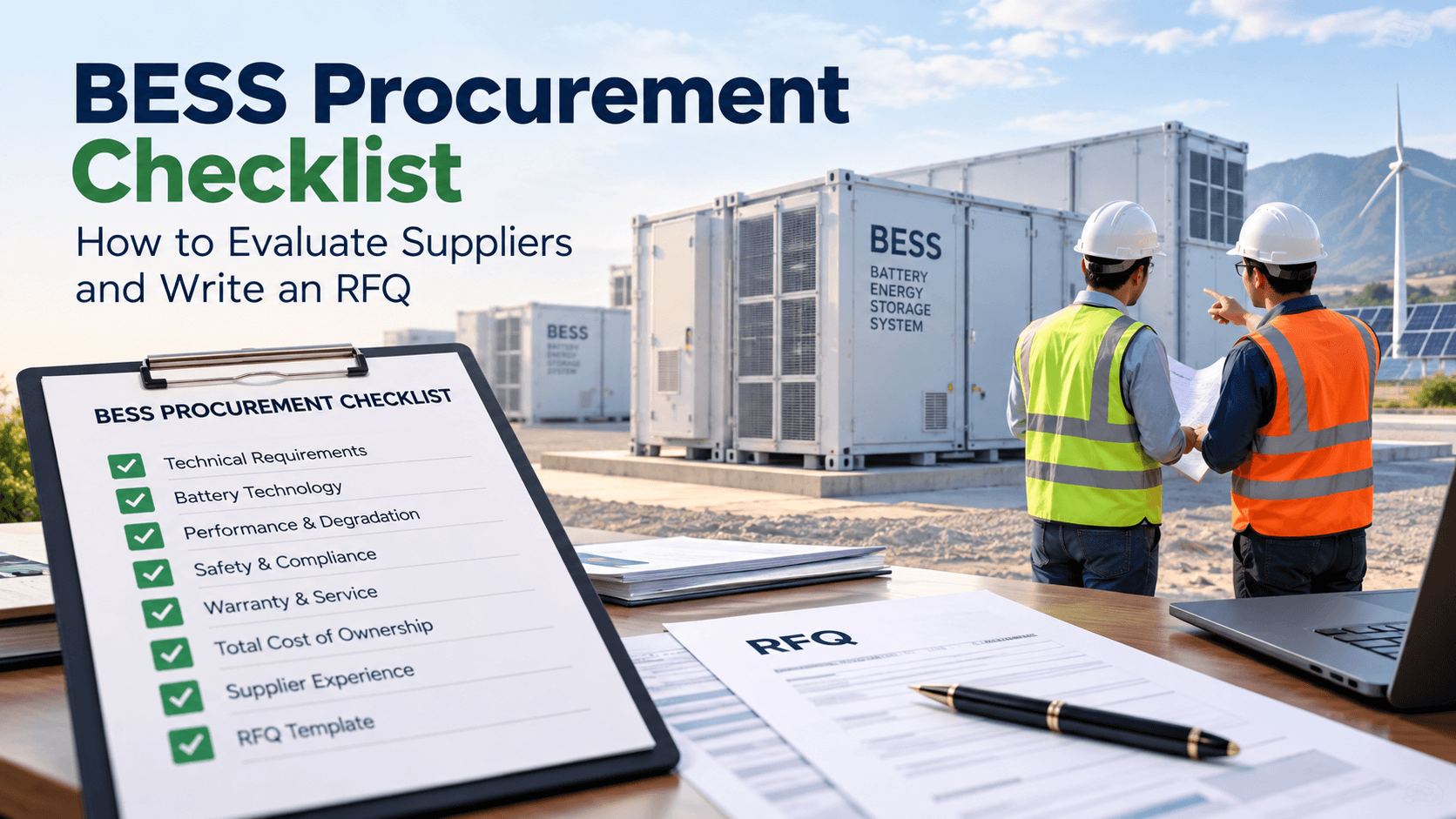
How to Evaluate a BESS Vendor
Price should not be the only selection criterion.
A technical and commercial evaluation should cover:
Technical
- Battery chemistry
- Cell manufacturer
- Energy density
- Cycle life
- Round-trip efficiency
- Operating temperature range
- PCS efficiency
- Response time
- Availability guarantee
- Degradation guarantee
Safety
- Fire detection
- Fire suppression
- Thermal management
- Emergency shutdown
- Safety certifications
- Site safety design
Commercial
- Warranty period
- Performance guarantees
- Liquidated damages
- Replacement terms
- Augmentation
- O&M costs
- Software licensing
- Spare parts
Integration
- EMS capabilities
- SCADA integration
- Utility communication
- Solar inverter integration
- Energy market interfaces
- Remote monitoring
A BESS is a long-lived infrastructure asset. Vendor stability and lifecycle support can therefore matter as much as the initial equipment price.
BESS Software and Energy Management
Hardware is only part of the system.
The software layer determines how the battery operates.
A modern BESS control platform may monitor:
- State of charge
- State of health
- Power output
- Energy flows
- Temperature
- Grid conditions
- Renewable generation
- Load
- Market prices
The EMS can then optimize charging and discharging against the project’s operating objectives.
For larger portfolios, centralized software can also provide fleet-level monitoring, forecasting, reporting and performance management.
BESS and India’s Energy Transition
India’s storage requirement is closely linked to its renewable energy ambitions.
The Ministry of New and Renewable Energy notes that storage can help reduce renewable variability, shift energy into peak periods, provide ancillary support, facilitate renewable integration and potentially defer some transmission and distribution investment.
The policy direction is therefore clear: storage is being treated as infrastructure needed to support a more renewable-heavy power system.
The key question for the industry is shifting from whether India needs BESS to how quickly projects can be financed, built and operated at scale.
What the 2026 BESS Market Means for Businesses
For utilities and developers, 2026 is increasingly about project execution.
Tender volumes are rising, government support is expanding and installed capacity is growing. At the same time, the market is becoming more demanding about performance, financing and delivery.
For commercial and industrial companies, the opportunity is more specific.
BESS can make sense where a business has a clear economic or operational problem, such as expensive peak demand, solar energy that cannot be consumed immediately, unreliable grid supply or a need for flexible power.
The technology should be sized around that problem rather than purchased simply because battery prices are falling.
BESS FAQ
Is BESS the same as a UPS?
No. A UPS is primarily designed to provide uninterrupted power to critical loads. A BESS is a broader energy storage system that can provide peak management, renewable integration, grid services, backup power and other functions. A BESS can form part of a backup power architecture, but the two terms are not interchangeable.
How long can a BESS provide electricity?
It depends on the system’s energy capacity and discharge power. A 100 MW / 200 MWh system has a nominal two-hour duration at 100 MW. Actual usable duration depends on operating limits, state of charge, efficiency and reserve requirements.
Is lithium-ion the only BESS technology?
No. Other battery technologies exist, including flow batteries and sodium-based technologies. Different technologies have different characteristics around duration, safety, cycle life, cost and operating conditions.
Is BESS profitable in India?
Profitability depends on the project’s revenue model, tariff, capex, financing, utilization, degradation, operating costs and applicable government support. There is no single BESS profitability figure that applies to every Indian project.
What is the future of BESS in India?
India’s official planning documents point toward substantial growth in storage requirements. CEA projects BESS requirements rising from around 34.7 GWh in 2026-27 to more than 236 GWh in 2031-32. Actual deployment will depend on procurement, project execution, grid infrastructure, financing, battery supply chains and the evolution of storage markets.
Final Takeaway
BESS is becoming a critical part of India’s evolving electricity system.
The technology can shift renewable electricity across time, manage peaks, support grid stability and provide flexibility that conventional generation and transmission infrastructure cannot always deliver economically.
India’s policy framework is also moving beyond pilot projects. VGF programs, transmission charge incentives, procurement guidelines, Energy Storage Obligations and updated technical standards are creating a more structured market.
For developers and utilities, the focus is increasingly on building bankable projects with reliable equipment, strong contracts and realistic lifecycle economics.
For businesses, the starting point should be different: identify the energy problem first, then determine whether BESS solves it at an acceptable total cost.
The scale of India’s projected storage requirement suggests that BESS will become an increasingly important part of the country’s power infrastructure through the rest of this decade and beyond.