
Why Swiss-Type Turning Works for Small Precision Parts
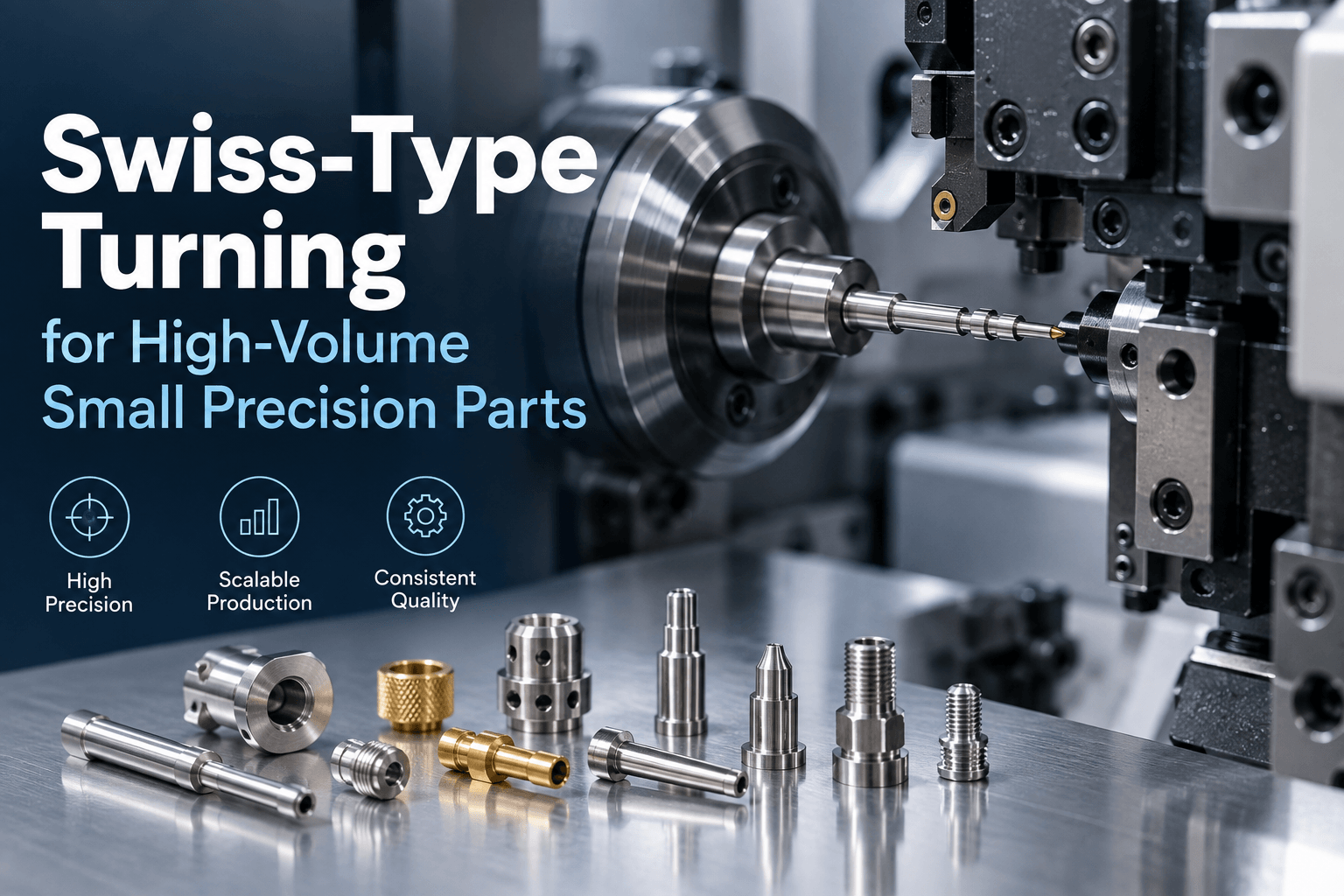
Manufacturing small, complex components at high volumes can be challenging with conventional CNC turning. As part sizes shrink and designs become more detailed, factors such as tool access, rigidity, cycle time, and dimensional stability become increasingly important.
Swiss-type turning addresses many of these challenges by supporting the machining of small-diameter parts with high precision and repeatability. The process is widely used for components that require tight tolerances, intricate features, and consistent production across large quantities.
For manufacturers, the key benefit is not simply precision. It is the ability to maintain precision efficiently over thousands or even millions of parts.
What Is Swiss-Type Turning?
Swiss-type turning is a CNC machining process designed primarily for small, slender, and precision components.
Unlike a conventional lathe, where the workpiece is generally held close to the chuck, a Swiss-type machine supports the material close to the cutting tool using a guide bushing. The material can move through the guide bushing while the cutting tools perform operations close to the support point.
This configuration helps reduce deflection and vibration, particularly when machining long, narrow components.
Swiss-type machines can also combine multiple operations, including:
- Turning
- Drilling
- Threading
- Grooving
- Milling
- Cross-hole machining
- Parting
The ability to perform several operations within one setup can reduce handling and improve production efficiency.
Advantages for High-Volume Production
Consistent Dimensional Accuracy
When producing large quantities of small components, maintaining consistent dimensions is often more important than achieving precision on a single part.
The guide bushing provides close support during machining, helping reduce workpiece movement and deflection. This makes Swiss-type turning suitable for applications where dimensional consistency is critical.
Efficient Cycle Times
High-volume manufacturing places considerable pressure on cycle time. Even a small reduction in machining time can have a significant effect when multiplied across thousands of components.
Swiss-type machines can perform several operations in a single cycle, reducing the need to move parts between different machines or setups.
Reduced Setup Requirements
Conventional manufacturing may require multiple machines or setups to complete a complex small component.
Swiss-type machining can often combine turning and secondary operations in one process. Fewer setups can mean less handling, shorter production schedules, and fewer opportunities for setup-related variation.
Better Control of Slender Parts
Long, thin components can be difficult to machine because cutting forces may cause the material to bend or vibrate.
The guide-bushing arrangement supports the material near the cutting area. This is one of the main reasons Swiss-type turning is well suited to small-diameter shafts, pins, sleeves, and other slender components.
Which Parts Are Suitable for Swiss-Type Turning?
Swiss-type turning is particularly useful when a component has a combination of small dimensions, complex geometry, and demanding production requirements.
Common examples include:
- Medical and surgical components
- Automotive precision components
- Electronic connectors
- Instrumentation parts
- Aerospace components
- Fasteners and miniature shafts
- Hydraulic and pneumatic components
- Dental components
- Sensor and actuator components
The process is especially valuable when the same complex part must be produced repeatedly with minimal variation.
Swiss-Type Turning vs. Conventional CNC Turning
The right machining process depends on the component design, material, tolerances, volume, and required operations.
| Factor | Swiss-Type Turning | Conventional CNC Turning |
|---|---|---|
| Small-diameter parts | Highly suitable | Suitable for many applications |
| Slender components | Strong advantage | May require additional support |
| Complex small features | Highly suitable | Depends on machine configuration |
| High-volume production | Highly suitable | Suitable |
| Multiple operations | Often possible in one setup | May require additional operations |
| Tight repeatability | Strong capability | Strong capability |
| Large components | Generally less suitable | Often more suitable |
Swiss-type machining is not automatically the better choice for every turned component. For larger, simpler parts, conventional CNC turning may provide a more practical production solution.
Materials Commonly Used
Swiss-type turning can be used with a wide range of engineering materials, depending on machine capability, tooling, and component requirements.
Typical materials include:
Stainless Steel
Stainless steels are frequently used for precision components requiring corrosion resistance and mechanical durability. Tool selection and cutting parameters are important because some stainless grades can generate significant cutting forces or work harden.
Brass
Brass is commonly used for miniature components because it machines relatively well and can produce good surface finishes.
Aluminum
Aluminum is useful where low weight and efficient machining are important. Appropriate tooling and cutting conditions can help achieve clean surfaces and stable dimensions.
Titanium
Titanium can be machined on Swiss-type equipment, although it generally requires careful control of cutting conditions, tooling, heat generation, and tool wear.
Engineering Plastics
Certain engineering plastics can also be machined for applications requiring electrical insulation, chemical resistance, or low friction.
Material selection should always consider the final component’s mechanical, thermal, chemical, and regulatory requirements.
Managing Quality in High-Volume Swiss Machining
Producing a precision component once is different from producing it consistently at high volume.
A reliable production process typically involves more than machine accuracy. It requires control throughout the manufacturing cycle.
Tool Wear Monitoring
Cutting tools gradually wear during production. If wear is not monitored, dimensions and surface finish can begin to change.
Tool-life monitoring, scheduled tool replacement, and in-process inspection can help maintain consistent output.
Process Inspection
Inspection can be performed at defined stages throughout production rather than relying solely on final inspection.
Depending on the component, manufacturers may monitor:
- Critical diameters
- Lengths
- Thread dimensions
- Concentricity
- Surface finish
- Feature position
- Burr formation
Statistical Process Control
For high-volume programs, statistical process control can help identify dimensional trends before they result in significant quantities of nonconforming parts.
This allows production teams to respond to process drift rather than simply detecting defects after production.
Designing Parts for Swiss-Type Turning
Part design has a major effect on machining efficiency.
When designing a component for Swiss-type production, consider:
Keep Critical Features Machinable
Features should be positioned so that cutting tools can reach them efficiently. Extremely difficult tool paths can increase cycle times and tool wear.
Consider Material Diameter
The starting bar diameter should be selected with the finished geometry and material-removal requirements in mind. Oversized stock can increase machining time and material waste.
Avoid Unnecessary Tight Tolerances
Not every dimension needs the same tolerance.
Applying extremely tight tolerances to noncritical features can increase manufacturing costs without improving the component’s actual performance.
Plan for Burr Control
Small parts can be particularly sensitive to burrs. Chamfers, tool selection, cutting conditions, and secondary deburring requirements should be considered during design.
How Swiss-Type Turning Improves Production Efficiency
For high-volume programs, efficiency comes from the entire manufacturing process rather than machine speed alone.
A well-planned Swiss-type production workflow can reduce:
- Number of setups
- Manual part handling
- Secondary machining
- Workpiece deflection
- Cycle time
- Process variation
- Inspection-related delays
The result can be a more predictable production process, particularly for components that would otherwise require several machining operations.
When Should You Consider Swiss-Type Turning?
Swiss-type turning is worth evaluating when your components are:
- Small in diameter
- Long or slender
- Geometrically complex
- Produced in high quantities
- Required to meet tight tolerances
- Made from materials that require stable workholding
- Designed with multiple turning and milling features
For low-volume or relatively large components, another CNC machining process may be more appropriate.
The best approach is to evaluate the part geometry, annual volume, material, tolerances, surface-finish requirements, and secondary operations together rather than selecting a machine type based on part size alone.
Conclusion
Swiss-type turning provides a practical manufacturing solution for high-volume production of small precision components. Its guide-bushing design helps control slender workpieces, while multi-axis machining capabilities can combine several operations within a single production cycle.
For manufacturers, the value comes from the combination of precision, repeatability, and production efficiency. When part geometry and production volume are a good match, Swiss-type turning can help create a stable and scalable process for demanding small-part applications.