ODM vs EMS vs JDM: Choosing the Right Manufacturing Partner Model for Electronics Brands
Choosing a manufacturing partner is not simply a matter of comparing unit prices. For electronics brands, the manufacturing model can determine who controls the product design, how much engineering support you receive, how quickly you can launch, and what happens to your intellectual property when the relationship ends.
Three models come up frequently: ODM, EMS, and JDM.
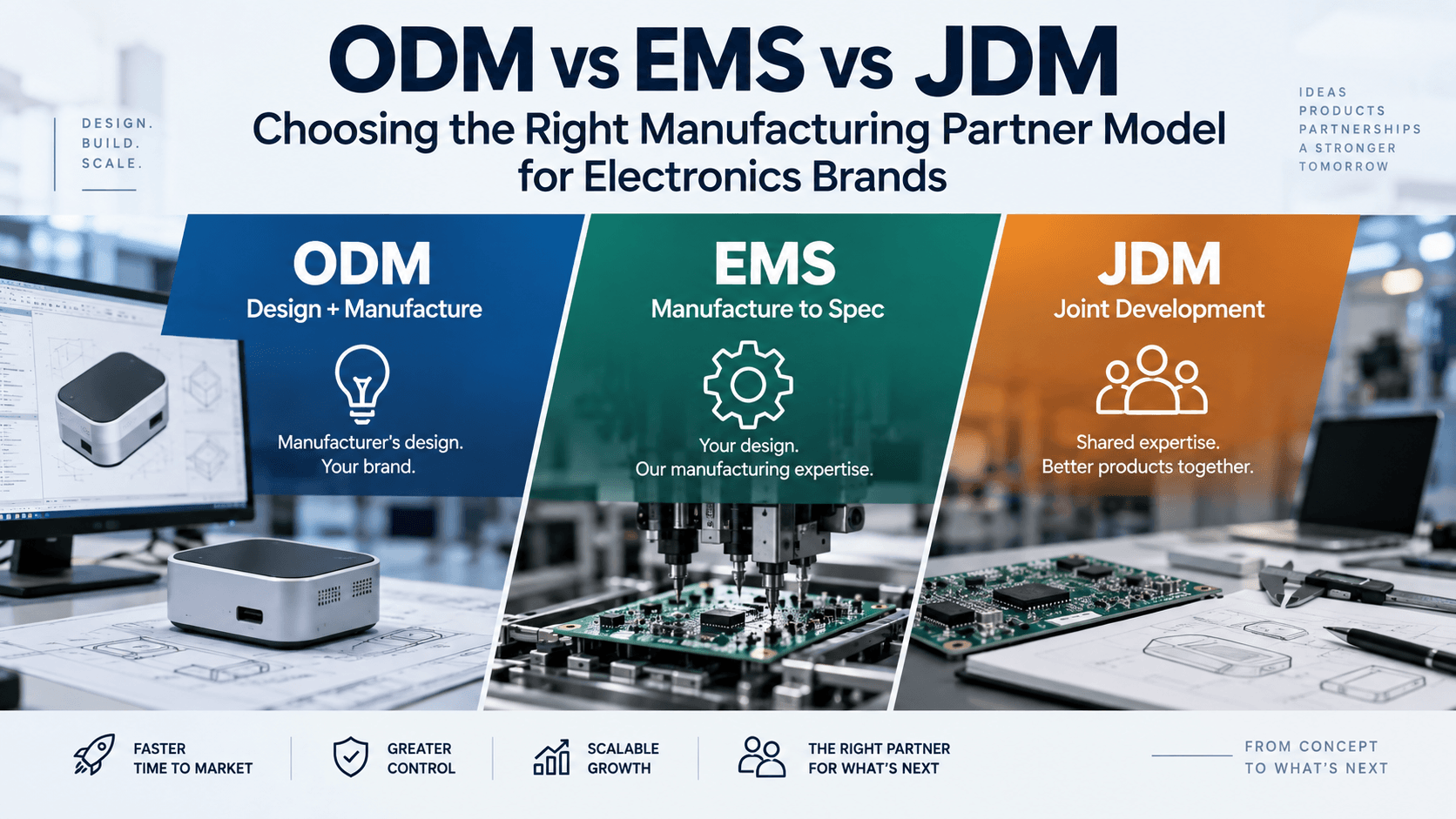
An ODM typically designs and manufactures a product that a brand can sell under its own name. An EMS provider manufactures a product based on the brand’s existing design. A JDM sits between the two, with the brand and manufacturer sharing responsibility for product development.
The right model depends on what your company already has and what it needs from a manufacturing partner.
ODM vs EMS vs JDM at a Glance
| Factor | ODM | EMS | JDM |
|---|---|---|---|
| Product design | Manufacturer | Brand | Shared |
| Manufacturing | Manufacturer | Manufacturing partner | Manufacturing partner |
| Typical IP ownership | Manufacturer | Brand | Negotiated/shared |
| Engineering involvement | High | Limited to manufacturing support | High |
| Customization | Low to moderate | High | High |
| Upfront development effort | Lower | Higher | Shared |
| Time to market | Often faster | Depends on design maturity | Moderate |
| Best suited for | Fast product launches | Proprietary products | Co-developed products |
| Main consideration | Differentiation and IP | Finding the right production partner | Defining ownership and responsibilities |
These categories are not always rigid. A manufacturer may provide DFM feedback while operating as an EMS partner, or an ODM may offer substantial customization. The contract ultimately determines responsibilities, ownership, and deliverables.
What Is an ODM?
ODM stands for Original Design Manufacturer.
An ODM develops the product design and manufactures it. The customer typically purchases an existing platform or a customized version and sells the finished product under its own brand.
This model is common when a company wants to enter a product category without building a large internal engineering team.
For example, imagine a consumer electronics brand wants to launch a smart plug. Instead of developing the electronics, firmware, enclosure, certification strategy, and manufacturing process from scratch, it could select an ODM platform and customize elements such as the enclosure, packaging, firmware, or branding.
The ODM handles much of the underlying product development and manufacturing work.
When ODM Makes Sense
ODM can be useful when:
- Speed to market is a major priority.
- The product does not need highly proprietary technology.
- The brand has limited internal engineering resources.
- The company wants to minimize upfront development work.
- Existing ODM platforms already meet most technical requirements.
- The company’s competitive advantage is primarily branding, distribution, or customer access.
The trade-off is control.
An ODM’s existing design may also be available to other customers, depending on the agreement. Customization and exclusivity can be negotiated, but they should never be assumed.
The Main ODM Question: What Do You Actually Own?
Before signing an ODM agreement, clarify ownership of:
- Product design files
- Schematics
- PCB layouts
- Firmware and source code
- Mechanical drawings
- Tooling and molds
- Test fixtures
- Custom engineering work
- Certifications
- Customer-specific modifications
- Supplier and component information
A low development cost is less attractive if your company later discovers that it cannot transfer the product to another manufacturer.
What Is EMS?
EMS stands for Electronics Manufacturing Services.
In an EMS relationship, the brand or OEM typically owns the product design and hires the EMS provider to manufacture it.
The EMS partner may handle activities such as:
- Component sourcing
- PCB assembly
- SMT and through-hole assembly
- Testing and inspection
- Box build
- Final assembly
- Packaging
- Supply chain management
- Logistics
- Repair and after-sales manufacturing support
The exact scope varies by provider.
The key distinction is that the EMS partner is primarily executing the customer’s design rather than providing a product platform that the customer simply rebrands.
When EMS Makes Sense
EMS is generally suited to electronics brands that already have a proprietary product design.
That might mean you have:
- A completed schematic
- PCB design files
- A validated bill of materials
- Mechanical drawings
- Firmware
- Product specifications
- Test procedures
- Certification requirements
You want a manufacturing partner that can turn those specifications into repeatable production.
This approach gives the brand greater control over product differentiation and intellectual property.
It also means the brand carries more responsibility for the product itself. If the design has a fundamental engineering problem, the EMS provider cannot necessarily solve it simply because it manufactures the product.
A good EMS partner can provide DFM and DFT feedback, but the division of engineering responsibility should be clearly defined.
What Is JDM?
JDM stands for Joint Development Manufacturer.
JDM is a collaborative model. Instead of the brand arriving with a fully finished design, the brand and manufacturing partner work together to develop the product.
The brand may contribute:
- Product requirements
- Customer insights
- Industrial design
- Product architecture
- Proprietary technology
- Software
- Algorithms
- Brand requirements
The manufacturing partner may contribute:
- Electronics engineering
- PCB design
- Mechanical engineering
- Component expertise
- DFM
- Supply chain knowledge
- Manufacturing engineering
- Testing and validation
The exact division depends on the project.
That flexibility is also what makes JDM agreements more complicated than straightforward EMS contracts.
When JDM Makes Sense
JDM can be attractive when a company has a strong product concept but does not have every engineering capability needed to take it to production.
Consider a startup developing an industrial IoT device.
The company might understand:
- The customer problem
- Required connectivity
- Software requirements
- Industrial design
- Target price
- Performance requirements
But it may not have specialists in RF engineering, PCB layout, thermal management, manufacturing engineering, and component sourcing.
A JDM partner can fill those gaps while remaining involved in manufacturing.
This can reduce the need to build a large engineering organization before the product reaches scale.
ODM vs EMS vs JDM: The Biggest Difference Is Design Ownership
The easiest way to understand the three models is to start with the product design.
With ODM: the manufacturer brings the design.
With EMS: the brand brings the design.
With JDM: the brand and manufacturer develop the design together.
That distinction affects almost everything else.
If your product design is your primary competitive advantage, you will usually want strong control over the resulting IP and manufacturing assets.
If your advantage comes from distribution, brand, or speed rather than proprietary technology, an ODM arrangement may be more practical.
If you have a differentiated product concept but need significant engineering support, JDM may provide a middle ground.
Cost: Look Beyond the Unit Price
Manufacturing quotes can make ODM appear attractive because much of the development cost is embedded in the manufacturer’s existing platform.
But unit price alone does not tell you the total cost of ownership.
Consider:
- Engineering and NRE
- Tooling
- Certification
- Prototype iterations
- Component sourcing
- Inventory
- Engineering changes
- Quality failures
- Warranty costs
- Product transfers
- Supplier changes
- End-of-life component management
An EMS project may require more upfront engineering investment because the brand is developing its own product.
That investment, however, can create an asset the company controls.
With ODM, the lower development burden can be valuable when speed and simplicity matter more than owning the underlying technology.
JDM falls somewhere between these models, with engineering investment and ownership determined by the development agreement.
Time to Market vs Product Differentiation
There is often a practical trade-off between speed and control.
An ODM can shorten development time when an existing platform already meets most of the product requirements.
EMS can require more preparation because the product needs to be fully engineered before production can begin.
JDM can accelerate development when the brand needs outside engineering expertise, but collaborative development still requires time for specifications, prototypes, validation, and design iterations.
The important question is not simply:
“Which model is fastest?”
Ask instead:
“How much of the product already exists, and how much engineering work remains?”
If the answer is “almost everything is already designed,” EMS may be appropriate.
If the answer is “we need a proven product platform,” ODM may make sense.
If the answer is “we know what we want to build but need help engineering it,” JDM deserves consideration.
IP and Contract Terms Matter More Than the Acronym
Manufacturing terminology can create a false sense of security.
Calling a relationship “JDM” does not automatically tell you who owns the resulting intellectual property.
The same applies to tooling, firmware, custom PCB layouts, and engineering work.
Before development begins, define ownership for each major asset.
Design IP
Specify who owns:
- Schematics
- PCB layouts
- Mechanical designs
- Firmware
- Software
- Source code
- Test procedures
- Engineering documentation
Tooling
Clarify who owns molds, fixtures, jigs, test equipment, and custom production tooling.
Also specify what happens if the relationship ends.
Can the tooling be transferred to another manufacturer?
Who pays for relocation?
Who maintains it?
These questions become important when you need a second-source manufacturer.
Custom Engineering
A manufacturer may start with its own platform and then perform significant engineering work specifically for your product.
Do not assume that paying for the customization automatically gives you ownership.
The agreement should distinguish between:
- Pre-existing manufacturer IP
- Customer-owned IP
- Newly developed project IP
- Generic improvements
- Customer-specific modifications
That distinction is especially important in JDM arrangements.
Supply Chain Control Is Another Key Difference
The manufacturing model also affects how much visibility you have into the supply chain.
With EMS, the brand often controls the approved BOM and can establish approved manufacturer and supplier lists.
With ODM, the manufacturer may control much more of the component and supplier ecosystem because the product itself is based on the manufacturer’s platform.
JDM arrangements can fall anywhere between these approaches.
For a product with a long expected lifecycle, ask:
- Who approves component substitutions?
- Who owns the approved vendor list?
- Who manages component obsolescence?
- Who owns the BOM?
- Can the brand audit the supply chain?
- Can the brand qualify a second source?
- What happens when a key component reaches end of life?
These questions can matter just as much as the initial manufacturing quote.
Which Manufacturing Model Fits Your Situation?
A simple decision framework can narrow the options.
Choose ODM When You Need a Proven Product Platform
ODM is worth considering when:
- You need to launch quickly.
- Your product requirements are close to an existing platform.
- You have limited internal engineering resources.
- Your differentiation is primarily commercial rather than technical.
- You are comfortable negotiating around manufacturer-owned IP.
The critical step is understanding exactly what can and cannot be customized.
Choose EMS When You Own the Product Design
EMS is generally the natural fit when:
- Your engineering team has completed the design.
- Your IP is commercially important.
- You need manufacturing scale.
- You want control over the BOM and product roadmap.
- You may need to move production between suppliers later.
The main challenge is selecting an EMS partner with the right capabilities, quality systems, capacity, certifications, and supply chain expertise.
Choose JDM When You Need Shared Engineering
JDM can make sense when:
- You have a strong product concept.
- Your internal engineering resources are limited.
- The product requires significant customization.
- You want the manufacturer involved during development.
- You are prepared to define shared responsibilities and IP carefully.
JDM works best when both sides are clear about what each party contributes and what each party receives.
Questions to Ask a Potential Manufacturing Partner
Before selecting an ODM, EMS, or JDM partner, ask questions that reveal how the relationship will work in practice.
Product Development
- What engineering capabilities do you have in-house?
- Which parts of development will your team handle?
- Who approves engineering changes?
- How do you manage DFM reviews?
- What happens when the design requires a major revision?
Manufacturing
- What production volumes can you support?
- What are your NPI processes?
- How do you handle pilot builds?
- What testing capabilities are available?
- How do you manage quality and traceability?
Supply Chain
- Who owns the BOM?
- Who selects suppliers?
- How are substitutions approved?
- How do you handle component shortages?
- What is your process for managing obsolete components?
IP
- Who owns the underlying design?
- Who owns modifications?
- Who owns tooling?
- Can we transfer production to another manufacturer?
- What happens to our files when the agreement ends?
Commercial Terms
- What development costs are upfront?
- What costs are included in the unit price?
- What are the minimum order quantities?
- Who carries inventory?
- How are engineering changes priced?
- What happens if forecasts change?
The goal is to understand the entire commercial relationship, not just the first production quote.
The Bottom Line
ODM, EMS, and JDM are not interchangeable manufacturing models.
ODM is built around a manufacturer’s existing design and engineering capabilities. It can reduce development effort and accelerate launch, particularly when a proven platform is close to what the brand needs.
EMS is built around the customer’s product design. It is a strong fit for brands that want to retain control over proprietary hardware while outsourcing production, sourcing, testing, and related manufacturing activities.
JDM is built around collaboration. It makes sense when the brand has a clear product vision but needs substantial engineering and manufacturing expertise to turn that vision into a production-ready product.
The most important decision is therefore not which acronym sounds best. It is determining what you need your manufacturing partner to own, design, build, and manage.
Once those responsibilities are clear, the right partnership model becomes much easier to evaluate.
FAQs
Is ODM better than EMS for electronics startups?
It depends on the startup’s product and capabilities. ODM can reduce development effort when an existing platform meets most requirements. EMS can provide greater control when the startup already owns a proprietary design.
Is JDM the same as ODM?
No. An ODM typically develops and owns the underlying product platform, while JDM involves collaborative development between the brand and manufacturing partner. The exact allocation of IP and responsibilities depends on the contract.
Who owns the IP in an EMS relationship?
In a typical EMS arrangement, the customer owns the product design and the EMS provider manufactures it. However, ownership of manufacturing improvements, tooling, software, and other project assets should be explicitly defined in the agreement.
Can an ODM product be customized?
Yes. Many ODMs offer customization, but the extent varies. Before proceeding, determine which modifications are exclusive to your company and which remain part of the manufacturer’s underlying platform.
What should electronics brands prioritize when choosing a manufacturing partner?
Start with product ownership and technical requirements. Then evaluate engineering capability, manufacturing quality, supply chain resilience, certifications, capacity, communication, tooling ownership, IP terms, transferability, and total cost of ownership.