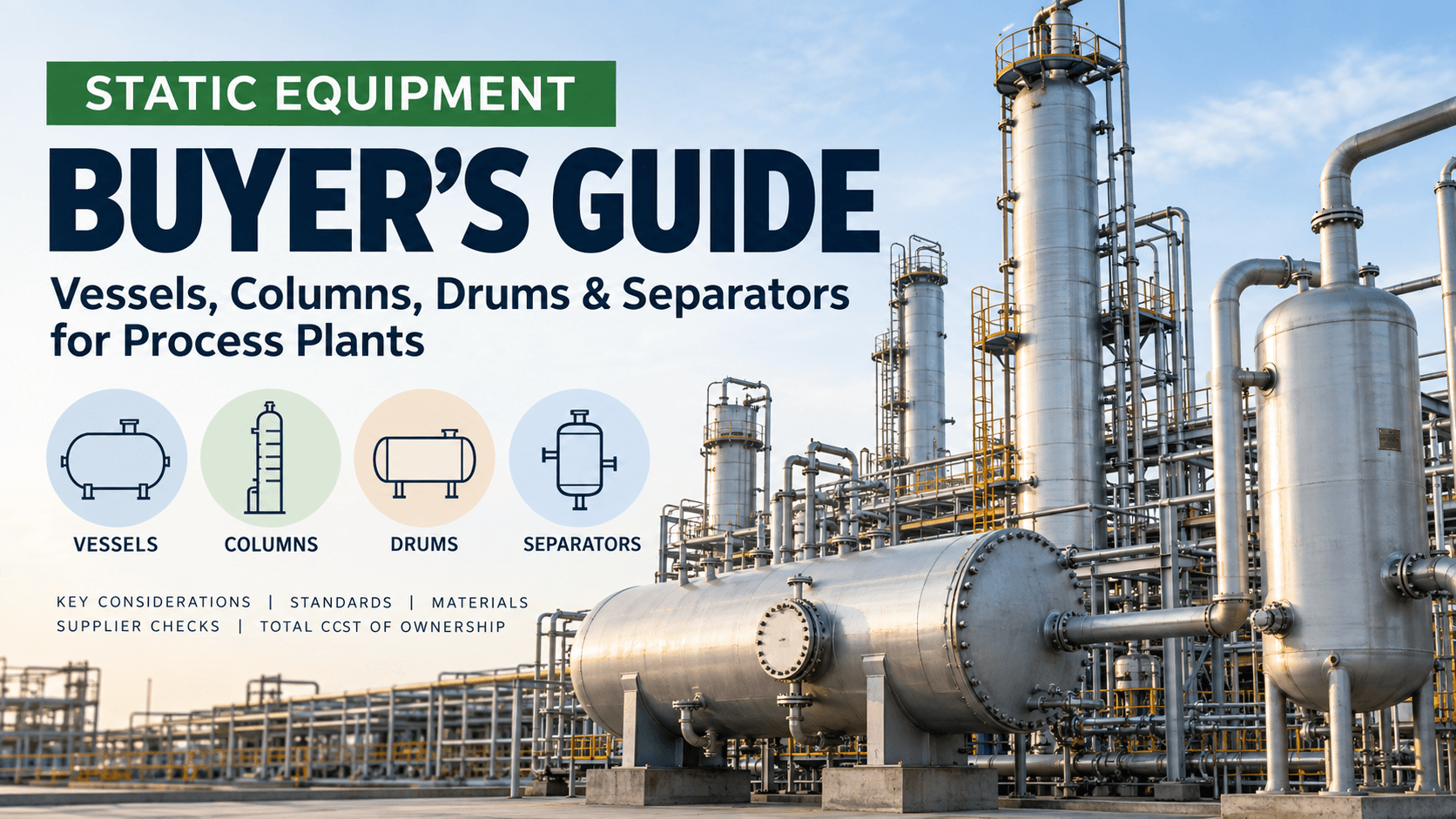
Static Equipment Buyer’s Guide: Vessels, Columns, Drums & Separators for Process Plants
Understanding Static Equipment in Process Plants
Static equipment forms the backbone of many process plants. Unlike pumps, compressors, and other rotating machinery, these assets generally have no moving parts. They provide the space and operating conditions needed for storage, separation, reaction, distillation, and other process operations.
Common examples include:
- Pressure vessels
- Process columns
- Storage and surge drums
- Knockout drums
- Separators
- Filters and coalescers
- Reactors
- Heat exchangers
For buyers, selecting static equipment is rarely just a matter of comparing vessel dimensions and prices. The equipment has to match the process conditions, applicable codes, materials, site requirements, inspection requirements, and long-term operating needs.
A lower initial price can become expensive if the equipment requires modifications, causes installation delays, or has unsuitable materials or documentation.
The Four Main Equipment Types Buyers Need to Understand
Pressure Vessels
Pressure vessels are enclosed containers designed to hold liquids, gases, or mixtures at pressures that differ significantly from atmospheric pressure.
They are commonly used for:
- Feed and product storage
- Chemical processing
- Reaction
- Surge capacity
- Gas-liquid separation
- Buffering between process units
The design pressure and temperature are among the first parameters a buyer should review. These determine much of the vessel’s mechanical design, wall thickness, materials, and pressure-rating requirements.
Process Columns
Columns are tall vertical vessels used primarily for separation processes such as distillation, absorption, stripping, and fractionation.
A column package may include:
- Shell
- Trays or packing
- Distributors
- Demisters
- Internal supports
- Feed nozzles
- Reboiler and condenser connections
- Platforms and ladders
- Instrumentation connections
Columns can become substantially more complex than standard pressure vessels because their performance depends heavily on internal components.
When comparing suppliers, buyers should therefore evaluate the complete column design rather than treating the shell as the entire equipment package.
Drums
Drums provide temporary holding, separation, or surge capacity within a process system.
Typical applications include:
- Knockout drums
- Reflux drums
- Flash drums
- Surge drums
- Accumulator drums
- Compressor suction drums
Sizing a drum involves more than calculating volume. Residence time, vapor disengagement, liquid carryover, operating range, and control requirements can all affect the final design.
Separators
Separators divide process streams into different phases, most commonly gas and liquid or liquid and liquid.
Common designs include:
- Horizontal separators
- Vertical separators
- Three-phase separators
- Cyclonic separators
- Gas-liquid separators
- Oil-water separators
Start With the Process Data Sheet
Before requesting quotations, buyers should establish a clear equipment data sheet.
At minimum, this should cover:
| Parameter | What to Specify |
|---|---|
| Service | What the equipment will handle |
| Fluid | Chemical composition and phase |
| Operating pressure | Normal operating pressure |
| Design pressure | Maximum pressure used for design |
| Operating temperature | Normal operating temperature |
| Design temperature | Temperature used for mechanical design |
| Flow rate | Normal, minimum, and maximum where relevant |
| Volume | Required operating and total volume |
| Corrosion allowance | Required allowance based on service |
| Materials | Shell, heads, internals, cladding or lining |
| Orientation | Horizontal or vertical |
| Design code | Applicable construction standard |
| Inspection | NDE, testing, and inspection requirements |
| Nozzles | Size, rating, orientation, and quantity |
| Internals | Trays, packing, demisters, distributors, etc. |
Incomplete process information creates uncertainty for both the engineering team and the supplier.
It can also result in quotations that appear comparable but are based on different assumptions.
Choosing the Right Material of Construction
Material selection directly affects equipment reliability, cost, fabrication, and maintenance.
Carbon steel may be appropriate for many services, but process conditions can require stainless steel, low-temperature materials, alloy steels, nickel alloys, titanium, or corrosion-resistant linings and cladding.
The selection should consider:
- Corrosion rate
- Chloride exposure
- Hydrogen service
- Sour service
- Temperature
- Pressure
- Fluid composition
- Erosion
- Product contamination requirements
- Weldability
- Future operating conditions
Buyers should avoid selecting materials based solely on the lowest purchase price.
A more expensive alloy may reduce corrosion risk and extend equipment life. Conversely, specifying an unnecessarily exotic material can increase capital expenditure without providing meaningful operational benefits.
Codes and Standards Matter
Static equipment is commonly designed and fabricated according to recognized pressure equipment codes and standards.
Depending on the project location and service, requirements may involve standards such as:
- ASME BPVC Section VIII
- API standards
- EN standards
- PD standards
- National pressure equipment regulations
- Client-specific specifications
The applicable requirements should be established before procurement begins.
The buyer should also confirm whether the quotation includes the required design calculations, material certificates, welding documentation, inspection records, pressure testing, and code certification.
Key Factors When Buying Pressure Vessels
Pressure vessels should be evaluated across several dimensions.
Design Pressure and Temperature
These establish the mechanical design basis. Make sure suppliers clearly identify both design and operating conditions in their quotations.
Vessel Geometry
Diameter, tangent-to-tangent length, head type, and orientation influence fabrication cost and transportation requirements.
Common head configurations include:
- Ellipsoidal heads
- Torispherical heads
- Hemispherical heads
- Flat or dished heads for appropriate applications
Nozzle Configuration
Nozzles can have a significant impact on fabrication complexity.
Review:
- Number of nozzles
- Nozzle diameter
- Flange rating
- Orientation
- Reinforcement
- Instrument connections
- Drain and vent requirements
A supplier that excludes several required nozzles from its base price may initially appear cheaper.
Internal Components
Internal devices can include baffles, demisters, distributors, spargers, coils, supports, and other components.
These should be specified clearly because they can materially affect both price and performance.
Buying Columns: Look Beyond the Shell
A column quotation should be evaluated as a process package, not simply as a fabricated vessel.
Ask suppliers to identify:
- Column diameter and height
- Design pressure and temperature
- Number and type of trays
- Packing type and quantity
- Liquid distributors
- Feed devices
- Demisters
- Internal supports
- Manways
- Platforms and ladders
- Insulation requirements
- Special metallurgy
- Transport limitations
For distillation columns, the internal design is particularly important because it affects separation efficiency and operating performance.
The procurement team should make sure the supplier’s mechanical scope and process-engineering scope are clearly separated and understood.
How to Evaluate Drums and Separators
For drums and separators, process performance is often the critical consideration.
A supplier should be able to demonstrate that the proposed equipment can accommodate the specified operating range.
Important considerations include:
Residence Time
Liquid residence time needs to be sufficient for the intended process duty.
Vapor-Liquid Disengagement
The vessel needs enough space for vapor and liquid phases to separate without excessive entrainment.
Liquid Carryover
Inappropriate sizing or internal design can result in liquid entering downstream gas equipment.
Gas Blowby
For certain services, buyers need to consider abnormal operating conditions and potential gas flow through liquid outlets.
Three-Phase Separation
Oil, water, and gas separation can require additional internal components and careful interface-level control.
Procurement Specifications That Prevent Problems
A strong purchase specification should define the equipment scope before bids arrive.
Include:
- Approved design codes
- Design conditions
- Materials of construction
- Corrosion allowance
- Welding requirements
- Heat treatment requirements
- NDE requirements
- Hydrostatic or pneumatic testing requirements
- Painting and coating
- Insulation
- Nameplates
- Documentation
- Spare parts
- Transportation requirements
- Site installation requirements
It should also identify what is included, excluded, and optional in the supplier’s quotation.
This makes commercial comparison much easier.
Comparing Static Equipment Suppliers
Price is important, but it should not be the only selection criterion.
A practical supplier evaluation can consider:
| Factor | What to Check |
|---|---|
| Technical compliance | Does the design meet the specification? |
| Relevant experience | Has the supplier built similar equipment? |
| Manufacturing capacity | Can it meet the required schedule? |
| Quality system | What inspections and controls are in place? |
| Certifications | Are required certifications available? |
| Materials | Can the supplier source specified materials? |
| Documentation | Is the required manufacturing dossier included? |
| Delivery | Can transportation and site delivery be supported? |
| Commercial terms | Price, payment terms, warranty, exclusions |
| After-sales support | Can issues be resolved after delivery? |
A supplier’s experience with similar pressure, temperature, materials, and equipment size is generally more useful than a generic claim of manufacturing experience.
Total Cost of Ownership
The purchase price is only one part of the financial decision.
Consider:
Total cost = Equipment + Transportation + Installation + Inspection + Maintenance + Downtime + Lifecycle replacement
For example, an inexpensive carbon steel vessel may have a higher lifecycle cost than a more corrosion-resistant alternative if the process causes rapid degradation.
Buyers should also consider fabrication lead time. A small price saving may have little value if it delays commissioning of an entire process unit.
Common Procurement Mistakes
Comparing Quotes With Different Scopes
One supplier may include internals, platforms, insulation, and testing while another excludes them.
Always normalize the scope before comparing prices.
Ignoring Transportation Constraints
Large columns and vessels can become transportation projects in their own right.
Check:
- Maximum transport dimensions
- Weight
- Route restrictions
- Lifting requirements
- Site access
- Modularization possibilities
Treating Documentation as an Afterthought
For regulated or safety-critical equipment, documentation can be extensive.
Confirm documentation requirements before placing the purchase order.
Choosing Materials Too Early or Too Late
Material selection should follow the process design and corrosion assessment. Changing materials late in procurement can cause major cost and schedule impacts.
Focusing Only on Initial Cost
Equipment reliability, maintenance, inspection requirements, and expected service life can have a much larger financial impact than a small difference in purchase price.
A Practical Static Equipment Buying Checklist
Before awarding a purchase order, confirm that:
- Process data sheet is complete
- Design pressure and temperature are approved
- Material of construction is finalized
- Applicable design code is identified
- Corrosion allowance is specified
- Nozzle schedule is approved
- Internal components are defined
- Welding and NDE requirements are clear
- Inspection and testing requirements are agreed
- Painting/coating requirements are specified
- Transportation requirements are understood
- Supplier exclusions have been reviewed
- Manufacturing schedule is acceptable
- Documentation requirements are included
- Warranty terms are acceptable
- Final technical and commercial comparisons use the same scope
Final Thoughts
Buying static equipment requires a balance between process performance, mechanical integrity, project schedule, and lifecycle cost.
The best procurement process starts well before the RFQ. Clear process data, defined design standards, complete material requirements, and a standardized technical scope give suppliers a common basis for quotation.
For vessels, columns, drums, and separators, buyers should look beyond the shell and headline price. Internals, metallurgy, inspection, documentation, transportation, and long-term reliability can all determine whether an equipment purchase delivers value after the plant starts operating.
A well-defined specification makes supplier comparisons easier, reduces change orders, and gives the project team much greater confidence in the final equipment selection.