

IT Hardware Localization: How Laptop, Tablet & PC Brands Are Building in India
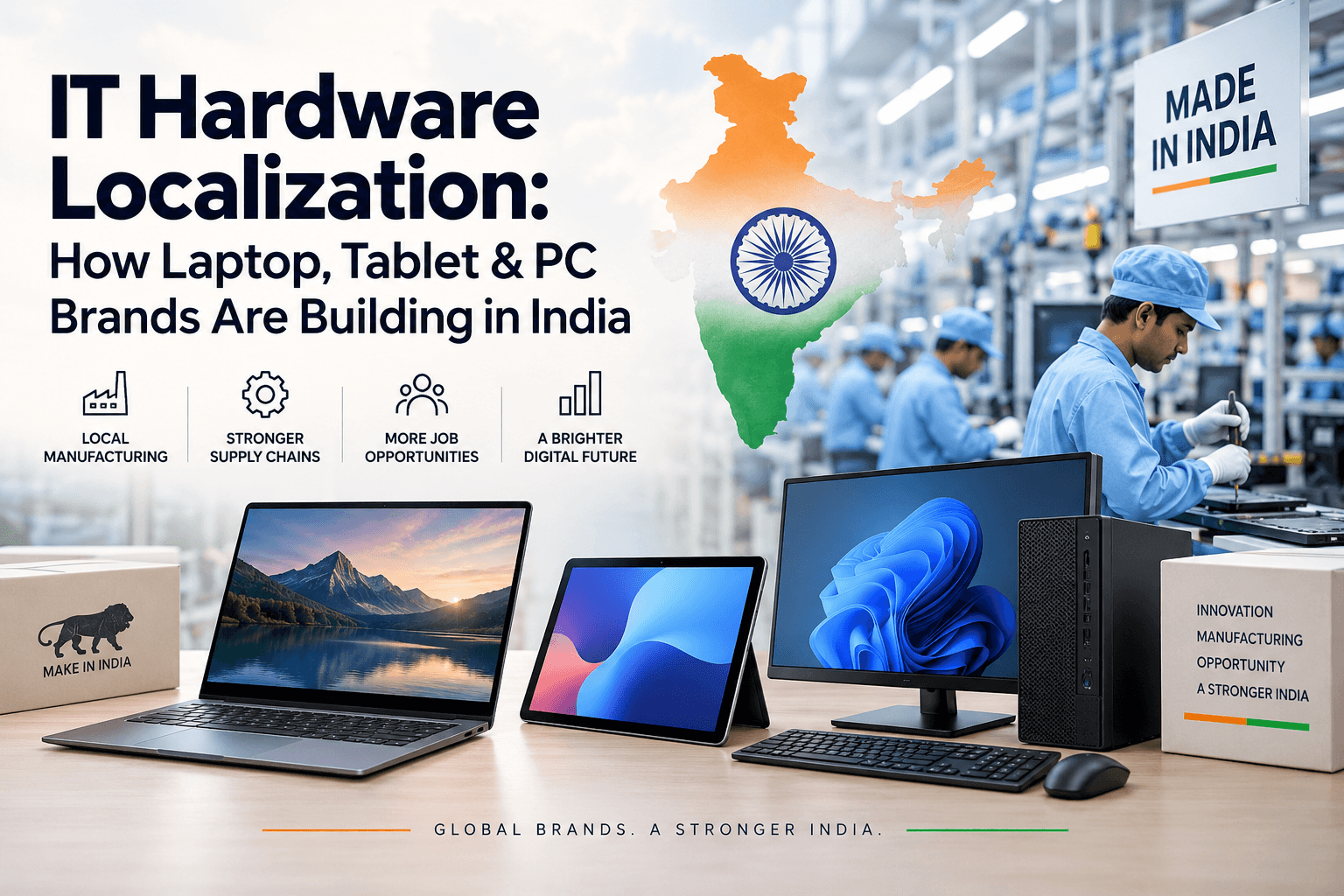
India’s IT hardware market is entering a new phase. Laptop and PC brands are no longer looking at the country only as a large consumer market. They are increasingly treating India as a manufacturing and supply-chain base.
The shift is being driven by a combination of government incentives, rising demand, global supply-chain diversification, and the need to develop more electronics manufacturing capacity inside the country.
The biggest change is that localization is moving beyond simple assembly. Companies are gradually building capabilities around printed circuit board assemblies, memory modules, SSDs, displays, batteries, power adapters, chassis and other components.
That matters because the long-term opportunity is not simply to put together laptops in India. It is to build a deeper IT hardware ecosystem that can support domestic demand and, eventually, exports.
India’s IT Hardware Manufacturing Push
The central policy behind this transition is the PLI 2.0 scheme for IT Hardware, introduced in 2023 with an approved outlay of ₹17,000 crore.
The scheme covers:
- Laptops
- Tablets
- All-in-One PCs
- Servers
- Ultra Small Form Factor devices
It provides incentives linked to incremental sales and localization of components and sub-assemblies. The scheme runs for six years and is designed to encourage both domestic and international manufacturers to establish production in India.
The government approved 27 manufacturers under the scheme, including companies associated with major brands such as Acer, Asus, Dell, HP and Lenovo.
This is important because localization at scale requires more than individual factories. It requires a network of suppliers, contract manufacturers, component companies, logistics providers, testing facilities and skilled workers.
From Laptop Assembly to Component Localization
The first stage of localization is relatively straightforward: assemble imported components in India.
The harder step is increasing the percentage of the product’s value that comes from Indian manufacturing.
PLI 2.0 is structured around this progression. Its localization framework includes incentives for areas such as PCBA, bare PCBs, memory modules, SSDs, display panels, power adapters, batteries and cabinets or chassis. It also provides additional incentives connected with semiconductor packaging and India-designed system-on-chip processors.
This distinction is crucial.
A laptop carrying a “Made in India” label does not necessarily mean that most of its components are manufactured domestically. A meaningful localization strategy requires gradually developing the supplier ecosystem behind the final product.
That is where India’s next phase of electronics manufacturing will be decided.
Major Laptop Brands Are Increasing Their India Footprint
The government has already identified major global brands as participants in India’s IT hardware manufacturing push.
Acer, Asus, Dell, HP and Lenovo are among the well-known brands covered by the approved manufacturer ecosystem under PLI 2.0.
Other international brands are also working with Indian manufacturing partners.
One example is MSI. In January 2025, Indian electronics manufacturer Syrma SGS inaugurated a laptop assembly line in Chennai for MSI. The facility initially targeted annual production of 100,000 laptops, with plans to scale capacity to as much as one million units depending on demand.
The development illustrates an important model for India’s hardware industry: global brands do not necessarily need to build every factory themselves. They can work with Indian electronics manufacturing services companies that provide production infrastructure and supply-chain capabilities.
Why Brands Are Looking at India
The economics are changing for several reasons.
1. India has a large domestic market
India already represents a significant market for laptops, desktops, tablets and enterprise hardware.
Manufacturing closer to customers can reduce dependence on long international supply chains and give companies greater flexibility in responding to domestic demand.
The government’s original PLI 2.0 rationale explicitly positioned India as both a domestic supply base and a potential export hub for global IT hardware companies.
2. Global supply chains are diversifying
Companies are increasingly looking beyond a single manufacturing geography.
The disruptions of recent years, combined with geopolitical tensions and changing trade relationships, have encouraged electronics companies to develop alternative production locations.
India is one of the countries competing for this investment.
A 2025 report from Business Standard noted growing interest from global laptop brands in shifting production from China to Indian manufacturing partners, supported by the ₹17,000 crore PLI programme.
3. Government incentives reduce the cost of localization
Building an electronics manufacturing ecosystem is expensive.
Factories require specialized equipment, testing infrastructure, skilled workers and reliable suppliers. Component manufacturers also need sufficient scale before local production becomes commercially competitive.
PLI incentives are intended to help close some of that initial cost gap.
The scheme provides an average incentive of around 5% linked to localization, with specific incentives assigned to qualifying components and sub-assemblies.
The Numbers Show That Manufacturing Is Starting to Scale
The transition is still relatively young, but the early numbers show measurable progress.
According to government data, PLI 2.0 for IT Hardware had generated cumulative production of about ₹16,531 crore by December 2025, alongside ₹856.64 crore of investment and 4,776 direct jobs.
The government’s FY2025-26 budget documentation also reported cumulative incremental sales of ₹17,075 crore and 6,048 incremental jobs by FY2025-26 for approved IT hardware companies.
These numbers are still small compared with India’s overall electronics industry. But they indicate that IT hardware localization is moving from policy announcements into actual production.
Chennai Is Emerging as an Important Hardware Hub
Tamil Nadu has become one of the most important locations in India’s electronics manufacturing ecosystem.
Chennai, in particular, is home to manufacturing operations serving multiple electronics categories.
The Syrma SGS-MSI laptop facility in the Madras Export Processing Zone provides a useful example of how this ecosystem is developing. The factory combines an Indian manufacturing company with an international technology brand and is designed to serve both domestic and potentially global demand.
The broader Tamil Nadu electronics ecosystem has also benefited from large-scale manufacturing investments, creating supplier networks and a workforce familiar with electronics production.
For laptop and PC companies, these existing capabilities can make India more attractive than starting a manufacturing ecosystem from scratch.
What Localization Means for IT Hardware Buyers
For businesses purchasing laptops, desktops and tablets, localization could eventually have practical implications.
Better supply availability
Local manufacturing can shorten some parts of the supply chain and make it easier for brands to replenish products for the Indian market.
This can be particularly useful for enterprise buyers purchasing hundreds or thousands of devices.
More configuration flexibility
As local manufacturing capabilities mature, vendors may be able to offer greater flexibility around configurations, enterprise requirements and production volumes.
This is especially relevant for large organizations that need standardized hardware across offices.
Potentially stronger after-sales ecosystems
Manufacturing does not automatically improve service quality. However, a deeper local hardware ecosystem can support the development of local repair, logistics, spare-parts and technical service capabilities.
For enterprise buyers, that can matter as much as the initial purchase price.
The Biggest Challenge: Moving Beyond Assembly
India’s biggest opportunity is also its biggest challenge.
It is relatively easy to establish an assembly line when most components arrive from overseas.
Building a competitive component ecosystem is considerably harder.
Displays, advanced processors, memory chips, batteries, PCBs and other components require significant capital investment, specialized technology and economies of scale.
This is why the government’s localization incentives extend beyond final assembly. The policy framework specifically includes components such as PCBA, memory, SSDs, displays, power systems and chassis.
India’s electronics industry is now moving toward this deeper stage of manufacturing.
The broader Electronics Components and Materials Scheme is another part of that effort, aimed at developing domestic production of critical electronic components and materials.
The Supply Chain Will Determine India’s Success
A laptop factory alone does not create a complete hardware industry.
A competitive ecosystem needs:
- Component suppliers
- PCB manufacturers
- Semiconductor packaging capabilities
- Display and battery suppliers
- Precision plastics and metal suppliers
- Testing and certification facilities
- Logistics infrastructure
- Skilled manufacturing talent
- Product engineering and design capabilities
This is where India’s electronics strategy is becoming more ambitious.
The country has already demonstrated that it can build large-scale electronics assembly operations. The next test is whether it can develop enough upstream manufacturing to make localization economically competitive.
That distinction will determine whether India becomes primarily an assembly destination or a genuine global IT hardware manufacturing hub.
What This Means for Laptop, Tablet and PC Brands
For global brands, India offers more than manufacturing incentives.
It offers a combination of market size, engineering talent, established electronics manufacturing capabilities and an opportunity to diversify production.
But companies will need to balance localization against cost.
Local components must meet the required standards while remaining competitive with established Asian supply chains. This is not guaranteed. India’s manufacturing ecosystem is still developing, and imported components can remain cheaper or more readily available in several categories.
The companies that succeed will likely be those that take a long-term approach rather than treating India simply as a low-cost assembly location.
India Is Moving Toward a Deeper Hardware Ecosystem
The story of India’s IT hardware localization is no longer just about “Made in India” laptops.
The more important question is how much of the laptop, tablet or PC can eventually be designed, manufactured, assembled and supported within India?
Government incentives have created momentum. Global brands are participating. Indian electronics manufacturers are expanding their capabilities, and component localization is becoming a larger policy priority.
There is still a substantial gap between assembling products locally and building a globally competitive hardware supply chain.
But the direction is clear.
India is positioning itself as a serious manufacturing base for laptops, tablets, PCs and other IT hardware. If component localization, supplier scale and manufacturing competitiveness continue to improve, the country’s role could evolve from serving its own consumer market to becoming an important node in the global IT hardware supply chain.
Key Takeaways
- India’s IT hardware localization push is being driven heavily by PLI 2.0.
- The programme covers laptops, tablets, All-in-One PCs, servers and USFF devices.
- Major global brands including Acer, Asus, Dell, HP and Lenovo are part of the approved manufacturing ecosystem.
- Indian electronics manufacturers are increasingly working with international brands.
- Localization is expanding from final assembly toward components and sub-assemblies.
- Chennai and Tamil Nadu are emerging as important electronics manufacturing hubs.
- The biggest long-term challenge is building a competitive domestic component ecosystem.
- India’s success will depend on whether it can move from assembly-led manufacturing to deeper value addition.
Frequently Asked Questions
Are laptops manufactured in India?
Yes. Multiple IT hardware manufacturers are producing laptops in India, including through partnerships between Indian electronics manufacturers and international brands. Syrma SGS, for example, began laptop production for MSI at its Chennai facility in 2025.
Which laptop brands are manufacturing in India?
The government has identified major brands including Acer, Asus, Dell, HP and Lenovo within the PLI 2.0 IT hardware manufacturing ecosystem.
What is PLI 2.0 for IT Hardware?
PLI 2.0 is a six-year government incentive programme designed to encourage domestic manufacturing and localization of laptops, tablets, All-in-One PCs, servers and Ultra Small Form Factor devices. It has an approved outlay of ₹17,000 crore.
Is India manufacturing laptop components too?
The localization framework includes PCBA, bare PCBs, memory modules, SSDs, display panels, power adapters, batteries and chassis, among other components and sub-assemblies.
Will India become a major laptop export hub?
That is a major policy objective, but it is not guaranteed. India’s ability to compete globally will depend on component costs, manufacturing scale, supply-chain depth, infrastructure, skills and product quality.