
5-Axis vs 3-Axis CNC Machining: Choosing the Right Process for Complex Geometries
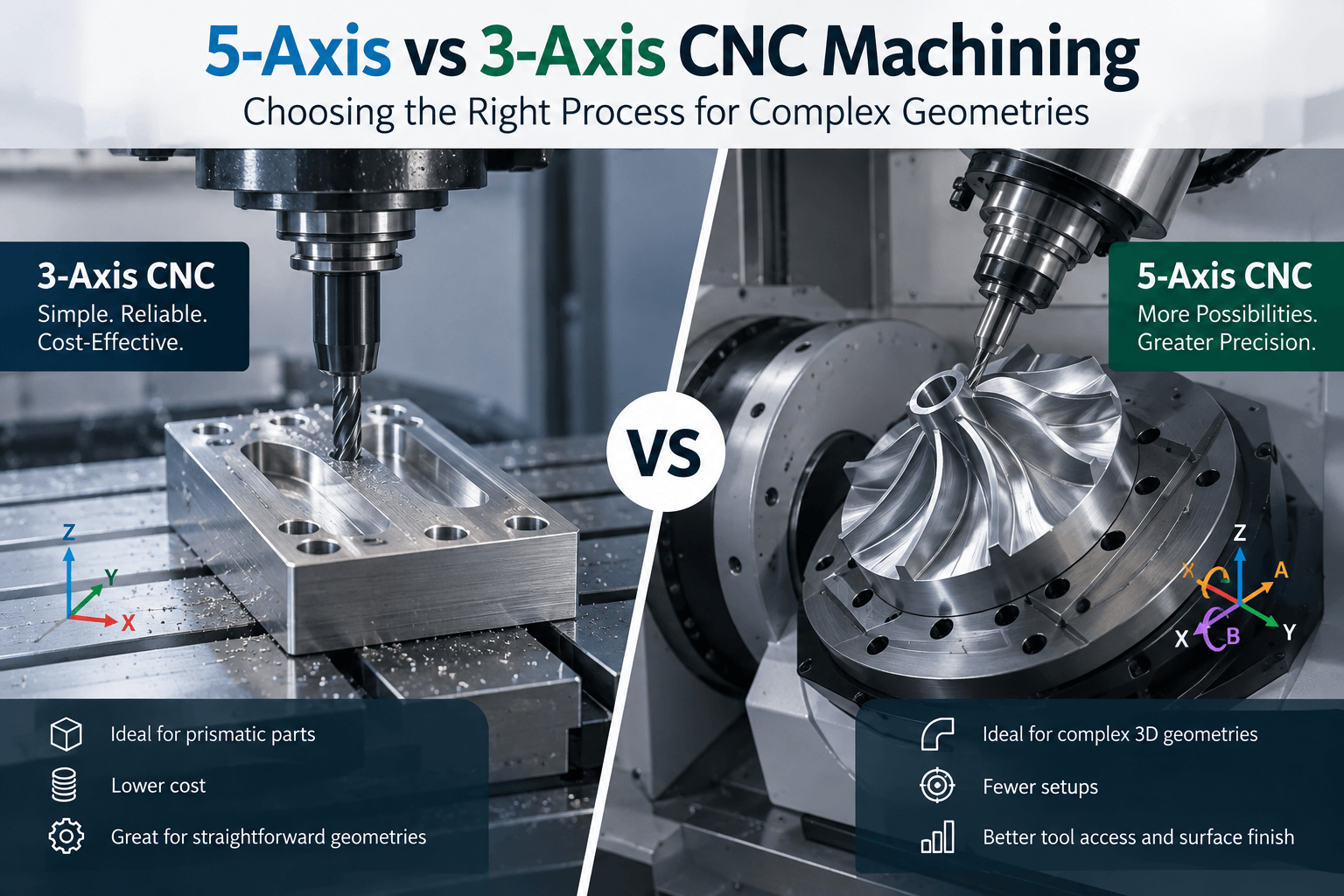
Choosing between 3-axis and 5-axis CNC machining can have a major impact on part quality, production time, tooling costs, and overall manufacturing efficiency. The right choice depends less on which machine is more advanced and more on the geometry, tolerances, material, production volume, and finishing requirements of the part.
For simple prismatic components, 3-axis machining is often the practical and economical option. For parts with deep cavities, angled surfaces, undercuts, or complex 3D contours, 5-axis machining can reduce setups and improve access to difficult features.
This guide explains the key differences between 3-axis and 5-axis CNC machining and when each process makes sense.
What Is 3-Axis CNC Machining?
A 3-axis CNC machine moves the cutting tool along three linear axes: X, Y, and Z.
The workpiece typically remains fixed while the tool moves around it. This configuration works well for parts with features that can be reached from the top or from a limited number of orientations.
Common applications include:
- Plates and brackets
- Housings
- Mounting components
- Simple molds and fixtures
- Parts with pockets, holes, slots, and flat surfaces
The main advantage of 3-axis machining is its simplicity. Machines, programming, tooling, and operation can be less expensive than comparable 5-axis equipment.
However, complex parts may require multiple setups. Each additional setup can increase machining time and introduce opportunities for positioning errors.
What Is 5-Axis CNC Machining?
5-axis CNC machining adds two rotational axes to the three linear axes.
Instead of only moving along X, Y, and Z, the machine can rotate the cutting tool, workpiece, or both. This allows the tool to approach a feature from different angles without manually repositioning the part.
5-axis machining is particularly useful for complex geometries such as:
- Turbine blades
- Aerospace structural components
- Impellers
- Medical implants
- Complex molds and dies
- Automotive components
- Parts with compound curves
- Components with angled holes and surfaces
The major benefit is improved tool access. A single setup can often reach several faces or complex surfaces that would require multiple setups on a 3-axis machine.
3-Axis vs 5-Axis CNC Machining: Key Differences
| Factor | 3-Axis CNC | 5-Axis CNC |
|---|---|---|
| Linear movement | X, Y, Z | X, Y, Z |
| Rotary movement | None | Two additional axes |
| Part complexity | Low to moderate | Moderate to very high |
| Setups | Often multiple | Often fewer |
| Tool access | Limited | Excellent |
| Programming | Simpler | More complex |
| Machine cost | Generally lower | Generally higher |
| Best for | Prismatic parts | Complex 3D geometries |
| Surface finishing | Good for accessible surfaces | Better access for contoured surfaces |
| Undercut capability | Limited | Much better |
The important point is that 5-axis machining is not automatically better for every job. Its advantages become more valuable as part geometry and machining requirements become more demanding.
When 3-Axis CNC Machining Is the Better Choice
Simple Part Geometry
If the component consists mainly of flat surfaces, pockets, drilled holes, and features accessible from one or two directions, 3-axis machining can be sufficient.
For example, a rectangular aluminum mounting plate with several holes and pockets may not benefit enough from 5-axis capabilities to justify the additional cost.
Lower Production Costs
3-axis machines generally have lower equipment and programming costs. For straightforward components, this can translate into a lower manufacturing cost.
If a part does not require advanced tool orientation, using a 5-axis machine may add capability without adding meaningful value.
High-Volume Production of Simple Parts
For repeatable components with relatively uncomplicated geometry, 3-axis machining can be highly efficient.
Once the workholding and machining process are optimized, the process can deliver consistent results at a competitive cost.
When 5-Axis CNC Machining Makes More Sense
Complex 3D Contours
5-axis machines can maintain better tool orientation when machining curved or sculpted surfaces.
This is particularly valuable for aerospace, medical, automotive, and energy components where complex contours are part of the functional design.
Deep Cavities and Difficult-to-Reach Features
A long tool projecting deep into a cavity can be prone to vibration and deflection.
With 5-axis machining, the tool can often approach the feature from a more favorable angle. This may allow the use of shorter, more rigid cutting tools.
Undercuts and Angled Features
Some geometries are difficult or impossible to machine efficiently with a fixed 3-axis setup.
5-axis movement can expose surfaces and features that would otherwise require additional fixtures, repositioning, or specialized tooling.
Fewer Setups
One of the biggest advantages of 5-axis machining is the ability to complete more of a component in a single setup.
Fewer setups can mean:
- Less fixture preparation
- Reduced handling time
- Lower repositioning errors
- Better feature-to-feature accuracy
- Shorter overall production time
For complex components, these benefits can offset the higher cost of 5-axis equipment.
How Geometry Influences the Decision
Geometry should usually be the starting point when deciding between the two processes.
Ask whether the part contains:
- Multiple faces that need machining
- Compound curves
- Deep or narrow cavities
- Angled holes
- Undercuts
- Tight positional relationships between features
- Surfaces that require controlled tool orientation
If most features are accessible with the part fixed in one orientation, 3-axis machining may be adequate.
If the tool needs to continuously change orientation to access or accurately machine the geometry, 5-axis machining becomes much more attractive.
Accuracy and Setup Considerations
Accuracy is not determined by the number of axes alone.
A well-maintained 3-axis machine with good workholding can produce highly accurate parts. However, every additional setup introduces another opportunity for alignment error.
For a complex component that requires several orientations, a 5-axis process can reduce these accumulated errors by machining more features without removing the part from the fixture.
This is especially important when several features must maintain tight positional relationships.
Surface Finish and Tool Orientation
Tool orientation can have a significant effect on surface quality.
When machining complex surfaces on a 3-axis machine, the tool may need to use orientations that are not ideal for maintaining consistent cutting conditions. This can result in more scalloping, tool marks, or additional finishing operations.
5-axis machining allows the cutting tool to follow complex surfaces while maintaining a more appropriate orientation.
That can improve surface finish and reduce the amount of manual finishing required, depending on the geometry and machining strategy.
Programming Complexity
The additional capability of a 5-axis machine comes with greater programming complexity.
3-axis toolpaths are generally easier to create, simulate, verify, and modify.
5-axis machining requires careful control of:
- Tool orientation
- Rotary-axis movement
- Collision avoidance
- Machine kinematics
- Tool length
- Workholding clearance
- Cutting strategies
Advanced CAM software and accurate machine simulation are therefore important for successful 5-axis production.
The programming investment is usually easier to justify when the part geometry provides a clear manufacturing advantage.
Cost Comparison
The total cost should be evaluated rather than simply comparing machine hourly rates.
A 3-axis process may have a lower machine rate but require:
- Multiple fixtures
- More setups
- Additional inspection
- Longer cycle times
- More tool changes
- Additional finishing operations
A 5-axis process may have a higher hourly rate but complete the same part with fewer setups and less secondary work.
For complex parts, the 5-axis process can therefore be more economical despite the higher machine cost.
A Practical Decision Framework
When deciding between 3-axis and 5-axis CNC machining, consider these five factors:
1. Part Geometry
Start with the shape and accessibility of the features.
Simple geometry usually favors 3-axis machining. Complex geometry often favors 5-axis.
2. Number of Setups
Estimate how many times the workpiece would need to be repositioned on a 3-axis machine.
If multiple setups are required, compare that process against a single or reduced-setup 5-axis strategy.
3. Tolerance Requirements
Determine whether repositioning could affect critical feature relationships.
For high-precision components, reducing setups may provide a meaningful process advantage.
4. Production Volume
For high volumes, even small cycle-time savings can have a significant financial impact.
For low-volume or prototype work, the simplest process that reliably meets requirements may be preferable.
5. Total Manufacturing Cost
Compare the complete process, not just the machine rate.
Include programming, fixtures, setup time, machining, inspection, finishing, and potential scrap or rework.
3-Axis or 5-Axis: Which Should You Choose?
There is no universal winner.
Choose 3-axis CNC machining when:
- The geometry is relatively simple
- Most features are accessible from a few orientations
- Multiple setups are manageable
- Cost sensitivity is high
- Advanced tool orientation is unnecessary
Choose 5-axis CNC machining when:
- The component has complex 3D surfaces
- Multiple angled features need machining
- Undercuts or deep cavities are present
- Multiple setups would be required
- Tight relationships between features are important
- Better tool access can reduce cycle time or improve surface quality
The best manufacturing process is the one that meets the required geometry, tolerance, surface finish, quality, and cost targets with the least unnecessary complexity.
Final Takeaway
The choice between 3-axis and 5-axis CNC machining should be driven by the part, not by the machine.
For straightforward components, 3-axis machining often provides an efficient and cost-effective solution. As geometry becomes more complex, 5-axis machining can provide better tool access, fewer setups, improved consistency, and more efficient production.
If you’re evaluating a new component, review the geometry and manufacturing sequence first. A simple 3-axis process may be all you need. But when multiple setups, difficult surfaces, or complex tool orientations start driving the process, 5-axis machining can become the more efficient choice.