Rocket and Aerospace Casing Manufacturing: Materials and Process Considerations
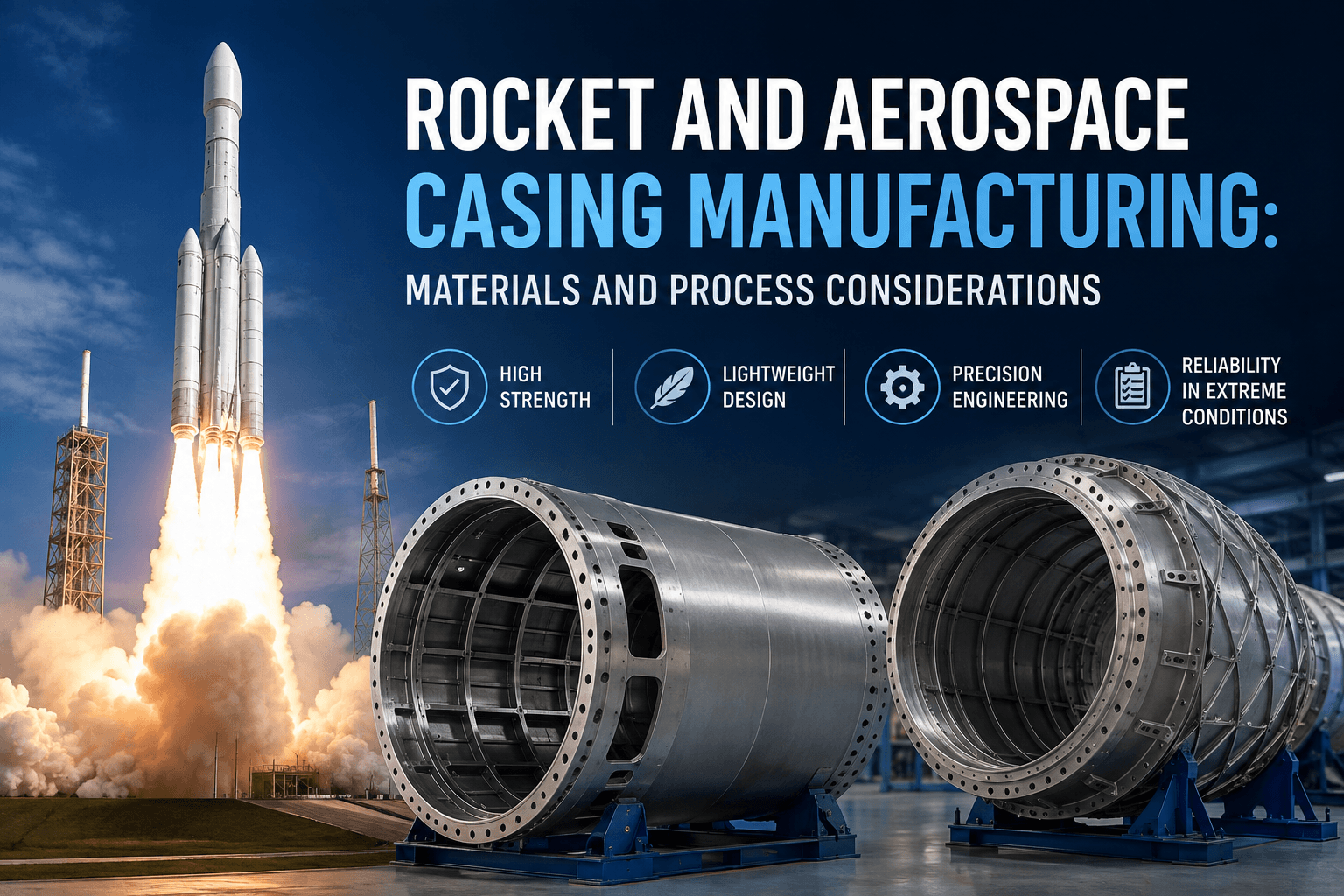
Rocket and aerospace casings have to do much more than contain internal components. They must withstand demanding mechanical loads, temperature changes, vibration, pressure, and the repeated stresses associated with transportation, testing, and operation.
That makes casing manufacturing a careful balance between material selection, structural performance, manufacturability, dimensional accuracy, and quality assurance.
For aerospace manufacturers, choosing the right material or machining method is rarely a single-variable decision. A lightweight alloy may reduce mass but introduce challenges in machining or joining. A high-strength material may improve structural performance while increasing manufacturing cost. Composite materials can offer excellent weight savings, but require tightly controlled production processes and inspection methods.
This article examines the major material and process considerations involved in aerospace casing manufacturing, with a focus on general civil and commercial aerospace applications.
What Is an Aerospace Casing?
An aerospace casing is a structural enclosure designed to protect and support components within an aerospace system.
Depending on the application, a casing can be used around propulsion components, avionics, instrumentation, tanks, or other assemblies. In each case, the casing has to perform its structural role without adding unnecessary weight.
Common requirements include:
- High strength-to-weight ratio
- Resistance to fatigue and vibration
- Dimensional stability
- Temperature resistance
- Corrosion resistance
- Consistent wall thickness
- Reliable joining and sealing
- Tight dimensional tolerances
- Traceable material and production records
The exact requirements depend heavily on the application, operating environment, and applicable aerospace standards.
Material Selection for Aerospace Casings
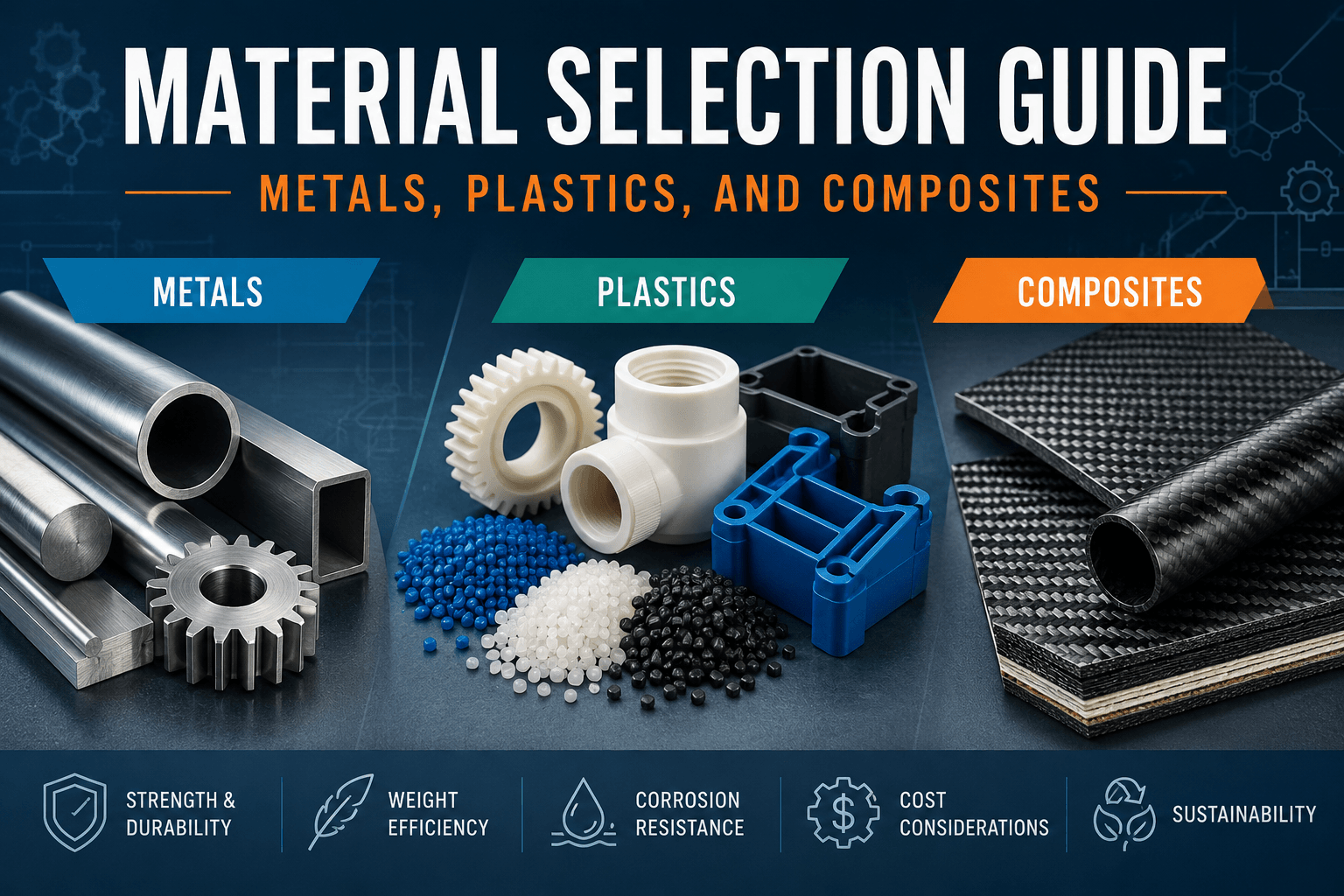
Material selection is one of the earliest and most important manufacturing decisions. Engineers typically evaluate mechanical properties alongside temperature performance, corrosion behavior, machinability, joining characteristics, availability, and cost.
Aluminum Alloys
Aluminum alloys are widely used where low weight and good machinability are important.
Their relatively low density makes them attractive for aerospace structures where reducing mass can improve overall system efficiency. Many aluminum alloys also offer good corrosion resistance and can be machined using established production methods.
The tradeoff is that aluminum generally has lower temperature capability than many high-performance steels or nickel-based alloys. Material selection therefore needs to account for the expected thermal environment rather than relying on strength alone.
Titanium Alloys
Titanium offers an attractive combination of low density, high strength, and corrosion resistance.
It is particularly useful when designers need structural performance that aluminum cannot provide without adding significant material. Titanium can also perform well in elevated-temperature environments.
Manufacturing titanium components, however, can be more demanding. Tool wear, heat management, machining parameters, and material costs can all affect production economics.
Nickel-Based Alloys
Nickel-based alloys are typically considered when high-temperature strength and environmental resistance are major requirements.
These materials can maintain useful mechanical properties at temperatures where conventional lightweight alloys become unsuitable. Their performance makes them valuable for demanding aerospace applications.
The downside is manufacturing difficulty. Nickel alloys can be difficult to machine and may require specialized tooling, process control, and inspection.
Composite Materials
Fiber-reinforced composites provide another route to reducing structural weight.
Carbon fiber composites, for example, can offer excellent specific strength and stiffness while allowing engineers to tailor material orientation to expected loads.
However, composite casing production introduces a different set of manufacturing challenges. Fiber placement, resin systems, curing, void content, bonding, and environmental exposure all need to be controlled.
Composites also require inspection methods suited to detecting internal defects that may not be visible from the outside.
Key Manufacturing Processes
There is no single manufacturing process suitable for every aerospace casing. The geometry, material, production volume, structural requirements, and available equipment all influence the process selection.
CNC Machining
CNC machining is commonly used to produce precision aerospace components from metal stock, forgings, or near-net-shape preforms.
The process provides strong control over:
- Bore dimensions
- Flange geometry
- Mounting features
- Interfaces
- Surface finishes
- Critical alignment features
For aerospace work, machining strategy matters because excessive material removal can introduce distortion or residual stresses.
Manufacturers therefore need to consider workholding, cutting conditions, tool selection, inspection, and the sequence in which features are produced.
Forging
Forging can produce components with favorable mechanical properties by shaping material under controlled force.
For aerospace applications, forgings may be selected when structural integrity and material properties are more important than minimizing the initial manufacturing cost.
A forged component can then undergo machining to achieve its final dimensions and interfaces.
Sheet Metal Forming
Thin-walled aerospace structures can sometimes be produced through controlled forming operations.
The process can be attractive for suitable geometries and production volumes, but springback, thickness variation, surface damage, and dimensional control must be carefully managed.
Tooling design and process validation are particularly important when components have tight dimensional requirements.
Additive Manufacturing
Additive manufacturing is increasingly relevant to aerospace production, particularly for complex geometries that are difficult or expensive to produce using conventional methods.
Potential advantages include reduced material waste, part consolidation, and greater geometric freedom.
However, additive manufacturing does not eliminate the need for conventional finishing and inspection. Printed components may require machining, heat treatment, surface finishing, and detailed non-destructive inspection before they can be accepted for aerospace use.
Composite Layup and Curing
Composite casings require a different production workflow from metal components.
Typical considerations include material storage, ply placement, fiber orientation, consolidation, curing, trimming, and inspection.
Process consistency is critical. Small variations in manufacturing can affect laminate properties and final dimensions.
Why Dimensional Accuracy Matters
Aerospace casings often contain interfaces that must align precisely with adjacent components.
Small dimensional errors can create problems during assembly, including uneven loads, poor sealing, interference, or misalignment.
Manufacturers therefore use dimensional inspection throughout production rather than relying exclusively on a final inspection.
Coordinate measuring machines, laser scanning, optical inspection, and other metrology technologies can help verify complex geometries.
The goal is not simply to produce a part that matches a drawing. It is to maintain a controlled manufacturing process that consistently produces parts within specification.
Surface Finish and Corrosion Protection
Surface condition can influence both performance and service life.
Machined surfaces may require controlled finishing to meet engineering requirements. Depending on the material and application, additional treatments can provide corrosion protection or improve surface characteristics.
Possible treatments include anodizing, conversion coatings, plating, passivation, and specialized protective finishes.
The selected treatment must be compatible with the base material and the intended operating environment.
Thermal Considerations
Temperature can significantly affect material behavior.
As temperature changes, materials expand and contract. Different materials also respond differently to thermal cycling.
For aerospace casings, engineers may therefore need to evaluate:
- Operating temperature range
- Thermal gradients
- Coefficient of thermal expansion
- Thermal conductivity
- Strength retention at temperature
- Repeated thermal cycling
- Compatibility between joined materials
These considerations become particularly important when a casing interfaces with components made from different materials.
Joining and Assembly
A casing may be manufactured as a single component or assembled from multiple sections.
Joining methods can include mechanical fastening, welding, brazing, adhesive bonding, or specialized aerospace joining techniques.
The choice depends on material compatibility, structural requirements, temperature exposure, inspection requirements, and service conditions.
Joining processes must also be controlled carefully because defects introduced during assembly can compromise an otherwise well-manufactured component.
Quality Control and Non-Destructive Testing
Aerospace manufacturing places significant emphasis on quality assurance because defects that are acceptable in ordinary industrial components may be unacceptable in flight-critical structures.
Inspection programs can include:
- Dimensional inspection
- Visual inspection
- Surface inspection
- Ultrasonic testing
- Radiographic testing
- Eddy current inspection
- Dye penetrant inspection
- Material verification
- Hardness testing
- Documentation and traceability
The appropriate method depends on the material and component.
Non-destructive testing is particularly valuable because it can identify certain internal or surface discontinuities without destroying the finished component.
Traceability Is Part of the Manufacturing Process
Aerospace quality is not only about the physical component. It is also about being able to demonstrate how that component was produced.
Manufacturers commonly maintain records covering material certificates, heat or lot information, machine operations, inspections, process parameters, non-conformance handling, and final acceptance.
This traceability supports quality investigations, supplier management, regulatory compliance, and long-term product support.
Designing for Manufacturability
A strong aerospace casing design should account for manufacturing from the beginning.
A design that looks efficient on paper may become expensive or difficult to produce if it contains unnecessarily tight tolerances, inaccessible features, complex setups, or difficult-to-machine geometries.
Design-for-manufacturing considerations can include:
- Selecting materials that match both performance and production capabilities.
- Applying tight tolerances only where they provide functional value.
- Minimizing unnecessary machining operations.
- Providing suitable access for inspection.
- Considering how the component will be fixtured.
- Designing joints and interfaces for repeatable assembly.
- Planning inspection requirements before production begins.
This approach can reduce manufacturing risk without compromising engineering requirements.
Balancing Performance, Cost, and Production Volume
Material and process decisions also change depending on production volume.
For low-volume aerospace programs, expensive tooling may be difficult to justify. Flexible CNC machining or additive manufacturing may be more attractive.
For higher production volumes, dedicated tooling and optimized forming processes can potentially provide better economics.
The most suitable solution is therefore rarely the cheapest material or the fastest individual process. Manufacturers need to evaluate the complete production system.
Building a Reliable Aerospace Casing Manufacturing Process
A robust casing manufacturing program connects engineering, materials, production, quality, and inspection rather than treating each as a separate activity.
A practical workflow typically begins with defining functional and environmental requirements. Engineers then select candidate materials and manufacturing methods before validating the design through analysis, prototypes, testing, and process qualification as appropriate.
Once production begins, process controls and inspection should provide feedback that helps maintain consistent quality.
The result is a manufacturing process designed around repeatability and controlled variation, not simply the production of one successful prototype.
Final Considerations
Rocket and aerospace casing manufacturing demands a careful balance of weight, strength, thermal performance, manufacturability, durability, and quality.
Aluminum can provide an effective lightweight solution for suitable applications. Titanium offers higher performance where its cost and manufacturing complexity can be justified. Nickel-based alloys can address demanding temperature environments, while composites provide opportunities for significant weight reduction when their specialized manufacturing requirements can be controlled.
The material is only part of the equation. Machining, forming, joining, surface treatment, inspection, and traceability all contribute to the final performance of an aerospace casing.
For manufacturers, the strongest approach is to make material and process decisions together, validate those decisions against the intended operating environment, and build quality controls into the production process from the start.
Frequently Asked Questions
What materials are commonly used for aerospace casings?
Common material families include aluminum alloys, titanium alloys, nickel-based alloys, steels, and fiber-reinforced composites. The right choice depends on structural, thermal, environmental, and manufacturing requirements.
Is CNC machining suitable for aerospace casing manufacturing?
Yes. CNC machining is widely used for precision aerospace components because it can produce complex geometries and tight dimensional requirements when supported by appropriate tooling, fixturing, process control, and inspection.
Why are composites used in aerospace casings?
Composites can provide a high strength-to-weight ratio and allow engineers to tailor structural properties through fiber orientation. Their production requires specialized control of layup, curing, bonding, and inspection.
What quality checks are important for aerospace casings?
Depending on the component, manufacturers may use dimensional inspection, material verification, visual inspection, non-destructive testing, surface inspection, and detailed production traceability.
What is the biggest manufacturing challenge?
There is no single challenge for every casing. The difficulty usually comes from balancing demanding performance requirements with material behavior, manufacturing complexity, dimensional accuracy, inspection requirements, cost, and repeatability.