Custom vs. Standard Extrusion Profiles: When Does Custom Tooling Pay Off?
Choosing between a standard extrusion profile and a custom profile can have a significant impact on a project’s cost, performance, lead time, and manufacturing complexity.
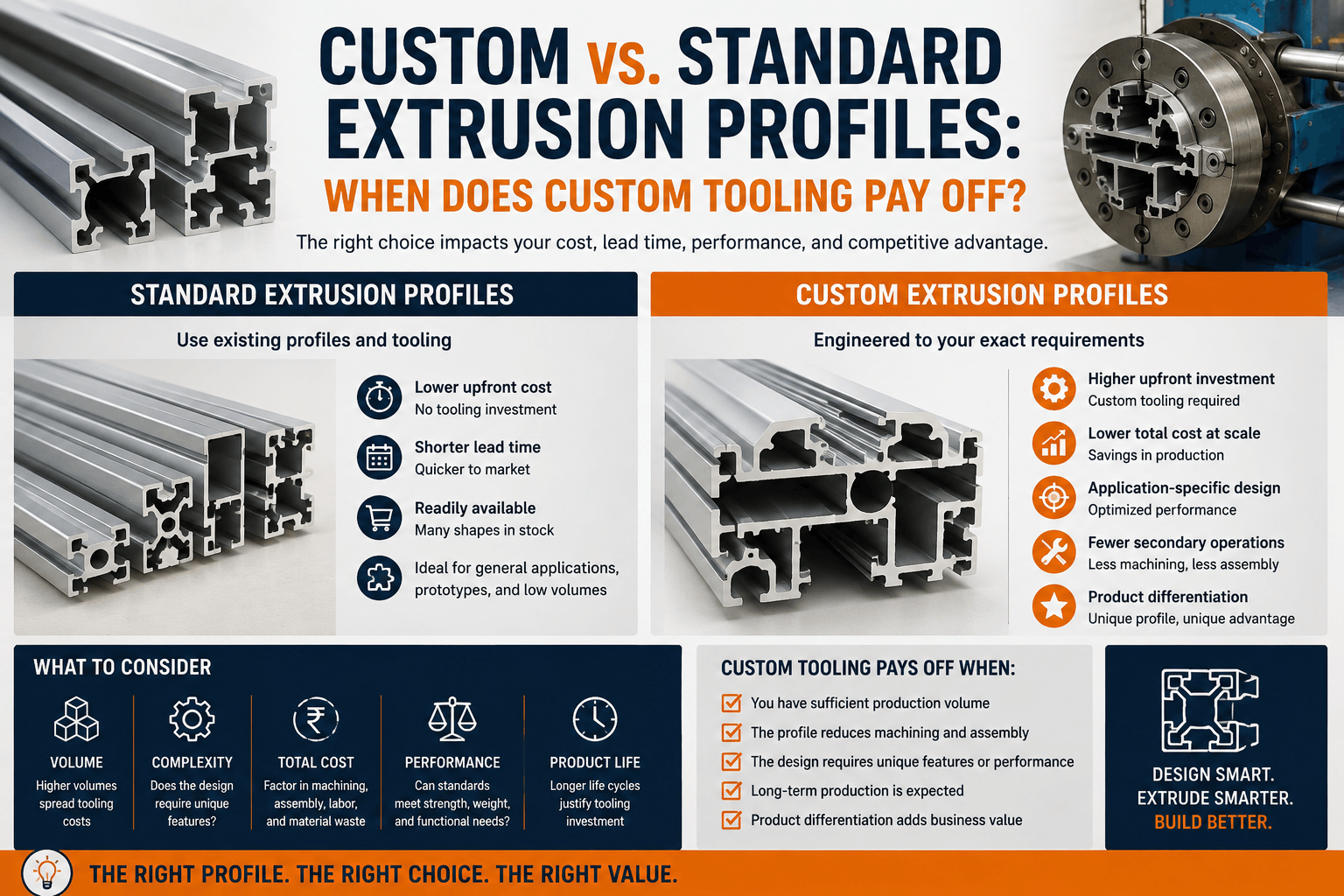
Standard aluminum extrusion profiles are readily available and can often meet common structural or assembly requirements without the need for new tooling. Custom extrusion profiles, on the other hand, are designed around a specific application and require dedicated tooling, but they can eliminate secondary operations and improve the finished product.
The right choice depends on more than the initial tooling cost.
For manufacturers, engineers, contractors, and procurement teams, the key question is: When does the long-term value of a custom extrusion justify the upfront investment?
What Is an Extrusion Profile?
An extrusion profile is a cross-sectional shape created by forcing a material, commonly aluminum, through a specially designed die.
The process can produce complex and consistent shapes while reducing the need for multiple fabrication steps.
Extruded profiles are used in applications such as:
- Construction systems
- Transportation equipment
- Solar mounting systems
- Industrial machinery
- Automotive components
- Electrical enclosures
- Heat sinks
- Furniture and fixtures
- Rail and infrastructure systems
- Automation equipment
The profile can be simple, such as a rectangular tube, or highly engineered with channels, ribs, grooves, mounting points, and other integrated features.
Standard vs. Custom Extrusion Profiles
The basic difference is straightforward.
Standard extrusion profiles use existing dies and established shapes that are already available from a manufacturer or supplier.
Custom extrusion profiles require a dedicated die designed specifically for the customer’s geometry.
Neither option is automatically better. The right solution depends on production volume, design requirements, assembly needs, material, tolerances, and the economics of the project.
| Factor | Standard Profile | Custom Profile |
|---|---|---|
| Tooling | Existing tooling | New dedicated tooling |
| Upfront cost | Lower | Higher |
| Design flexibility | Limited | High |
| Lead time | Usually shorter | Usually longer initially |
| Optimization | General-purpose | Application-specific |
| Secondary operations | May be required | Can often be reduced |
| Production economics | Strong for smaller quantities | Strong for suitable larger volumes |
| Product differentiation | Limited | High |
Why Standard Extrusion Profiles Are Often the First Choice
Standard profiles are attractive because they reduce the barriers to starting production.
Since the extrusion die already exists, manufacturers can often move directly to material selection, cutting, finishing, machining, and assembly.
This can make standard profiles particularly useful for:
- Prototypes
- Small production runs
- One-off projects
- General structural applications
- Applications with flexible design requirements
- Projects with tight initial deadlines
For example, if a machine frame can be built using an existing rectangular aluminum tube without compromising strength or assembly requirements, investing in a custom die may not provide enough value to justify the additional cost.
Lower Initial Investment
The most obvious advantage is avoiding new tooling costs.
This is important when projected production volume is low or uncertain.
Faster Product Launch
Existing profiles can reduce the time required to move from design to production because there is no need to design, manufacture, test, and approve a new extrusion die.
Easier Procurement
Standard profiles may be available from multiple suppliers, depending on the material, dimensions, alloy, and market.
That can give purchasing teams more sourcing flexibility.
The Limitations of Standard Profiles
Standard profiles are not always the most economical solution once the entire manufacturing process is considered.
A profile may technically work but require additional cutting, drilling, milling, welding, fastening, or machining.
For example, imagine a manufacturer needs an aluminum profile with three mounting channels and a specific internal cavity. A standard profile might provide the required structural shape but lack one of the mounting features.
The manufacturer could modify the standard extrusion through machining.
That approach avoids custom tooling, but it adds labor, machining time, material waste, and potentially another quality-control step.
This is where custom extrusion can become financially attractive.
What Makes a Custom Extrusion Profile Different?
A custom extrusion profile is designed around the actual requirements of the final product.
Instead of starting with an available shape and adapting the product around it, engineers can design the extrusion around the application.
A custom profile can potentially integrate:
- Mounting channels
- Fastener locations
- Internal cavities
- Ribs
- Flanges
- Interlocking features
- Snap-fit features
- Cable channels
- Heat-dissipation features
- Decorative surfaces
- Weight-reduction features
The result can be a component that performs several functions in one extrusion.
When Does Custom Extrusion Tooling Pay Off?
The answer depends on the economics of the entire manufacturing process.
A useful way to think about the decision is:
Custom tooling makes more sense when the savings and performance benefits generated by the custom profile exceed the additional tooling and development costs.
Several factors determine whether that happens.
1. Production Volume
Production volume is often the biggest factor.
A custom die has an upfront cost. As production volume increases, that tooling investment can be spread across more parts.
For example, assume a custom extrusion requires an additional $5,000 in tooling.
At 500 units, the tooling cost represents:
$5,000 ÷ 500 = $10 per unit
At 10,000 units, the same tooling represents:
$5,000 ÷ 10,000 = $0.50 per unit
The actual economics will depend on tooling, material, machining, finishing, and production costs, but the principle is important.
Higher production volumes make it easier to justify custom tooling.
However, volume alone does not guarantee that custom tooling is the right choice. The profile must also create meaningful savings or performance improvements.
2. Reducing Secondary Machining
One of the strongest reasons to choose a custom extrusion is to reduce secondary operations.
Suppose a standard extrusion requires:
- Cutting
- CNC milling
- Drilling
- Slotting
- Deburring
- Assembly
A custom profile might incorporate some of those features directly into the extrusion.
That can reduce:
- Machine time
- Labor
- Tool wear
- Material handling
- Scrap
- Work-in-process inventory
- Quality inspection requirements
Even when the custom die costs more initially, removing several downstream operations can produce substantial savings over a large production run.
3. Improving Material Efficiency
Custom extrusion can also reduce material use.
Instead of starting with a heavier standard profile and machining it into shape, engineers can design wall thicknesses, cavities, and ribs around the actual load requirements.
This can create a lighter component without sacrificing the required performance.
Material savings become particularly valuable in high-volume applications or industries where weight affects transportation, energy consumption, or product performance.
4. Simplifying Assembly
A custom profile can sometimes replace multiple components with one extruded part.
For example, an engineered profile might combine:
- A structural member
- A mounting flange
- A cable channel
- A fastening track
If those features are integrated into one extrusion, the finished product may require fewer separate parts.
Fewer parts can mean fewer fasteners, less inventory, shorter assembly time, and fewer opportunities for assembly errors.
This is an important consideration when calculating the value of custom tooling.
5. Meeting Unique Performance Requirements
Sometimes the decision is not primarily about cost.
A standard profile may simply fail to meet the application’s requirements.
Custom extrusion may be necessary when the product needs a specific combination of:
- Strength
- Stiffness
- Weight
- Thermal performance
- Space constraints
- Mounting geometry
- Appearance
- Corrosion resistance
- Integration with other components
For example, a heat sink may need a very specific fin arrangement to achieve the required thermal performance within a limited footprint.
A standard profile may not provide the necessary geometry.
In that situation, custom tooling can be justified because it enables the product to work as intended.
6. Reducing Part Count
Part consolidation can have a surprisingly large financial impact.
Consider a product that currently uses five separate metal components. A custom extrusion could potentially combine two or three of those functions into a single profile.
That can reduce:
- Purchasing complexity
- Inventory
- Assembly labor
- Fastener requirements
- Inspection points
- Packaging
- Supplier coordination
The tooling investment should therefore be evaluated against the entire assembly, not just the cost of the extrusion itself.
7. Improving Product Differentiation
Custom extrusion profiles can also create design advantages that are difficult to achieve with off-the-shelf profiles.
A proprietary profile can support:
- Unique product designs
- Brand-specific appearance
- Integrated mounting systems
- Specialized functionality
- Improved ergonomics
- Better space utilization
For manufacturers selling a repeat product, these benefits can be commercially valuable.
A custom profile may become part of the product’s competitive advantage rather than simply a manufacturing component.
8. Long-Term Product Stability
Custom tooling can make sense when a profile will remain in production for several years.
Long-term products can justify tooling investment because the cost is distributed across a larger production base.
This is especially relevant for:
- Industrial equipment
- Transportation components
- Solar systems
- Construction products
- Modular structures
- Electrical systems
- Consumer products with stable designs
Before investing, however, manufacturers should consider whether the product design is mature enough.
Creating custom tooling for a product that is still undergoing major design changes can create unnecessary costs.
The Break-Even Point for Custom Tooling
A simple break-even calculation can help compare the two options.
Suppose:
- Custom tooling cost = $6,000
- Standard profile cost = $12 per unit
- Custom profile cost = $8 per unit
- Additional savings from reduced machining = $2 per unit
The effective custom-profile cost becomes:
$8 + $2 = $10 per unit
The saving is therefore:
$12 – $10 = $2 per unit
The tooling break-even volume is:
$6,000 ÷ $2 = 3,000 units
At approximately 3,000 units, the tooling investment has theoretically paid for itself.
After that point, additional production can generate further savings, assuming the underlying cost assumptions remain valid.
This is a simplified example. A real business case should include tooling maintenance, development costs, scrap, secondary operations, finishing, inventory, freight, quality costs, and expected production life.
Custom Tooling Costs More Than the Die
One common mistake is to compare only the cost of the extrusion die.
The total tooling investment can include:
- Die design
- Die manufacturing
- Prototype trials
- Sample production
- Die corrections
- Testing
- First-article inspection
- Engineering changes
- Die storage
- Tool maintenance
The supplier should explain what is included in the tooling quotation and what happens if the profile requires modification after initial trials.
This is particularly important for complex profiles.
Design Considerations Before Ordering Custom Tooling
A custom extrusion should be designed for manufacturability, not just for the final CAD model.
Engineers should work with the extrusion manufacturer early in the process.
Important considerations can include:
Wall thickness
Large variations in wall thickness can make extrusion more difficult and may affect dimensional stability.
Profile complexity
Features such as deep cavities, thin walls, sharp transitions, and complex hollow sections may influence tooling and production requirements.
Tolerances
Not every feature needs extremely tight tolerances. Overly restrictive tolerances can increase manufacturing costs without providing meaningful product benefits.
Corner geometry
Appropriate radii and transitions can improve manufacturability and reduce unnecessary tooling complexity.
Alloy selection
The selected aluminum alloy affects strength, extrudability, finishing, and other performance characteristics.
Finishing requirements
Anodizing, powder coating, painting, or other finishes can influence both design and final dimensions.
Don’t Forget Finishing and Post-Processing
The extrusion process is only one part of the manufacturing chain.
After extrusion, profiles may require:
- Cutting
- CNC machining
- Drilling
- Punching
- Bending
- Welding
- Anodizing
- Powder coating
- Painting
- Assembly
A custom profile should therefore be evaluated based on the finished component, not just the raw extrusion.
A profile that costs slightly more to extrude but eliminates several machining operations may be cheaper overall.
Custom vs. Standard: Which Is Better for Your Project?
There is no universal answer.
A standard extrusion is usually attractive when:
- Production volume is low
- The application is relatively simple
- Existing profiles meet the requirements
- The project has a short development timeline
- Secondary machining is inexpensive
- Product design is still changing
Custom extrusion is often worth considering when:
- Production volume is moderate to high
- The product has a long production life
- Secondary machining is expensive
- Multiple parts can be consolidated
- Weight reduction is important
- A specific geometry is required
- Assembly can be simplified
- Performance cannot be achieved with standard profiles
Questions to Ask Your Extrusion Supplier
Before committing to custom tooling, ask the supplier:
- Can an existing profile meet the application requirements?
- What modifications would be needed to use a standard profile?
- What is the complete cost of custom tooling?
- What is the expected tool life?
- How long will tooling development take?
- What sample approval process will be used?
- What tolerances are realistic?
- Can the profile be optimized for extrusion?
- What secondary operations can be eliminated?
- What finishing options are available?
- How will tooling changes be handled?
- What are the minimum and economic production quantities?
- What lead time should be expected for repeat orders?
- Can the supplier support design changes and production scaling?
These questions help move the conversation from “What does the die cost?” to “What will this manufacturing approach cost over the life of the product?”
A Practical Decision Framework
Before choosing a standard or custom extrusion, evaluate five areas.
Volume
How many units will be produced annually, and how long will the product remain in production?
Complexity
Does the application require geometry that standard profiles cannot provide efficiently?
Secondary Operations
How much machining, fabrication, and assembly is required after extrusion?
Performance
Can a standard profile meet the required strength, weight, thermal, dimensional, and functional requirements?
Total Cost
What is the total cost per finished component after tooling, extrusion, machining, finishing, labor, inspection, and logistics?
If a custom profile performs better while reducing the total cost per finished part, custom tooling can be a strong investment.
Final Thoughts
The decision between custom and standard extrusion profiles should not be based on tooling cost alone.
Standard profiles offer speed, lower upfront investment, and sourcing flexibility. Custom profiles require more initial engineering and tooling investment, but they can reduce machining, simplify assembly, improve material efficiency, and deliver performance that standard profiles cannot provide.
The strongest business case for custom tooling usually appears when production volume, product life, manufacturing savings, and performance requirements all point in the same direction.
Before committing to a custom die, compare the complete lifecycle cost of both approaches. Include tooling, material, machining, finishing, labor, quality, assembly, logistics, and expected production volume.
In many applications, the cheapest extrusion is not the one with the lowest purchase price. It is the one that produces the lowest cost, simplest assembly, and best-performing finished product over the life of the project.