
Industrial IoT and Sensors: Enabling Smart Factories
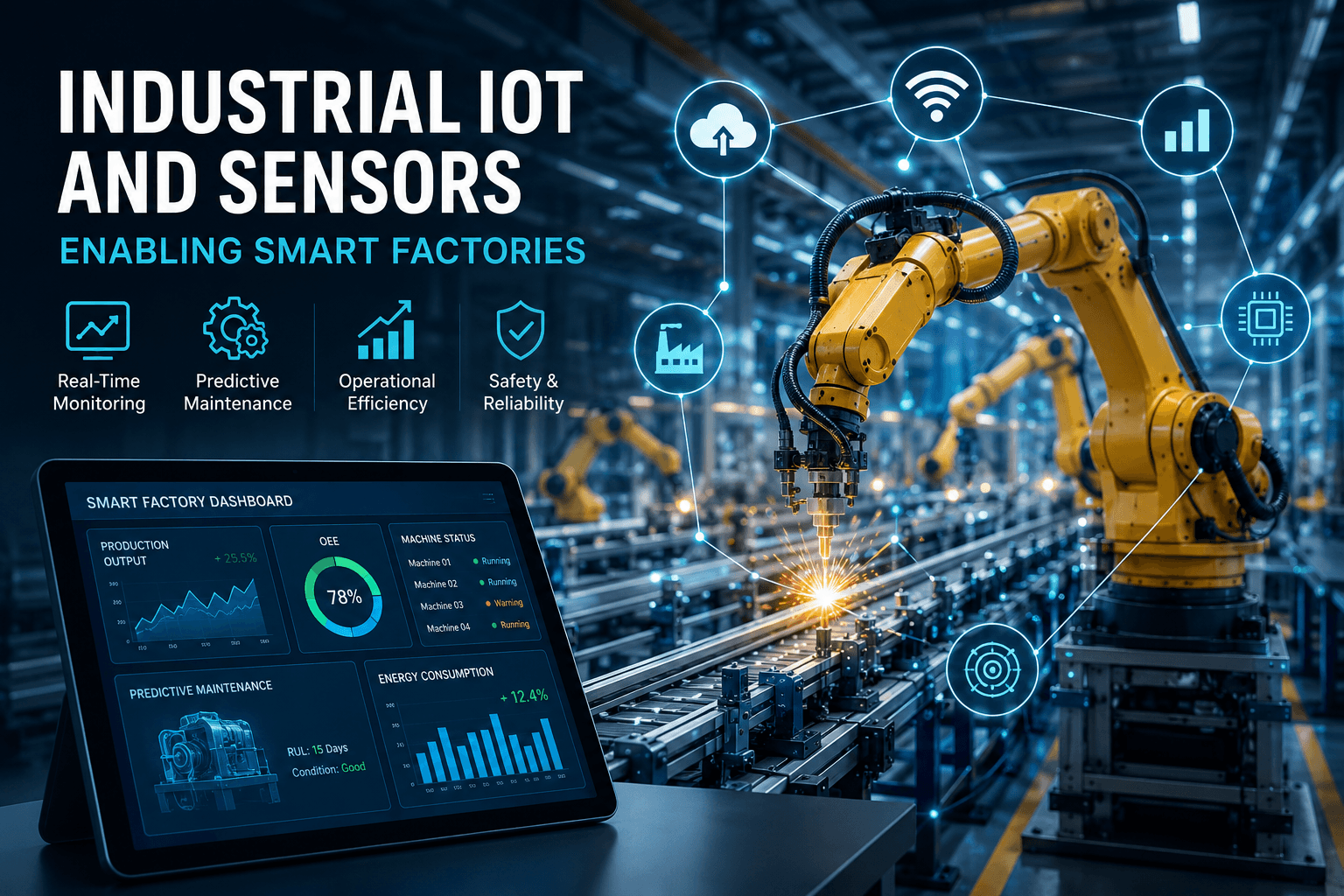
Industrial manufacturing is undergoing a major transformation. Instead of relying on manual inspections and disconnected machines, manufacturers are connecting equipment, sensors, and software to create smarter, more efficient production environments.
Industrial Internet of Things (IIoT) makes this possible. By combining connected sensors, industrial networks, and real-time analytics, manufacturers gain continuous visibility into operations. The result is faster decision-making, reduced downtime, improved product quality, and more efficient use of resources.
This article explains how Industrial IoT and sensors work together to enable smart factories, their benefits, common applications, and the challenges organizations should consider before implementation.
What Is Industrial IoT?
Industrial IoT (IIoT) refers to the use of connected devices, sensors, machines, and industrial software to collect, exchange, and analyze operational data.
Unlike consumer IoT devices such as smart speakers or fitness trackers, IIoT focuses on industrial environments including manufacturing plants, warehouses, energy facilities, and production lines.
Connected machines continuously send operational data to edge devices, cloud platforms, or centralized monitoring systems. This data helps manufacturers monitor equipment health, optimize production, and automate routine decisions.
What Are Industrial Sensors?
Industrial sensors are devices that detect physical conditions and convert them into digital information that machines and software can process.
These sensors provide continuous insight into equipment performance and environmental conditions.
Common industrial sensors include:
- Temperature sensors
- Pressure sensors
- Vibration sensors
- Proximity sensors
- Flow sensors
- Humidity sensors
- Current and voltage sensors
- Optical and vision sensors
- Gas detection sensors
- Position and motion sensors
Each sensor provides a specific type of measurement that contributes to a complete view of factory operations.
How IIoT and Sensors Work Together
A smart factory relies on a continuous flow of information.
The process typically follows these steps:
- Sensors collect operational data from machines and production equipment.
- Industrial gateways or controllers receive the sensor data.
- Data is transmitted through industrial communication networks.
- Analytics software processes the information in real time.
- Dashboards, alerts, and automation systems help operators respond immediately.
For example, a vibration sensor may detect abnormal movement in a motor. Instead of waiting for a failure, the system automatically generates a maintenance alert before production is interrupted.
This proactive approach helps manufacturers prevent costly downtime.
Key Benefits of Industrial IoT in Smart Factories
Real-Time Equipment Monitoring
Manufacturers no longer need to rely solely on scheduled inspections.
Connected sensors provide live updates on machine status, operating conditions, and production performance. Operators can identify issues immediately instead of discovering them after equipment fails.
Predictive Maintenance
Traditional maintenance follows either fixed schedules or reactive repairs.
IIoT enables predictive maintenance by continuously monitoring equipment health. Maintenance teams receive alerts when sensor data indicates wear, overheating, excessive vibration, or other warning signs.
Benefits include:
- Reduced unexpected downtime
- Lower maintenance costs
- Longer equipment life
- Improved maintenance planning
Improved Production Efficiency
Production managers can identify bottlenecks using real-time performance data.
Machine utilization, cycle times, throughput, and idle periods become visible, allowing continuous process improvements based on actual operating conditions.
Better Quality Control
Sensors monitor manufacturing conditions throughout production.
If temperature, pressure, or machine settings move outside acceptable limits, operators can take corrective action before defective products are produced.
This reduces scrap, rework, and warranty costs.
Energy Optimization
Manufacturing facilities consume significant amounts of electricity, compressed air, water, and fuel.
IIoT systems identify excessive energy consumption, equipment inefficiencies, and unnecessary operating hours, helping organizations reduce operating expenses.
Enhanced Worker Safety
Safety sensors monitor hazardous environments and equipment.
Connected systems can detect:
- Gas leaks
- High temperatures
- Unsafe machine conditions
- Unauthorized access
- Dangerous operating environments
Automated alerts help protect employees before incidents occur.
Common Applications of IIoT in Manufacturing
Predictive Maintenance
Sensors continuously monitor equipment such as pumps, compressors, motors, conveyors, and CNC machines.
Maintenance teams receive early warnings when operating conditions begin to change.
Asset Tracking
Manufacturers use RFID tags, GPS, and Bluetooth sensors to track raw materials, tools, containers, and finished products throughout the facility.
This improves inventory accuracy and reduces lost assets.
Production Monitoring
IIoT platforms collect production metrics including:
- Machine availability
- Production output
- Downtime
- Reject rates
- Overall Equipment Effectiveness (OEE)
Managers can quickly identify areas that require improvement.
Environmental Monitoring
Factories often need to maintain controlled conditions for product quality.
Sensors monitor:
- Temperature
- Humidity
- Air quality
- Dust levels
- Clean room conditions
This is especially important in pharmaceutical, food, and electronics manufacturing.
Remote Equipment Management
Engineers can monitor production facilities from any location.
Cloud-connected IIoT platforms provide secure access to dashboards, alerts, and equipment diagnostics without requiring personnel to be physically present.
Challenges of Implementing Industrial IoT
While IIoT offers significant benefits, successful implementation requires careful planning.
Cybersecurity Risks
Connected devices increase the number of potential entry points for cyberattacks.
Manufacturers should implement:
- Network segmentation
- Device authentication
- Secure communication protocols
- Regular software updates
- Continuous security monitoring
Integration with Legacy Equipment
Many factories operate machines that were never designed for connectivity.
Industrial gateways and retrofit sensor solutions can extend the life of existing equipment while enabling digital transformation.
Data Management
Thousands of sensors generate large volumes of operational data every day.
Organizations need effective data storage, filtering, and analytics strategies to transform raw information into actionable insights.
Employee Training
Technology alone does not create a smart factory.
Operators, maintenance teams, and engineers need training to understand sensor data, analytics platforms, and automated workflows.
Best Practices for IIoT Deployment
Organizations planning an IIoT initiative can improve success by following several best practices:
- Start with a small pilot project before scaling.
- Focus on solving measurable business problems.
- Select sensors that provide meaningful operational data.
- Standardize communication protocols where possible.
- Prioritize cybersecurity from the beginning.
- Integrate sensor data with existing ERP and MES systems.
- Continuously monitor performance and optimize processes.
A phased approach reduces implementation risk while delivering measurable improvements over time.
The Future of Smart Factories
Industrial IoT continues to evolve as artificial intelligence, machine learning, edge computing, and advanced analytics become more integrated into manufacturing operations.
Future smart factories will increasingly automate decision-making based on real-time operational data. Machines will identify maintenance needs, adjust production settings, optimize energy consumption, and coordinate with other connected systems with minimal human intervention.
Digital twins, autonomous robots, and AI-powered quality inspection systems will further enhance manufacturing efficiency and flexibility.
Organizations that invest in connected infrastructure today will be better positioned to adapt to changing market demands and maintain long-term competitiveness.
Conclusion
Industrial IoT and smart sensors are reshaping modern manufacturing by connecting machines, people, and processes through real-time data. These technologies enable predictive maintenance, improve production efficiency, strengthen quality control, optimize energy usage, and enhance workplace safety.
While implementation requires thoughtful planning around cybersecurity, integration, and data management, the long-term benefits often outweigh the initial investment. As manufacturing continues to become more connected and data-driven, Industrial IoT will remain a key foundation for building smarter, more resilient factories.
Key Takeaways
- Industrial IoT connects machines, sensors, and software to enable real-time manufacturing insights.
- Smart sensors continuously monitor equipment performance and environmental conditions.
- Predictive maintenance reduces downtime and maintenance costs.
- Real-time monitoring improves production efficiency and product quality.
- Successful IIoT adoption depends on strong cybersecurity, effective integration, and employee training.
Frequently Asked Questions
What is the difference between IoT and Industrial IoT?
Consumer IoT focuses on personal devices such as smart home products and wearables. Industrial IoT is designed for manufacturing, energy, logistics, and other industrial environments where reliability, safety, and operational efficiency are critical.
Which sensors are most commonly used in smart factories?
Temperature, pressure, vibration, proximity, flow, humidity, current, optical, and gas detection sensors are among the most widely used in industrial applications.
How does IIoT improve maintenance?
By continuously monitoring equipment conditions, IIoT identifies early signs of wear or failure. Maintenance can be scheduled before breakdowns occur, reducing downtime and repair costs.
Is Industrial IoT suitable for small manufacturers?
Yes. Many manufacturers begin with a limited deployment focused on one production line or a specific maintenance challenge, then expand as they realize measurable improvements.
Can existing factory equipment be connected to IIoT systems?
In many cases, yes. Retrofit sensors, industrial gateways, and communication modules can connect legacy equipment without replacing existing machinery.