Metro, Rail, and Highway Infrastructure: Component Sourcing Challenges in India
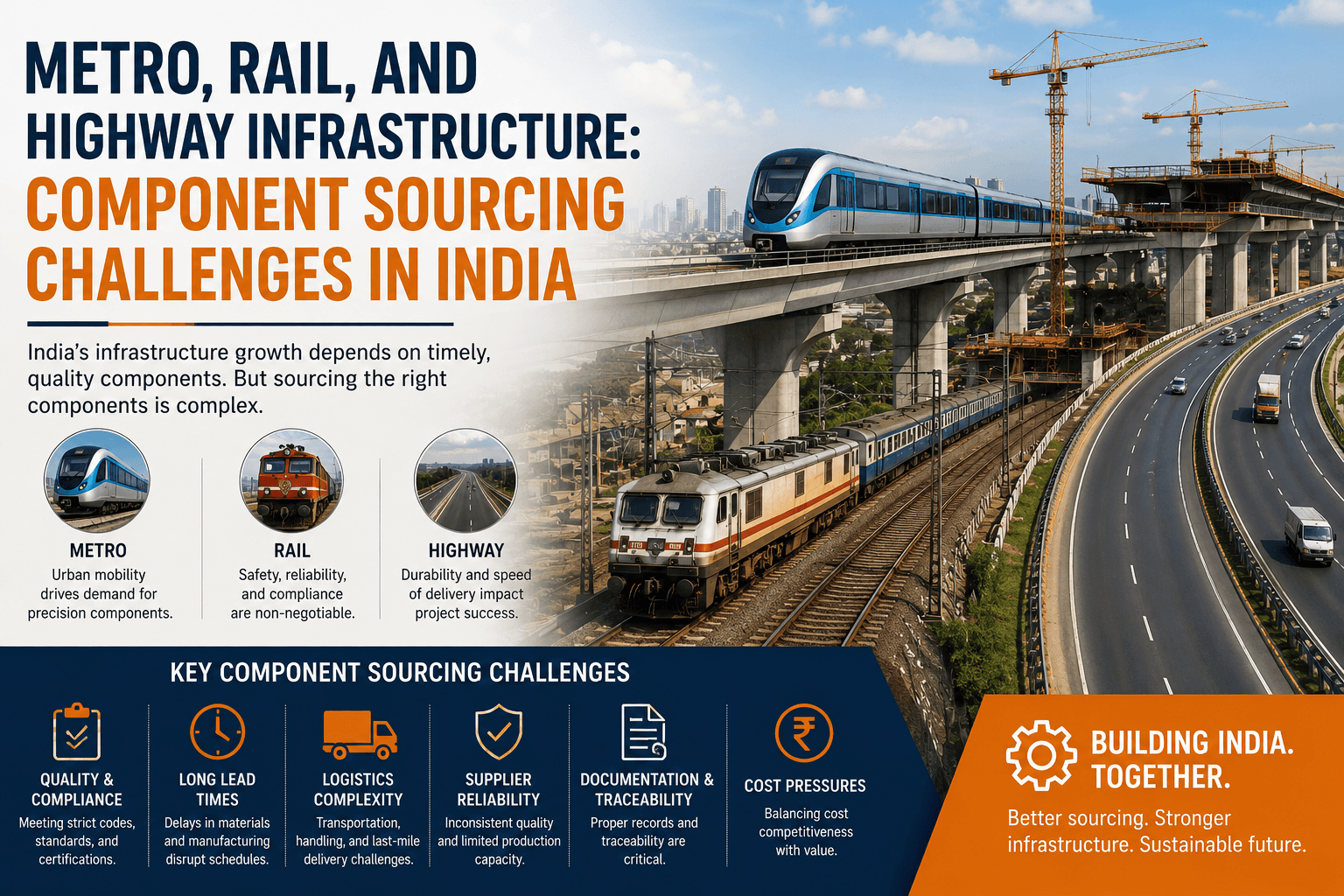
India’s investment in transport infrastructure is creating sustained demand for everything from structural steel and fabricated metal components to electrical systems, safety equipment, fasteners, brackets, assemblies, and specialized engineering products.
For contractors and EPC companies, however, sourcing these components is rarely as simple as finding a supplier with the right product at the right price.
Metro, railway, and highway projects operate under strict technical specifications, quality requirements, project schedules, and documentation controls. A component that is inexpensive but late, poorly documented, difficult to install, or inconsistent with the approved specification can create much larger costs downstream.
The real sourcing challenge is finding suppliers that can consistently deliver quality, compliance, capacity, documentation, and schedule reliability at the same time.
Why Component Sourcing Is Critical for Indian Infrastructure Projects
Transport infrastructure projects involve hundreds or thousands of individual components. Many are manufactured by different suppliers and ultimately have to work together as part of one integrated system.
For example, a highway project may require structural steel, guardrail systems, bridge components, bearings, expansion joints, drainage elements, fabricated supports, fasteners, signage structures, and electrical infrastructure.
Metro and rail projects add another layer of complexity. Components may need to meet project-specific requirements covering civil structures, electrical and electromechanical systems, signalling, telecommunications, rolling stock, and other subsystems.
The Ministry of Housing and Urban Affairs has also emphasized standardization and indigenization across metro components, including rolling stock, signalling and telecom, electrical and electromechanical systems, and civil engineering structures.
This makes supplier selection a technical and operational decision, not simply a purchasing decision.
1. Meeting Project-Specific Technical Specifications
One of the biggest sourcing challenges is ensuring that a supplier can manufacture exactly what the project requires.
Infrastructure components may have specific requirements for:
- Material grades
- Dimensions and tolerances
- Welding
- Surface treatment
- Coatings
- Mechanical properties
- Load capacity
- Corrosion resistance
- Testing
- Inspection
- Packaging
- Traceability
Highway and bridge projects, for example, operate within established frameworks involving Indian Roads Congress standards and Ministry of Road Transport and Highways specifications. MoRTH’s specifications for structural steel cover activities including furnishing, fabrication, transportation, erection, and painting.
This means contractors should not evaluate suppliers only on whether they manufacture a particular product. They should assess whether the supplier can manufacture it to the project’s approved specification.
2. Quality Consistency Across Large Volumes
Infrastructure projects often require large quantities of similar components.
Producing one acceptable component is very different from producing several hundred or several thousand components with consistent dimensions, finishes, and mechanical performance.
Quality variation can create problems during installation. Components may not fit together correctly, require rework, or need additional inspection before they can be accepted.
A capable supplier should therefore have documented quality-control processes covering incoming materials, fabrication, inspection, finishing, and final dispatch.
Contractors should look for evidence of:
- Material inspection
- In-process quality checks
- Dimensional inspection
- Welding inspection
- Coating inspection
- Final inspection
- Nonconformance management
- Batch or component traceability
The objective is simple: quality should be repeatable, not dependent on individual production batches.
3. Documentation and Traceability
Infrastructure procurement involves more paperwork than many conventional industrial purchases.
Depending on the component and project, contractors may need material certificates, inspection reports, test results, drawings, quality plans, coating records, welding documentation, and other records.
Traceability becomes particularly important when a project involves safety-critical or structural components.
A supplier should be able to connect the finished product to the relevant production and inspection records.
This gives the contractor greater confidence that the component supplied is the component that was inspected and approved.
It also makes quality investigations easier if an issue appears later.
4. Local Manufacturing and Procurement Requirements
Local sourcing has become an important consideration in Indian infrastructure procurement.
For metro projects, government initiatives have promoted progressive indigenization and local manufacturing. MoHUA documents identify minimum local-content requirements for different categories of metro components and describe standardized procurement approaches.
For contractors, this creates an important supplier-selection question:
Can the supplier meet the project’s local-content and procurement requirements without compromising technical performance?
A domestic supplier may also offer advantages in terms of lead times, communication, technical support, spare availability, and after-sales coordination.
However, “local supplier” should not automatically mean “qualified supplier.” Technical capability and documented quality performance still need to be evaluated.
5. Capacity and Production Lead Times
A supplier may have excellent products but insufficient manufacturing capacity for a large infrastructure project.
This is particularly relevant when multiple projects are competing for the same manufacturing resources.
Before awarding a major order, contractors should understand:
- Current production capacity
- Existing order commitments
- Available fabrication equipment
- Workforce capacity
- Raw material availability
- Subcontracting arrangements
- Expected production lead time
- Ability to scale production
- Contingency plans for delays
Capacity should be evaluated against the project schedule, not simply the supplier’s normal delivery time.
A supplier that can produce 50 components per month may be suitable for one project but inadequate for another that requires 500 components within a short installation window.
6. Raw Material Availability
Raw material shortages can quickly become manufacturing delays.
Steel products, specialty alloys, fasteners, coatings, electrical components, and other inputs may have different procurement cycles.
Contractors should understand where critical raw materials come from and whether the supplier maintains reliable sources.
For fabricated metal components, this may include verifying:
- Steel availability
- Material grade
- Thickness or section availability
- Mill documentation
- Heat-number traceability
- Approved material sources
- Backup suppliers
Early procurement planning can be particularly valuable for long-lead materials.
7. Transportation and Logistics
India’s infrastructure projects often span large geographic areas.
A supplier may be located hundreds or thousands of kilometres from the project site, making transportation an important part of the sourcing decision.
Large fabricated components create additional challenges because their size and weight can affect:
- Truck selection
- Route planning
- Loading and unloading
- Permits
- Packaging
- Handling equipment
- Damage risk
- Delivery sequencing
The cheapest supplier is not necessarily the lowest-cost supplier once transportation, handling, storage, and potential delays are included.
For large infrastructure components, contractors should evaluate total delivered cost, not just the ex-factory price.
8. Fabrication Accuracy and Installation Fit
Dimensional accuracy becomes especially important when components are assembled at the project site.
A small deviation in a fabricated bracket, support, plate, frame, or structural member can cause installation difficulties when it interfaces with another component.
Contractors should identify critical dimensions and tolerances during procurement.
This is particularly important for:
- Structural steel assemblies
- Bridge components
- Metro station structures
- Cable supports
- Equipment frames
- Access platforms
- Handrail systems
- Brackets and supports
- Connection plates
- Modular assemblies
MoRTH documentation references specific fabrication tolerances for steel structures, demonstrating why fabrication accuracy should be treated as a defined engineering requirement rather than an informal expectation.
9. Corrosion Protection and Environmental Conditions
Infrastructure components are often exposed to harsh operating environments.
Highways can expose steel to rain, humidity, dust, road salts, and pollutants. Railway and metro infrastructure may face weather exposure, vibration, water ingress, and difficult maintenance conditions.
Some bridge applications can involve particularly aggressive environments. MoRTH has issued guidance concerning stainless steel use in bridge projects located in marine environments susceptible to severe corrosion.
The right material and protection system therefore depends on where and how the component will be used.
Contractors should evaluate requirements for:
- Galvanizing
- Painting systems
- Protective coatings
- Surface preparation
- Stainless steel
- Corrosion-resistant materials
- Coating thickness
- Repair of damaged coatings
Corrosion protection should be specified before procurement, not decided after fabrication is complete.
10. Supplier Qualification and Technical Capability
A supplier’s catalog is not enough to establish capability.
Contractors should evaluate whether the manufacturer has experience producing comparable components under similar technical requirements.
Useful qualification criteria include:
Manufacturing capability
Does the supplier have the machinery, tooling, fabrication space, welding capability, and finishing equipment required?
Quality systems
Does the supplier have documented inspection and quality-control procedures?
Project experience
Has the supplier successfully delivered components for comparable metro, railway, highway, bridge, or industrial projects?
Engineering support
Can the supplier review drawings, identify manufacturing issues, and recommend practical solutions without changing the engineering intent?
Production capacity
Can the supplier handle the required quantity within the project schedule?
Documentation
Can the supplier provide the inspection and compliance records required by the contractor, consultant, or authority?
These questions help separate a supplier that simply sells components from one that can support a major infrastructure project.
11. Design Changes and Engineering Coordination
Infrastructure projects rarely remain completely static from design approval through installation.
Drawings may be revised. Quantities may change. Site conditions may require modifications. Interface requirements may also evolve.
If a supplier cannot manage revisions effectively, outdated components may enter production.
A strong sourcing process should establish:
- Approved drawing revisions
- Document-control procedures
- Change approval
- Revision tracking
- Shop drawing requirements
- Technical queries
- Manufacturing release procedures
The supplier should have a clear process for stopping production when a critical drawing or specification changes.
12. Balancing Cost With Total Project Value
Price remains important, but infrastructure procurement requires a broader view.
A lower purchase price can become expensive if the supplier causes:
- Installation delays
- High rejection rates
- Additional inspections
- Transportation problems
- Rework
- Field modifications
- Warranty issues
- Documentation gaps
Instead of comparing suppliers on price alone, contractors should consider total cost of ownership and project impact.
A useful evaluation can include:
| Factor | What to Evaluate |
|---|---|
| Price | Unit cost and total order value |
| Quality | Rejection and defect history |
| Capacity | Production volume and available resources |
| Lead time | Manufacturing and delivery schedule |
| Compliance | Standards, certifications, and documentation |
| Logistics | Freight, handling, and delivery risk |
| Technical support | Engineering and drawing coordination |
| Traceability | Material and production records |
| After-sales support | Replacement, repair, and technical assistance |
This approach creates a more realistic comparison between suppliers.
Metro, Rail, and Highway Projects Have Different Sourcing Priorities
Although these sectors share many procurement challenges, their requirements are not identical.
Metro infrastructure
Metro projects typically involve complex interfaces between civil, electrical, mechanical, signalling, telecom, and rolling-stock systems.
Standardization and local manufacturing are significant considerations. MoHUA maintains specific policies and standards covering metro rail procurement and components.
Railway infrastructure
Railway projects require close attention to railway-specific standards, specifications, safety requirements, and maintenance considerations.
Indian Railways maintains extensive technical and procurement documentation, including railway codes, standard conditions, specifications, and standards associated with railway works.
Highway infrastructure
Highway projects place strong emphasis on road and bridge specifications, quality assurance, fabrication, durability, construction sequencing, and field installation.
MoRTH and IRC documents provide detailed frameworks for road and bridge works. The IRC has also recently listed updated publications covering steel bridge detailing and fabrication and erection of steel bridges.
Understanding these differences helps contractors build more effective supplier qualification and procurement strategies.
How Contractors Can Improve Component Sourcing
A more reliable sourcing process starts before the purchase order is issued.
1. Freeze technical requirements early
Clearly define materials, dimensions, tolerances, standards, coatings, testing, and documentation before requesting final quotations.
2. Prequalify suppliers
Evaluate suppliers based on technical capability, quality systems, capacity, experience, and documentation.
3. Audit critical suppliers
For high-value or safety-critical components, consider factory audits before large-scale production begins.
4. Use sample or first-article approvals
Where appropriate, approve an initial component or production sample before releasing the full batch.
5. Monitor production
Do not wait until dispatch to discover problems. Use inspection checkpoints during manufacturing.
6. Plan logistics early
Large or specialized components may require transportation planning well before the delivery date.
7. Maintain supplier alternatives
For critical components, having a qualified secondary source can reduce the impact of unexpected capacity or supply problems.
A Practical Supplier Evaluation Checklist
Before selecting a component supplier, contractors can assess:
- Relevant infrastructure project experience
- Required manufacturing capacity
- Proven quality-control system
- Appropriate certifications and approvals
- Ability to meet project specifications
- Material traceability
- Welding and fabrication capability
- Testing and inspection capability
- Coating and corrosion-protection capability
- Document-control procedures
- Production lead time
- Transportation capability
- Packaging and handling procedures
- Technical support
- Ability to handle engineering revisions
- Previous delivery performance
- Competitive total delivered cost
The Future of Infrastructure Component Sourcing in India
As Indian infrastructure projects become larger and more technically integrated, supplier selection is likely to become increasingly strategic.
Standardization and indigenization are already important themes in metro procurement. MoHUA has specifically highlighted standardization as a way to support interoperability, indigenous manufacturing, long-term investment, and cost efficiency.
At the same time, highway and bridge standards continue to evolve. The Indian Roads Congress listed revised guidance in 2024-25 for steel bridge detailing and fabrication and erection, among other areas.
For contractors, this means supplier relationships should be built around more than price and availability. Technical competence, documentation, manufacturing consistency, responsiveness, and the ability to adapt to changing requirements will increasingly influence project outcomes.
Final Thoughts
Component sourcing for metro, rail, and highway infrastructure projects in India is a complex balance between cost, quality, compliance, capacity, logistics, and schedule.
The right supplier is not necessarily the one offering the lowest quotation. It is the supplier that can consistently produce the required component to specification, document its quality, meet the delivery schedule, and respond effectively when project requirements change.
For contractors, a structured supplier qualification process can reduce procurement risk before it reaches the construction site.
The earlier technical, quality, manufacturing, and logistics requirements are addressed, the easier it becomes to keep infrastructure projects moving without costly surprises.