
Assemblies vs. Individual Components: When to Source a Full Sub-Assembly
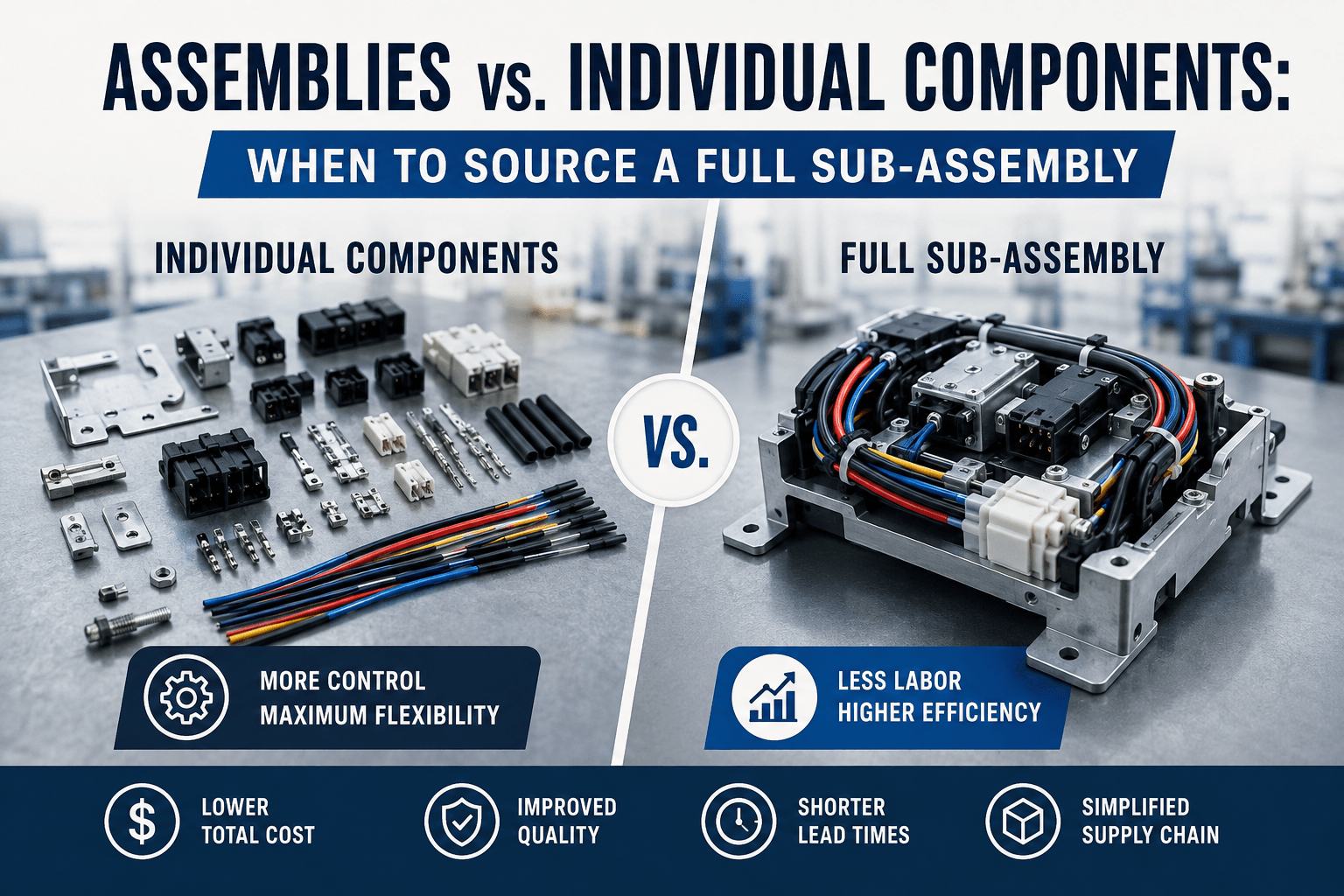
Manufacturers are constantly balancing cost, quality, lead time, and operational efficiency. One sourcing decision that often gets overlooked is whether to purchase individual components and assemble them in-house or source a complete sub-assembly from a supplier.
The right choice depends on more than unit price. Assembly complexity, production volume, quality requirements, labor availability, and supply chain resilience all play a role. Understanding these factors helps manufacturers reduce costs while improving production efficiency.
What Is a Sub-Assembly?
A sub-assembly is a group of individual components that have already been assembled into a functional unit before reaching the final production line.
Examples include:
- Wiring harnesses
- Control panels
- Hydraulic manifolds
- Gearbox assemblies
- PCB assemblies
- Valve assemblies
Instead of receiving dozens of separate parts, manufacturers receive a ready-to-install module.
When Individual Components Make Sense
Buying individual components is often the better option when manufacturers want maximum flexibility and have the resources to manage assembly internally.
This approach works well when:
- Products are highly customized.
- Engineering changes happen frequently.
- Production volumes are relatively low.
- Assembly processes are simple.
- Skilled labor is readily available.
Keeping assembly in-house also provides greater control over inspection, testing, and process improvements.
When a Full Sub-Assembly Is the Better Choice
As production volumes increase, assembling every component internally can become expensive and time-consuming.
Sourcing a complete sub-assembly is often the better option when:
Assembly Requires Specialized Expertise
Some assemblies require precision tooling, soldering, torque control, calibration, or automated testing. Suppliers that specialize in these processes can often produce higher-quality assemblies with fewer defects.
Labor Costs Continue to Rise
Every manual assembly step consumes labor hours.
Purchasing completed assemblies allows manufacturers to:
- Reduce direct labor costs
- Lower overtime requirements
- Simplify workforce planning
- Improve production efficiency
The savings often outweigh the higher purchase price of the assembled product.
Production Bottlenecks Need to Be Eliminated
Assembly operations frequently become production bottlenecks.
Moving assembly work to a qualified supplier frees internal capacity for higher-value manufacturing activities while shortening production cycles.
Quality Must Be Consistent
Experienced assembly suppliers typically operate standardized production processes supported by documented quality controls.
Benefits include:
- Consistent assembly methods
- Better process repeatability
- Reduced human error
- Comprehensive testing before shipment
- Lower warranty and rework costs
Supply Chains Need Simplification
Managing dozens of component suppliers increases purchasing complexity.
A complete sub-assembly reduces:
- Purchase orders
- Supplier relationships
- Incoming inspections
- Inventory handling
- Material shortages
Fewer moving parts often translate into more predictable production schedules.
Cost Comparison Beyond Unit Price
Comparing only the purchase price can lead to the wrong sourcing decision.
A complete cost analysis should include:
- Component purchasing costs
- Assembly labor
- Production overhead
- Quality inspection
- Scrap and rework
- Inventory carrying costs
- Warehouse space
- Equipment maintenance
- Production downtime
In many cases, a higher-priced sub-assembly lowers the total cost of ownership.
Questions to Ask Before Switching
Before moving from individual components to complete assemblies, evaluate the following:
- Is assembly consuming valuable production time?
- Are quality issues occurring during internal assembly?
- Does the process require specialized equipment?
- Would inventory become easier to manage?
- Can a supplier meet quality and delivery requirements consistently?
- Will engineering changes remain manageable?
Answering these questions helps determine whether outsourcing assembly delivers measurable value.
Potential Challenges
While sub-assemblies offer many advantages, they are not the right solution for every operation.
Manufacturers should consider:
- Reduced flexibility for late-stage design changes
- Dependence on supplier production capacity
- Higher impact if an assembly shipment is delayed
- Qualification time for new suppliers
Working closely with trusted suppliers and maintaining clear specifications helps minimize these risks.
Best Practices for Sourcing Sub-Assemblies
To achieve successful results:
- Provide complete engineering drawings and documentation.
- Define testing and quality requirements upfront.
- Establish clear communication channels.
- Review supplier manufacturing capabilities.
- Monitor delivery performance and quality metrics.
- Plan for future design revisions.
A collaborative supplier relationship often delivers better long-term results than focusing solely on purchase price.
Conclusion
Choosing between sourcing individual components and purchasing a complete sub-assembly is a strategic manufacturing decision rather than simply a procurement choice.
Individual components provide flexibility and control, making them well suited for low-volume or highly customized production. Complete sub-assemblies, however, can reduce labor costs, improve quality, simplify inventory management, and accelerate production for higher-volume manufacturing.
Evaluating total cost, operational efficiency, and long-term scalability helps manufacturers select the sourcing strategy that delivers the greatest business value.
Key Takeaways
- Individual components offer greater flexibility for custom or low-volume production.
- Sub-assemblies reduce labor, simplify procurement, and improve production efficiency.
- Total cost of ownership matters more than unit price alone.
- Specialized suppliers can improve quality and consistency.
- The best sourcing strategy depends on production volume, complexity, and long-term operational goals.
Frequently Asked Questions
Q. What is a sub-assembly in manufacturing?
A sub-assembly is a partially assembled product made from multiple components that is installed into a larger final product during manufacturing.
Q. Is sourcing sub-assemblies more expensive?
The purchase price is often higher, but reduced labor, lower inventory costs, fewer defects, and improved productivity frequently lower the overall cost of ownership.
Q. Which industries commonly use sub-assemblies?
Industries such as automotive, aerospace, industrial equipment, electronics, medical devices, and heavy machinery commonly source complete sub-assemblies.
Q. How do I decide between components and assemblies?
Evaluate production volume, assembly complexity, labor costs, quality requirements, engineering flexibility, supplier capabilities, and total lifecycle costs instead of focusing only on unit price.