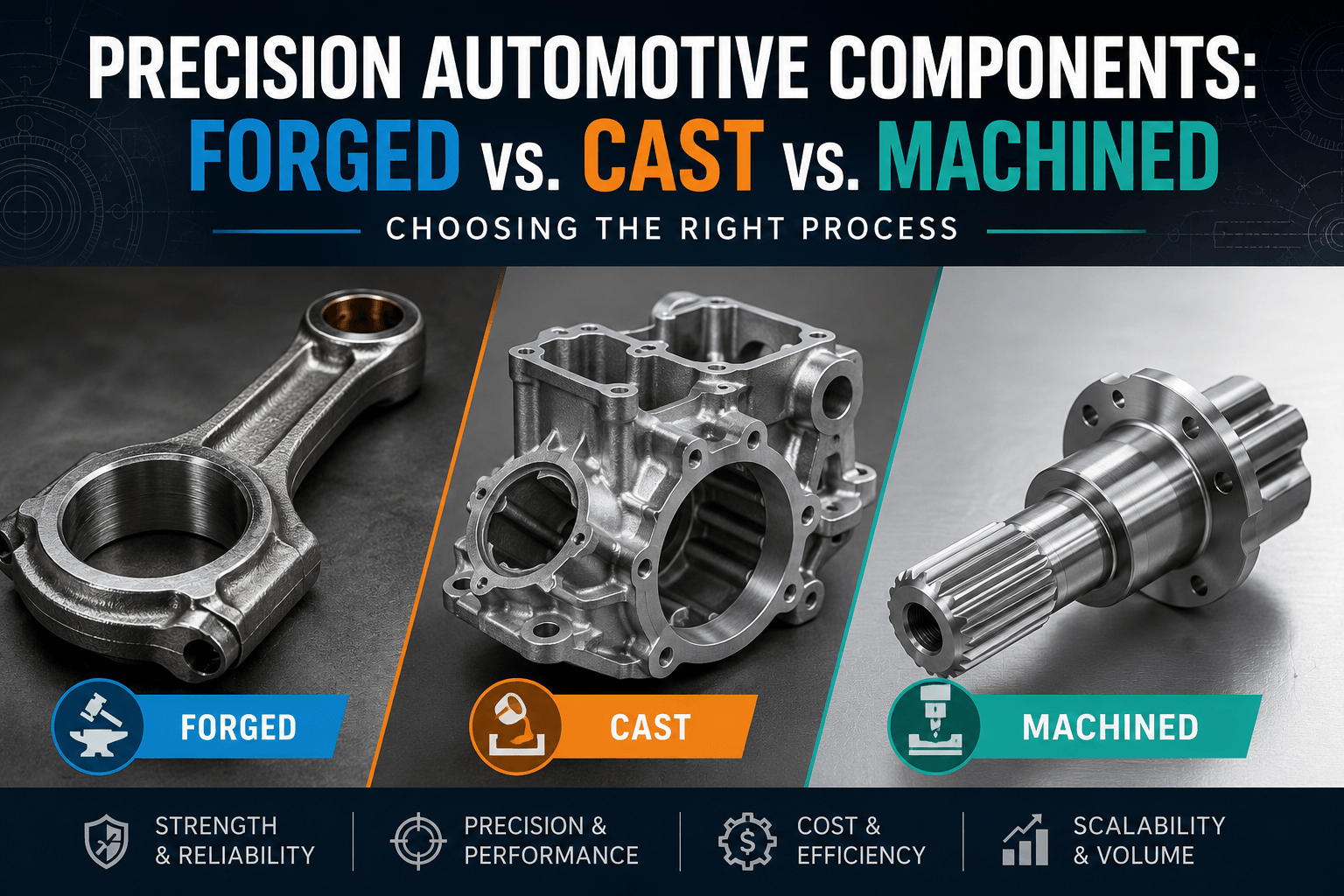
Precision Automotive Components: Forged vs. Cast vs. Machined, Choosing the Right Process
Choosing how an automotive component is made can affect far more than its purchase price. The manufacturing process influences strength, dimensional accuracy, weight, production volume, tooling costs, lead times, and ultimately how reliably the part performs.
For most precision automotive components, buyers are choosing between three broad approaches: forging, casting, and machining.
There is no single process that is best for every component. Forging is often preferred when strength and fatigue resistance matter most. Casting works well for complex shapes and higher-volume production. Machining provides excellent dimensional control and flexibility, especially for precision parts and lower production volumes.
The right choice depends on what the component needs to do, how many units you need, and where you can accept tradeoffs between cost, performance, and precision.
Forged vs. Cast vs. Machined Components at a Glance
| Factor | Forged | Cast | Machined |
|---|---|---|---|
| Strength | Excellent | Moderate to high | Depends heavily on starting material |
| Fatigue resistance | Excellent | Generally lower than comparable forgings | Depends on material and geometry |
| Dimensional precision | Moderate before finishing | Moderate before finishing | Excellent |
| Complex shapes | Moderate | Excellent | Good, but complexity can increase cost |
| Tooling investment | High | Moderate to high | Low |
| Low-volume economics | Usually less attractive | Usually less attractive | Excellent |
| High-volume economics | Excellent when tooling is justified | Excellent | Can become expensive |
| Material waste | Relatively low | Low | Often higher because material is removed |
| Secondary machining | Often required | Often required | Already integral to the process |
| Design changes | Tooling may limit flexibility | Tooling may limit flexibility | Relatively easy |
These are general characteristics rather than fixed rules. Material, component geometry, tolerances, production method, tooling, heat treatment, and supplier capabilities can significantly change the economics and performance of each option.
What Are Forged Automotive Components?
Forging shapes metal through controlled compressive force. Depending on the application, the material may be heated before being pressed or hammered into the required form.
The key advantage is what happens inside the material.
Rather than simply filling a mold, the forging process can orient the metal’s grain flow around the component geometry. When the forging and heat-treatment processes are properly engineered, this can provide excellent strength, toughness, and fatigue resistance.
That makes forging particularly useful for components exposed to repeated loads, impact, torque, or demanding operating conditions.
Common automotive applications can include:
- Connecting rods
- Crankshafts
- Gears and transmission components
- Axles and shafts
- Steering and suspension components
- Wheel hubs and other load-bearing parts
Advantages of forging
High strength and fatigue resistance
Forged components are commonly selected for structural and safety-critical applications because the process can produce strong, durable parts with favorable grain flow.
Good material integrity
A controlled forging process can reduce some of the internal discontinuities associated with certain casting processes. Actual quality still depends on material, tooling, process control, and inspection.
Suitable for demanding applications
Forging becomes especially attractive when a component must survive high cyclic loads over a long service life.
Limitations of forging
Tooling is one of the biggest considerations. Dies and associated process development create upfront costs, which can make forging difficult to justify for prototypes or very small production runs.
Forged parts may also require machining afterward to achieve tight tolerances, specific surface finishes, holes, threads, sealing surfaces, and other precision features.
For buyers, this means the quote should be evaluated as a complete manufacturing route, not simply the forging price.
What Are Cast Automotive Components?
Casting involves pouring or injecting molten material into a mold and allowing it to solidify into the required shape.
Several casting methods are used in automotive manufacturing, including sand casting, investment casting, gravity die casting, and high-pressure die casting. Each offers different combinations of cost, accuracy, surface finish, production speed, material compatibility, and tooling requirements.
Casting’s biggest advantage is geometric freedom.
Complex shapes, internal passages, ribs, bosses, and other features can often be incorporated directly into a cast component. This can reduce the amount of machining and assembly required later.
Common automotive applications include:
- Engine blocks
- Cylinder heads
- Transmission housings
- Pump housings
- Brackets
- Aluminum structural components
- Various drivetrain housings and covers
Advantages of casting
Complex geometries
Casting can create shapes that would be difficult, wasteful, or expensive to produce entirely through machining or forging.
Efficient material use
Because material is formed close to the final geometry, casting can minimize waste compared with machining a complex component from a solid billet.
Scalable production
Certain casting processes become highly economical at large volumes once tooling and production systems are established.
Part consolidation
A casting can sometimes replace several individually manufactured pieces with one integrated component. This may reduce assembly operations, fasteners, inventory, and potential failure points.
Limitations of casting
Casting quality depends heavily on process control. Porosity, inclusions, shrinkage, incomplete filling, and other defects can affect performance if they are not properly controlled.
Cast components also generally do not offer the same fatigue characteristics as an equivalent well-designed forging when materials and operating conditions are comparable.
Like forgings, castings frequently require secondary machining where tight tolerances, sealing surfaces, bearing locations, or threaded features are required.
What Are Machined Automotive Components?
Machining creates a component by removing material from a workpiece using processes such as CNC milling, turning, drilling, boring, and grinding.
The starting material might be bar stock, plate, billet, tube, a forging, or even a casting.
That distinction is important. Machining is not always an alternative to forging or casting. It is often the next step after them.
For example, a manufacturer may forge the basic shape of a component for strength and then CNC machine critical surfaces to achieve the required tolerances.
Machining is particularly valuable when precision, flexibility, and relatively low tooling requirements are priorities.
Typical applications include:
- Shafts
- Bushings
- Spacers
- Precision housings
- Prototypes
- Custom drivetrain components
- Fixtures and tooling
- Low-volume specialty components
Advantages of machining
High dimensional accuracy
Modern CNC equipment can produce highly controlled dimensions when the machine, tooling, workholding, programming, and inspection processes are properly managed.
Design flexibility
Changing a CNC program is generally easier and less expensive than modifying a forging or casting tool.
This makes machining useful for prototypes, engineering changes, custom components, and lower-volume production.
Lower tooling investment
Machining still requires fixtures, cutting tools, programming, and setup, but the initial investment can be substantially lower than dedicated forging or casting tooling.
Wide material selection
Machining can be applied to many automotive metals and engineering materials, depending on the required performance.
Limitations of machining
The biggest issue is often cost at scale.
Every machined component consumes machine time, cutting tools, labor, energy, and potentially significant amounts of raw material. As production volume rises, the cost per part may not fall as dramatically as it can with a mature forging or casting process.
Material waste can also be substantial when a complex component is cut from a large billet.
Forged vs. Cast: Which Is Better for Automotive Components?
The answer depends on what “better” means for the application.
If the primary requirement is high strength, toughness, or fatigue resistance, forging is often the stronger candidate.
If the priority is complex geometry, near-net-shape production, or economical high-volume manufacturing, casting may offer greater advantages.
Consider a heavily loaded drivetrain component. Repeated torque and cyclic stresses may make a forged solution attractive because fatigue performance is critical.
Now consider a transmission housing with complex internal geometry. Casting can make more sense because producing the same geometry from a forged blank or solid billet could be unnecessarily difficult and expensive.
The component’s function should drive the process decision.
Forged vs. Machined: When Does Each Make Sense?
This comparison requires one important clarification: a forged component can also be machined.
In fact, forging plus precision machining is a common manufacturing route for demanding automotive components.
Forging creates the basic shape and desired material properties. Machining then produces critical dimensions and surfaces.
Machining directly from billet may make more sense when:
- Production quantities are relatively low
- Designs are still changing
- Tight tolerances are required
- Dedicated forging tooling cannot be justified
- Prototypes or replacement parts are needed quickly
As production volumes rise, machining large amounts of excess material from every component can become inefficient.
At that point, producing a near-net-shape forging and machining only critical areas may reduce cycle time and material consumption.
Cast vs. Machined: Cost or Precision?
Casting and machining frequently work together as well.
A manufacturer can cast a component close to its final shape, then machine bearing bores, sealing surfaces, mounting faces, or threaded holes.
This approach provides the geometric advantages of casting while using machining only where additional precision is necessary.
Machining an entire complex housing from billet might provide excellent accuracy, but the material waste and machine time could make the component expensive at automotive production volumes.
For prototypes or low-volume specialty vehicles, however, avoiding casting tooling may make billet machining economically reasonable.
The production quantity changes the calculation.
How Production Volume Affects Your Decision
Volume is one of the most important factors buyers should consider.
Prototype and low-volume production
Machining is often attractive because it requires relatively little dedicated tooling and makes design changes easier.
If an engineer changes a dimension after testing, modifying a machining program may be significantly easier than replacing production dies or molds.
Medium-volume production
The answer becomes more application-specific.
A buyer should compare the total cost of machining against tooling plus per-part costs for forging or casting. Expected program duration matters as much as annual volume.
High-volume production
Forging and casting become increasingly attractive when the production volume can absorb the tooling investment.
The lowest quoted unit price, however, should not automatically determine the decision.
Buyers should consider total manufacturing cost, including tooling, secondary machining, scrap, inspection, logistics, quality requirements, and expected tool maintenance.
Consider Total Cost, Not Just Piece Price
Suppose Supplier A offers a lower unit price for a cast component, while Supplier B proposes a more expensive forged and machined version.
The cheaper quote is not necessarily the cheaper component.
If the application subjects the part to demanding cyclic loads, the potential consequences of inadequate performance could outweigh the initial savings.
The opposite can also happen.
Specifying a forged component for a lightly loaded bracket may introduce tooling and processing costs without providing meaningful value to the end application.
Good sourcing decisions match manufacturing capability to functional requirements.
Seven Questions to Ask Before Selecting a Process
Before deciding between forged, cast, and machined automotive components, buyers should understand the following.
1. What loads will the component experience?
Consider static loads, cyclic loads, torque, vibration, impact, temperature, and other operating conditions.
Higher mechanical demands may favor forged materials or another manufacturing route engineered specifically for those conditions.
2. How tight are the tolerances?
Do not specify extremely tight tolerances everywhere unless they are functionally necessary.
A component might be cast or forged near net shape and then machined only at critical interfaces. This can provide the required precision without adding unnecessary manufacturing cost.
3. How complex is the geometry?
Complex internal cavities, thin walls, ribs, and integrated features can favor casting.
Simpler load-bearing geometries may be well suited to forging.
Machining becomes attractive when the geometry can be produced efficiently with standard CNC operations.
4. What is the expected production volume?
Calculate expected demand across the program, not just the first purchase order.
A process with higher upfront tooling costs may become significantly more economical over a multi-year production run.
5. How stable is the design?
If the design is still evolving, expensive dedicated tooling can create financial risk.
Machining may provide greater flexibility during prototype and validation stages before the design is transferred to a higher-volume manufacturing process.
6. What material properties are required?
Strength, hardness, fatigue resistance, corrosion resistance, temperature capability, and weight targets can all influence the appropriate combination of material and process.
Material and manufacturing process should therefore be evaluated together.
7. What quality controls does the supplier use?
The process name alone does not guarantee component quality.
Ask potential suppliers about:
- Material traceability
- Process controls
- Dimensional inspection
- Heat-treatment controls where applicable
- Non-destructive testing where required
- Measurement equipment and calibration
- Production part approval processes
- Automotive quality certifications relevant to the program
For automotive sourcing, consistent process control is often just as important as the manufacturing method itself.
When a Hybrid Manufacturing Approach Is Better
One of the biggest mistakes buyers can make is treating forging, casting, and machining as mutually exclusive choices.
Many precision automotive components use more than one process.
A forged and machined component can combine strong material properties with tight dimensional control.
A cast and machined component can combine complex near-net geometry with precise functional surfaces.
Even within the same vehicle system, different parts may require completely different manufacturing strategies.
The better question is therefore not simply, “Should this part be forged, cast, or machined?”
Ask:
Which combination of processes delivers the required performance, quality, volume, and total cost?
That question leads to a much more useful supplier discussion.
Quick Process Selection Guide
Choose forging when strength, toughness, fatigue performance, and reliability under demanding loads are primary requirements, particularly when production volume can justify dedicated tooling.
Choose casting when the component has complex geometry, integrated features, or near-net-shape requirements and the expected production volume supports the selected casting method.
Choose machining when dimensional accuracy, design flexibility, prototypes, lower quantities, or reduced dedicated tooling investment are priorities.
Consider forging plus machining when the component needs both demanding mechanical properties and precision features.
Consider casting plus machining when complex geometry must be combined with tight tolerances at specific functional surfaces.
How to Compare Automotive Component Suppliers
Once you have identified a likely manufacturing route, compare suppliers on more than price.
A capable precision automotive component manufacturer should be able to explain why a proposed process is appropriate for the component, including where its limitations are.
Ask suppliers to explain their recommended raw material form, production process, secondary operations, inspection plan, expected tooling requirements, production capacity, and approach to maintaining repeatability.
A supplier that simply manufactures the drawing may miss opportunities to improve manufacturability or cost.
Early design-for-manufacturing discussions can identify unnecessarily tight tolerances, difficult features, excessive machining allowances, or opportunities to use near-net-shape manufacturing.
That collaboration can be particularly valuable before tooling is finalized.
Frequently Asked Questions
Q. Are forged automotive parts stronger than cast parts?
Forged components often provide better strength, toughness, and fatigue performance than comparable cast components because of the material structure created during forging. However, performance depends on the alloy, heat treatment, geometry, manufacturing quality, and loading conditions. The manufacturing process alone does not determine component strength.
Q. Is CNC machining better than casting?
Neither process is universally better. CNC machining provides high precision and design flexibility with relatively low dedicated tooling requirements. Casting can produce complex near-net shapes more economically at suitable production volumes. Many automotive components are cast first and CNC machined afterward.
Q. Why are forged parts more expensive?
Forged components can require dedicated dies, process development, heat treatment, trimming, and secondary machining. These upfront costs can make forging expensive at low volumes. At higher volumes, however, the tooling investment can be spread across many parts.
Q. Which manufacturing process is best for precision automotive components?
The best process depends on the component’s loads, material, geometry, tolerances, production quantity, design maturity, quality requirements, and target cost. Machining is commonly used when high dimensional precision is required, while forging or casting can produce the underlying component efficiently before critical features are machined.
Q. Can cast or forged components achieve tight tolerances?
Yes, but tight functional dimensions are often created through secondary machining. Instead of requiring the entire component to meet machining-level tolerances, manufacturers can forge or cast the near-net shape and machine only the critical features.
Choosing the Right Manufacturing Process
For general B2B buyers, the most useful way to compare forged vs. cast vs. machined automotive components is to start with the application’s requirements rather than the manufacturing technology.
Define the loads, tolerances, material properties, annual volume, program life, design stability, and quality requirements first. Then compare manufacturing routes based on total cost and performance.
Forging can provide excellent mechanical performance. Casting can efficiently produce complex shapes. Machining offers precision and flexibility. In many automotive applications, the most effective solution combines these processes rather than choosing only one.
When evaluating suppliers, ask them to justify the proposed manufacturing route against your actual component requirements. The right supplier should be able to explain not only what they can manufacture, but why that process makes sense for the part.