RFQ Process for Manufacturing: How to Get Accurate Quotes
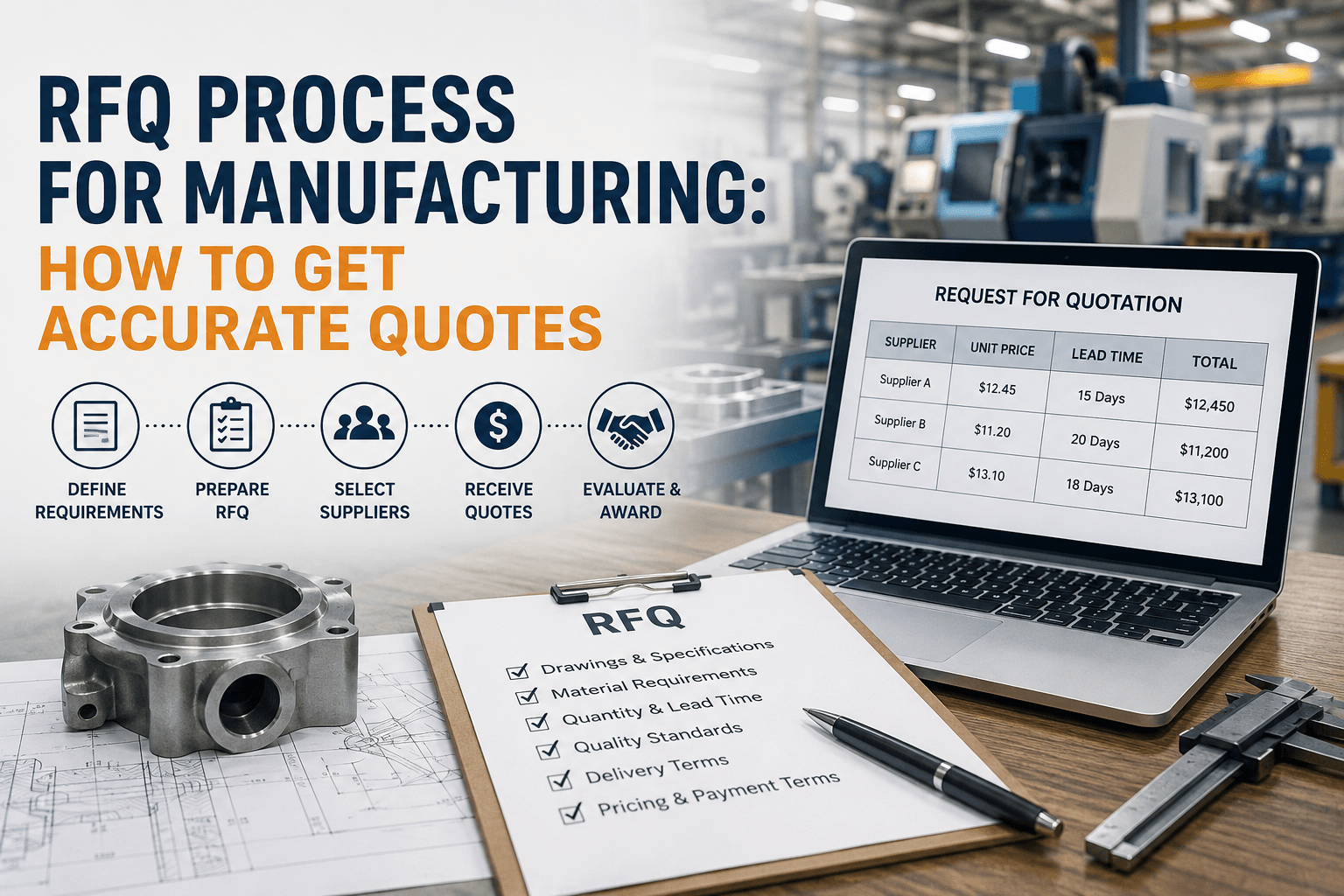
Getting competitive pricing from suppliers starts with a well-written Request for Quotation (RFQ). Yet many manufacturers struggle with inaccurate quotes, unexpected costs, and long negotiation cycles because the information they provide is incomplete or unclear.
An effective RFQ process helps suppliers understand exactly what you need. That leads to faster responses, more accurate pricing, and fewer surprises during production.
This guide explains how the manufacturing RFQ process works, what information every RFQ should include, common mistakes to avoid, and practical ways to improve quote accuracy.
What Is an RFQ in Manufacturing?
A Request for Quotation (RFQ) is a formal document sent to suppliers asking them to provide pricing for specific products, materials, or manufacturing services.
Unlike a Request for Proposal (RFP), which focuses on finding the best solution to a business problem, an RFQ is used when the product specifications are already defined. Suppliers respond primarily with pricing, delivery timelines, and commercial terms.
Manufacturers commonly use RFQs for:
- Custom machined parts
- Sheet metal fabrication
- Plastic injection molding
- Electronics manufacturing
- Raw materials
- Production tooling
- Contract manufacturing
The more detailed your RFQ, the more reliable the supplier’s quotation will be.
Why Accurate RFQs Matter
An incomplete RFQ creates uncertainty for suppliers. When critical details are missing, suppliers often:
- Add extra cost to cover risk
- Estimate instead of calculating actual production costs
- Ask multiple clarification questions
- Delay submitting quotations
- Deliver quotes that cannot be fairly compared
A detailed RFQ reduces these issues and allows procurement teams to compare suppliers based on consistent information.
The Manufacturing RFQ Process
1. Define Your Requirements
Before contacting suppliers, gather all technical and commercial requirements.
This includes:
- Product specifications
- Engineering drawings
- Material requirements
- Quantity
- Quality standards
- Delivery schedule
- Packaging instructions
Internal alignment between engineering, purchasing, production, and quality teams prevents conflicting requirements later.
2. Prepare the RFQ Package
The RFQ should answer every question a supplier would normally ask before preparing pricing.
A complete package typically includes:
- Part numbers
- CAD files or engineering drawings
- Bill of Materials (BOM)
- Material specifications
- Surface finish requirements
- Tolerances
- Inspection requirements
- Certifications
- Target production volume
- Delivery location
- Required lead time
Providing complete documentation minimizes back-and-forth communication.
3. Select Qualified Suppliers
Price should not be the only selection factor.
Choose suppliers based on factors such as:
- Manufacturing capabilities
- Industry experience
- Quality certifications
- Production capacity
- Financial stability
- Previous performance
- Geographic location
Sending RFQs only to qualified suppliers increases response quality and saves time.
4. Allow Enough Time for Quoting
Complex manufacturing projects require suppliers to review drawings, estimate labor, calculate material usage, and coordinate with subcontractors.
Rushing the process often results in rough estimates rather than accurate quotations.
Provide realistic deadlines, especially for complex assemblies or custom products.
5. Evaluate Supplier Responses
The lowest quote is not always the best choice.
Compare suppliers across multiple criteria, including:
- Unit pricing
- Tooling costs
- Setup fees
- Shipping costs
- Production lead time
- Payment terms
- Quality certifications
- Warranty
- Production capacity
Looking at total cost rather than unit price helps avoid expensive surprises later.
6. Clarify and Negotiate
If quotations differ significantly, discuss the assumptions behind each quote.
Questions to ask include:
- Are tooling costs included?
- What production volume was assumed?
- Are shipping charges included?
- Are inspection costs included?
- What happens if volumes increase?
- Are material price changes covered?
Clarification ensures you’re comparing equivalent offers.
7. Award the Purchase Order
Once the supplier is selected, convert the accepted quotation into a purchase order with clearly documented specifications, pricing, delivery dates, and commercial terms.
Maintaining documentation helps prevent future disputes.
What Information Should Every Manufacturing RFQ Include?
A high-quality RFQ typically contains the following information:
Product Information
- Part name
- Part number
- Product description
- Revision number
Technical Documentation
- Engineering drawings
- CAD models
- Bill of Materials
- Assembly instructions
- Quality standards
Material Specifications
Clearly define:
- Material grade
- Approved alternatives
- Heat treatment
- Surface finish
- Coatings
Production Requirements
Include:
- Annual volume
- Initial order quantity
- Batch size
- Prototype requirements
- Expected future demand
Quality Requirements
Specify:
- Inspection procedures
- Dimensional tolerances
- Industry certifications
- Testing requirements
- Documentation requirements
Commercial Terms
Include:
- Delivery location
- Required lead time
- Payment terms
- Incoterms (if applicable)
- Currency
- Quote validity period
The more complete these details are, the easier it becomes for suppliers to provide comparable quotes.
Common RFQ Mistakes That Lead to Inaccurate Quotes
Many purchasing teams unintentionally create delays by leaving out important details.
Common mistakes include:
Missing Drawings
Incomplete or outdated drawings force suppliers to make assumptions.
Unclear Material Specifications
General descriptions such as “steel” or “plastic” are usually insufficient.
Instead, specify exact grades and standards.
Undefined Quantities
Pricing changes significantly based on production volume.
Always provide expected order quantities and annual forecasts.
Ignoring Quality Requirements
Inspection standards and certification requirements directly affect manufacturing costs.
Include these requirements from the beginning.
Frequent RFQ Revisions
Changing specifications after suppliers begin preparing quotes wastes time and often delays procurement.
Finalize engineering documents before issuing the RFQ whenever possible.
Best Practices for Getting More Accurate Supplier Quotes
Organizations that consistently receive accurate quotations often follow a structured process.
Some proven practices include:
- Use standardized RFQ templates.
- Attach complete engineering documentation.
- Keep revision control up to date.
- Invite only qualified suppliers.
- Ask suppliers to identify assumptions.
- Compare total landed cost instead of unit price alone.
- Establish clear communication channels.
- Maintain a centralized record of supplier quotations.
These practices improve consistency while reducing administrative work.
How Digital RFQ Management Improves Manufacturing Procurement
Many manufacturers now manage RFQs using procurement software instead of spreadsheets and email.
Digital RFQ management can help teams:
- Standardize RFQ templates
- Store engineering documents in one place
- Track supplier responses
- Compare quotations automatically
- Manage approval workflows
- Maintain revision history
- Improve collaboration between engineering and procurement
For organizations handling hundreds of RFQs each year, automation can reduce manual effort and improve visibility throughout the sourcing process.
Frequently Asked Questions
Q. What is the difference between an RFQ and an RFP?
An RFQ requests pricing for products or services with clearly defined specifications. An RFP is used when the buyer is looking for suppliers to propose different solutions to a broader business need.
Q. How many suppliers should receive an RFQ?
Many manufacturers invite three to five qualified suppliers. This typically provides enough competition while keeping the evaluation process manageable.
Q. How long should suppliers have to respond?
Simple RFQs may require only a few business days, while complex manufacturing projects often need one to three weeks, depending on the level of technical review involved.
Q. What makes an RFQ successful?
A successful RFQ includes complete technical specifications, realistic timelines, clear commercial requirements, and sufficient detail for suppliers to prepare accurate, comparable quotations.
Key Takeaways
The quality of supplier quotes depends largely on the quality of the RFQ. Clear specifications, complete documentation, and realistic expectations help suppliers provide accurate pricing and reliable delivery commitments.
By following a structured RFQ process, manufacturers can reduce procurement delays, improve supplier comparisons, and make more informed sourcing decisions. Over time, consistent RFQ practices also strengthen supplier relationships and contribute to smoother production planning.