

Nearshoring vs Offshoring: Weighing the Trade-offs
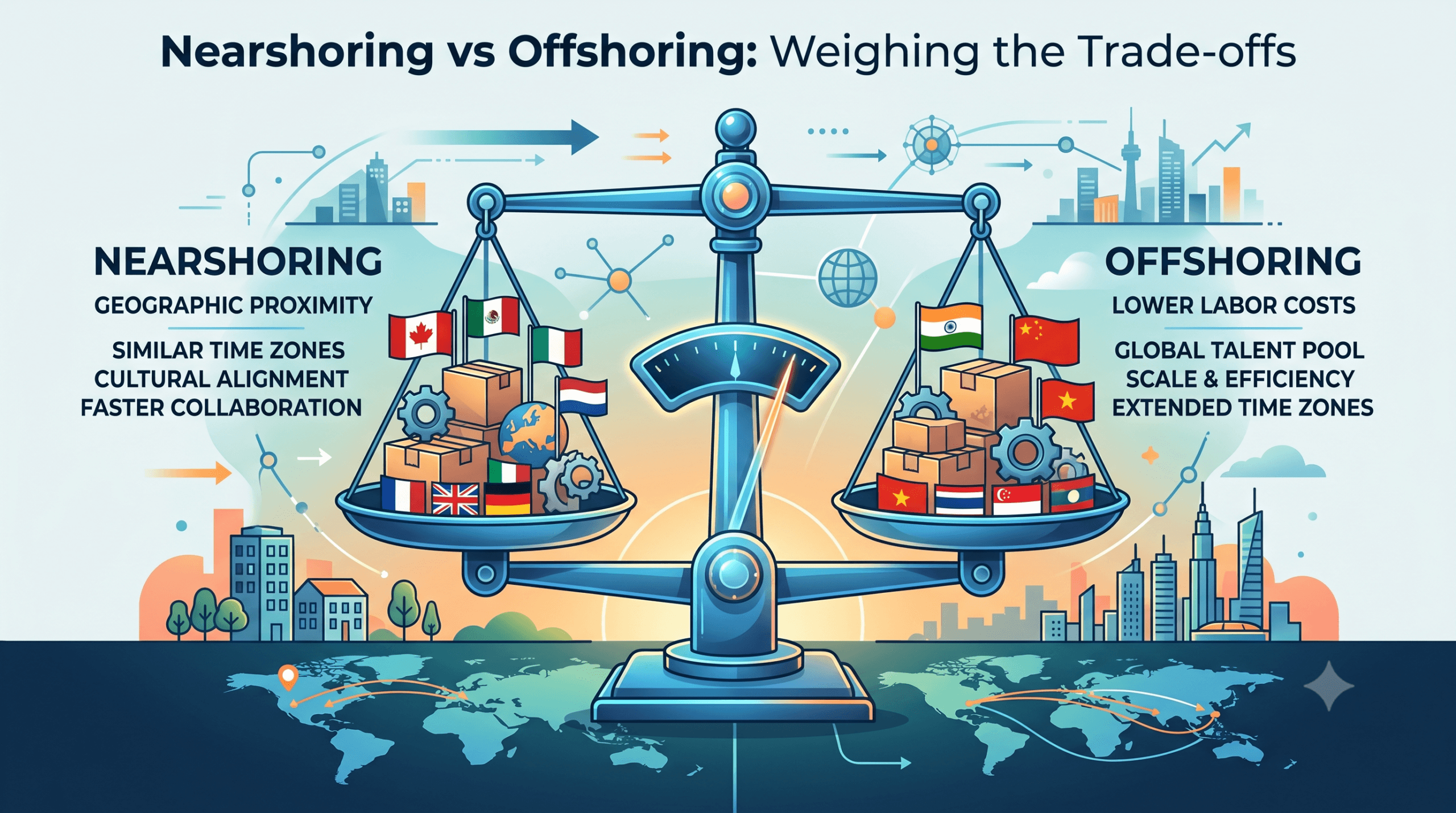
Choosing where to build your software team is no longer just about finding the lowest hourly rate. Companies today must balance cost, collaboration, speed, security, and access to specialized talent. That’s why many organizations are comparing nearshoring and offshoring before making long-term outsourcing decisions.
While both models help businesses scale development without hiring entirely in-house, they solve different problems. Understanding the trade-offs can help you choose the approach that aligns with your budget, timelines, and business goals.
What Is Nearshoring?
Nearshoring means outsourcing work to a nearby country, usually within the same region or a similar time zone.
For example:
- A US company hiring developers in Mexico or Colombia
- A German company partnering with a software team in Poland
- An Australian business working with developers in New Zealand
The biggest advantage is proximity. Teams often share overlapping work hours, similar business cultures, and shorter travel times.
What Is Offshoring?
Offshoring involves outsourcing work to countries that are geographically farther away, often across multiple time zones.
Common examples include:
- US companies hiring development teams in India, Vietnam, or the Philippines
- UK businesses outsourcing projects to Pakistan or Bangladesh
- European organizations working with teams across Asia
Offshoring is often chosen to reduce development costs and gain access to large pools of technical talent.
Nearshoring vs Offshoring at a Glance
| Factor | Nearshoring | Offshoring |
|---|---|---|
| Time zone overlap | High | Low to moderate |
| Communication | Easier real-time collaboration | Often asynchronous |
| Travel | Shorter and more convenient | Longer and more expensive |
| Development costs | Moderate | Usually lower |
| Cultural alignment | Typically stronger | Can require more adaptation |
| Talent availability | Good | Very large global talent pool |
| Project management | Easier for agile teams | Requires structured coordination |
Cost Comparison
Cost is often the first factor companies consider, but it should not be the only one.
Offshoring generally offers lower hourly rates because labor costs are lower in many overseas markets. For organizations with tight budgets or large-scale development needs, this can significantly reduce operating expenses.
Nearshoring usually costs more than offshoring but less than hiring locally. Many businesses find the additional investment worthwhile because smoother communication and faster decision-making can improve productivity.
The lowest hourly rate does not always translate into the lowest overall project cost. Delays, rework, and communication challenges can offset initial savings.
Collaboration and Communication
Software development depends on continuous collaboration between developers, designers, product managers, and stakeholders.
Nearshore teams typically work during similar business hours, making it easier to:
- Hold daily stand-ups
- Resolve issues quickly
- Review code in real time
- Make faster product decisions
Offshore teams often rely more on asynchronous communication. This approach can work well with mature processes, but questions may take hours instead of minutes to resolve.
Organizations using agile development often benefit from greater time zone overlap.
Talent Availability
Both models provide access to skilled professionals, but the available talent pools differ.
Nearshoring gives companies access to regional experts who may have experience with similar markets, regulations, and customer expectations.
Offshoring opens the door to one of the largest global talent markets. Businesses can often find specialists in areas such as:
- Artificial intelligence
- Cloud engineering
- Cybersecurity
- Mobile development
- DevOps
- Data engineering
For projects requiring niche technical expertise, offshoring often provides more hiring flexibility.
Cultural and Language Considerations
Successful outsourcing depends on more than technical ability.
Shared business culture, communication styles, and language proficiency influence how smoothly projects progress.
Nearshore teams often have:
- Similar workplace expectations
- Better cultural familiarity
- Fewer communication misunderstandings
Offshore partnerships can also be highly successful, particularly when vendors invest in English proficiency, project management training, and cross-cultural communication.
The quality of the vendor usually matters more than geography alone.
Security and Compliance
Organizations handling sensitive customer data should evaluate security practices before selecting any outsourcing partner.
Important considerations include:
- Data protection policies
- Regulatory compliance
- Secure development practices
- Access controls
- Intellectual property protection
- Security certifications
Whether nearshore or offshore, vendors should demonstrate mature security processes and clear contractual protections.
Project Management Requirements
Nearshore partnerships generally require less coordination because teams share working hours and can collaborate throughout the day.
Offshore engagements often benefit from:
- Detailed documentation
- Clearly defined workflows
- Regular progress reports
- Project management tools
- Well-established escalation procedures
Companies with mature development processes can successfully manage distributed offshore teams at scale.
When Nearshoring Makes Sense
Nearshoring is often the better choice if your business values:
- Frequent stakeholder collaboration
- Fast decision-making
- Agile software development
- Easier travel for on-site meetings
- Strong cultural alignment
It is especially useful for projects where requirements evolve frequently and close communication is essential.
When Offshoring Makes Sense
Offshoring is often the better fit when your priorities include:
- Lower development costs
- Scaling engineering capacity quickly
- Accessing specialized technical skills
- Supporting round-the-clock development
- Building long-term dedicated teams
Organizations with well-defined requirements and established delivery processes often realize substantial benefits from offshore development.
How to Choose the Right Model
There is no universal answer. The best outsourcing strategy depends on your priorities.
Choose nearshoring if collaboration speed, shared working hours, and regional alignment are your biggest concerns.
Choose offshoring if cost efficiency, access to specialized talent, and large-scale hiring are more important.
Many companies also adopt a hybrid approach, combining nearshore product management with offshore engineering teams. This model balances communication efficiency with access to broader technical expertise.
Key Takeaways
Nearshoring and offshoring each offer clear advantages. Nearshoring simplifies collaboration through closer proximity and overlapping time zones, making it well suited for agile projects and teams that need frequent interaction.
Offshoring offers greater cost savings and access to a larger global talent pool, making it an attractive option for organizations looking to scale efficiently or hire specialized expertise.
Rather than focusing only on hourly rates, evaluate the total value each model delivers. Consider communication, productivity, security, project complexity, and long-term business goals. The right choice is the one that supports sustainable delivery while helping your organization achieve its strategic objectives.
Frequently Asked Questions
Q. Is nearshoring more expensive than offshoring?
In most cases, yes. However, improved collaboration and fewer delays can reduce the total cost of ownership over the life of a project.
Q. Which model is better for agile software development?
Nearshoring often works better for agile teams because overlapping work hours support continuous collaboration, sprint planning, and rapid feedback.
Q. Does offshoring reduce software quality?
Not necessarily. Software quality depends on the vendor’s expertise, engineering practices, quality assurance processes, and project management, rather than geographic location.
Q. Can companies combine nearshoring and offshoring?
Yes. Many organizations use a hybrid delivery model, keeping customer-facing roles and product management nearshore while leveraging offshore teams for software development and specialized engineering.