Minimum Order Quantities (MOQ) in Contract Manufacturing: How They’re Set
Minimum Order Quantities (MOQs) are one of the first topics that come up when discussing contract manufacturing. Whether you’re launching a new product or scaling an existing one, understanding how MOQs work can help you plan production, manage costs, and choose the right manufacturing partner.
While many buyers view MOQs as fixed requirements, they’re usually based on the manufacturer’s production economics. Knowing what drives these numbers can help you negotiate more effectively and avoid unexpected costs.
What Is a Minimum Order Quantity?
A Minimum Order Quantity (MOQ) is the smallest number of units a manufacturer is willing to produce in a single production run. The purpose is simple. Manufacturers need to cover setup costs, labor, materials, machine time, and overhead while maintaining profitable operations.
MOQs vary widely depending on the product, manufacturing process, and industry. A simple plastic component may have an MOQ of a few hundred units, while a custom electronic assembly may require several thousand units before production becomes cost effective.
Why Manufacturers Set MOQs
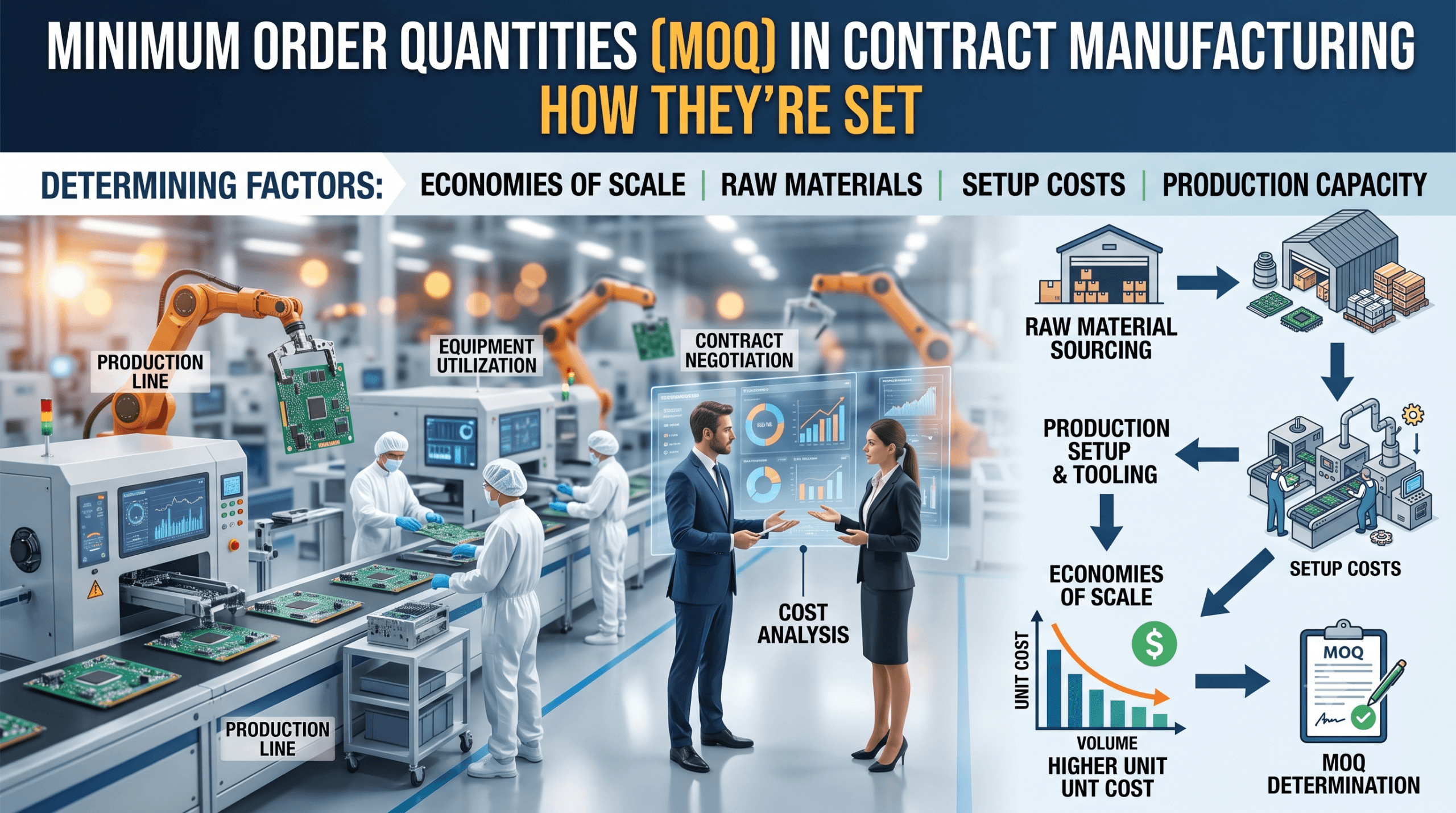
Manufacturers invest significant time and resources before the first product is even produced. These upfront costs remain relatively constant regardless of whether the order is for 100 units or 10,000 units.
Common reasons for setting MOQs include:
- Production setup and machine calibration
- Material sourcing requirements from suppliers
- Tooling and mold preparation
- Labor allocation
- Quality inspection and testing
- Packaging and logistics planning
- Inventory management
Without an MOQ, manufacturers may struggle to recover these fixed costs, making small production runs financially unsustainable.
Key Factors That Influence MOQ
Product Complexity
Products with multiple components, custom finishes, or strict quality requirements typically have higher MOQs. More complex products require additional engineering, setup time, and inspection processes.
Raw Material Requirements
Many raw material suppliers have their own minimum purchase requirements. If a manufacturer must buy large quantities of material to fulfill your order, that directly affects the MOQ offered to customers.
For example, a supplier may only sell aluminum sheets in bulk quantities. Even if your order requires only half the material, the manufacturer still has to purchase the full amount.
Manufacturing Process
Different production methods have different cost structures.
Injection molding usually involves higher tooling costs but lower per-unit costs at larger volumes. CNC machining often supports smaller production runs because it requires less dedicated tooling. Assembly-based manufacturing may fall somewhere in between depending on labor requirements.
Tooling Costs
Custom molds, dies, fixtures, or specialized equipment increase the manufacturer’s upfront investment. These costs are often spread across the total production volume, resulting in higher MOQs.
Production Capacity
Manufacturers schedule production to maximize equipment utilization. Very small orders can interrupt production schedules, making them less attractive than larger, more efficient production runs.
Packaging and Shipping
Packaging materials are often purchased in bulk. Likewise, transportation costs become more economical when spread across larger shipments.
How MOQs Affect Buyers
MOQs influence more than just the order size. They affect purchasing budgets, inventory planning, cash flow, and time to market.
Higher MOQs can lead to:
- Larger upfront investments
- Increased inventory holding costs
- Greater storage requirements
- Higher financial risk for new products
- Reduced flexibility when product demand changes
However, larger production runs often reduce the cost per unit, improving overall profitability for established products.
Can MOQs Be Negotiated?
In many cases, yes.
Manufacturers understand that startups and growing businesses may not initially require large production volumes. While they may not eliminate the MOQ entirely, they often offer alternatives that work for both parties.
Negotiation options may include:
- Higher unit pricing for smaller orders
- Shared production runs with other customers
- Phased production schedules
- Partial inventory releases
- Standardized materials instead of custom components
- Long-term purchasing agreements
Strong communication about future demand can also improve negotiation outcomes.
Tips for Managing MOQ Challenges
Forecast Demand Accurately
Reliable sales forecasts help determine whether meeting an MOQ makes financial sense and reduce the risk of excess inventory.
Standardize Product Designs
Using standard materials and components can lower manufacturing complexity and make smaller production runs more feasible.
Consolidate Orders
Combining multiple product variations or purchase orders into one production run may help satisfy MOQ requirements more efficiently.
Build Long-Term Relationships
Manufacturers are often more flexible with customers who demonstrate consistent ordering patterns and long-term growth potential.
Understand Total Cost
A lower MOQ does not always result in lower overall costs. Consider factors such as unit pricing, shipping, storage, inventory carrying costs, and future production needs before making a decision.
Questions to Ask a Contract Manufacturer About MOQ
Before selecting a manufacturing partner, ask questions such as:
- What factors determine your MOQ?
- Is the MOQ based on units, material usage, or production hours?
- Can MOQs change as order volumes increase?
- Are pilot production runs available?
- Are there price differences for lower-volume orders?
- Can inventory be produced at once but shipped in stages?
- Are there opportunities to reduce MOQ through design changes?
These conversations help establish realistic expectations and identify opportunities for cost savings.
Finding the Right Balance
MOQs exist to balance manufacturing efficiency with production costs. They are not arbitrary numbers but reflect the realities of sourcing materials, operating equipment, and maintaining profitability.
For buyers, understanding how MOQs are calculated makes it easier to compare manufacturers, negotiate favorable terms, and develop a production strategy that supports both business growth and financial stability.
The most successful manufacturing partnerships are built on transparency. By discussing production volumes, future demand, and operational requirements early in the process, both manufacturers and customers can find solutions that support long-term success.
Key Takeaways
- MOQs represent the minimum production quantity a manufacturer can produce profitably.
- Product complexity, tooling, materials, and production setup all influence MOQ requirements.
- Higher MOQs often reduce per-unit costs but require larger upfront investments.
- Many manufacturers are willing to negotiate MOQs through pricing adjustments, phased production, or long-term agreements.
- Understanding the reasons behind MOQs helps businesses make better sourcing and inventory decisions.
Frequently Asked Questions
Q. What is a typical MOQ in contract manufacturing?
There is no universal MOQ. It can range from a few hundred units for simple products to several thousand units for custom or highly engineered products.
Q. Why do custom products usually have higher MOQs?
Custom products often require specialized tooling, unique materials, engineering support, and additional quality checks, all of which increase upfront production costs.
Q. Can startups work with manufacturers that have high MOQs?
Yes. Many manufacturers offer pilot runs, phased production, or higher per-unit pricing to accommodate smaller initial orders.
Q. Does a higher MOQ always mean lower costs?
Not necessarily. While the cost per unit often decreases, businesses should also consider storage costs, inventory carrying costs, and cash flow before placing large orders.