
Rubber and Gasket Manufacturing: Materials and Selection Guide
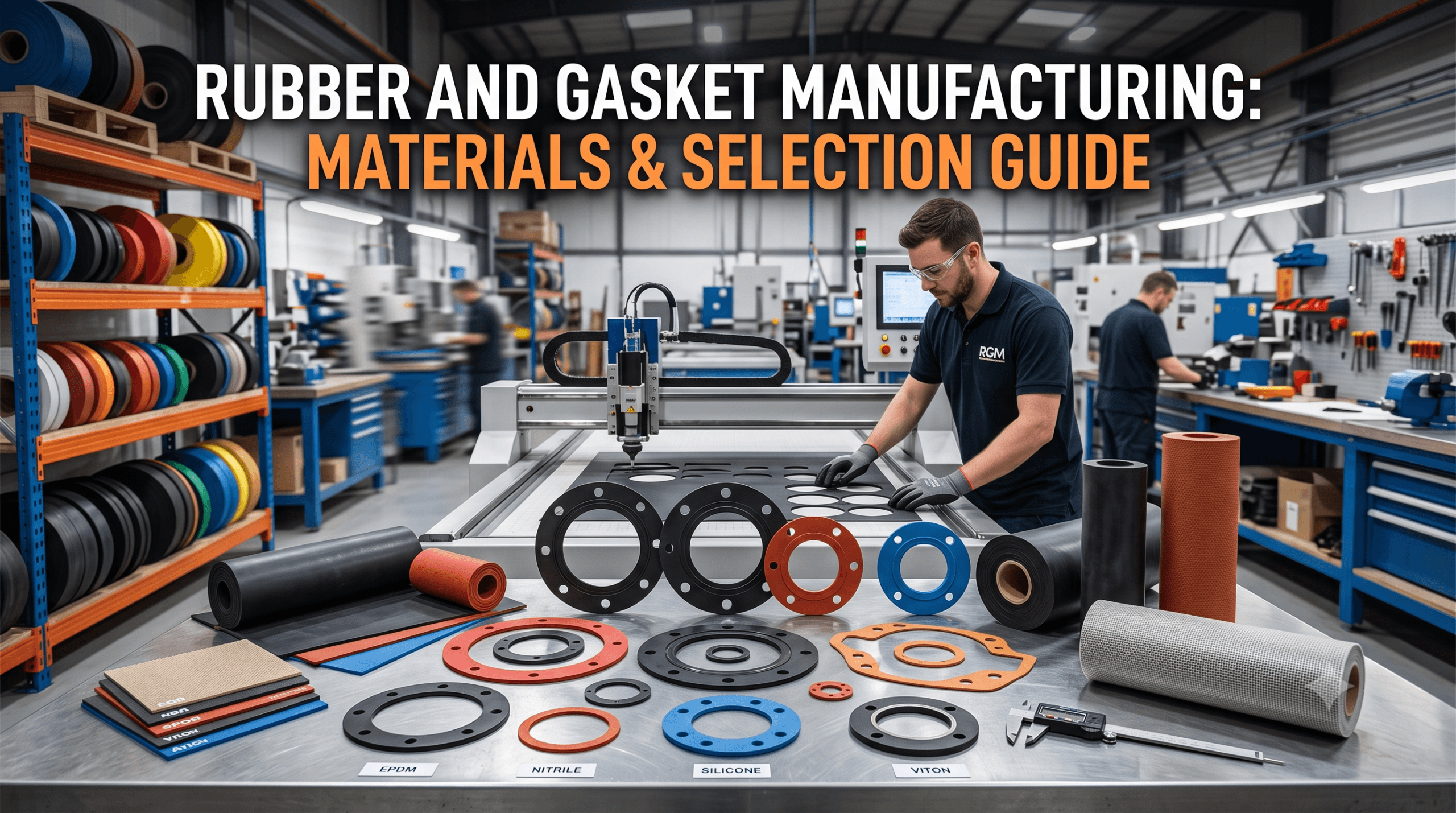
Rubber gaskets play a critical role in sealing systems across industries. From automotive engines to industrial pipelines and medical equipment, the right gasket prevents leaks, withstands harsh operating conditions, and extends equipment life.
Choosing the wrong material can lead to premature failure, costly downtime, and safety risks. Understanding the properties of different rubber compounds and the manufacturing processes behind them helps engineers, buyers, and maintenance teams select the best solution for their application.
What Is a Rubber Gasket?
A rubber gasket is a sealing component placed between two mating surfaces to prevent the escape of liquids, gases, dust, or contaminants. When compressed, the gasket fills surface imperfections and creates a reliable seal.
Rubber gaskets are used in applications such as:
- Automotive engines and transmissions
- HVAC systems
- Water treatment equipment
- Oil and gas facilities
- Food and beverage processing
- Chemical manufacturing
- Electrical enclosures
- Marine equipment
The effectiveness of a gasket depends largely on selecting the right material for the operating environment.
Common Rubber Materials Used in Gasket Manufacturing
Different rubber compounds offer unique combinations of temperature resistance, chemical compatibility, flexibility, and durability.
Natural Rubber (NR)
Natural rubber offers excellent elasticity and abrasion resistance, making it suitable for general-purpose sealing.
Best for:
- Water applications
- Low-pressure sealing
- Vibration isolation
Advantages:
- Excellent flexibility
- High tensile strength
- Good wear resistance
- Cost-effective
Limitations:
- Poor resistance to oils and fuels
- Limited weather resistance
- Not suitable for ozone exposure
EPDM Rubber
EPDM (Ethylene Propylene Diene Monomer) is one of the most widely used gasket materials for outdoor and water-based applications.
Best for:
- Drinking water systems
- Steam applications
- HVAC equipment
- Outdoor installations
Advantages:
- Outstanding weather resistance
- Excellent UV resistance
- Good ozone resistance
- Performs well in hot water and steam
Limitations:
- Poor resistance to petroleum oils
- Not recommended for fuels
Nitrile Rubber (NBR)
Nitrile rubber is widely selected for applications involving petroleum products.
Best for:
- Hydraulic systems
- Fuel handling equipment
- Oil seals
- Automotive components
Advantages:
- Excellent oil resistance
- Good fuel resistance
- Strong mechanical properties
- Good abrasion resistance
Limitations:
- Moderate weather resistance
- Limited ozone resistance
Neoprene (CR)
Neoprene provides a balanced combination of weather resistance, mechanical strength, and chemical resistance.
Best for:
- Refrigeration systems
- Marine equipment
- Industrial machinery
Advantages:
- Good weather resistance
- Moderate oil resistance
- Flame-resistant properties
- Good mechanical strength
Limitations:
- Lower chemical resistance than specialty elastomers
Silicone Rubber
Silicone is commonly chosen for applications requiring extreme temperature performance and cleanliness.
Best for:
- Medical devices
- Food processing equipment
- Electronics
- Pharmaceutical manufacturing
Advantages:
- Wide operating temperature range
- Excellent flexibility
- Non-toxic grades available
- Excellent UV resistance
Limitations:
- Lower tear strength
- Poor resistance to many fuels and oils
Fluoroelastomer (FKM)
FKM is designed for demanding environments involving chemicals and high temperatures.
Best for:
- Chemical processing
- Aerospace
- Automotive engines
- Oil and gas equipment
Advantages:
- Excellent chemical resistance
- High temperature capability
- Outstanding fuel resistance
- Long service life
Limitations:
- Higher material cost
- Not suitable for certain steam applications
Rubber Gasket Manufacturing Processes
The manufacturing method influences gasket performance, consistency, and production cost.
Compression Molding
Compression molding is commonly used for medium and large production runs. The rubber compound is placed into a heated mold where pressure forms the final gasket.
Benefits include:
- Cost-effective tooling
- Suitable for thick components
- High material utilization
Injection Molding
Injection molding is ideal for producing high volumes of precision rubber gaskets with tight dimensional tolerances.
Benefits include:
- Fast production cycles
- Excellent repeatability
- Reduced material waste
- High production efficiency
Transfer Molding
Transfer molding combines aspects of compression and injection molding. It is often used for complex gasket geometries and components containing inserts.
Benefits include:
- Better dimensional accuracy
- Suitable for intricate designs
- Improved surface finish
Die Cutting
Flat sheet rubber can be die cut into custom gasket shapes quickly and economically.
Common applications include:
- Flange gaskets
- Electrical insulation
- Industrial sealing
- Packaging equipment
Waterjet Cutting
Waterjet cutting produces highly accurate custom gaskets without generating heat that could affect material properties.
Benefits include:
- Clean edges
- Excellent dimensional accuracy
- No tooling required for prototypes
- Suitable for small production runs
Factors to Consider When Selecting a Rubber Gasket Material
Selecting the right gasket requires evaluating the complete operating environment.
Temperature
Every rubber compound has a recommended operating temperature range. Exceeding these limits can lead to hardening, cracking, or loss of sealing performance.
Chemical Compatibility
The gasket material must resist degradation from oils, solvents, fuels, acids, alkalis, and cleaning chemicals encountered during service.
Pressure Requirements
High-pressure applications require materials with appropriate compression characteristics and mechanical strength.
Environmental Exposure
Outdoor installations should consider:
- UV radiation
- Ozone exposure
- Moisture
- Weathering
- Salt spray
Compression Set
Compression set measures how well a gasket returns to its original shape after prolonged compression. Lower compression set generally contributes to longer sealing performance.
Regulatory Compliance
Some industries require certified materials, including:
- Food-grade compounds
- Medical-grade silicone
- Drinking water approvals
- Flame-retardant materials
- Industry-specific regulatory compliance
Custom Rubber Gasket Manufacturing
Many applications require custom-designed gaskets rather than standard sizes.
Custom manufacturing may include:
- Unique shapes
- Special thicknesses
- Custom hardness (durometer)
- Adhesive backing
- Fabric reinforcement
- Metal inserts
- Multi-layer construction
Custom solutions help improve sealing performance while reducing installation issues.
Common Applications Across Industries
Rubber gaskets are used in nearly every industrial sector.
| Industry | Typical Applications |
|---|---|
| Automotive | Engines, transmissions, fuel systems |
| Aerospace | Hydraulic systems, environmental controls |
| Oil and Gas | Pipelines, valves, pumps |
| Chemical Processing | Tanks, reactors, piping systems |
| Food Processing | Mixers, filling equipment, conveyors |
| Water Treatment | Pumps, filters, pipe flanges |
| HVAC | Ductwork, compressors, chillers |
| Electronics | Enclosures, weatherproof seals |
Tips for Choosing the Right Rubber Gasket
Before selecting a gasket material, consider the following:
- Identify the operating temperature range.
- Confirm compatibility with all process fluids.
- Evaluate pressure requirements.
- Consider indoor or outdoor exposure.
- Review expected service life.
- Verify any industry certification requirements.
- Work with an experienced gasket manufacturer for custom applications.
Taking these factors into account helps reduce maintenance costs and improve equipment reliability.
Conclusion
Rubber gasket performance depends on selecting the right material for the application. Factors such as temperature, pressure, chemical exposure, environmental conditions, and regulatory requirements all influence material choice.
Whether using natural rubber for general sealing, EPDM for weather resistance, nitrile for oil exposure, silicone for high-temperature applications, or FKM for aggressive chemicals, understanding each material’s strengths and limitations helps ensure reliable, long-lasting performance.
Investing time in proper material selection and partnering with an experienced manufacturer can improve sealing reliability, reduce downtime, and extend the life of critical equipment.