Solar Battery Storage Systems for Commercial and Industrial Users
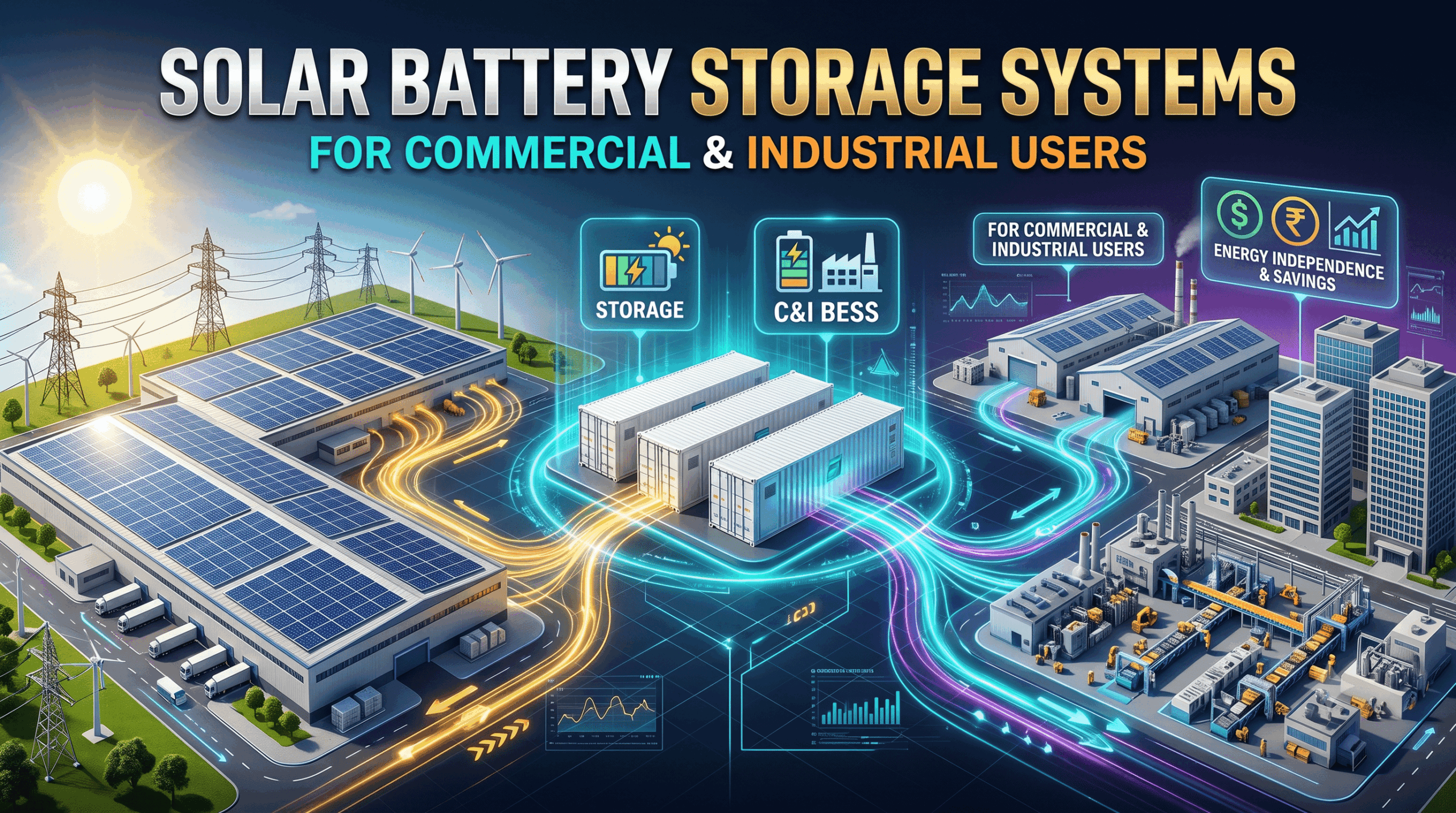
Commercial and industrial businesses are under growing pressure to manage electricity costs, maintain reliable operations, and reduce their carbon footprint. Solar power helps address these challenges, but solar panels alone cannot supply energy whenever a facility needs it. Production often continues after sunset, electricity demand can spike during peak hours, and power interruptions can disrupt critical operations.
Solar battery storage systems help bridge this gap by storing electricity when it is available and supplying it when demand increases or solar generation falls. For commercial and industrial (C&I) users, the right system can improve solar self-consumption, manage peak demand, support backup power, and provide greater control over energy costs.
In India, where businesses are increasingly exploring integrated renewable energy solutions, battery storage is becoming an important part of long-term energy planning. However, its financial value depends on electricity tariffs, load patterns, battery costs, and the way the system is operated.
What Are Solar Battery Storage Systems?
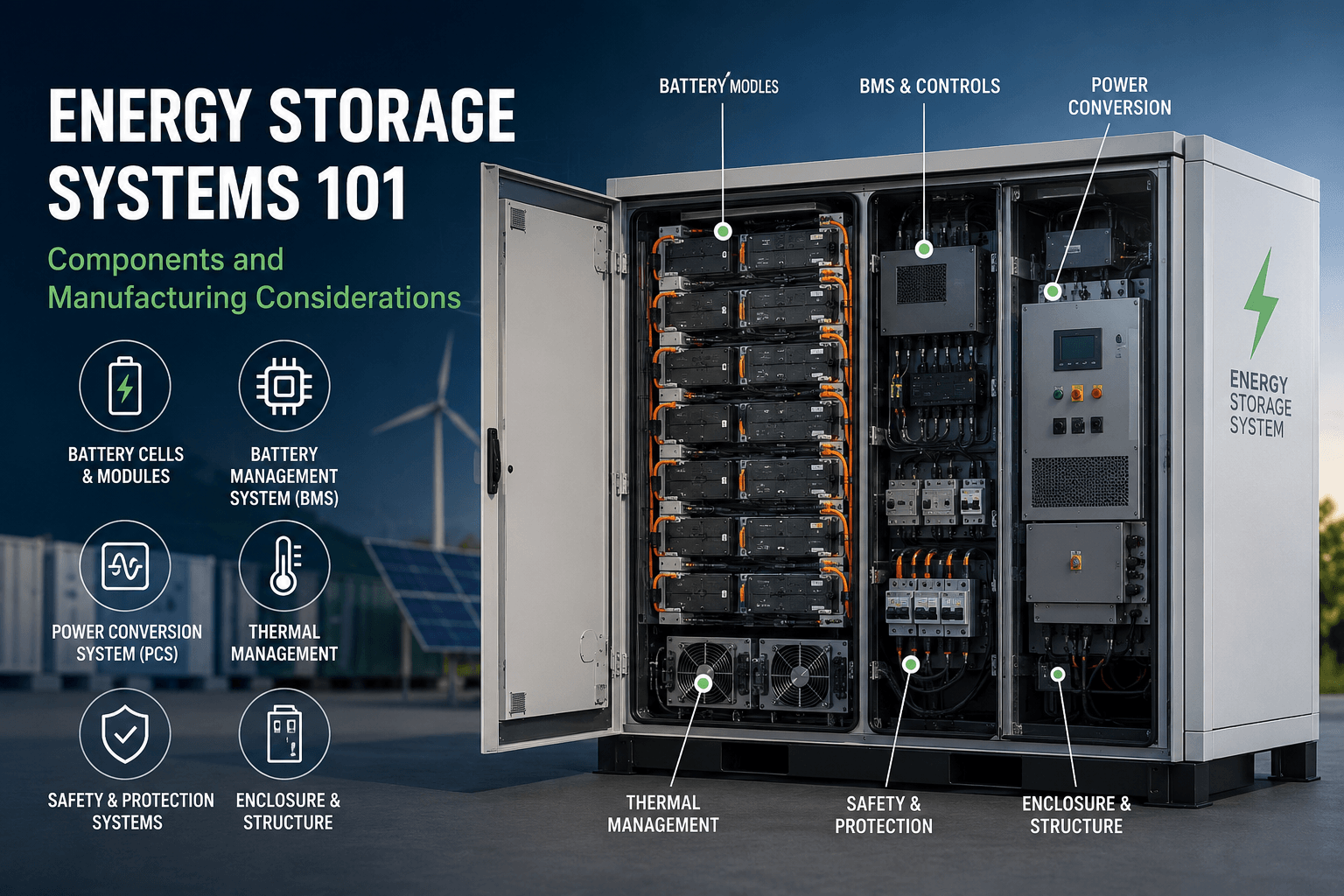
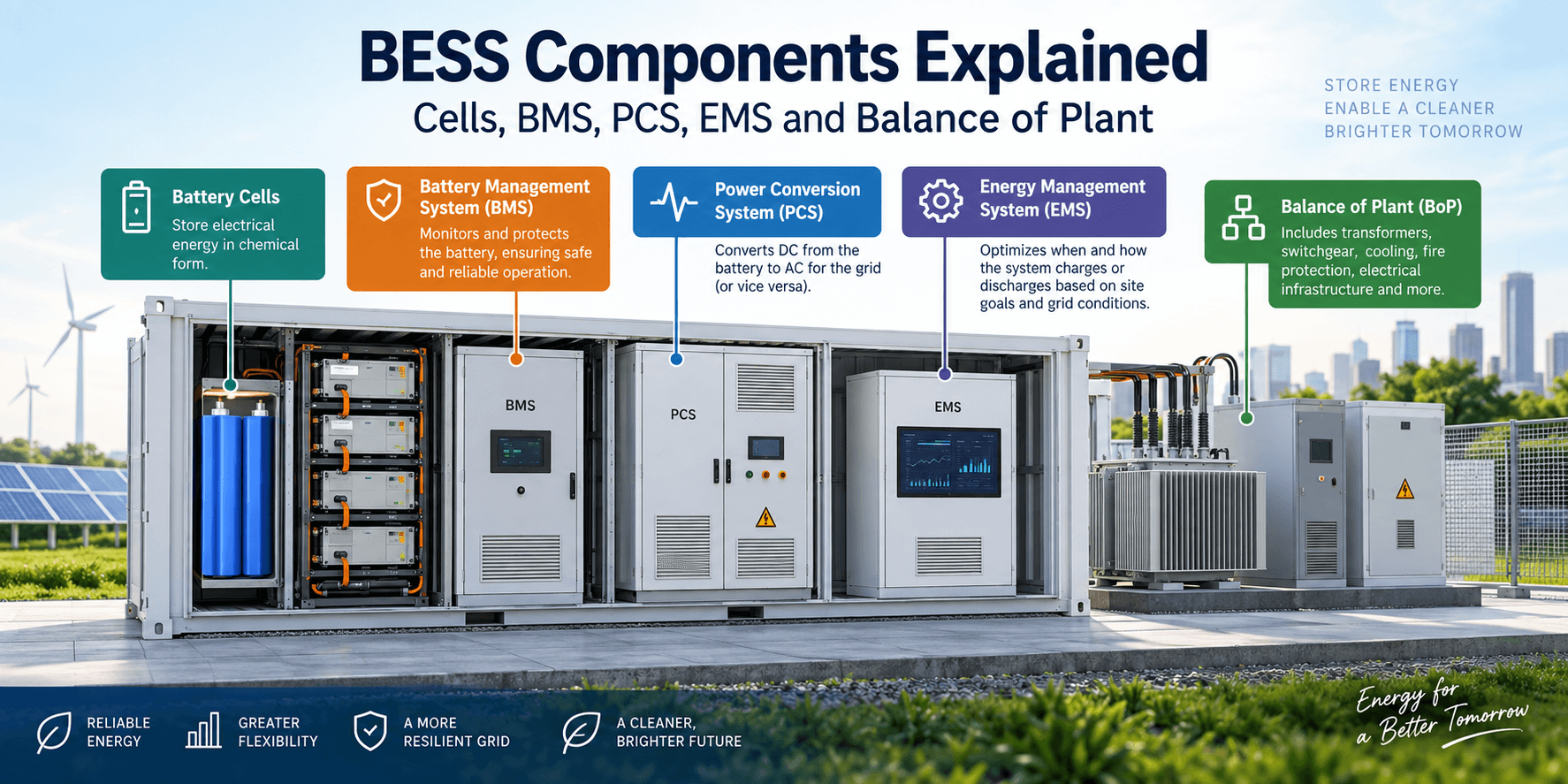
Solar battery storage systems store electricity generated by solar panels for use at a later time. They typically combine solar photovoltaic (PV) panels, batteries, power conversion equipment, a battery management system, and an energy management system.
Unlike a conventional solar installation that primarily supplies electricity during daylight hours, a solar-plus-storage system allows businesses to use some of their generated energy when sunlight is unavailable.
For commercial and industrial facilities, these systems can be configured to support different operating needs, including:
- Reducing electricity purchases during expensive peak periods.
- Storing excess daytime solar generation for later use.
- Supporting essential equipment during selected power interruptions.
- Managing changes in electricity demand.
- Improving the use of renewable energy across multiple shifts.
A battery storage system can also operate alongside grid electricity and, where appropriate, a diesel generator. The exact configuration depends on the facility’s power requirements and backup objectives.
How Solar Battery Storage Works in Commercial and Industrial Facilities
A commercial solar battery storage system works by coordinating solar generation, electricity consumption, battery charging, and battery discharge.
1. Solar Panels Generate Electricity
During daylight hours, solar panels generate electricity that can power machinery, lighting, air conditioning, computers, refrigeration systems, and other facility loads.
Using solar electricity directly can reduce the amount of power purchased from the grid.
2. Excess Solar Energy Charges the Battery
When solar generation exceeds immediate electricity demand, the surplus can charge the battery, provided the system has been designed to capture and store that energy.
Without suitable storage or another means of using the surplus, some solar generation may be exported to the grid or curtailed, depending on the installation and applicable rules.
3. Stored Energy Powers the Facility When Needed
When solar production declines or electricity demand rises, the battery can discharge to supply the connected loads.
This is particularly useful for businesses that operate into the evening, experience short periods of high demand, or want to reduce grid consumption during expensive tariff periods.
4. An Energy Management System Coordinates Operation
An energy management system (EMS) monitors electricity consumption, solar output, battery charge levels, and other operating conditions. It uses this information to determine when the battery should charge or discharge.
A well-configured EMS helps balance electricity savings, battery life, operational requirements, and backup reserves.
Key Benefits of Solar Battery Storage for Commercial and Industrial Users
The value of battery storage extends beyond simply saving solar energy for later. Businesses can use it to address several energy management challenges, although the benefits depend on the facility’s operating conditions.
1. Reduce Electricity Costs
Electricity can represent a significant operating expense for factories, warehouses, commercial buildings, hospitals, and data centres.
A battery can help reduce costs by storing electricity during lower-cost periods and supplying it when grid electricity is more expensive. When paired with solar, it can also increase the amount of self-generated renewable electricity used on-site.
Potential savings come from several sources:
- Lower electricity purchases during peak-price periods.
- Better utilisation of available solar generation.
- Reduced exposure to time-of-day tariff differences.
- Lower billed maximum demand, where the tariff structure and billing rules support demand-charge savings.
Businesses should evaluate each source of savings separately to avoid counting the same benefit twice.
2. Manage Peak Electricity Demand
Many industrial and commercial electricity bills include demand charges based on measured peak demand or contracted capacity.
For example, a manufacturing facility may experience a short demand spike when several machines start simultaneously. A properly sized battery can discharge during that interval to reduce the grid power drawn by the facility.
This practice is known as peak shaving.
The actual financial benefit depends on the utility’s demand measurement interval, billing methodology, contracted demand rules, and the battery’s ability to respond at the right time.
3. Improve Solar Energy Utilisation
Solar panels typically produce the most electricity during daylight hours. Businesses that consume most of their energy in the evening may be unable to use all their solar generation directly.
Battery storage helps move some of that energy from periods of high solar production to periods of higher demand.
This can be valuable for:
- Manufacturing plants with multiple shifts.
- Cold storage facilities operating around the clock.
- Commercial buildings with evening cooling requirements.
- Warehouses and logistics centres with extended operating hours.
- Facilities with limited or less favourable compensation for exported solar electricity.
The battery should be sized around the actual surplus available for charging. Installing a large battery does not automatically improve project returns if the solar system rarely produces enough excess energy to charge it.
4. Support Business Continuity During Power Interruptions
Power interruptions can affect production schedules, temperature-sensitive inventory, IT systems, and customer service.
A battery system designed for backup operation can supply selected critical loads during an outage. However, not every grid-connected solar-plus-battery installation can automatically provide backup power.
The system may require compatible inverters, islanding protection, appropriate switching equipment, and a dedicated backup-load configuration.
Businesses should identify which equipment must remain operational, the maximum power it requires, and the expected backup duration before selecting a system.
For long outages or loads requiring extended autonomy, retaining a generator may still be necessary.
5. Reduce Dependence on Diesel Generators
Many industrial facilities use diesel generators to manage unreliable grid supply or protect critical operations.
A solar battery storage system may reduce generator runtime by supplying energy during shorter interruptions and managing some fluctuations in demand. This can lower diesel consumption, maintenance requirements, noise, and local emissions.
However, batteries are not a universal replacement for generators. Extended outages, large motor loads, and high continuous power requirements may still require generator support.
The most suitable solution may be a hybrid arrangement combining solar, battery storage, grid power, and existing backup generation.
6. Support Sustainability and Energy Reporting
Businesses with renewable energy targets can use battery storage to increase the share of solar electricity consumed on-site.
This can contribute to emissions reduction when stored solar electricity displaces higher-emission grid electricity or diesel generation.
Companies should also account for charging sources, conversion losses, battery manufacturing impacts, and the emissions intensity of displaced electricity when evaluating environmental performance.
Battery storage supports sustainability goals most effectively when it is integrated into a broader energy strategy rather than treated as a standalone green technology.
Common Applications of Commercial and Industrial Solar Battery Storage
Different facilities have different energy requirements. The best battery configuration depends on how much electricity a business uses, when it uses it, and how sensitive its operations are to interruptions.
Manufacturing Plants
Manufacturing facilities may have large motors, production lines, compressors, and other equipment that create sharp demand peaks.
Battery storage can help manage these peaks, increase solar utilisation, and support selected control systems or essential equipment during short interruptions.
Facilities with continuous production should pay particular attention to power ratings, discharge duration, motor-starting requirements, and the consequences of an unexpected shutdown.
Warehouses and Logistics Centres
Warehouses often have substantial rooftop space for solar panels and daytime loads from lighting, conveyors, material-handling equipment, and charging infrastructure.
Battery storage can help align daytime solar generation with evening operations and manage charging demand where electric vehicles or material-handling equipment create concentrated loads.
Commercial Buildings and Office Campuses
Office buildings, IT parks, shopping centres, and business campuses often have significant cooling, lighting, and ventilation requirements.
A battery can help shift solar energy into later operating hours and manage peak demand associated with air conditioning.
Backup requirements should be defined separately for critical systems such as emergency lighting, communications, access control, and essential IT infrastructure.
Hospitals and Healthcare Facilities
Hospitals need reliable electricity for critical equipment, monitoring systems, refrigeration, lighting, and essential building services.
Battery storage can support selected loads when the system is engineered for backup operation. It should complement, not automatically replace, legally required backup arrangements and other established resilience measures.
Data Centres
Data centres have high electricity demand and strict requirements for continuity of service.
Battery storage can form part of a broader power architecture that includes uninterruptible power supplies (UPS), generators, grid connections, and energy management controls.
The battery’s role must be clearly defined. A UPS designed for immediate power continuity may have different requirements from a larger battery system intended to reduce peak demand or shift renewable energy.
Cold Storage and Food Processing
Cold storage facilities need dependable refrigeration to protect products and maintain temperature conditions.
Solar battery storage can help use renewable electricity beyond daylight hours and support selected refrigeration loads during interruptions. The system must be sized around compressor loads, starting currents, temperature limits, and the consequences of losing refrigeration.
Types of Battery Technologies for Commercial and Industrial Use
Choosing the right battery chemistry affects system cost, operating life, safety requirements, maintenance, and usable energy capacity.
Lithium Iron Phosphate (LFP)
Lithium iron phosphate batteries are widely considered for stationary commercial and industrial storage because of their cycle-life characteristics, thermal stability relative to several other lithium-ion chemistries, and suitability for frequent cycling.
They are often a strong candidate for solar-plus-storage projects that charge and discharge regularly.
However, LFP systems still require suitable thermal management, battery monitoring, protection systems, and installation practices.
Other Lithium-Ion Batteries
Other lithium-ion chemistries may be suitable for particular applications depending on energy density, power requirements, cost, and operating conditions.
Businesses should compare complete system performance rather than selecting a battery based on chemistry alone.
Lead-Acid Batteries
Lead-acid batteries have a long history in backup power applications and may suit some smaller or less frequently cycled systems.
For applications involving frequent deep cycling, their usable capacity, maintenance needs, space requirements, and replacement frequency should be compared carefully against alternatives.
For most projects, the decision should consider the total cost of ownership over the expected operating period, not only the initial purchase price.
How to Choose the Right Solar Battery Storage System
A battery that is too small may fail to deliver the expected savings or backup duration. A battery that is too large can increase upfront costs without creating enough additional value.
A structured assessment helps businesses avoid both problems.
1. Analyse Electricity Consumption
Start with at least 12 months of electricity bills and, ideally, interval-level consumption data.
Review:
- Daily and seasonal electricity consumption.
- Maximum demand and when it occurs.
- Daytime and evening load patterns.
- Time-of-day tariff differences.
- Contracted demand and applicable penalties.
- Existing solar generation and energy exports.
- The frequency and duration of power interruptions.
This analysis establishes whether the main opportunity is peak shaving, solar self-consumption, backup power, or a combination of uses.
2. Determine Battery Power and Energy Capacity
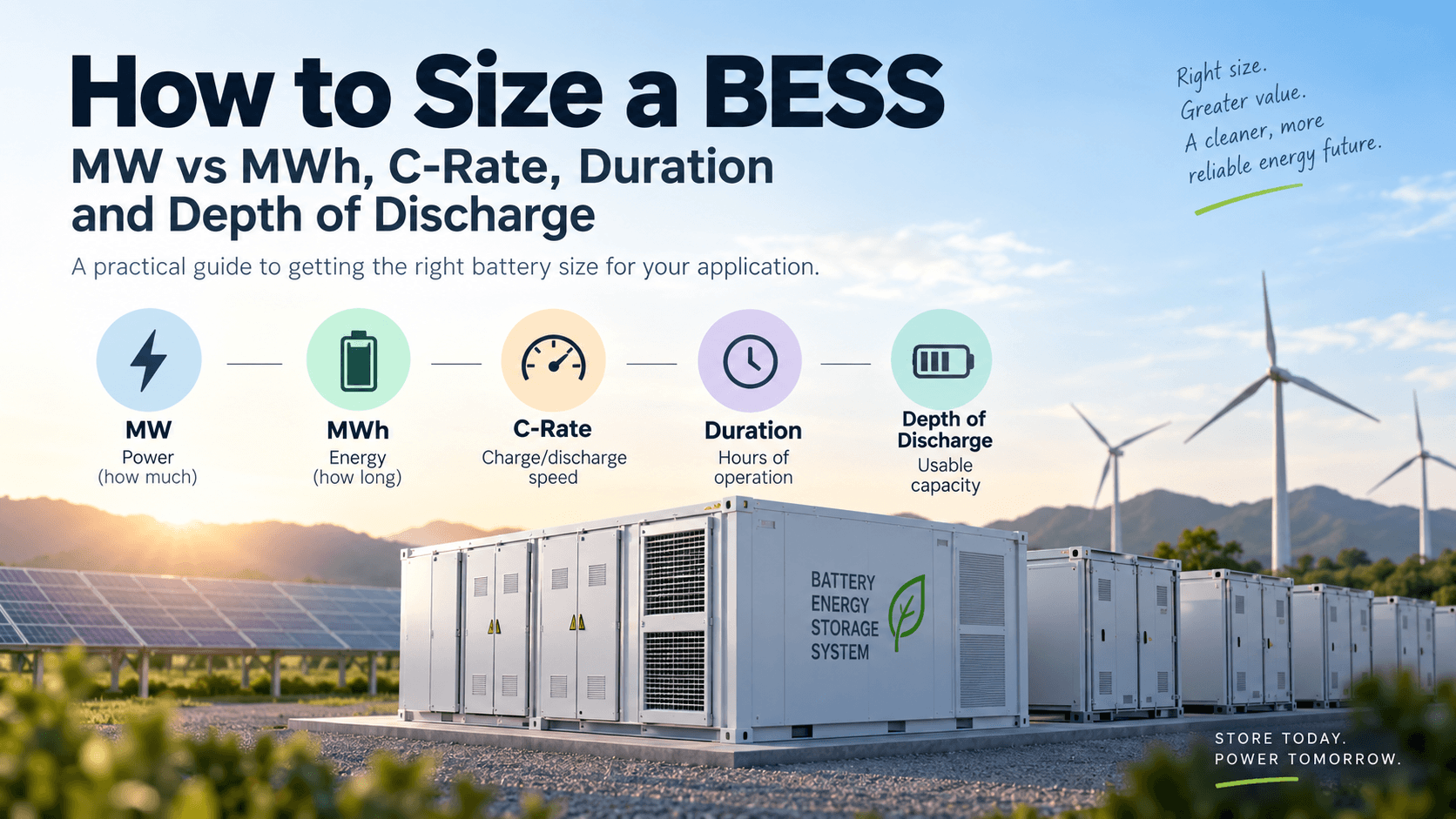
Battery power and energy capacity measure two different things.
Power capacity, measured in kW or MW, indicates how much electricity the system can deliver at a given moment.
Energy capacity, measured in kWh or MWh, indicates how much electricity it can store and deliver over time.
For example, a battery rated at 500 kW with 1,000 kWh of nominal energy capacity has a nominal energy-to-power ratio of two hours.
Actual discharge duration will depend on usable capacity, discharge limits, conversion losses, operating conditions, and the power being supplied.
Sizing should therefore reflect both the facility’s peak power requirement and the duration for which the battery must operate.
3. Check Solar Generation and Charging Opportunities
Review the solar system’s hourly generation profile alongside facility consumption.
The assessment should establish how much surplus energy is available, how often the battery can charge, and whether the battery can reach the required state of charge before the next peak period.
If grid charging is permitted and economically appropriate, the analysis should also consider off-peak electricity prices and charging losses.
4. Evaluate Inverter and Electrical Compatibility
The power conversion system (PCS) converts electricity between the battery’s direct-current supply and the alternating-current systems used by most commercial facilities.
Compatibility with existing solar inverters, transformers, switchgear, protection systems, and control equipment is important.
Businesses should also confirm whether the design supports grid-connected operation, backup operation, or both.
5. Review Safety and Installation Requirements
Battery installations require careful planning for electrical protection, fire safety, ventilation or thermal management, access, monitoring, and emergency response.
Before procurement, confirm that the proposed system complies with applicable local electrical, fire, building, and utility requirements.
Ask suppliers for relevant certifications, protection specifications, commissioning procedures, warranty terms, and emergency-response documentation.
6. Compare Warranty and Lifecycle Costs
The lowest-priced system may not deliver the lowest long-term cost.
Compare:
- Expected operating life and cycle limits.
- Guaranteed usable capacity and capacity degradation.
- Round-trip efficiency.
- Warranty conditions and exclusions.
- Maintenance and monitoring costs.
- Replacement costs and service availability.
- End-of-life handling and recycling arrangements.
These factors affect how much usable energy the battery can deliver throughout its service life.
Understanding the ROI of Solar Battery Storage Systems
The financial case for battery storage depends on how the facility uses electricity and which savings the system can reliably generate.
A practical evaluation should estimate annual benefits and compare them with the full cost of installation and operation.
Main Factors That Affect Payback
Electricity tariff: Larger differences between peak and off-peak prices can improve the value of energy shifting.
Demand charges: Facilities with high demand charges may benefit when the battery consistently reduces billed peak demand.
Solar surplus: More usable excess solar generation can create additional opportunities for self-consumption.
Battery utilisation: A system that cycles regularly for valuable purposes may generate more savings than one that remains idle for long periods.
System efficiency: Charging and discharging losses reduce the amount of electricity ultimately delivered.
Battery degradation: Usable capacity declines over time, which can affect future savings.
Installed cost: Battery equipment, inverters, electrical integration, civil works, safety systems, and commissioning all contribute to the project cost.
A Simple Example of Battery Energy Savings
Consider a facility that delivers 500 kWh of battery energy to its loads each operating day. Assume the battery is charged from electricity that would otherwise have been exported or used at a lower-value time.
For illustration, suppose the avoided electricity cost is ₹8 per kWh and the effective charging energy costs ₹3 per kWh, after accounting for the charging energy required to deliver the stored electricity.
The gross energy-arbitrage benefit would be:
- Delivered energy per day: 500 kWh
- Value of avoided electricity: 500 × ₹8 = ₹4,000
- Cost of charging energy: 500 × ₹3 = ₹1,500
- Gross daily benefit: ₹2,500
Over 300 operating days, the gross annual benefit would be ₹7,50,000.
This is an illustrative calculation, not a guaranteed saving or a project payback estimate. It excludes demand-charge savings, fixed costs, battery degradation, maintenance, financing, taxes, and the opportunity cost of solar electricity that could otherwise have been used directly.
A proper financial model should also account for whether the assumed charging and avoided-energy prices apply to the facility’s actual tariff and operating schedule.
Challenges Businesses Should Consider Before Investing
Battery storage can create meaningful operational and financial benefits, but not every facility will achieve an attractive return.
High Initial Investment
Commercial battery systems require investment in batteries, conversion equipment, controls, protection systems, installation, and commissioning.
Businesses should compare the expected lifecycle savings with the total installed cost and assess ownership, financing, and service options.
Battery Degradation
Batteries lose usable capacity as they age and cycle. Operating temperature, charging practices, discharge depth, and cycling frequency can affect degradation.
Financial models should use realistic capacity assumptions and include any augmentation or replacement costs required during the project’s life.
Safety and Space Requirements
Battery systems need appropriate locations, electrical protection, thermal management, and access for inspection and maintenance.
The installation must reflect the specific equipment, site layout, environmental conditions, and applicable safety requirements.
Tariff and Regulatory Uncertainty
Electricity tariffs, demand-charge structures, export compensation, and grid-interconnection requirements can change.
In India, the relevant state electricity regulations and distribution utility rules should be reviewed before investment. A project that looks attractive under one tariff structure may deliver different savings under another.
Integration With Existing Infrastructure
Facilities with existing solar systems, generators, UPS equipment, or building management platforms may need additional controls and electrical upgrades.
Early coordination between the battery supplier, electrical contractor, solar EPC provider, and facility team can reduce integration problems.
Solar Battery Storage vs Conventional Backup Power
Solar battery storage and diesel generators serve overlapping but different purposes.
| Factor | Solar Battery Storage | Diesel Generator |
|---|---|---|
| Energy source | Stored electricity from solar or the grid | Diesel fuel |
| Response | Can supply power rapidly when properly configured | Requires starting and synchronisation |
| Routine operation | Can shift energy and manage demand | Primarily used for backup or specific operating needs |
| Local emissions | No direct exhaust emissions during discharge | Produces exhaust emissions during operation |
| Extended outages | Limited by stored energy and recharge opportunities | Can operate longer with sufficient fuel and maintenance |
| Ongoing requirements | Battery monitoring, thermal management, and electrical maintenance | Fuel storage, engine servicing, and fuel supply |
For many commercial and industrial facilities, the most suitable option is not necessarily one or the other. A hybrid solution can use batteries for rapid response, short interruptions, and energy management while retaining generators for prolonged outages.
The Future of Solar Battery Storage for Commercial and Industrial Users
Commercial and industrial energy management is moving toward integrated systems that coordinate renewable generation, storage, grid electricity, and flexible demand.
In India, this shift is reflected in the growing focus on combining solar power with battery energy storage to improve renewable energy utilisation and manage changing electricity demand. Industry coverage has also highlighted the importance of evaluating storage alongside tariffs, open-access procurement, and existing energy infrastructure rather than treating it as a separate purchase.
Several developments are likely to influence adoption:
- Smarter energy management: Control systems can use consumption and tariff data to improve charging and discharging decisions.
- Greater renewable integration: Storage can help businesses use more solar electricity outside daylight hours.
- Flexible energy procurement: Businesses can assess rooftop solar, open-access renewable electricity, and storage as parts of one energy strategy.
- Improved operational resilience: Properly configured systems can support critical loads and reduce reliance on generators for selected applications.
- More detailed financial assessment: Businesses are increasingly evaluating storage based on the value of individual services, rather than assuming every installation delivers the same return.
The most successful projects will be those designed around actual operating data, clear financial objectives, and realistic technical requirements.
Conclusion
Solar battery storage systems offer commercial and industrial users a practical way to manage electricity costs, increase solar energy utilisation, and improve control over their power supply.
Their value depends on more than battery capacity or equipment pricing. Businesses need to understand when electricity is consumed, how demand charges are calculated, how much solar energy is available for storage, and what level of backup their operations require.
Before investing, conduct a detailed load analysis, compare system configurations, verify safety and regulatory requirements, and model savings across the battery’s expected operating life.
With the right design and operating strategy, solar battery storage can become a useful part of a broader energy management plan, helping businesses balance cost, reliability, and sustainability.
Frequently Asked Questions
What is a solar battery storage system for commercial use?
It is a system that stores electricity generated by solar panels or supplied by the grid for later use. Commercial facilities can use it to increase solar self-consumption, manage peak demand, and supply selected loads during power interruptions when the system supports backup operation.
Can industrial solar batteries reduce electricity bills?
Yes. Savings may come from reduced peak-period electricity purchases, greater solar self-consumption, and lower billed maximum demand where the tariff structure allows it. The results depend on electricity prices, the facility’s load profile, battery efficiency, and operating strategy.
How long can a commercial solar battery provide backup power?
Backup duration depends on usable battery capacity and the connected load. A battery supplying 100 kW from 200 kWh of usable energy could theoretically run that load for two hours, before allowing for additional losses, operating limits, and reserve requirements.
Which battery technology is suitable for industrial solar storage?
Lithium iron phosphate batteries are a common option for commercial and industrial stationary storage. However, the right choice depends on operating requirements, safety, lifecycle costs, warranty coverage, and compatibility with the electrical system.
Can solar battery storage replace diesel generators?
It can reduce generator use in some applications, particularly for shorter interruptions and selected critical loads. It may not replace generators where outages are prolonged or loads require substantial continuous power. A hybrid system may offer a more practical solution.
Is solar battery storage worth the investment for every business?
No. The investment is more attractive when a facility has valuable peak-demand savings, sufficient solar surplus, meaningful tariff differences, or a clear need for backup power. A site-specific financial and technical assessment is necessary before making a decision.