
Sodium-Ion vs Lithium-Ion Batteries: Which Wins for Stationary Storage?
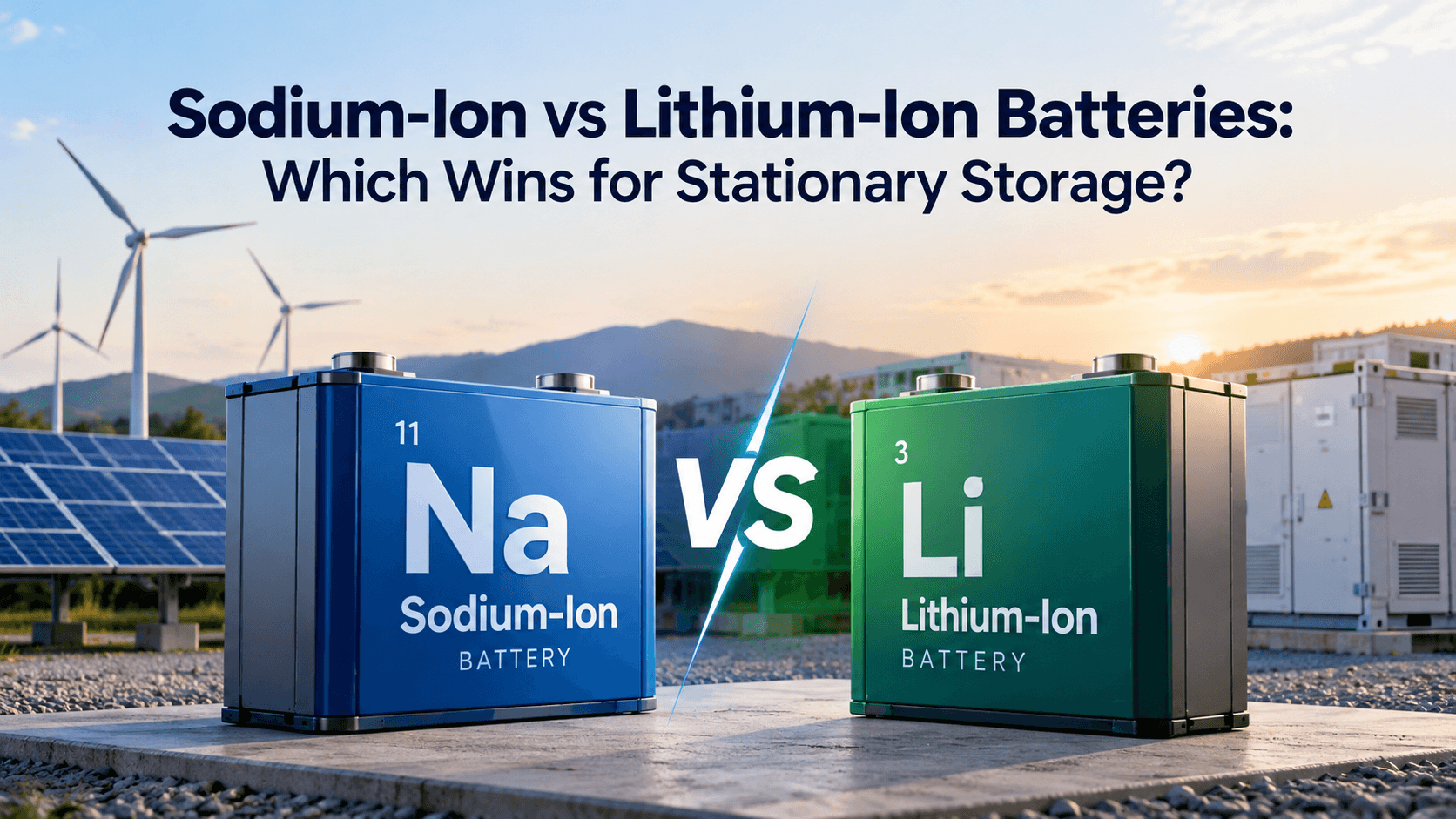
For most stationary energy storage projects today, lithium-ion batteries remain the stronger all-around choice. They offer higher energy density, a mature supply chain, proven performance, and extensive deployment experience.
But sodium-ion batteries are becoming a serious alternative, particularly where cost, safety, cold-weather performance, and reduced dependence on lithium and other constrained materials matter more than compact size.
The better technology depends on the application. A grid-scale battery connected to a solar farm has very different requirements from a battery installed inside a commercial building.
What makes stationary storage different?
Stationary batteries do not need to move.
That simple distinction changes the technology trade-off. Electric vehicles need batteries that pack as much energy as possible into a limited space and weight. Stationary systems can often afford a larger physical footprint.
This gives sodium-ion batteries an opportunity.
Sodium is abundant and widely available, while lithium-ion batteries benefit from years of manufacturing scale and optimization. For stationary storage, the lower energy density of sodium-ion can be less important if there is enough available space.
The main questions are therefore:
- How much does the system cost over its operating life?
- How safely can it operate?
- How long will it last?
- How much space does it require?
- How efficiently does it charge and discharge?
- How easily can the system be manufactured and scaled?
- What happens to performance in different climates?
Sodium-ion vs lithium-ion: key differences
| Factor | Sodium-ion | Lithium-ion |
|---|---|---|
| Energy density | Generally lower | Generally higher |
| Material availability | Sodium is abundant | Lithium supply is more constrained |
| Manufacturing maturity | Emerging | Highly mature |
| Cost potential | Strong long-term potential | Competitive today |
| Safety | Potentially favorable depending on chemistry and design | Varies significantly by chemistry |
| Cold-weather performance | Can be an advantage for some chemistries | Performance varies by chemistry |
| Cycle life | Chemistry-dependent | Chemistry-dependent |
| Space requirements | Usually higher | Usually lower |
| Supply chain | Developing | Extensive global ecosystem |
| Stationary storage fit | Very promising | Excellent and proven |
These are broad comparisons. Battery performance depends heavily on the specific cell chemistry, system design, operating conditions, and manufacturer.
Energy density: lithium-ion has the advantage
Energy density is one of lithium-ion’s biggest strengths.
A lithium-ion battery can generally store more energy in a given amount of space than a sodium-ion battery. That matters when a project has limited land or when reducing the size of battery enclosures, cooling systems, and supporting infrastructure is important.
For stationary storage, however, energy density is not always the deciding factor.
A utility-scale solar-plus-storage project may have enough land for additional battery containers. In that situation, accepting a larger footprint could make sense if sodium-ion delivers advantages elsewhere.
For urban commercial installations, data centers, or buildings with limited space, lithium-ion’s compact footprint can remain a major benefit.
Cost: sodium-ion has an interesting path
Cost comparisons are more complicated than comparing the price of individual cells.
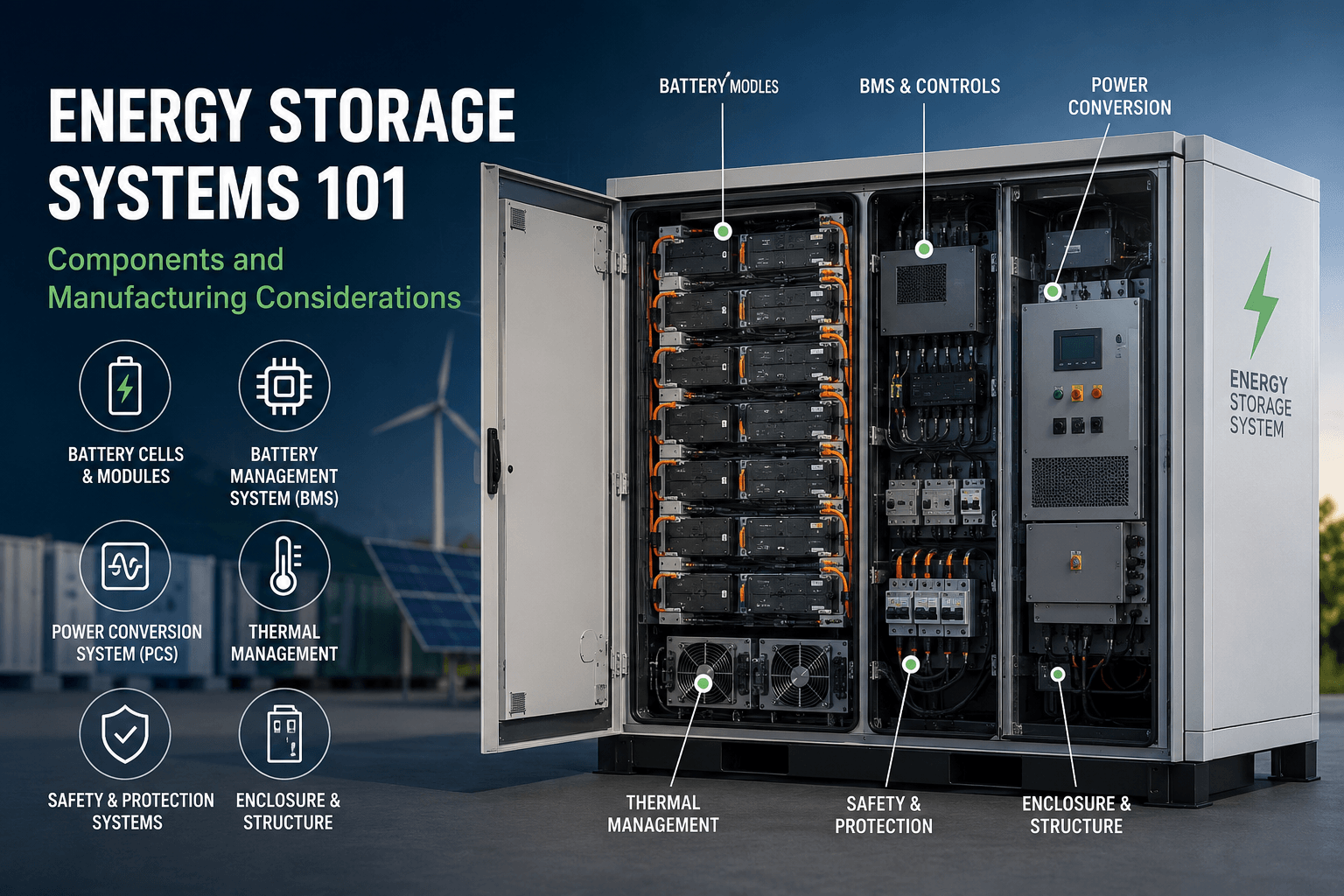
A complete storage system includes:
- Battery cells
- Modules and racks
- Battery management systems
- Thermal management
- Inverters
- Enclosures
- Fire protection
- Installation
- Maintenance
- Replacement costs
- Financing and operating costs
Sodium-ion’s biggest economic argument comes from its underlying materials.
Sodium is abundant, and sodium-ion cells can reduce or avoid reliance on some materials used in particular lithium-ion chemistries. That could make sodium-ion attractive as manufacturing scales.
However, lithium-ion currently benefits from enormous manufacturing scale and a mature supply chain. Lower theoretical material costs do not automatically translate into lower installed system costs.
For buyers, the important metric is not simply battery cost per kWh. It is the total cost of ownership over the expected operating life.
Safety: chemistry matters more than the label
It is tempting to say that sodium-ion is simply safer than lithium-ion. That is too broad.
Both technologies can be engineered into safe stationary storage systems, and both require appropriate battery management, thermal controls, monitoring, enclosure design, and fire protection.
Lithium-ion also represents a broad family of chemistries. Lithium iron phosphate, for example, has different characteristics from nickel-manganese-cobalt chemistry.
Sodium-ion cells may offer favorable thermal and safety characteristics in some designs, but system-level safety still depends on how the battery is engineered and operated.
For a commercial or utility project, evaluate the complete energy storage system, not just the cell chemistry.
Lifespan and cycle life
Stationary batteries can spend years performing relatively predictable charge and discharge cycles.
That makes cycle life extremely important.
Lithium-ion has a substantial track record in stationary applications, especially lithium iron phosphate systems. Manufacturers have optimized cell designs and operating strategies for applications such as:
- Solar energy shifting
- Peak shaving
- Frequency regulation
- Backup power
- Microgrids
- Renewable energy integration
Sodium-ion technology is newer, so long-term field data is less extensive.
That does not mean sodium-ion cannot achieve competitive cycle life. It means buyers should examine independently verified cycle-life data and warranty conditions rather than relying on chemistry-level assumptions.
Cold-weather performance
Temperature can significantly affect battery performance.
Some sodium-ion chemistries have demonstrated promising low-temperature behavior, which could make them attractive for storage projects operating in cold environments.
Lithium-ion systems can also be designed for cold climates, but they may require additional thermal management to maintain performance.
For projects in regions with harsh winters, temperature performance should therefore be part of the technology selection process rather than treated as an afterthought.
Supply chain and resource availability
This is one of sodium-ion’s strongest strategic arguments.
Lithium-ion battery production has grown rapidly, but the industry depends on global supply chains for lithium and, depending on the chemistry, other critical materials.
Sodium is far more abundant.
That does not mean sodium-ion batteries have no supply-chain challenges. The technology still needs specialized manufacturing equipment, cathode materials, anodes, electrolytes, separators, and other components.
The advantage is that sodium-ion could diversify the battery supply chain and reduce dependence on some materials that face greater resource or geopolitical constraints.
For large-scale energy infrastructure, that diversification can have strategic value beyond the battery’s upfront price.
Where lithium-ion makes more sense
Lithium-ion is generally the safer choice when a project prioritizes proven technology, compact installations, and a mature supplier ecosystem.
It is particularly well suited to:
Commercial and industrial storage
Businesses often have limited physical space and need predictable performance. Lithium-ion’s energy density and established installation ecosystem make it a strong fit.
Data centers
Data centers place a premium on reliability, power density, monitoring, and proven infrastructure. Lithium-ion systems have a significant deployment history in this market.
Urban energy storage
When land and floor space are expensive, lithium-ion’s higher energy density can offset some of its material and supply-chain disadvantages.
Projects requiring established financing and warranties
Banks, insurers, developers, and EPC contractors are generally more familiar with established lithium-ion technologies. That familiarity can reduce project risk.
Where sodium-ion could win
Sodium-ion becomes more compelling when space is relatively inexpensive and the project benefits from its material and performance characteristics.
Utility-scale renewable storage
Large solar and wind projects can often accommodate additional battery capacity. In these applications, energy density may matter less than cost, durability, safety, and supply-chain resilience.
Cold climates
Projects exposed to low temperatures may benefit from sodium-ion’s favorable low-temperature characteristics in suitable chemistries.
Long-duration storage
As sodium-ion technology develops, it could become increasingly attractive for applications where storing energy for longer periods matters more than minimizing the physical footprint.
Cost-sensitive deployments
If manufacturing reaches sufficient scale, sodium-ion could become a strong option for projects where minimizing lifetime storage costs is the primary objective.
The real comparison is project economics
The biggest mistake in choosing between sodium-ion and lithium-ion is asking, “Which battery is better?”
The more useful question is:
“Which battery produces the best economics and operational performance for this specific storage project?”
Consider a simple example.
A solar farm has plenty of available land and needs several hours of energy storage. A sodium-ion system may require more physical space, but that may have little financial impact on the project.
Now consider a battery installed in a dense commercial building. The same increase in footprint could require additional construction, floor space, cooling capacity, or permitting work.
The chemistry that wins in the first project may lose in the second.
What buyers should compare
When evaluating proposals, look beyond the advertised battery price.
Ask vendors for:
- Usable energy capacity, not just nameplate capacity.
- Round-trip efficiency under realistic operating conditions.
- Expected cycle life at the intended depth of discharge.
- Calendar life and degradation assumptions.
- Performance at different temperatures.
- Warranty terms and degradation guarantees.
- Safety certifications and testing.
- Expected auxiliary power consumption.
- Replacement and augmentation requirements.
- Total installed cost and projected lifetime cost.
A battery that costs less per kWh but degrades faster or consumes more auxiliary energy may not be the cheapest system over its lifetime.
So, which wins?
Lithium-ion wins today on maturity, energy density, manufacturing scale, and deployment experience.
Sodium-ion has the stronger long-term case where abundant materials, supply-chain diversification, cold-weather performance, and potentially lower costs outweigh its lower energy density and newer manufacturing ecosystem.
For most buyers, this is not an either-or decision yet. Lithium-ion remains the benchmark, while sodium-ion is emerging as a credible second option for specific stationary storage applications.
The market may ultimately support both. Stationary storage is too diverse for a single battery chemistry to be optimal everywhere.
The smartest approach is to start with the project’s requirements, model lifetime economics, and then select the chemistry that fits the application rather than choosing a technology first.