
What Is a Lithium Iron Phosphate (LiFePO4) Battery?
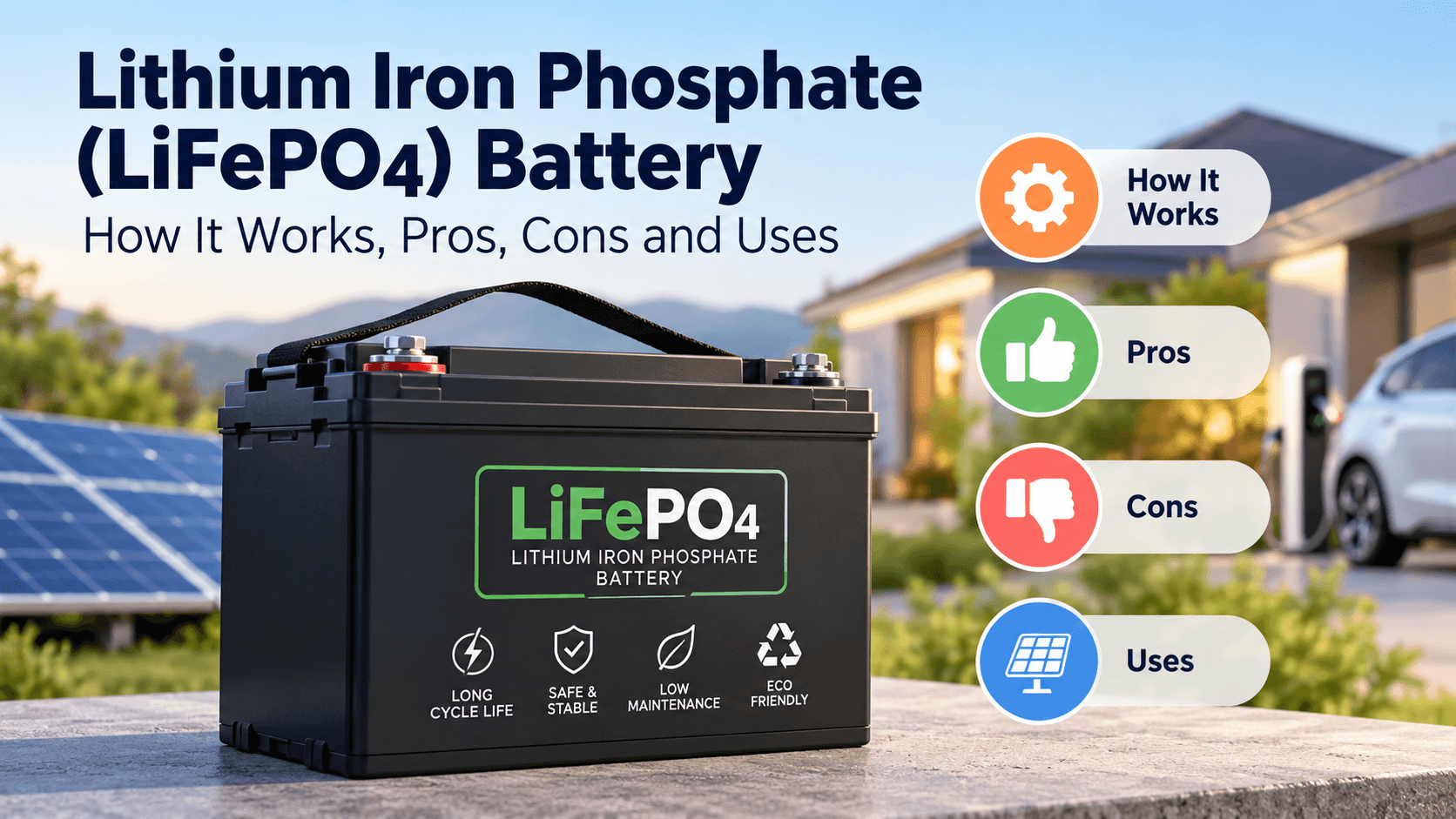
A lithium iron phosphate (LiFePO4 or LFP) battery is a type of rechargeable lithium-ion battery that uses lithium iron phosphate as the cathode material. It is known for its long cycle life, strong thermal stability, relatively high safety, and consistent performance.
LiFePO4 batteries are increasingly used in applications that need reliable energy storage, including solar power systems, electric vehicles, backup power, marine equipment, and industrial energy storage.
Unlike some other lithium-ion chemistries, LiFePO4 batteries typically prioritize safety, durability, and long service life over maximum energy density.
How Does a LiFePO4 Battery Work?
A LiFePO4 battery stores and releases electrical energy through the movement of lithium ions between the cathode and anode.
During charging, an external power source drives lithium ions from the cathode toward the anode. During discharge, the ions move back toward the cathode while electrons travel through the external circuit, producing usable electrical power.
A typical LiFePO4 battery contains four main components:
- Cathode: Made primarily from lithium iron phosphate.
- Anode: Usually made from graphite.
- Electrolyte: Allows lithium ions to move between the electrodes.
- Separator: Keeps the anode and cathode apart while allowing ions to pass through.
A battery management system (BMS) is also commonly used in LiFePO4 battery packs. It monitors factors such as voltage, temperature, and current and helps protect the cells from operating outside safe limits.
What Happens During Charging?
When the battery charges, lithium ions move from the LiFePO4 cathode to the graphite anode. Energy from the charger is stored in the battery through this electrochemical process.
The BMS can regulate charging and protect the battery from conditions such as overvoltage, excessive current, or unsafe temperatures.
What Happens During Discharging?
When the battery powers a device, lithium ions move back toward the cathode. Electrons travel through the external circuit, providing electricity to the connected load.
This process continues until the battery reaches its discharge limit.
Key Characteristics of LiFePO4 Batteries
LiFePO4 batteries have several characteristics that make them different from other lithium-ion battery chemistries.
| Characteristic | LiFePO4 Battery |
|---|---|
| Cathode chemistry | Lithium iron phosphate |
| Nominal cell voltage | About 3.2 V |
| Energy density | Moderate compared with some lithium-ion chemistries |
| Cycle life | Generally high |
| Thermal stability | Strong |
| Maintenance | Low |
| Rechargeable | Yes |
| Common uses | Solar storage, EVs, backup power, industrial systems |
Actual performance depends on the cell design, manufacturer, operating conditions, charging method, and battery management system.
Advantages of LiFePO4 Batteries
1. Long Cycle Life
One of the biggest advantages of LiFePO4 technology is its long cycle life.
A properly designed and operated LiFePO4 battery can withstand many charge and discharge cycles before its usable capacity declines significantly. This makes the chemistry attractive for applications where batteries are cycled frequently.
For solar energy storage, for example, a battery may be charged and discharged regularly. A long cycle life can reduce the need for frequent battery replacement.
2. Good Thermal Stability
LiFePO4 chemistry is known for good thermal and chemical stability compared with several other lithium-ion chemistries.
This contributes to its strong safety profile. However, “safer” does not mean risk-free. Poor-quality cells, damaged batteries, incorrect charging, manufacturing defects, or inadequate battery management can still create hazards.
3. Strong Safety Characteristics
LiFePO4 batteries are generally considered one of the more stable lithium-ion chemistries.
The phosphate-based cathode structure is relatively stable, which reduces the likelihood of thermal runaway under many abuse conditions compared with some other lithium-ion chemistries.
Battery design still matters. A complete battery pack should have appropriate protection, thermal management, cell balancing, and a suitable BMS.
4. High Usable Capacity
LiFePO4 batteries can typically be discharged to a greater depth than traditional lead-acid batteries without the same level of damage associated with deep discharge.
This can provide more usable energy from a battery of a given rated capacity.
The recommended depth of discharge still depends on the specific battery manufacturer’s specifications.
5. Low Maintenance
LiFePO4 batteries do not require the routine water replacement associated with flooded lead-acid batteries.
They are also less affected by some of the maintenance requirements associated with conventional battery technologies, making them useful for systems where regular maintenance is difficult.
6. Good Performance for High-Load Applications
LiFePO4 batteries can deliver substantial current when properly designed.
This makes them suitable for applications that require bursts of power, such as electric vehicles, inverters, power tools, and certain industrial systems.
The actual current capability depends heavily on the cells, BMS, wiring, thermal design, and battery pack configuration.
Disadvantages of LiFePO4 Batteries
LiFePO4 technology also has limitations.
1. Lower Energy Density Than Some Lithium-Ion Chemistries
LiFePO4 batteries generally have lower energy density than lithium-ion chemistries such as nickel manganese cobalt oxide (NMC).
That means a LiFePO4 battery may need more space or weight to store the same amount of energy.
For stationary energy storage, this may be a minor concern. For applications where weight and physical size are critical, it can be more important.
2. Higher Upfront Cost Than Lead-Acid
The purchase price of a LiFePO4 battery is often higher than that of a comparable lead-acid battery.
However, comparing only the initial purchase price can be misleading. Longer cycle life, higher usable capacity, lower maintenance, and better efficiency can affect the total cost of ownership.
3. Performance in Very Cold Conditions
Low temperatures can affect LiFePO4 battery performance.
Charging a LiFePO4 battery below its specified temperature range can cause permanent damage to the cells. Many battery packs therefore use temperature monitoring and charging protection.
For cold environments, the battery system may require additional heating or other temperature-management measures.
4. Requires Battery Management
A LiFePO4 battery pack needs appropriate control and protection.
A BMS can monitor individual cell voltages, temperature, current, and other operating conditions. Poorly designed protection electronics can reduce both safety and battery life.
5. Not Ideal for Every Application
LiFePO4 is an excellent choice for many energy-storage applications, but it is not automatically the best battery chemistry for every product.
Applications that prioritize maximum energy density or very low weight may favor another chemistry.
LiFePO4 vs. Other Battery Chemistries
Battery chemistry should be selected based on the requirements of the application rather than a simple “best battery” ranking.
| Factor | LiFePO4 | Lead-Acid | NMC Lithium-Ion |
|---|---|---|---|
| Cycle life | High | Lower | High |
| Energy density | Moderate | Low | High |
| Thermal stability | High | Moderate | Lower than LFP |
| Maintenance | Low | Can be higher | Low |
| Weight | Relatively low | High | Relatively low |
| Upfront cost | Higher | Lower | Higher |
| Common applications | Storage, EVs, backup power | Backup, automotive, low-cost storage | EVs, electronics, power tools |
The right choice depends on factors such as cost, available space, required power, expected cycle frequency, operating temperature, and desired service life.
Common Uses of LiFePO4 Batteries
Solar Energy Storage
LiFePO4 batteries are widely used in residential and commercial energy-storage systems.
They can store electricity generated by solar panels during the day and provide power when solar generation falls or electricity demand rises.
Their long cycle life makes them particularly suitable for applications involving regular charging and discharging.
Electric Vehicles
LFP batteries are used in various electric vehicles.
Their safety characteristics, durability, and potentially lower material costs make them attractive for vehicles where maximum range per kilogram is not the only design priority.
Backup Power
LiFePO4 batteries can provide backup electricity for homes, offices, telecommunications equipment, and other critical systems.
Compared with traditional lead-acid backup batteries, their longer cycle life and lower maintenance requirements can make them attractive for frequently cycled backup systems.
Recreational Vehicles and Marine Systems
LiFePO4 batteries are also popular in RVs, boats, and off-grid systems.
Their relatively low weight and ability to provide substantial usable capacity can be valuable where space and payload are limited.
Portable Power Stations
Many modern portable power stations use LiFePO4 cells because of their long cycle life and safety characteristics.
They can power devices such as laptops, lights, appliances, and other equipment during camping, travel, outdoor work, or emergencies.
Industrial Energy Storage
Businesses and industrial facilities can use LiFePO4 battery systems for energy storage, peak-demand management, renewable energy integration, and backup power.
How Long Do LiFePO4 Batteries Last?
The service life of a LiFePO4 battery depends on factors such as:
- Depth of discharge
- Charge and discharge rates
- Operating temperature
- Charging practices
- Cell quality
- Battery management
- Storage conditions
- Overall battery design
Cycle life is therefore not a single number that applies to every LiFePO4 battery.
A high-quality battery operated within its recommended limits can provide many years of service, particularly in applications with controlled temperatures and moderate operating conditions.
How Should a LiFePO4 Battery Be Charged?
LiFePO4 batteries should be charged using a charger and charging profile designed for LiFePO4 chemistry.
Using an unsuitable charger can result in poor performance or battery damage.
A properly designed system should also account for:
- Maximum charging voltage
- Charging current
- Battery temperature
- Cell balancing
- BMS protection
- Manufacturer specifications
Do not assume that a charger designed for one battery chemistry is suitable for another.
Are LiFePO4 Batteries Safe?
LiFePO4 batteries have a strong safety profile, but no rechargeable battery is completely risk-free.
Safety depends on more than the chemistry itself. Cell quality, pack construction, electrical protection, charging equipment, temperature control, and the BMS all play important roles.
For commercial or high-power systems, the battery should be designed, installed, and maintained according to applicable electrical and safety requirements.
Is a LiFePO4 Battery Worth It?
For many applications, yes.
LiFePO4 can be a strong option when long cycle life, safety, low maintenance, and reliable energy storage are more important than achieving the highest possible energy density.
It is particularly well suited to solar storage, backup power, RV and marine systems, and many electric-vehicle applications.
The higher initial cost can also make sense when the battery will be cycled frequently over several years.
Final Thoughts
LiFePO4 batteries have become an important lithium-ion technology because they offer a practical combination of safety, durability, usable capacity, and long cycle life.
They are not the perfect choice for every application. Their lower energy density and higher upfront cost can matter when space, weight, or initial budget are the primary constraints.
For energy-storage applications where reliability and long service life matter, however, LiFePO4 is one of the most compelling battery chemistries available today.
Frequently Asked Questions
Is LiFePO4 better than lithium-ion?
LiFePO4 is itself a type of lithium-ion battery chemistry. Compared with other lithium-ion chemistries, it generally offers strong thermal stability and long cycle life, while giving up some energy density.
Can LiFePO4 batteries be discharged completely?
They can tolerate deeper discharge than many traditional lead-acid batteries, but regularly reaching a battery’s absolute minimum voltage is not recommended unless the manufacturer specifically permits it.
Can LiFePO4 batteries be used with solar panels?
Yes. LiFePO4 batteries are commonly used for solar energy storage. The solar charging system must use appropriate charge-control settings and be compatible with the battery’s specifications.
Can LiFePO4 batteries catch fire?
LiFePO4 chemistry is relatively thermally stable compared with several other lithium-ion chemistries, but battery fires are still possible under severe abuse, damage, defects, or improper charging. Proper battery design and protection are essential.
Why are LiFePO4 batteries popular for solar storage?
Their long cycle life, high usable capacity, low maintenance requirements, and good safety characteristics make them well suited to applications where the battery is charged and discharged regularly.