

Zinc & Aluminum Price Trends 2026: A Sourcing Guide for Indian Manufacturers
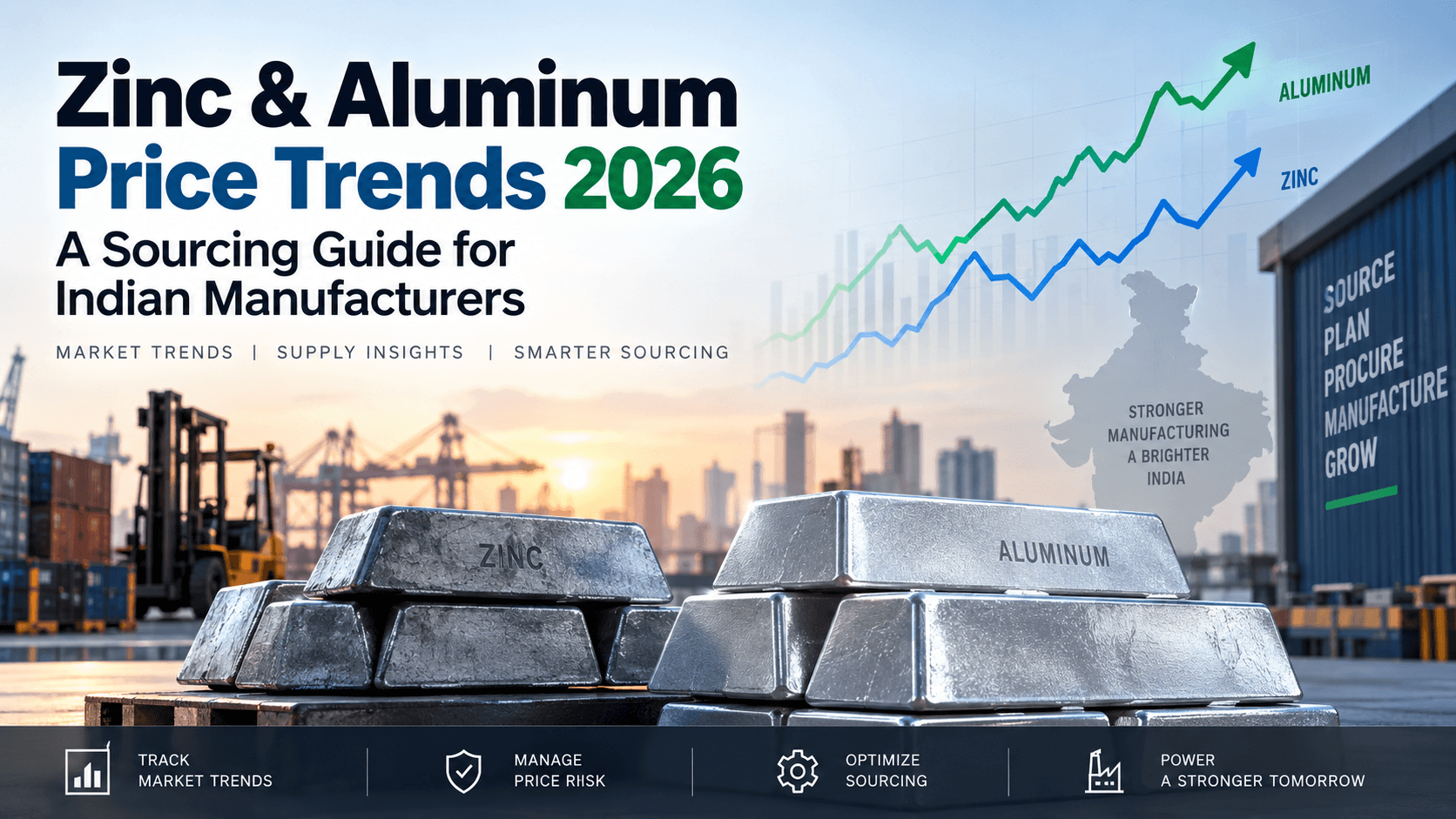
For Indian manufacturers, zinc and aluminum prices in 2026 have become less about predicting the next monthly move and more about managing volatility intelligently.
Aluminum prices have moved sharply higher through parts of 2026, while zinc has also experienced significant swings. Global inventories, supply disruptions, energy costs, Chinese demand, currency movements, and changes in trade flows can all feed into the price Indian buyers ultimately pay.
As of September 2026, the contrast between the two metals is particularly useful for procurement teams. Recent market analysis points to relatively tight aluminum fundamentals, while zinc faces a more mixed supply and demand picture.
For manufacturers that use these metals in castings, components, electrical products, construction materials, automotive parts, hardware, or engineered products, the key question is not simply, “Will metal prices rise?”
It is:
How should we source, contract, inventory, and price our products when metal costs can change quickly?
2026 Zinc and Aluminum Price Trends at a Glance
The two metals have followed different paths during 2026.
Aluminum prices
Indian aluminum prices rose considerably during the first half of 2026. NALCO’s published IE07 basic price increased from ₹307.25/kg in January to ₹402.35/kg in June before falling to ₹354.95/kg in July. These figures are basic ex-works prices, excluding taxes and freight.
MCX aluminum was trading around ₹353/kg on September 17, 2026, with the day’s range at approximately ₹349.75 to ₹353.40/kg.
The wider market backdrop remains important. The World Bank’s metals outlook published ahead of 2026 identified aluminum among the metals expected to see stronger price performance as supply constraints interact with modest demand growth.
Zinc prices
Zinc has also experienced substantial volatility.
Government of India mineral data reported an average LME zinc price of $3,321 per tonne in February 2026, up 23% from $2,708 per tonne in February 2025.
By September, LME zinc had moved through a much wider range. LME cash zinc was $4,186 per tonne on September 9 before declining to $3,922 per tonne on September 15.
This illustrates an important sourcing lesson: a yearly average can hide substantial short-term procurement risk.
Why Zinc and Aluminum Prices Are Moving
Commodity prices rarely have a single cause. For Indian manufacturers, it helps to separate global drivers from the factors that directly affect the landed procurement cost.
1. Global supply constraints
Mining and smelting disruptions can affect prices quickly.
Aluminum is particularly sensitive to smelter availability because production is highly energy intensive. Disruptions to major producing regions, electricity availability, logistics, or raw material supply can tighten the market.
Recent 2026 market analysis has highlighted limited inventories and continuing recovery issues in parts of the global aluminum supply chain.
Zinc has a different supply profile. Mine production, smelter economics, treatment charges, inventories, and refined metal availability all influence the market.
2. Chinese industrial demand
China remains a major influence on global base-metal markets.
Changes in Chinese construction, manufacturing, infrastructure investment, exports, and industrial production can affect global demand expectations and therefore commodity prices.
For Indian procurement teams, this means that a price movement can occur even when domestic demand has not changed materially.
3. LME prices
The London Metal Exchange is a major reference point for global non-ferrous metals.
Indian suppliers may use LME-linked formulas when pricing aluminum, zinc, and related products. However, the final domestic price is not simply the LME price converted into rupees.
A typical procurement price can also include:
- LME reference price
- Currency conversion
- Premiums
- Duties and taxes
- Freight
- Processing or conversion charges
- Supplier margins
- Product-specific premiums
- Local market conditions
That is why procurement teams should monitor the complete pricing formula, not just the LME headline.
4. The Indian rupee
Indian manufacturers carry an additional currency exposure when their suppliers reference international metal prices.
Even if the dollar-denominated metal price remains unchanged, a weaker rupee can increase the rupee cost of imported or internationally benchmarked material.
This makes INR/USD monitoring particularly important for companies that have thin margins or long customer contracts.
5. Inventory levels
Exchange inventories provide an important signal about physical market tightness.
For example, LME zinc stocks were around 111,225 tonnes on September 15, 2026, according to market data.
Inventory data should not be treated as a standalone price predictor. Instead, procurement teams can use it alongside demand trends, supply disruptions, treatment charges, and supplier lead times.
What 2026 Means for Indian Manufacturers
The biggest sourcing mistake is treating zinc and aluminum as ordinary fixed-price inputs.
They are market-linked commodities. Your commercial strategy needs to account for that.
Build a metal-price adjustment mechanism
If you sell products under contracts lasting several months, consider separating the metal component from the conversion component.
For example:
Final Product Price = Metal Component + Conversion Cost + Processing + Logistics + Margin
The metal component can then be linked to an agreed benchmark or reference period.
This approach can reduce the risk of absorbing a sudden commodity increase into a fixed selling price.
Avoid relying on a single supplier
Supplier diversification is useful when metal prices and availability are volatile.
A practical supplier structure might include:
- A primary supplier for the majority of volume
- A qualified secondary supplier
- An approved backup source for urgent requirements
The objective is not simply to obtain the lowest quoted price. It is to maintain supply continuity while preserving negotiation leverage.
Compare landed cost, not quoted price
A supplier offering aluminum at ₹X/kg is not necessarily cheaper than another supplier quoting a higher base price.
Compare the complete landed cost, including:
- Material price
- Freight
- Taxes and duties
- Conversion charges
- Packaging
- Payment terms
- Rejection rates
- Delivery reliability
- Minimum order quantities
For recurring purchases, even a small difference in yield or rejection rate can outweigh a nominal price advantage.
Should Manufacturers Buy Ahead When Prices Fall?
There is no universal answer.
Buying additional inventory can make sense when the material is critical, lead times are long, and the carrying cost is low relative to the potential procurement risk.
But aggressive stockpiling creates another problem: working capital becomes tied up in inventory.
A better approach is to establish inventory rules before the market moves.
For example, procurement teams can define:
Minimum stock: Quantity required to cover normal lead time plus a safety buffer.
Target stock: Normal operating inventory based on expected consumption.
Strategic stock: Additional material purchased when pricing and supply conditions meet predefined criteria.
This turns inventory purchasing from an emotional response to a commodity rally into a repeatable procurement process.
Zinc vs. Aluminum: What Procurement Teams Should Monitor
The two metals require somewhat different watchlists.
| Factor | Aluminum | Zinc |
|---|---|---|
| Primary benchmark | LME aluminum / domestic benchmarks | LME zinc / domestic benchmarks |
| Major demand drivers | Automotive, construction, power, packaging, transport | Galvanizing, die casting, construction, automotive |
| Key supply factors | Smelter capacity, energy, alumina, bauxite | Mine supply, smelters, treatment charges |
| Important market signal | Exchange inventories and smelter availability | Exchange inventories and refined supply |
| India-specific exposure | LME, INR, domestic premiums, freight | LME, INR, domestic premiums, freight |
| Procurement concern | Price and availability volatility | Price volatility and supply balance |
The right sourcing strategy depends on how much of each metal is contained in your product and how easily you can pass price changes through to customers.
A Practical 2026 Sourcing Strategy
For manufacturers buying significant quantities of zinc or aluminum, a structured approach can make commodity volatility easier to manage.
Step 1: Calculate your true metal exposure
Start with the amount of zinc or aluminum consumed per finished product.
For example, if a component uses 2.5 kg of aluminum and aluminum rises by ₹40/kg, the direct raw-material impact is:
2.5 × ₹40 = ₹100 per component
This simple calculation helps sales and procurement teams understand exactly how much commodity movement the business can absorb.
Step 2: Separate metal costs from conversion costs
Your supplier quotation should make it clear which portion relates to the metal itself and which portion covers processing.
This makes future price negotiations much easier.
Step 3: Establish a benchmark
Agree internally on which benchmark you will monitor.
Depending on the product and supplier arrangement, this could involve:
- LME pricing
- MCX pricing
- Domestic producer price circulars
- An agreed supplier index
- A negotiated monthly average
The important point is consistency.
Step 4: Set purchasing bands
Instead of attempting to predict the exact bottom or top of the market, establish purchasing rules.
For example:
- Normal market: purchase according to regular monthly demand
- Lower-than-target price: consider increasing coverage
- Rapid price increase: protect critical near-term requirements
- Supply disruption: prioritize availability over small price differences
The actual thresholds should reflect your cash flow, inventory capacity, and customer contracts.
Step 5: Review contracts regularly
Long-term supplier agreements should clearly define how commodity price changes are handled.
Check:
- Price benchmark
- Pricing frequency
- Average or spot pricing
- Currency adjustment
- Premiums
- Freight treatment
- Review periods
- Minimum quantities
- Price escalation clauses
A vague “market price” clause can create disputes when commodity prices move sharply.
How Procurement Teams Can Reduce Metal Price Risk
Price volatility cannot always be eliminated, but its impact can be reduced.
Use multiple pricing mechanisms
Not every purchase needs the same contract structure.
You might use fixed pricing for short-term requirements, indexed pricing for longer contracts, and negotiated spot purchases for tactical requirements.
The mix depends on your demand visibility.
Improve demand forecasting
Better forecasts give procurement teams more time to negotiate and plan.
A manufacturer that knows its expected aluminum requirement for the next six months can negotiate differently from a company purchasing material only when production orders arrive.
Track yield and scrap
Commodity management does not stop at the purchase order.
If a production process generates excessive scrap, the effective metal cost per sellable unit increases.
Track:
Purchased metal → Processed metal → Scrap → Recoverable scrap → Finished output
This can reveal savings opportunities that have nothing to do with predicting the LME price.
Evaluate recycled material where appropriate
Secondary and recycled metals can provide another sourcing option, depending on product specifications, quality requirements, certifications, and customer approvals.
For some applications, increasing recycled content can change both the cost structure and supply strategy.
However, material substitution should always be evaluated against technical requirements rather than price alone.
What to Watch Through the Rest of 2026
Manufacturers should keep an eye on five areas.
Global metal inventories
Inventory changes can provide clues about physical availability, although they should be interpreted alongside demand and supply data.
Chinese demand
China’s industrial activity remains an important factor for global base-metal pricing.
Energy and smelter economics
Aluminum is particularly exposed to energy costs and smelter operating conditions.
Currency movements
For Indian buyers, the relationship between the US dollar and Indian rupee can materially affect the domestic cost of globally benchmarked metals.
Trade and geopolitical developments
Tariffs, sanctions, shipping disruptions, regional conflicts, and changes in trade routes can quickly alter metal flows and premiums.
The first half of 2026 demonstrated how geopolitical developments could contribute to sharp movements across LME metals.
The Bottom Line for Indian Manufacturers
The 2026 zinc and aluminum market reinforces a simple procurement principle: do not build your sourcing strategy around predicting commodity prices perfectly.
Instead, build a system that can handle price movement.
Monitor the right benchmarks, understand your metal exposure, diversify suppliers, negotiate transparent pricing formulas, manage inventory deliberately, and connect commodity costs to customer pricing wherever commercially possible.
For aluminum buyers, recent 2026 data shows why large price swings can materially affect manufacturing costs. For zinc buyers, the sharp movements seen in LME pricing show the importance of monitoring both global supply conditions and domestic procurement costs.
The manufacturers that manage these inputs well are not necessarily the ones that predict the next price move correctly. They are the ones with enough visibility and flexibility to make good purchasing decisions when the market moves.
FAQs
What is driving aluminum prices in India in 2026?
Aluminum prices are influenced by global LME prices, supply availability, smelter capacity, energy costs, Chinese demand, currency movements, domestic premiums, and logistics. Indian producer prices can therefore move even when local demand remains relatively stable.
Why is zinc price volatile in 2026?
Zinc prices are affected by mine supply, smelter production, treatment charges, inventories, Chinese demand, global industrial activity, currency movements, and geopolitical developments. LME zinc showed significant movement during September 2026.
Should Indian manufacturers lock in aluminum or zinc prices?
It depends on demand visibility, inventory capacity, cash flow, customer contracts, and supplier terms. Instead of automatically fixing all purchases, manufacturers can combine fixed, indexed, and shorter-term purchasing arrangements.
How can manufacturers protect margins from metal price increases?
Common approaches include metal-price escalation clauses, indexed procurement contracts, shorter quotation validity periods, supplier diversification, inventory planning, improved material yield, and aligning customer pricing with changes in commodity costs.
Which is more important, LME price or domestic metal price?
For procurement decisions, the domestic landed or supplier price is more directly relevant. However, LME prices can be an important underlying benchmark for understanding where the market is moving.
How often should manufacturers review zinc and aluminum prices?
Companies with high metal exposure may monitor benchmarks daily but make purchasing decisions weekly or monthly. The appropriate frequency depends on consumption, lead time, inventory levels, contract structure, and the proportion of metal cost in the finished product.