India’s Drone & UAV Manufacturing Ecosystem: Components, PLI, and Sourcing
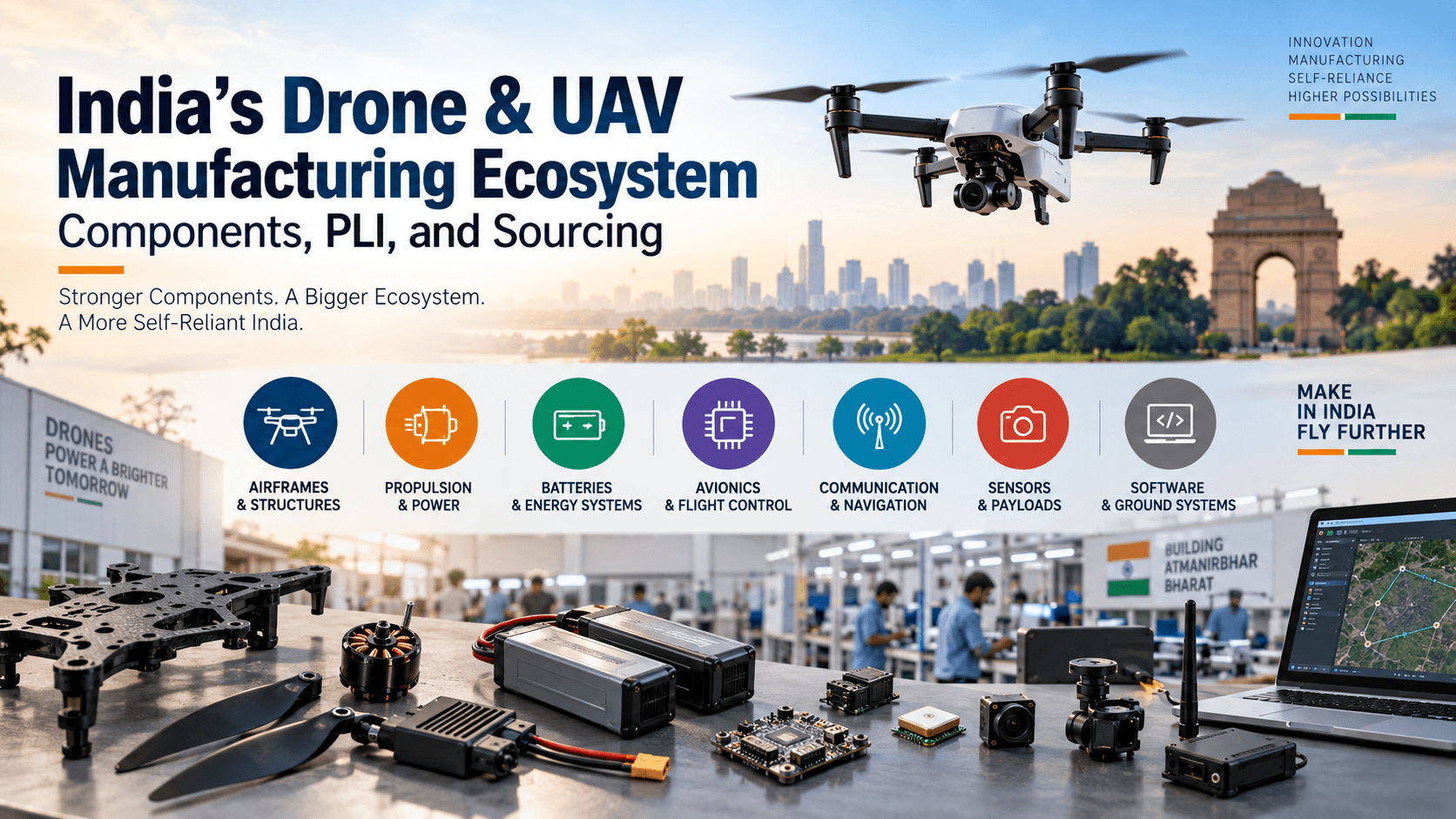
India’s drone and UAV manufacturing sector has moved beyond assembling finished aircraft. The ecosystem is increasingly focused on domestic components, electronics, propulsion, batteries, sensors, flight-control systems, software, and specialised payloads.
As of February 2026, India had more than 38,500 registered drones, nearly 39,900 DGCA-certified remote pilots, and 244 approved remote-pilot training organisations, reflecting a broader commercial ecosystem around drone deployment.
For manufacturers, however, the bigger question is not simply how many drones India can produce. It is how much of the UAV value chain can be sourced and manufactured domestically.
India’s drone manufacturing ecosystem at a glance
The Indian UAV value chain can broadly be divided into six layers:
- Airframe and mechanical systems
- Propulsion and power
- Flight electronics and avionics
- Communication and navigation
- Sensors and mission payloads
- Software, ground control and support systems
The government’s drone PLI framework explicitly covers many of these categories, including airframes, propulsion, batteries, IMUs, INS, flight-control modules, ground-control stations, communication systems, cameras, sensors, spraying systems, trackers and safety systems.
This is important for sourcing teams because the opportunity is increasingly shifting from importing complete drones to building multi-tier domestic supply chains.
Key components in India’s UAV supply chain
Airframes and structural components
The airframe includes the physical structure that houses and supports the drone’s electronics, propulsion and payload.
Common materials include:
- Carbon-fibre composites
- Glass-fibre composites
- Aluminium alloys
- Engineering plastics
- Lightweight structural foams
- Machined and fabricated metal parts
For smaller multirotor UAVs, manufacturing can involve composite moulding, CNC machining, injection moulding and precision assembly.
For larger fixed-wing and defence UAVs, structural engineering becomes more demanding, with greater emphasis on weight reduction, vibration management, aerodynamic performance and environmental durability.
The government’s PLI framework specifically includes airframes among eligible drone components.
Motors, ESCs and propulsion
Propulsion is one of the most important parts of a multirotor UAV.
A typical electric propulsion system includes:
- Brushless DC motors
- Electronic speed controllers (ESCs)
- Propellers
- Motor mounts
- Power distribution components
- Wiring and connectors
Motor and ESC sourcing can have a significant effect on flight time, payload capacity, reliability and maintenance requirements.
For industrial and defence applications, buyers typically need to evaluate more than unit price. Thermal performance, efficiency, operating life, vibration, environmental resistance and availability of replacement units can be equally important.
Batteries and power systems
Battery technology is a major constraint on UAV endurance.
Common requirements include:
- Lithium-ion or lithium-polymer cells
- Battery management systems
- Battery packs
- Chargers
- Power distribution boards
- Voltage regulators
- Battery monitoring systems
India is also building broader domestic battery manufacturing capacity. The country’s Advanced Chemistry Cell PLI programme has an approved outlay of ₹18,100 crore for 50 GWh of capacity, although this programme is separate from the drone-specific PLI scheme.
For UAV manufacturers, this creates potential upstream opportunities while also highlighting an important sourcing issue: cell manufacturing, battery-pack assembly and UAV-specific battery electronics are different parts of the value chain.
Flight control and avionics
The flight-control stack is effectively the electronic nervous system of a UAV.
It can include:
- Flight-control boards
- IMUs
- Accelerometers
- Gyroscopes
- Barometers
- GNSS modules
- Magnetometers
- Navigation systems
- Autopilot software
- Ground-control stations
The drone PLI framework specifically identifies IMUs, inertial navigation systems, flight-control modules and ground-control stations as eligible component categories.
For commercial manufacturers, the sourcing challenge is often not simply finding a component supplier. It is ensuring that the entire avionics stack works reliably together.
A low-cost sensor can become expensive if calibration, integration or field reliability creates problems later.
Communication and connectivity
Commercial and industrial UAVs increasingly require reliable communications between the aircraft, operator and supporting systems.
Potential components include:
- RF modules
- Telemetry radios
- Antennas
- Transponders
- Satellite communication systems
- Cellular connectivity
- Data links
- Encryption and communication hardware
The PLI framework includes RF, transponder and satellite-based communication systems within its component coverage.
For long-range or defence applications, communication architecture can become a core differentiator rather than a commodity component.
Cameras, sensors and mission payloads
A drone is often only as useful as its payload.
Depending on the application, UAVs may carry:
- RGB cameras
- Thermal cameras
- Multispectral cameras
- LiDAR
- Mapping sensors
- Agricultural sensors
- Inspection equipment
- Spraying systems
- Delivery mechanisms
- Surveillance payloads
This is one area where India’s broader electronics and component manufacturing ecosystem could become increasingly relevant.
In August 2026, the government reported that 106 projects had been approved under the Electronics Components Manufacturing Scheme, with projected investment of ₹69,548 crore. The programme includes domestic manufacturing of critical electronic components and materials.
For UAV companies, the long-term opportunity is therefore broader than drone-specific policy. Electronics manufacturing initiatives can influence the availability and economics of upstream components.
Software is part of the manufacturing ecosystem
Modern UAV manufacturing is not limited to hardware.
A production-ready drone can require:
- Flight-control software
- Mission-planning software
- Ground-control software
- Fleet-management platforms
- Mapping software
- Computer vision
- AI-based analytics
- Remote diagnostics
- Cloud infrastructure
- Data-processing systems
The government’s original drone PLI framework was also expanded to include developers of drone-related IT products.
That matters because the competitive advantage of an Indian UAV manufacturer may increasingly come from the combination of aircraft + payload + software + data workflow, rather than the aircraft alone.
How India’s Drone PLI scheme works
India notified the drone and drone components PLI scheme in September 2021.
The scheme provided an incentive pool of ₹120 crore, spread over three financial years beginning in FY2021-22. The incentive was structured at 20% of eligible value addition, with a minimum domestic value-addition requirement of 40% of net sales.
The scheme covers both drone manufacturers and component manufacturers.
For startups and MSMEs, the original eligibility thresholds were:
| Category | Annual sales threshold |
|---|---|
| Drone manufacturers | ₹2 crore |
| Drone component manufacturers | ₹50 lakh |
| Non-MSME drone manufacturers | ₹4 crore |
| Non-MSME component manufacturers | ₹1 crore |
The initial PLI design therefore deliberately included smaller manufacturers rather than restricting participation to large industrial companies.
What has the Drone PLI achieved?
The government’s latest reported PLI data provides a useful picture of the programme’s scale.
As of 31 March 2026, the drone and drone components PLI sector had recorded:
- ₹595 crore in cumulative investment
- 2,650 cumulative employment generated
The figures are part of the government’s overall PLI programme reporting.
It is worth separating these figures from the much larger headline numbers sometimes associated with India’s overall PLI programme. The ₹2.40 lakh crore investment figure reported in July 2026 covers all 14 PLI sectors, not drones alone.
Where Indian manufacturers can source UAV components
For a UAV company building a domestic supply chain, sourcing can be approached in tiers.
Tier 1: Finished systems
These include:
- Complete propulsion systems
- Flight-control systems
- Communication systems
- Camera payloads
- Battery packs
- Navigation systems
This is generally the fastest way to bring a product to market, but it provides less control over the underlying supply chain.
Tier 2: Subassemblies
Manufacturers can progressively localise:
- Motor and ESC assemblies
- Battery packs
- Electronic control boards
- Wiring harnesses
- Sensor modules
- Payload assemblies
- Composite structures
This can improve cost control and product customisation without requiring every underlying component to be manufactured internally.
Tier 3: Critical components
The deepest localisation involves manufacturing or sourcing:
- Motors
- Magnets
- PCB assemblies
- Sensors
- Connectors
- RF components
- Battery cells
- Semiconductor devices
- Precision mechanical parts
This is significantly more capital-intensive, but it can reduce dependence on imported components over time.
Domestic sourcing does not mean buying everything locally
One of the biggest mistakes in UAV procurement is treating localisation as a binary decision.
A better approach is to classify components according to strategic importance, supply risk and economics.
For example:
| Component | Local sourcing priority | Why |
|---|---|---|
| Airframe | High | Relatively strong localisation opportunity |
| Composite parts | High | Can be manufactured domestically |
| Battery pack | High | Important for integration and service |
| Motors | Medium to high | Critical to performance |
| ESC | Medium to high | Important electronic subsystem |
| Flight controller | High for strategic UAVs | Core system and software integration |
| GNSS module | Depends on application | May involve imported semiconductor components |
| Camera payload | Application-dependent | Often specialised |
| Semiconductor chips | Strategic but difficult | Requires deeper electronics ecosystem |
| Li-ion cells | Strategic | Capital-intensive upstream manufacturing |
| Software | Very high | Strong opportunity for domestic development |
The goal should be to localise the components that have the greatest impact on performance, reliability, IP, security and supply continuity, rather than simply maximising the percentage of local parts.
What defence UAV manufacturers need to consider
Defence requirements make the sourcing question more complex.
In March 2026, the Ministry of Defence highlighted the need to build domestic capability across the drone component chain, specifically pointing to areas such as moulds, software, engines and batteries. The government also emphasised the role of startups, MSMEs, innovators and larger defence companies in developing the ecosystem.
For defence-oriented UAV manufacturers, sourcing decisions can therefore involve additional requirements around:
- Traceability
- Cybersecurity
- Secure communications
- Electronic warfare resilience
- Supply-chain security
- Long-term component availability
- Testing and qualification
- Controlled software and firmware
- Indigenous technology ownership
This creates opportunities for Indian suppliers that can provide more than low-cost manufacturing.
Challenges in India’s UAV component ecosystem
India’s ecosystem is growing, but localisation is not equally mature across every component.
Semiconductor dependence
Advanced processors, sensors, RF components and specialised chips can remain difficult to source domestically at competitive scale.
Battery-cell dependence
Battery-pack integration can be localised relatively quickly, while upstream cell manufacturing requires much larger investments and specialised technology.
Precision manufacturing
High-performance UAVs require tight tolerances in motors, gears, bearings, composite structures and electronic assemblies.
Quality consistency
Moving from prototype production to thousands of aircraft requires repeatable processes, supplier qualification and statistical quality control.
Certification and testing
Commercial and industrial UAV manufacturers must build certification and compliance considerations into product development rather than treating them as a final-stage exercise.
How UAV companies should build a sourcing strategy
A practical sourcing strategy starts with the aircraft’s bill of materials.
Step 1: Map the complete BOM
Break the UAV into:
- Mechanical components
- Electrical components
- Electronics
- Propulsion
- Batteries
- Avionics
- Communications
- Payload
- Software
Then identify the country of origin and supplier for every significant component.
Step 2: Identify critical imported components
Not every imported component creates the same level of risk.
Prioritise components that have:
- Long lead times
- Single-source suppliers
- High failure costs
- Export restrictions
- High replacement costs
- Security implications
- Significant impact on aircraft performance
Step 3: Build an Indian supplier shortlist
Evaluate suppliers on more than price.
Useful criteria include:
- Manufacturing capacity
- Quality certifications
- Production repeatability
- Engineering capability
- Testing facilities
- Delivery lead times
- Minimum order quantities
- Customisation capability
- After-sales support
- Traceability
Step 4: Develop second sources
A UAV manufacturer should avoid creating a new dependency while trying to eliminate an old one.
For critical components, establish at least one qualified alternative supplier wherever commercially and technically feasible.
Step 5: Localise strategically
Move from imported finished assemblies toward Indian subassemblies and eventually critical components where the economics and technology justify it.
This approach allows companies to increase domestic value addition without slowing product development unnecessarily.
India’s opportunity is moving up the value chain
The next phase of India’s UAV manufacturing story is unlikely to be defined simply by assembling more aircraft.
The more important development is the emergence of a component ecosystem around those aircraft.
Government policy already identifies a broad range of components within the drone PLI framework, while newer electronics and battery manufacturing initiatives can strengthen adjacent parts of the supply chain.
For UAV manufacturers and procurement teams, that creates a practical opportunity: design the aircraft around a resilient supply chain from the beginning.
The companies that develop strong domestic supplier networks, qualify multiple sources and progressively localise strategically important components can build greater control over cost, lead times, product design and long-term availability.
FAQs
What components are covered under India’s drone PLI scheme?
The scheme covers categories including airframes, propulsion and power systems, batteries, IMUs, inertial navigation systems, flight-control modules, ground-control stations, communication systems, cameras, sensors, spraying systems, trackers and safety-related systems.
How much is India’s drone PLI incentive?
The original drone and drone components PLI scheme has an approved outlay of ₹120 crore. The incentive was structured at 20% of eligible value addition over three financial years.
What is the domestic value-addition requirement?
The original scheme specified a minimum value addition of 40% of net sales for eligible manufacturers.
Can startups participate in India’s drone PLI scheme?
Yes. The original framework included specific eligibility thresholds for startups and MSMEs, including ₹2 crore in annual sales for drone manufacturers and ₹50 lakh for drone component manufacturers.
What should UAV manufacturers localise first?
There is no universal sequence, but manufacturers can typically begin with airframes, composite parts, mechanical assemblies, battery packs, wiring and selected electronics, then move toward more complex propulsion, avionics and other critical components as their volumes and engineering capabilities grow.
What is the biggest sourcing challenge for Indian UAV manufacturers?
The challenge varies by UAV category, but advanced electronics, semiconductors, specialised sensors, battery cells and high-performance propulsion components can require deeper supplier development than conventional mechanical parts.
Key takeaway
India’s UAV manufacturing ecosystem is developing from a drone assembly market into a broader industrial supply chain.
The opportunity now extends across airframes, motors, batteries, avionics, electronics, communications, sensors, payloads and software. Government programmes such as drone PLI, battery PLI and electronics manufacturing initiatives are supporting different layers of this ecosystem.
For manufacturers, the practical focus should be on BOM-level localisation, supplier qualification, dual sourcing and progressive value-chain integration rather than treating “Make in India” as simply an assembly requirement.