From RFQ to Delivery: How Zetwerk’s Project Management System Works
Manufacturing projects rarely fail because a single task was impossible. More often, delays happen between tasks: a quote is approved but the production team misses a revision, raw materials arrive late, quality issues surface after production, or logistics teams lack the latest delivery information.
This is where project management technology becomes important.
Zetwerk approaches manufacturing as an end-to-end workflow rather than a series of disconnected supplier activities. Its Manufacturing OS is designed to connect sourcing, supplier selection, pricing, production planning, quality assurance, logistics, tracking, and analytics. Customers can also access project updates, production photos, inspection reports, shipment information, and other project data through the platform.
So, how does the Zetwerk project management system work from an RFQ through final delivery?
The exact internal workflow can vary by project, manufacturing process, and customer requirements. But Zetwerk’s published information provides a clear picture of the major stages.
What Is Zetwerk’s Project Management System?
Zetwerk describes its technology platform as a Manufacturing OS, a digital backbone for coordinating complex manufacturing programs across suppliers, geographies, and product categories. The platform is intended to give customers greater visibility while helping Zetwerk teams coordinate production and supply chain activities.
Instead of managing separate spreadsheets, emails, supplier conversations, production updates, inspection documents, and shipment tracking, the system brings much of this information into a connected workflow.
According to Zetwerk, its project management software supports:
- Supplier selection and matching
- Pricing and estimation
- Production planning
- Quality assurance
- Project status tracking
- Production updates and photos
- Logistics tracking
- Shipping documentation
- Analytics and reporting
- Communication between customers, suppliers, and Zetwerk teams
The underlying idea is straightforward: manufacturing visibility should continue from the initial requirement through delivery, not stop when a purchase order is issued.
1. The Process Starts With the RFQ
An RFQ, or Request for Quotation, defines what a customer wants to manufacture.
Depending on the project, this can include drawings, specifications, materials, quantities, tolerances, finishing requirements, certifications, delivery requirements, and other technical information.
Zetwerk’s published RFQ guidance notes that detailed requirements help suppliers provide more accurate pricing and reduce clarification cycles.
For a manufacturing platform, the RFQ is more than a request for a price. It becomes the starting point for determining:
- What needs to be manufactured
- Which processes are required
- What capabilities the supplier needs
- How the component should be produced
- What quality requirements apply
- What timeline is realistic
This creates an important foundation for everything that follows.
2. Supplier Matching and Pricing
Once requirements are understood, the next challenge is finding the right manufacturing capacity.
Zetwerk says its Manufacturing OS connects customer requirements with suitable suppliers based on project needs. Its broader platform combines a global supplier network with technology designed to match specifications and capacity.
This matters because the cheapest supplier is not always the best supplier.
A suitable manufacturing partner may need the right combination of:
- Equipment
- Material expertise
- Production capacity
- Quality certifications
- Geographic location
- Process capability
- Lead time
- Cost structure
Zetwerk’s technology is designed to support supplier matching and pricing decisions before production begins.
The result is a workflow where sourcing and project planning are connected instead of being treated as separate procurement activities.
3. Purchase Order and Manufacturing Readiness
After the commercial terms are agreed and a purchase order is created, project management moves into execution.
This is where manufacturing projects can become complicated.
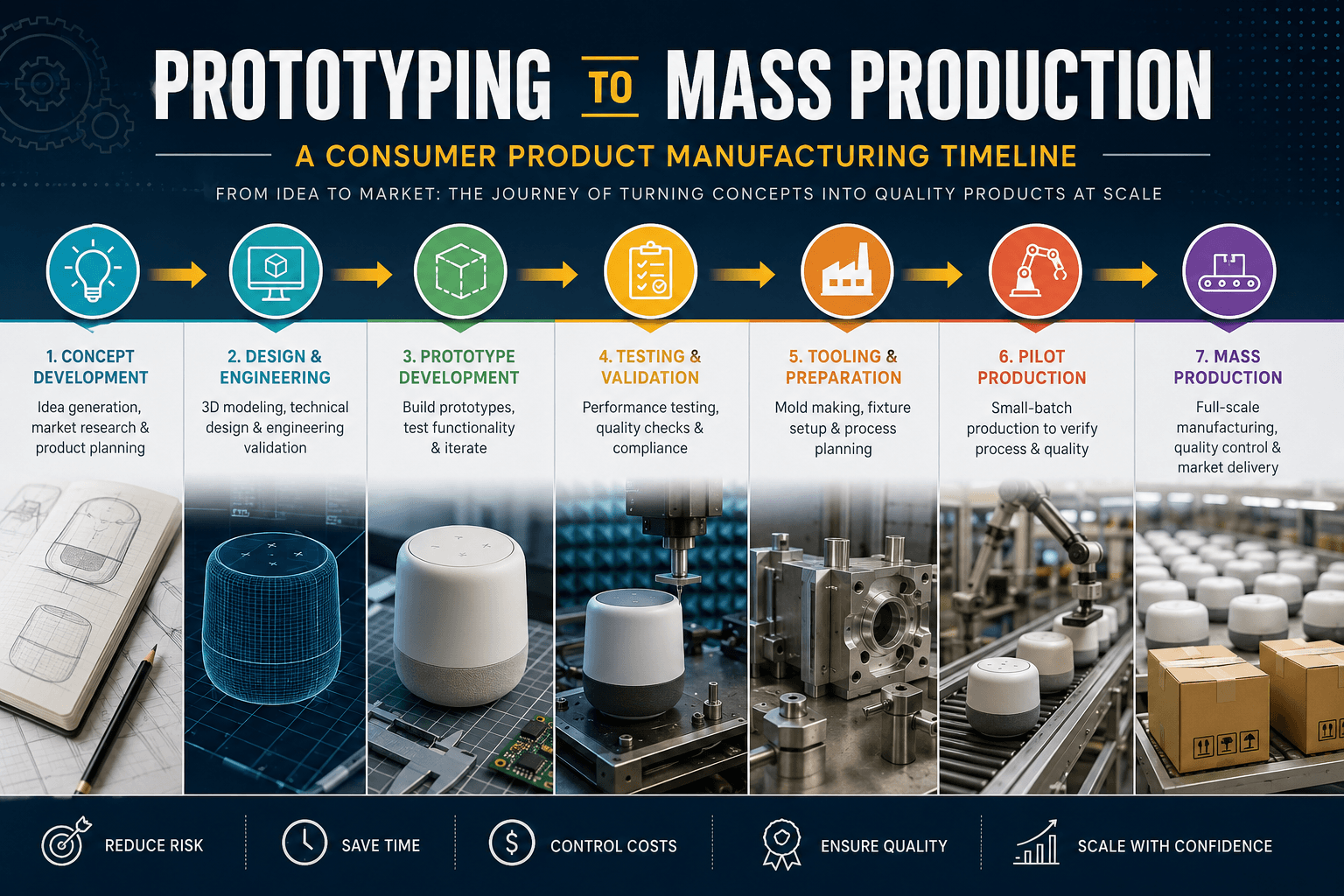
A production order may involve tooling, design-for-manufacturing reviews, material procurement, first-article approval, production scheduling, inspections, packaging, and logistics.
Zetwerk says its project management teams guide customers through the manufacturing process after a PO is created. The company also describes support across areas such as purchase orders, tool design, DFM, FAIR approval, inventory management, and delivery.
For customers, this creates a single project rather than a collection of unrelated tasks.
4. Design and Production Planning
Manufacturing does not necessarily begin immediately after a PO.
For engineered components, the design may need to be reviewed for manufacturability. Zetwerk says it conducts formal Design for Manufacturability reviews for relevant projects to identify potential production issues before manufacturing starts.
This step can help answer practical questions such as:
- Can the component be manufactured as designed?
- Are the specified tolerances achievable?
- Is the selected material appropriate?
- Does the design create unnecessary production complexity?
- Are tooling changes required?
- What process should be used?
The earlier these questions are addressed, the less likely they are to become expensive production problems later.
Zetwerk also identifies production planning as one of the core capabilities of its Manufacturing OS, with the goal of supporting on-time delivery.
5. Production Tracking and Project Visibility
Once manufacturing begins, visibility becomes one of the most important parts of project management.
Traditional manufacturing workflows can leave buyers dependent on periodic emails or calls to find out whether an order is on schedule.
Zetwerk’s project management system takes a different approach.
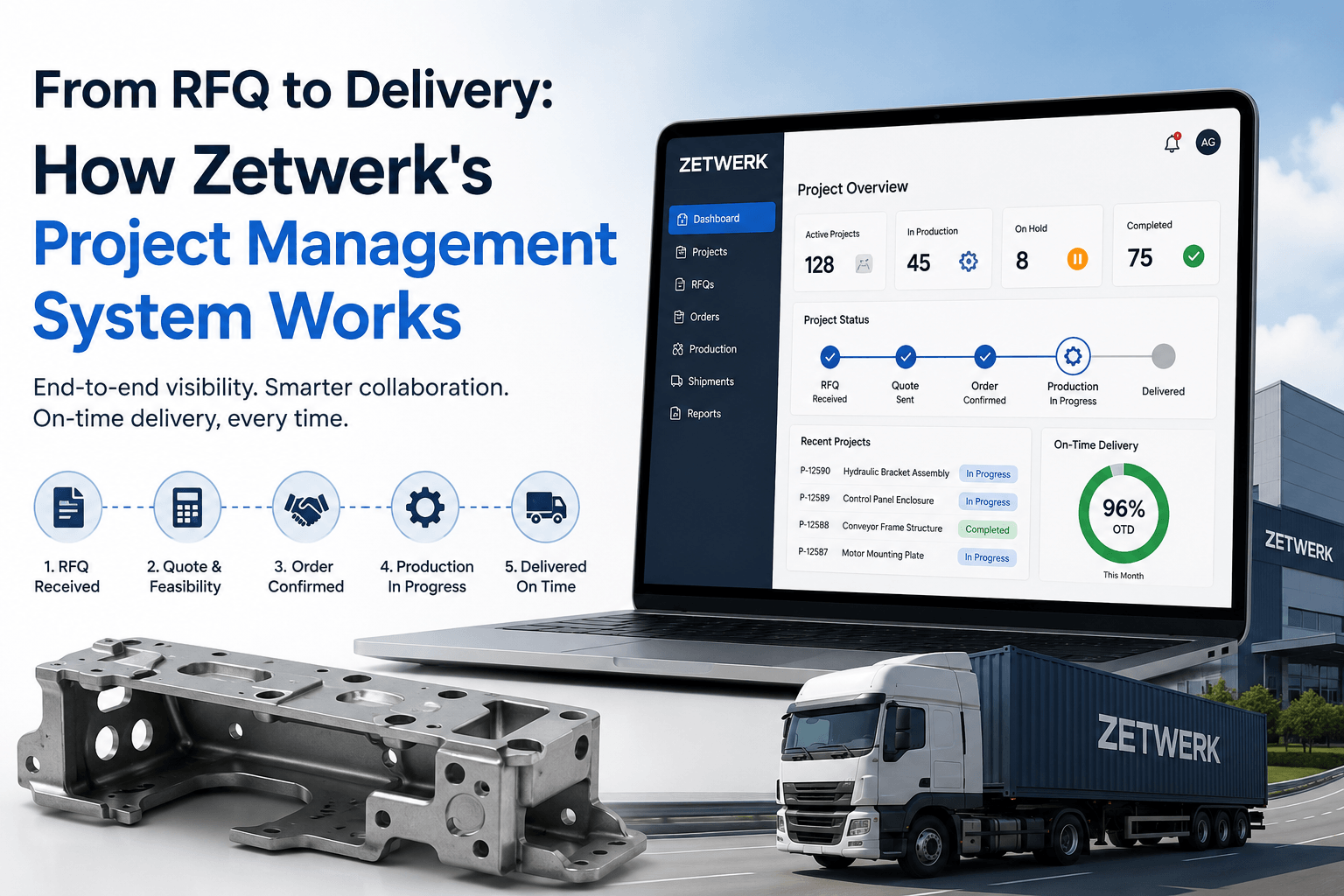
The company says its customers receive real-time project information through customizable dashboards, including the status of individual components. It also provides visual project timelines, including Gantt charts, to communicate deadlines and progress.
Production photos add another layer of visibility.
Zetwerk says its proprietary project management software supports tens of thousands of project updates each month and hundreds of image uploads each day.
For procurement and operations teams, that type of visibility can answer questions before they become escalation points:
Is production on schedule?
Which components are complete?
Where is the project currently blocked?
Has a manufacturing milestone been completed?
Does the production output match the expected timeline?
The goal is not simply to provide more data. It is to make the data useful for decision-making.
6. Quality Control Happens During the Workflow
Quality cannot be treated as the final checkpoint before shipment.
A defect discovered at the end of production can mean rework, additional inspection, material waste, or missed delivery dates.
Zetwerk says its quality assurance specialists oversee components during design, prototyping, and manufacturing, with inspections performed during production. Customers can receive inspection reports, analytics, insights, and production photos as part of the visibility provided by the platform.
For applicable projects, the workflow can also include First Article Inspection Report approval.
This creates a feedback loop between manufacturing and project management.
If an issue appears, the project team can address it while production is still underway instead of discovering the problem only when finished goods are ready to ship.
7. Managing Risks Before They Become Delays
One of the more important aspects of Zetwerk’s project management approach is monitoring risks outside the factory floor.
A project can be progressing perfectly from a production standpoint and still miss its delivery date because of material shortages, transportation delays, customs issues, or other supply chain disruptions.
Zetwerk says its project managers monitor external factors such as raw material availability and shipping times. The company says this allows teams to provide advance warnings and explore alternative production options when downstream issues could affect delivery.
That changes the role of project management.
Instead of simply reporting that a deadline was missed, the system and the teams supporting it are intended to identify potential problems early enough to act.
For manufacturers, this distinction matters.
Visibility tells you what happened. Proactive project management helps you decide what to do next.
8. Logistics and Shipment Tracking
Production is only half the job.
A component that leaves the factory but cannot be tracked reliably is still a supply chain risk.
Zetwerk provides managed logistics services that can include inland transportation, cross-border transportation, customs clearance, shipment tracking, and related logistics coordination.
Its Manufacturing OS also includes logistics tracking and real-time updates as core capabilities.
This extends project visibility beyond the factory.
Instead of treating manufacturing and transportation as two separate workflows, the project can continue through shipment and delivery.
For procurement teams, that means the project status can answer a more useful question than “Has production finished?”
It can answer:
“When will the finished goods actually reach us?”
9. Delivery and Project Closure
The final stage is delivery, but the project does not necessarily become irrelevant once goods leave the facility.
Zetwerk says customers can access information such as shipment tracking, shipping documentation, inspection reports, production photos, payment information, and project analytics.
That creates a record of the manufacturing journey from requirement to finished product.
For organizations managing repeat production, this information can also become valuable for future decisions.
Teams can use historical project information to understand supplier performance, recurring quality issues, lead times, production progress, and other operational patterns.
In other words, delivery can become the end of one project and the data foundation for the next.
Why This Model Matters for Manufacturing Buyers
The biggest advantage of a connected project management system is not that it replaces every manufacturing activity with software.
It is that it reduces the gaps between those activities.
A conventional multi-vendor workflow might look like this:
RFQ → supplier emails → quotation → purchase order → production calls → inspection documents → shipping emails → delivery
A connected manufacturing workflow is closer to:
RFQ → supplier matching → pricing → production planning → quality → tracking → logistics → delivery
The difference is coordination.
Zetwerk positions its Manufacturing OS around this connected model, combining digital project management with supplier capacity, manufacturing expertise, quality teams, and logistics support.
That is particularly relevant when projects involve multiple components, suppliers, manufacturing processes, or geographies.
What Customers Gain From End-to-End Project Management
For a procurement or operations team, the practical benefits can be significant.
Better visibility
Instead of waiting for manual updates, teams can access project status, production information, photos, inspection reports, and shipment details through the platform.
Earlier risk detection
Monitoring production, material availability, and logistics together can help surface problems before they affect the final delivery date.
Fewer coordination gaps
When project managers, suppliers, quality teams, and customers work from connected information, there are fewer opportunities for outdated specifications or missed updates to create confusion.
Stronger quality control
Quality information becomes part of the project lifecycle rather than something collected only after production is complete.
More predictable delivery
Production planning, project tracking, and logistics management work together to keep the delivery timeline visible throughout the project.
The Bigger Picture: Manufacturing as a Managed Workflow
The most interesting part of Zetwerk’s project management model is the shift from supplier management to workflow management.
Manufacturing buyers traditionally have to coordinate multiple parties themselves. Procurement manages suppliers, engineering manages drawings, quality manages inspections, operations monitors production, and logistics tracks shipments.
The more suppliers and components involved, the harder that becomes.
Zetwerk’s model brings these activities into a broader manufacturing operating system, supported by project managers and specialist teams. The company describes this as a platform that orchestrates sourcing, production, and delivery with end-to-end visibility and control.
That approach is especially useful for businesses that need to scale production without building an equally large internal supplier-management operation.
Final Takeaway
From RFQ to delivery, effective manufacturing project management is really about maintaining control across every handoff.
Zetwerk’s published approach connects the major stages of the manufacturing lifecycle: understanding requirements, matching suppliers, estimating costs, planning production, managing quality, tracking progress, coordinating logistics, and sharing project information with customers.
The result is a more connected way to manage manufacturing projects.
For buyers, the value is simple: fewer information gaps, earlier visibility into risks, better coordination across stakeholders, and a clearer path from the original RFQ to the finished product.
And as manufacturing supply chains become more distributed, that visibility is becoming less of a convenience and more of an operational requirement.
FAQs
What is Zetwerk’s Manufacturing OS?
Zetwerk’s Manufacturing OS is its technology platform for coordinating manufacturing activities across sourcing, supplier selection, pricing, production planning, quality, logistics, tracking, and analytics.
How does Zetwerk manage manufacturing projects?
Zetwerk combines project management software with dedicated teams that monitor production and coordinate areas such as purchase orders, tooling, DFM, quality approvals, inventory, and delivery.
Can customers track manufacturing progress?
Yes. Zetwerk says customers can use customizable project dashboards to view order progress and component-level status, along with project timeline updates and production photos.
How does Zetwerk handle quality control?
Zetwerk says its quality teams inspect components during design, prototyping, and manufacturing. Customers can also receive inspection reports, production photos, and other quality information through the project workflow.
Does Zetwerk manage logistics after production?
Yes. Its managed logistics services include shipment tracking, inland and cross-border transportation, customs clearance, and other logistics coordination.
Why is end-to-end project management important in manufacturing?
End-to-end project management connects sourcing, production, quality, and logistics. This makes it easier to identify risks early, keep stakeholders informed, and manage delivery timelines across complex manufacturing projects.